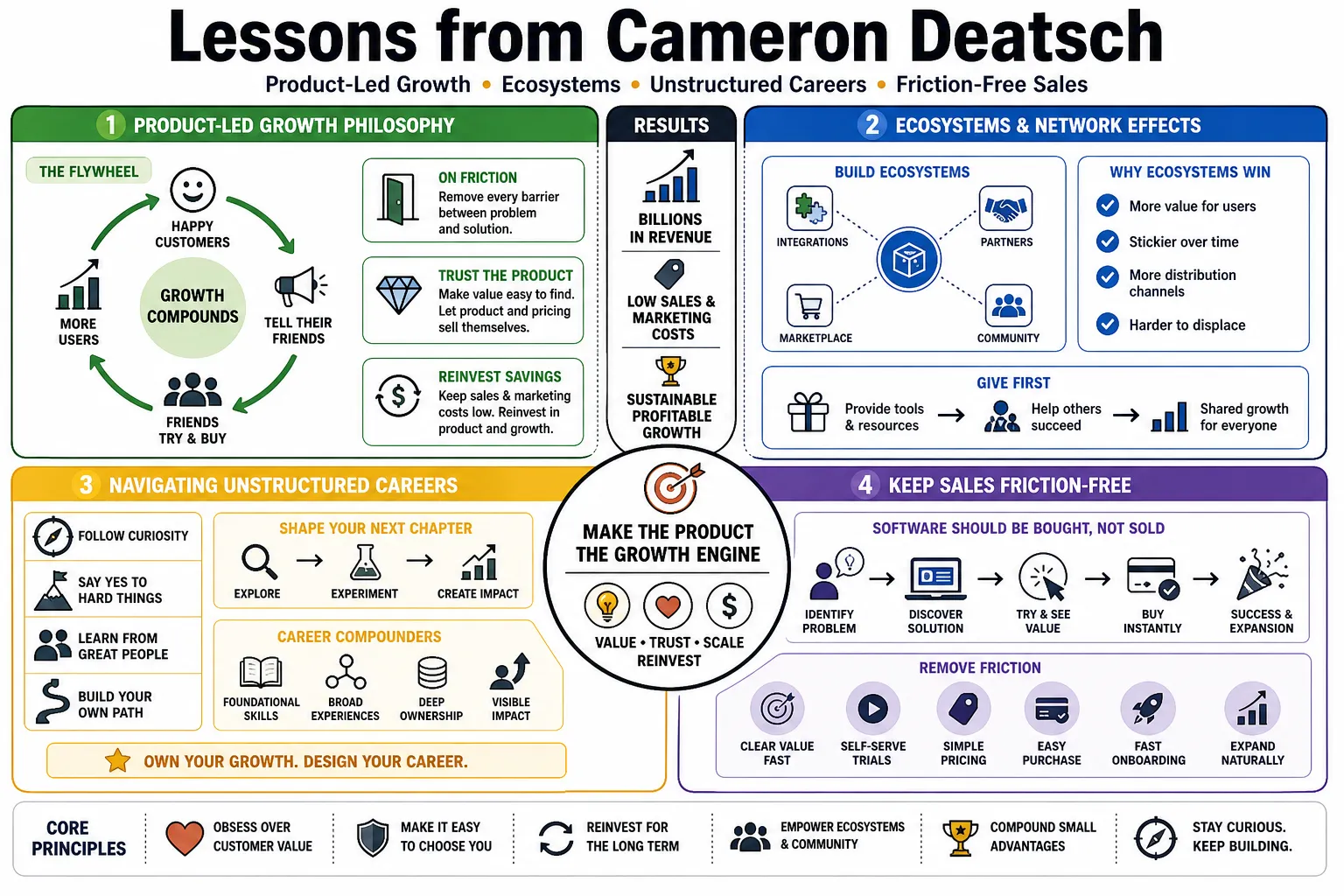
Lessons from Cameron Deatsch
Cameron Deatsch is Chief Revenue Officer of Atlassian, where he has held six different senior roles in nine years. — The Making of a Modern Software Executive.
Part 1: Product-Led Growth Philosophy
- On Building Tools People Love: Cameron Deatsch: "By focusing on building tools that people need and love, rather than building a sales force that convinces people to buy them, it flipped the industry on its head." — The Making of a Modern Software Executive.
- On Answering Customers Quickly: Cameron Deatsch: "The idea was: could we answer those customers' questions as quickly as possible and with as high satisfaction as possible." — Achieving the First $100M in Revenue Without a Sales Team (WorkOS podcast).
- On Investing in R&D Over Sales: Cameron Deatsch: "We invest more in R&D, and less on sales and marketing than most of our peers, and we combine that with relatively low-cost pricing." — Atlassian zeros in on customer retention, CRO says (CFO Dive interview).
- On New Customers Who Are Less Sophisticated: Cameron Deatsch: "We have 20,000 new customers coming in every single quarter that aren’t as sophisticated." — The Jira Guy: AMA with Cameron Deatsch, Part 2.
- On Letting Enterprise Steer the Ship: Cameron Deatsch: "As soon as you say you do both, the big amount of money from a small set of customers will eat you alive guaranteed because a sales rep, an enterprise machine, and an enterprise customer will always be able to steer the ship and go over your business more than a self-serve business that effectively doesn't have a voice." — Achieving the First $100M in Revenue Without a Sales Team (WorkOS podcast).
Part 2: Scaling Sales Without Friction
- On Support Staff Per Sales Rep: Cameron Deatsch: "For every sales rep, there's usually two or three other people in a business to make sure that sales rep's productive." — Achieving the First $100M in Revenue Without a Sales Team (WorkOS podcast).
- On Conversion and Usage: Cameron Deatsch: "You'll get higher conversion rates, you'll probably get higher ASPs, and the customer, if they do it right, will use more of your products." — Achieving the First $100M in Revenue Without a Sales Team (WorkOS podcast).
- On Incremental Dollars and Incremental Hiring: Cameron Deatsch: "You want to get away from a business model where every incremental dollar requires incremental hiring." — CRO Confidential: How The Biggest Product-Led Enterprise Company In The World Did It (SaaStr article quoting Deatsch).
- On Decoupling Revenue From Hiring: Cameron Deatsch: "You're not tying your revenue growth to how many people you can hire." — Achieving the First $100M in Revenue Without a Sales Team (WorkOS podcast).
- On Sales Steering the Ship: Cameron Deatsch: "My experience in tech had always been that the sales organization steers the ship." — The Making of a Modern Software Executive.
- On Keeping Prices Low: Cameron Deatsch: "Keep the prices low, think online distribution, think sales only when necessary, not a report or a whole bunch of crap." — Achieving the First $100M in Revenue Without a Sales Team (WorkOS podcast).
Part 3: Ecosystems and Partnerships
- On Taking Care of Customers in Hard Times: Cameron Deatsch: "If you're going through a hard time that you're not in control of, yeah, we're going to take care of you." — Atlassian zeros in on customer retention, CRO says (CFO Dive interview).
- On Extensibility as the Next Blocker: Cameron Deatsch: "The next big blocker that all of you will tell me about after compliance objections and scale is extensibility." — The Jira Guy: AMA with Cameron Deatsch, Part 2.
Part 4: Community and Customer Advocacy
Part 5: Navigating Career and Leadership
- On Being Thankful for the Present: Cameron Deatsch: "For now, I am thankful for what’s here, for what’s happening today, for the chance to show up and make a difference in people’s lives." — The Making of a Modern Software Executive.
- On Deciding What Big Thing to Change: Cameron Deatsch: "What I always focus on is: what’s the big thing we’re going to change, what’s the new muscle we are going to build, what’s the new challenge we’re going to take on?" — The Making of a Modern Software Executive.
- On Assuming a Reason: Cameron Deatsch: "When people give me an opportunity, I assume they are smart and have a reason for it." — The Making of a Modern Software Executive.
- On Starting a New Role: Cameron Deatsch: "I’d get a new role, get it running, build the team, set goals, set the strategy." — The Making of a Modern Software Executive.
- On Being the Engaging Person: Cameron Deatsch: "Be the engaging person they’re actually looking forward to talking to, the one who makes hard work just a little bit more fun." — The Making of a Modern Software Executive.
- On Changing the Business Early: Cameron Deatsch: "I always make sure, within the first six to 12 months of a new role, that I change the business in a way that’s meaningful." — The Making of a Modern Software Executive.
- On Writing Down Three Priorities: Cameron Deatsch: "At the start of each fiscal year, write down three high-level things you have to do to be successful." — The Making of a Modern Software Executive.
Part 6: Enterprise Expansion Strategy
- On Offering Upgrades to Existing Customers: Cameron Deatsch: "We also knew that we would only offer that to existing customers as largely an upgrade motion." — Achieving the First $100M in Revenue Without a Sales Team (WorkOS podcast).
- On Focusing Sales on a Few Products: Cameron Deatsch: "Of our 20 products, we really focus sales on three of them because we know we can have those high ASPs." — Achieving the First $100M in Revenue Without a Sales Team (WorkOS podcast).
- On Questions for Founders Under $50 Million: Cameron Deatsch: "My best would be if you're a founder and you're sub 50 million in revenue, you just have to ask these questions to yourself." — Achieving the First $100M in Revenue Without a Sales Team (WorkOS podcast).
- On Customers Standardizing on Atlassian: Cameron Deatsch: "What happened, at least over the last 10 years, is the bigger customers started standardizing on our products across the enterprise." — Achieving the First $100M in Revenue Without a Sales Team (WorkOS podcast).
- On Unblocking On-Prem Customers: Cameron Deatsch: "From a “Technical Blocker” perspective, we’ve unblocked 60% of our on Prem customers today." — The Jira Guy: AMA with Cameron Deatsch, Part 2.
Part 7: Transition and Platform Management
- On Sophisticated Workflows Across Products: Cameron Deatsch: "We found that the big enterprise customers, they were building these sophisticated workflows across our products and other products in their software development tool chain." — Achieving the First $100M in Revenue Without a Sales Team (WorkOS podcast).
- On Consolidation in the Cloud: Cameron Deatsch: "We had focused historically on the Server-to-Cloud migration tools, but we realized that a lot of consolidation in the Cloud is happening as well, and we’ve seen that too, and it should be available pretty soon." — The Jira Guy: AMA with Cameron Deatsch, Part 1.
- On Multi-Product DNA: Cameron Deatsch: "I will go even further to say the ones that became multi-product as part of their DNA earlier on in the world became even more successful." — Achieving the First $100M in Revenue Without a Sales Team (WorkOS podcast).
- On Growth Levers: Cameron Deatsch: "Build that multi-product DNA early because it can give you more growth levers down the road." — Achieving the First $100M in Revenue Without a Sales Team (WorkOS podcast).
- On Having the Right Team: Cameron Deatsch: "When you have the right team in place, when skill set, capacity, personality, culture, and need all align—that is one of your biggest assets, especially when you’re learning something new." — The Making of a Modern Software Executive.
- On the Data Center Promise: Cameron Deatsch: "The data Center promise, value-prop, and strategy is around performance, scale, administrative control, full access to, and control over your data." — The Jira Guy: AMA with Cameron Deatsch, Part 1.
- On Launching Products for Everyone: Cameron Deatsch: "The reality is our customer base is getting gigantic, and we want to be very clear that if we launch a product and make it generally available to our customer base, that it’s going to support the needs of all of our customers, both the very very big and the very very small." — The Jira Guy: AMA with Cameron Deatsch, Part 1.
- On Leaders Who Understand Technology: Cameron Deatsch: "I think you’re going to increasingly see a need for leadership to truly understand the tech experience and how to deliver value to customers." — The Making of a Modern Software Executive.
Part 8: Culture, Data, and Execution
- On Knowing Exactly Who Customers Are: Cameron Deatsch: "We also knew exactly who those customers were because we knew exactly what they used and how much usage and so on." — Achieving the First $100M in Revenue Without a Sales Team (WorkOS podcast).
- On Documenting Everything: Cameron Deatsch: "I document all my one-on-ones in Confluence document, I document all of my personal tasks and team tasks." — The Jira Guy: AMA with Cameron Deatsch, Part 1.
- On Challenging the Status Quo: Cameron Deatsch: "Saying this is how it’s always worked is as dangerous as chaos, because then you can never truly innovate." — The Making of a Modern Software Executive.
- On Partnering Deeply Early: Cameron Deatsch: "We’re trying to partner deeply with the people in the early days, to ensure that we are building the right set of features and roadmaps behind those products." — The Jira Guy: AMA with Cameron Deatsch, Part 1.
- On the Go-to-Market Organization: Cameron Deatsch: "I’m most proud of the broader go-to-market organization that I’m the leader of, in that some people have stepped up and taken bigger roles, we’ve hired some incredible leaders from outside the industry, and outside the business small; specifically, Kevin Egan, who we hired from Slack to run the Enterprise part of the business." — The Jira Guy: AMA with Cameron Deatsch, Part 1.
- On Customer Happiness Signals: Cameron Deatsch: "My customer happiness comes from CSAT – in-person service, feature requests – JAC, Customer Support from my Team." — The Jira Guy: AMA with Cameron Deatsch, Part 2.
- On Holding Experts to Account: Cameron Deatsch: "Hold the leaders and experts to account, and drill and drill and drill until you get the answers you’re looking for and the data to back it up." — The Making of a Modern Software Executive.
- On Products That Take a While: Cameron Deatsch: "Now it’s our third largest product and growing faster than anything else in our portfolio right, so we have a good track record; it just takes a while." — The Jira Guy: AMA with Cameron Deatsch, Part 1.