Camille Fournier wrote the first draft of The Manager's Path in late 2015, after four years leading engineering at a growing startup. — Following the Manager's Path - Camille Fournier.
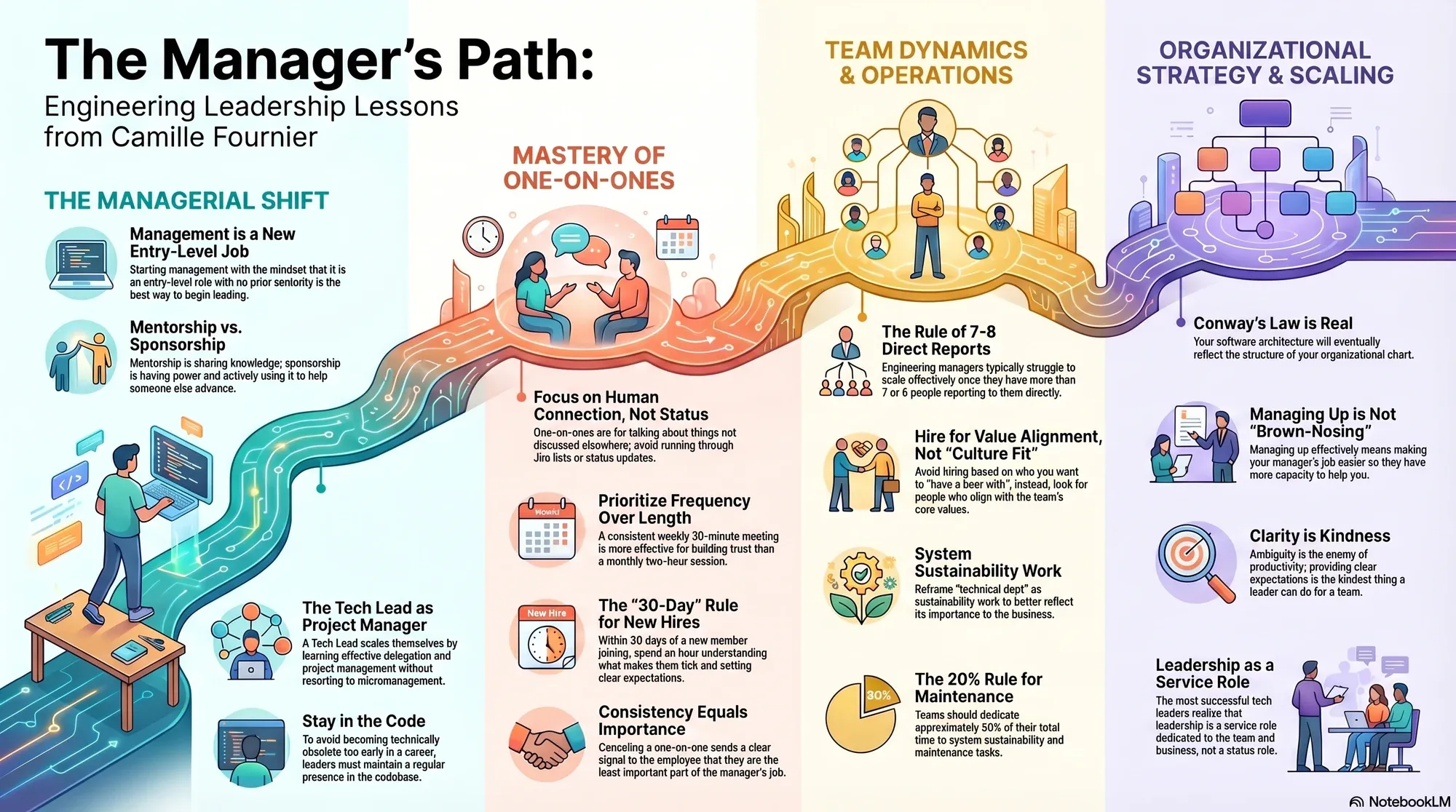
Part 1: The Transition to Leadership
- On What a Manager Is Responsible For: Camille Fournier: "The manager is responsible for, among other things, making sure the work gets done, at reasonable quality, in reasonable timeframe, without causing so much personnel strain that people constantly quit." — The Manager’s Path in the Age of AI.
- On Defining Senior: Camille Fournier: "When I talk about senior hiring, I am not talking about people with 3–7 years of experience who can be trusted to write good code independently and own projects; I’m thinking about the people who can act as the technical leaders for that group." — The Senior Shortcut.
- On Writing the First Draft of The Manager’s Path: Camille Fournier: "I wrote the first draft of The Manager’s Path in late 2015, after a four year period of intense learning and growth that came from being a new-ish manager leading engineering at a growing startup." — Following The Manager’s Path.
- On Getting Comfortable With AI: Camille Fournier: "If your company is using AI, you need to get comfortable with it so that you can help your team navigate the transition, and to avoid becoming irrelevant." — The Manager’s Path in the Age of AI.
- On the Value of Early-Career Engineers: Camille Fournier: "Don’t underestimate the value early career engineers can bring to a team; unless we’re a dying profession, their continued existance and success is the basis for our future." — The Senior Shortcut.
- On Directing Many Different Styles: Camille Fournier: "Your job involves directing work across many people with different approaches, styles, and opinions." — Revisiting Manager READMEs.
- On Managing Not Being Like Building a Computer: Camille Fournier: "Managing is not like building a computer where you're literally writing instructions and people are following them, it is not like that at all." — Management for Developers with Camille Fournier (CaSE podcast transcript).
- On Hiring Seniors to Avoid Managing: Camille Fournier: "PS: If you are hoping to hire only senior people so you can avoid having to manage them, you’re delusional." — The Senior Shortcut.
- On Rejecting Hopeless Messaging: Camille Fournier: "You must reject the hopeless messaging that paints the demise of you role as inevitable, that paints us as powerless to shape the future." — The Manager’s Path in the Age of AI.
Part 2: Mastery of One-on-Ones
- On Talking It Through: Camille Fournier: "Sometimes there’s a need to pre-read and prepare, but sometimes we just need to talk and see where the exploration of current top-of-mind concerns and information takes us." — Revisiting Manager READMEs.
- On Long Text Exchanges: Camille Fournier: "Increasingly long text exchanges have always been a sign that people need to stop and talk face-to-face, and AI logorrhea hasn’t changed that." — Guidelines for Respectful Use of AI.
- On Switching Off Our Brains: Camille Fournier: "Signs we’ve switched off our brains and our hearts include: not reviewing the AI-generated work, not taking the time to do human editing, not breaking the changes down into chunks, and avoiding real conversations through AI-mediated text exchange." — Guidelines for Respectful Use of AI.
- On Appreciating People as Human Beings: Camille Fournier: "Again, you don’t have to tell people all of the details of your personal life and you shouldn’t pry in all the details of theirs, but appreciating people as human beings is important so that they don’t feel like they have to just be all business with you." — Camille Fournier on Managing Technical Teams (Y Combinator podcast transcript).
- On Not Everything Needing a Template: Camille Fournier: "One piece of advice was that not everything should have a fixed process or template." — Revisiting Manager READMEs.
- On Ladders Not Being Checklists: Camille Fournier: "You should not try to create a ladder that functions as a pure checklist or scorecard that guarantees promotion if people check enough boxes; promotions are as much about the needs of the organization as the skills of the employees." — 10 Years of Engineering Ladders.
- On Prescriptive Ladders: Camille Fournier: "Your ladder should be more prescriptive than a horoscope; it’s impossible to avoid all subjective language like “increasing complexity”, “large systems”, “high impact”, but pay attention to where you use that and try to provide ways of roughly measuring this where possible." — 10 Years of Engineering Ladders.
- On Early-Career Hiring for the Long Game: Camille Fournier: "If you’re thinking about the long game, and hoping to build a company that will last, you probably want to invest in at least some early career hiring during periods of growth." — The Senior Shortcut.
- On One-on-One Cadence for a Team of Five: Camille Fournier: "If you are managing a team of five, who’s working on a project that you’re also dong a little bit of work on, you may only need to do a one-on-one every other week because a lot of the project work and conversation is going to come out in other ways." — Camille Fournier on Managing Technical Teams (Y Combinator podcast transcript).
Part 3: Hiring and Team Dynamics
- On Team Coherence: Camille Fournier: "My final idea for managers navigating this new world is to remember that we’re trying to take advantage of tools that provide incredible individual productivity while maintaining and even improving team coherence." — The Manager’s Path in the Age of AI.
- On Early-Career Attrition: Camille Fournier: "Sure, not every early career hire will turn out this way: many will leave within the first three years, some that never found their footing, and others that were great but itchy to try new things." — The Senior Shortcut.
- On Teams That Want to Own Everything: Camille Fournier: "Application teams that want to own everything themselves, should; the ones that need it will do it well, the ones that don’t do it well will have a clearer idea of the cost/benefit tradeoff of owning everything themselves." — Platform Engineering Beyond CFEngine.
- On Opinionated People Becoming Managers: Camille Fournier: "I think it's actually common for very highly opinionated people who really want things done their way to want to become managers." — Management for Developers with Camille Fournier (CaSE podcast transcript).
- On Hiring Wrong People Either Way: Camille Fournier: "I’ve yet to see a perfect shortcut; you’re going to hire the wrong people whether you hire only junior or only senior, and you’re inevitably going to lose some of the right ones either way." — The Senior Shortcut.
- On Catching Minor Annoyances Early: Camille Fournier: "If you don't ever talk to people and if people don't feel comfortable coming to you and expressing the minor annoyances, then you don't have that opportunity to catch them before they become major annoyances, before they become things that cause people to quit or cause projects to fail." — Management for Developers with Camille Fournier (CaSE podcast transcript).
- On Thinking About Company Values: Camille Fournier: "I do think that values are important, and if you are starting a startup or if you are an early startup that hasn't spent time thinking about your company's values, I actually think that's super important to do." — Management for Developers with Camille Fournier (CaSE podcast transcript).
- On Managing Far Larger Teams: Camille Fournier: "Many companies think that that increased visibility and waves hands AI productivity means managers can start to manage far larger teams, with no help coming as we reduce managers and don’t hire new ones." — The Manager’s Path in the Age of AI.
- On Never Assuming You Have Learned Everything: Camille Fournier: "Never assume that you've learned everything that you need to know, because it's almost certainly not true." — Management for Developers with Camille Fournier (CaSE podcast transcript).
- On Letting Interpersonal Issues Fester: Camille Fournier: "If two people are not getting along and you just let that sit and fester, it’s just going to cause you problems." — Camille Fournier on Managing Technical Teams (Y Combinator podcast transcript).
Part 4: Technical Vision and Strategy
- On Lessons From Rewrites and Migrations: Camille Fournier: "The lessons of rewrites and migrations are useful if you have inherited a legacy application stack that may need to evolve to meet your business demands." — Following The Manager’s Path.
- On Making It Easy for Others: Camille Fournier: "You don’t have to drive the next innovation to be strategic, you just need to make it easy for others to get there." — Dude, Where’s My Strategy?.
- On Why Rewrites Are a Bad Idea: Camille Fournier: "Spoiler alert: a lot of the talk centers around why rewriting platforms is almost always a very bad idea." — Dude, Where’s My Strategy?.
- On a Product Approach to Platforms: Camille Fournier: "Taking a product approach to platforms doesn’t mean making everyone happy all the time and building exactly what they ask you to build." — Platform Engineering Beyond CFEngine.
- On Platform-Level Support for Every Shift: Camille Fournier: "Pretty much every major change in technology that I have lived through has needed platform-level support: containerization, microservices, event-driven systems, big data, continuous delivery, observability, the cloud, elastic scaling." — Dude, Where’s My Strategy?.
- On the Cost of Choice: Camille Fournier: "Choice is always appealing in the beginning and often limiting over time as every bespoke choice must be supported indefinitely." — Platform Engineering Beyond CFEngine.
- On Heterogeneous Environments: Camille Fournier: "The problem of maintaining heterogenous environments, especially as these environments grow in dimensions of complexity (eg, all of the pieces that need to exist for you to deploy an application onto the cloud using a multitude of cloud services), is neverending." — Platform Engineering Beyond CFEngine.
- On Operational Expectations of Shared Services: Camille Fournier: "The operational expectations of shared software services are very high, and you need a team that mixes software, systems, and reliability engineering effectively." — Following The Manager’s Path.
- On Removing Operational Burden: Camille Fournier: "The value of a platform team is often commensurate with how much operational burden they are able to remove from application teams, and you undermine your value by shying away from it." — Platform Engineering Beyond CFEngine.
Part 5: Managing the Organization
- On Conway’s Law: Camille Fournier: "Conway’s Law is both an observation and something useful for humans: I know that if I work on a team, I work on certain systems, and I work closely with teams nearer to me in the org chart, and if I want to do something with work from teams farther away that may require more thought, conversation, etc." — The Manager’s Path in the Age of AI.
- On Lightweight Templates: Camille Fournier: "I find that the best templates and processes are lightweight in a way that they show what information should be collected but don’t dictate exactly the process to collect that information." — Revisiting Manager READMEs.
- On the Over-General Swamp: Camille Fournier: "If you allow every team to independently choose what they want all the time, you get what we call the over-general swamp." — Platform Engineering Beyond CFEngine.
- On Everyone Communicating Differently: Camille Fournier: "Left to their own devices, each person will develop a slightly different way of communicating with you, one that works for them and that they believe works for you." — Revisiting Manager READMEs.
- On Curatorial Choices: Camille Fournier: "Sometimes that hard work is making curatorial choices about what is supported and what is not, and making some niche group unhappy." — Platform Engineering Beyond CFEngine.
- On Owning Performance Reviews: Camille Fournier: "When you make management decisions, and yes, your performance reviews are management decisions, you need to be able to stand firmly behind them and own their consequences." — The Manager’s Path in the Age of AI.
- On Losing Alignment Across Teams: Camille Fournier: "When you have multiple people you’re trying to keep track of (let alone multiple teams!) I am not sure that even the best summarizations are going to catch the ways these individuals and groups can drift off in different directions and start to lose alignment and coherence." — The Manager’s Path in the Age of AI.
- On Sci-Fi Futures of Management: Camille Fournier: "To me, these are ideas from sci-fi futures." — The Manager’s Path in the Age of AI.
- On Following Up on Surprises: Camille Fournier: "No one catches every important detail, and you may risk missing more if you rely on AI, but if you follow up on the surprises that come out of this you have the chance to both fix the mistakes and identify areas to follow details more closely." — The Manager’s Path in the Age of AI.
- On Making Your Team a Team: Camille Fournier: "Making your team actually feel like a coherent group so that every teammate understands their role on the team but also, hopefully, they can cover for one another a little bit, sharing support burden, code review, doing design together." — Camille Fournier on Managing Technical Teams (Y Combinator podcast transcript).
Part 6: Communication and Conflict
- On READMEs Not Replacing Time With Your Team: Camille Fournier: "You can write all the READMEs you want in the world, you are not going to build trust with your team as if you are actually spending time with them." — People Leading People: Camille Fournier on Manager READMEs (Spinach transcript).
- On Specific Praise: Camille Fournier: "Certainly praise - it's good to tell people they're doing good work; it's good to be specific about what they're doing that's so good, not to be like 'Good job, folks!', although I fell under that trap sometimes, I will admit..." — Management for Developers with Camille Fournier (CaSE podcast transcript).
- On Not Promising a Path: Camille Fournier: "Don’t promise people that they can become the VP of X just because some people do job X, and don’t pretend that you should hire people straight out of school into jobs that are specializations that you only take on after years of working as a generalist." — 10 Years of Engineering Ladders.
- On Writing to Envision the Work: Camille Fournier: "I think it’s a shame people don’t do this more, even if they don’t publish it, because it helps you envision the work and catch things you might miss when writing bullet points." — 10 Years of Engineering Ladders.
- On Regular Performance Feedback: Camille Fournier: "I like to encourage people -- if you're managing individuals, to be giving regular performance feedback." — Management for Developers with Camille Fournier (CaSE podcast transcript).
- On Dealing With Interpersonal Issues Proactively: Camille Fournier: "A big mistake that I see rookie managers make is just not dealing with interpersonal issues on their team proactively." — Camille Fournier on Managing Technical Teams (Y Combinator podcast transcript).
- On Long-Winded AI-Assisted Messages: Camille Fournier: "Finally, if you’re writing long-winded emails or chat messages with AI-assistance in order to painstakingly try to explain something, perhaps you actually need to have a meeting or call instead." — Guidelines for Respectful Use of AI.
- On Getting Rid of Drag-Down Individuals: Camille Fournier: "The team is always so much happier and healthier and therefore more productive once they get rid of those super drag down individuals." — Camille Fournier on Managing Technical Teams (Y Combinator podcast transcript).
Part 7: Operational Excellence
- On Balancing Agility and Long-Running Initiatives: Camille Fournier: "You need to balance agility and speed of shipping for the ability to plan and execute long-running initiatives." — Following The Manager’s Path.
- On Information Stripped by Summaries: Camille Fournier: "Similarly, relying on summaries even of digital artifacts means that we are trusting that the algorithm has highlighted the important details we have to know, but it is necessarily stripping out some amount of information that might actually encode useful signals we might want to be aware of." — The Manager’s Path in the Age of AI.
- On Individual Versus Team Productivity: Camille Fournier: "Instead, I’m concerned that many of us haven’t considered that the ways AI can make an individual more productive (literally enabling them to produce more outputs) can have an overall negative impact on the team’s productivity." — Guidelines for Respectful Use of AI.
- On Not Rushing an Agenda: Camille Fournier: "I don’t want to feel rushed to finish everything on an agenda, and the temptation to immediately jump to conclusions about a topic based on an agenda item often increases miscommunication." — Revisiting Manager READMEs.
- On Hiring Junior Engineers in the AI Era: Camille Fournier: "Assuming you are still hiring junior engineers (you really should be even in this AI era), the good ones will learn quickly and want to see career progress in their first few years of working." — 10 Years of Engineering Ladders.
- On Running Long Engineering-Driven Projects: Camille Fournier: "We all need to occasionally run long, engineering-driven projects; we’d be better off if everyone got a little bit savvier at how to approach them." — Following The Manager’s Path.
- On People in the Wrong Job: Camille Fournier: "You can have people on the team who undermine the team's effectiveness by maybe just being in the wrong job, at the wrong company for them, and that comes out and it drags everyone down." — Management for Developers with Camille Fournier (CaSE podcast transcript).
- On the First 90 Days in a New Role: Camille Fournier: "A good rhythm for a new job/team is to learn for 90 days, then introduce what you need, and evolve from there with enough time to learn from each iteration (usually, 1-2 quarters)." — Revisiting Manager READMEs.
- On Quickly Grasping What Matters: Camille Fournier: "With a broad scope of work to oversee, you need to quickly grasp what matters and should be shared upward, outward, and down into different parts of your organization." — Revisiting Manager READMEs.
Part 8: The Senior Executive Mindset
- On Doing Hard Things Well: Camille Fournier: "I have spent my career in the relentless pursuit of figuring out how to do hard things well, and I love sharing what I’ve learned with the world." — Following The Manager’s Path.
- On Spending Gains on Slowing Down: Camille Fournier: "We should be spending some of our productivity gains on things that seem like slowing down: meetings, design reviews, conversations." — The Manager’s Path in the Age of AI.
- On Writing Code Instead: Camille Fournier: "Hell, if you’re going to ask me to write code and manage a huge team of people, I might just prefer to say, thanks, writing code is enough for me so I’ll go back to doing that." — The Manager’s Path in the Age of AI.
- On Vibe Coding as a Skill: Camille Fournier: "I’d sooner believe that prompt/vibe coding becomes a skill that other knowledge workers need to have and we just have much smaller engineering teams overall than engineering shifts to primarily juniorization." — Things I Currently Believe About AI and Tech Employment.
- On Talking to People: Camille Fournier: "My suggestion is one that I suspect some will dislike: I think you actually need to spend more time talking to people." — The Manager’s Path in the Age of AI.
- On Who Can Do Platform Leadership: Camille Fournier: "If I have one concern for the future of platform engineering, it’s that it might be so hard to pull off that companies will abandon it because there aren’t enough leaders who can do the job." — Following The Manager’s Path.
- On Defining Senior More Strictly: Camille Fournier: "At this stage of my career, I recognize that I define “senior” somewhat more strictly than many people." — The Senior Shortcut.
- On AI Writing Pulling Your Thinking: Camille Fournier: "AI writing is compelling, it draws your thinking in a direction, and it’s hard to fight that pull." — The Manager’s Path in the Age of AI.
- On Lessons That Still Hold Up: Camille Fournier: "In retrospect, it is amazing how much of what I wrote then still holds up to my own high standards after many additional years of management at larger companies and at larger scale." — Following The Manager’s Path.
- On Staying Hands-On as Long as You Are Growing: Camille Fournier: "I have always encouraged people to stay in hands-on engineering for as long as possible, as long as they still feel like they are learning and growing and have opportunities to challenge themselves." — Management for Developers with Camille Fournier (CaSE podcast transcript)
- On How Long It Takes to Become a Great Engineer: Camille Fournier: "I think people underestimate how much time and energy it takes to become a really great engineer." — Management for Developers with Camille Fournier (CaSE podcast transcript)
- On Defaulting to Writing Code: Camille Fournier: "New managers tend to default to writing code to solve their problems." — Camille Fournier on Managing Technical Teams (Y Combinator podcast transcript)
- On Management Making a Huge Difference: Camille Fournier: "I think management is important, and good management makes a huge difference in your day-to-day life, whether you realize it or not." — Management for Developers with Camille Fournier (CaSE podcast transcript)
- On More Power Than You Believe: Camille Fournier: "At a larger scale, you have more power than you might believe in managing your career and in managing your relationship with your manager." — Management for Developers with Camille Fournier (CaSE podcast transcript)
- On What Is Hard About Engineering: Camille Fournier: "I do think it's fairly rare though to find really strong engineering managers who have never been engineers themselves, just because it's hard to know what is hard about the job of engineering if you've never done it." — Management for Developers with Camille Fournier (CaSE podcast transcript)
- On a Tech Lead for Every Team: Camille Fournier: "I think that you probably need a tech lead for every team -- I would say most teams of 4-8 need a tech lead." — Management for Developers with Camille Fournier (CaSE podcast transcript)
- On Coaching Beyond Your Own Expertise: Camille Fournier: "I would not be a good mentor to someone who wants to know what it's like to be a superstar Python data analyst, because I've never done that; I can't mentor you on that." — Management for Developers with Camille Fournier (CaSE podcast transcript)
- On Mentees Becoming Friends or Referrals: Camille Fournier: "The people you mentor may end up being your best friend on the job, or they may end up being the person who gets you your next job, you never know." — Management for Developers with Camille Fournier (CaSE podcast transcript)
- On Being Explicit About What You Want: Camille Fournier: "You will make their job so much easier by being explicit about what it is that you want, what it is that you're looking for, what it is that you need, and I think that most managers will try to meet you there." — Management for Developers with Camille Fournier (CaSE podcast transcript)
- On Management at a Startup: Camille Fournier: "The thing is when you’re a really, really small startup, you don’t necessarily need to think that much about management." — Camille Fournier on Managing Technical Teams (Y Combinator podcast transcript)
- On Giving People a Team Identity: Camille Fournier: "Help them think of their identity as a team so that they feel comfortable working with one another." — Camille Fournier on Managing Technical Teams (Y Combinator podcast transcript)