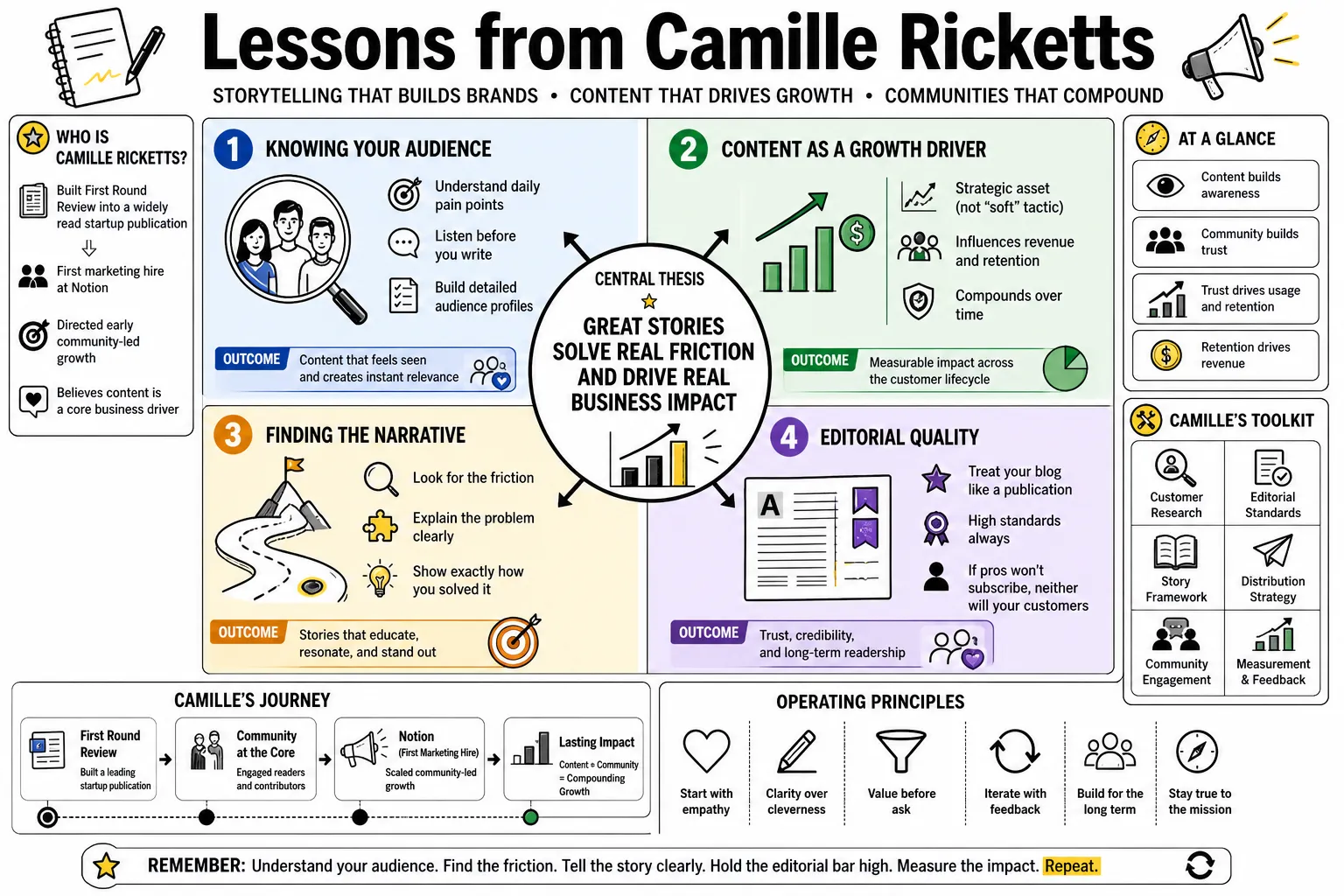
Lessons from Camille Ricketts
Camille Ricketts was the first marketing hire at Notion and earlier the first editor of First Round Review. — next play: Camille Ricketts.
Part 1: Storytelling and Content Strategy
- On Knowing Your Audience: Camille Ricketts: "A lot of it is about getting to know your audience to an almost beleaguered degree." — Podcast transcript archive on GitHub: Camille Ricketts episode.
- On Content-Market Fit: Camille Ricketts: "The way that you think about product market fit, you have to think about content market fit." — Podcast transcript archive on GitHub: Camille Ricketts episode.
- On Telling Your Stories Well: Camille Ricketts: "I think that putting those stories out there and making sure they're being told in the right way is important." — Camille Ricketts: Former Head of Marketing at Notion.
- On Quality Over Quantity: Camille Ricketts: "We prioritize quality over quantity, and only feature tactical advice surfaced in interviews with people who have a proven track record of success using the insights they’re sharing." — Meet the First Round Review Content Team (Managing Editor Q&A).
- On Vulnerability in Content: Camille Ricketts: "I think they end up being a lot more forthcoming, and since it’s very education-oriented and for a good cause, I think people share a lot more in terms of their personal anecdotes, their vulnerability, areas of weakness that might be teachable moments for others." — Content Marketing Conversations (Flipboard Q&A).
- On the Standard for Writing: Camille Ricketts: "Our lofty goal every time we write is to produce a blend of the Harvard Business Review and the New Yorker." — How Long It Takes to Create Different Types of Content (Q&A excerpt).
- On Craft and Time: Camille Ricketts: "This takes a lot of time and craft, which is why it can sometimes take up to eight hours to finish something that makes us proud." — How Long It Takes to Create Different Types of Content (Q&A excerpt).
- On Getting Better at Interviewing: Camille Ricketts: "I’ve gotten much better at interviewing, and asking for illustrative examples of how things operate and how advice gets applied." — Meet the First Round Review Content Team (Managing Editor Q&A).
- On Not Maximizing Every Number: Camille Ricketts: "We’re not sticklers about maximizing these numbers constantly — that would prevent us from pursuing high-quality but niche content that might appeal to a smaller audience." — Meet the First Round Review Content Team (Managing Editor Q&A).
- On Content That Does Not Feel Like an Ad: Camille Ricketts: "People aren’t going to share something that feels like an advertisement." — Content Marketing Conversations (Flipboard Q&A).
Part 2: Community-Led Growth
- On the Halo Effect of Quality: Camille Ricketts: "You have to trust the halo effect of putting out something quality." — Content Marketing Conversations (Flipboard Q&A).
- On Trust and Exposure to the Team: Camille Ricketts: "I think it's about maintaining a level of trust and actually exposure to the team itself and inviting people to really engage with us very deeply and not hold back." — How Notion Leverages Customer Segmentation and the Power of Community to Fuel Growth.
- On the Ambassador Program: Camille Ricketts: "The ambassador program is really the heart of how we interact with the community, and we call this program the Notion Pros." — How Notion Leverages Customer Segmentation and the Power of Community to Fuel Growth.
- On Preconceived Notions About Community: Camille Ricketts: "I would recommend highly not necessarily coming in with preconceived notions about what a community needs to look like." — Podcast transcript archive on GitHub: Camille Ricketts episode.
- On Loving Critics: Camille Ricketts: "We often note that the people who are our biggest critics are people who love the product the most, and we definitely see that across all of these channels." — How Notion Leverages Customer Segmentation and the Power of Community to Fuel Growth.
- On Products People Want to Share: Camille Ricketts: "I think that community lends itself particularly well if you have something that your product creates that people want to share because it exhibits something about themselves." — Podcast transcript archive on GitHub: Camille Ricketts episode.
- On Community and Ubiquity: Camille Ricketts: "In terms of how I think about what it actually is, it's when your community helps you achieve such ubiquity and such name recognition that it actually allows you to start moving upmarket into the enterprise." — Podcast transcript archive on GitHub: Camille Ricketts episode.
- On Certified Expert Users: Camille Ricketts: "The result there is to get a cohort of people who are deeply engaged with Notion, able to handle any manner of question, understand a lot of our more advanced use cases and who we feel totally comfortable connecting with our enterprise clients." — How Notion Leverages Customer Segmentation and the Power of Community to Fuel Growth.
- On Starting a Community Small: Camille Ricketts: "Being able and giving yourself the permission to start small and then learn from that group, and then move out to that next concentric circle and learn from them, and then move out from there." — Community-Led Growth: Camille Ricketts on marketing at Notion | Grow & Tell.
- On Drawing Guidelines: Camille Ricketts: "Of course, I'm sure, I'm positive for your listeners that we're going to run into instances where we need to draw guidelines, or we need to be more deliberate about this." — How Notion Leverages Customer Segmentation and the Power of Community to Fuel Growth.
Part 3: Building the Notion Brand
- On Leadership That Values Community: Camille Ricketts: "I think that we were really fortunate that Ivan saw the inherent value in community from the very beginning and was deeply supportive." — Podcast transcript archive on GitHub: Camille Ricketts episode.
- On Equipping Partners Without Losing Identity: Camille Ricketts: "I don't think that you should worry necessarily about losing your identity as long as you equip these types of partners, these types of influencers with just certain, still pretty flexible, high latitude brand guidelines." — Camille Ricketts: Former Head of Marketing at Notion.
- On Enterprise Buyers and Viral Videos: Camille Ricketts: "I think you can safely say that somebody is not going to buy a massive number of enterprise seats in a piece of software because they happened to see a video on TikTok." — Community-Led Growth: Camille Ricketts on marketing at Notion | Grow & Tell.
- On Appearing Everywhere at Once: Camille Ricketts: "I think it does go back to that ubiquity piece, where it's just so important to think through how your company can appear to be everywhere at once." — Community-Led Growth: Camille Ricketts on marketing at Notion | Grow & Tell.
- On Explaining in Customers' Terms: Camille Ricketts: "If you don't explain it in a way that actually connects with the way that people think about and define their own needs, it's not going to actually click, I think, for most people." — How Notion Leverages Customer Segmentation and the Power of Community to Fuel Growth.
- On Hiring Writers: Camille Ricketts: "Had you asked me this five years ago, I think I would've really emphasized someone who is an incredible writer, somebody who is not just good at compiling the information but has a certain amount of musicality to their writing." — Camille Ricketts: Former Head of Marketing at Notion.
- On Avoiding One-Size-Fits-All Experiences: Camille Ricketts: "I would also say that one of the things that I think Ben was best at is not putting a one size fits all experience on any of this." — Podcast transcript archive on GitHub: Camille Ricketts episode.
Part 4: The First Round Review Playbook
- On Waves of Marketing: Camille Ricketts: "I think over time, we've seen this, where first we had digital advertising as the first wave, and then content marketing emerged, because folks realized that there needed to be a more consultative approach, rather than just advertising." — Camille Ricketts: Former Head of Marketing at Notion.
- On Sourcing Through Introductions: Camille Ricketts: "We source our content through introductions to very smart people." — Meet the First Round Review Content Team (Managing Editor Q&A).
- On Championing Brilliant People: Camille Ricketts: "We just want to champion the most brilliant people that we come across and make their advice available." — Content Marketing Conversations (Flipboard Q&A).
- On Writing Longer and More Tactical: Camille Ricketts: "We thought, we’ll write longer and be much more granular and tactical so that everything we publish is somehow actionable and can probably be used by the person that day or the next day." — Content Marketing Conversations (Flipboard Q&A).
- On Letting Sources Guide Topics: Camille Ricketts: "We really like the people we speak to to guide our content because they tend to have an up-to-date and sharp sense of the biggest questions being asked in the industry, and new challenges that are always emerging." — Meet the First Round Review Content Team (Managing Editor Q&A).
- On Letting the Expert Speak: Camille Ricketts: "We interview people who are known, proven experts at whatever it is that they’re doing, and we write the articles in such a way, without bylines, that it feels like that person is speaking to you." — Content Marketing Conversations (Flipboard Q&A).
- On Re-Marketing a Published Piece: Camille Ricketts: "Whenever we publish, we send out a newsletter linking directly to the most recent story, and we continue to re-market the piece on Twitter, LinkedIn and Facebook through the day it appears and several subsequent days." — Meet the First Round Review Content Team (Managing Editor Q&A).
Part 5: Humanizing B2B Marketing
- On Making the Source a Partner: Camille Ricketts: "Whenever I write something, I’m engaging the source as my partner in producing this piece of content, and that means they get to see what I’m planning to put out before it actually is public." — Content Marketing Conversations (Flipboard Q&A).
- On Collecting Fun Customer Stories: Camille Ricketts: "At the same time, we were constantly looking for these sorts of anomalous or fun stories of what Notion had done for people that we could then tell through various means." — Community-Led Growth: Camille Ricketts on marketing at Notion | Grow & Tell.
- On Visual Storytelling: Camille Ricketts: "The last thing I'll say on that and then I'll stop rambling about it is that, we saw the value of visual storytelling and how that should really take the lead on social media." — Community-Led Growth: Camille Ricketts on marketing at Notion | Grow & Tell.
Part 6: Product Positioning and Messaging
- On Starting With Product Marketing: Camille Ricketts: "I think, most companies, regardless of which path they're taking, there need to start with really strong product marketing." — Camille Ricketts: Former Head of Marketing at Notion.
- On Pricing and MVPs: Camille Ricketts: "I see MVPs being built, where people are going to use it, but as soon as pricing gets introduced there will be a huge drop-off." — Camille Ricketts: Former Head of Marketing at Notion.
Part 7: Navigating Startup Growth
- On Founder-Led Marketing: Camille Ricketts: "I've seen this increasingly that there's this movement or understanding that, founders should stick with founder-led marketing and sales as long as possible, versus hiring somebody to just do it over there, while they figure out the product." — Camille Ricketts: Former Head of Marketing at Notion.
- On Product Managers and Unified Launches: Camille Ricketts: "I think that PMs similarly are the ones who assemble a lot of threads across a marketing organization, in order to launch things that feel unified and coherent." — Camille Ricketts: Former Head of Marketing at Notion.
- On Order of Operations: Camille Ricketts: "I think about it in terms of order of operations of what you really need to be doing at any given time over the course of a company's life." — Camille Ricketts: Former Head of Marketing at Notion.
- On a Team With a Familial Quality: Camille Ricketts: "We were all working really hard and in this thing together, but it's that team familial quality that stands out to me." — Podcast transcript archive on GitHub: Camille Ricketts episode.
- On Cross-Pollination: Camille Ricketts: "The environment that was created, I think, lent itself to a lot of creativity and then also just a lot of cross population among everybody that was there, regardless of what their skill set was." — Community-Led Growth: Camille Ricketts on marketing at Notion | Grow & Tell.
- On Customer Advisory Boards: Camille Ricketts: "I think that you have the opportunity to do customer advisory boards, which is really convening even smaller circles of ideal fit users and making sure that they are connected to each other as well as you, and then incentivize to provide you with feedback." — Podcast transcript archive on GitHub: Camille Ricketts episode.
Part 8: Career and Leadership Insights
- On Moving From Reporting to Content Marketing: Camille Ricketts: "I could talk for a long time how noble and incredible the profession of being a reporter is. But I never liked reporting at someone’s expense." — Content Marketing Conversations (Flipboard Q&A).
- On Work Everyone Feels Good About: Camille Ricketts: "What content marketing allows me to do is to produce work that everybody involved feels excited about." — Content Marketing Conversations (Flipboard Q&A).
- On Learning on Your Feet: Camille Ricketts: "Given the fact that I had not been through a classic rocket ship arc, and I certainly hadn't been first-hand exposed to a ton of later-stage enterprise motion, it was this experience of having to execute while learning on my feet constantly." — Community-Led Growth: Camille Ricketts on marketing at Notion | Grow & Tell.
- On Leaning Into Your Strengths: Camille Ricketts: "I think that so much of a founder's strength comes from leaning into where they know that they love to work, what they know about themselves." — Podcast transcript archive on GitHub: Camille Ricketts episode.
- On Doubling Down: Camille Ricketts: "Instead of trying to make that happen elsewhere, just double down and almost get rid of the other choices." — Content Marketing Conversations (Flipboard Q&A).
- On Listening to Your Audience: Camille Ricketts: "I think I’ve learned to listen to my audience better over time." — Meet the First Round Review Content Team (Managing Editor Q&A).