Campbell Harvey is a professor of finance at Duke University and a research associate at the National Bureau of Economic Research. — Campbell Harvey - Global Macro Series.
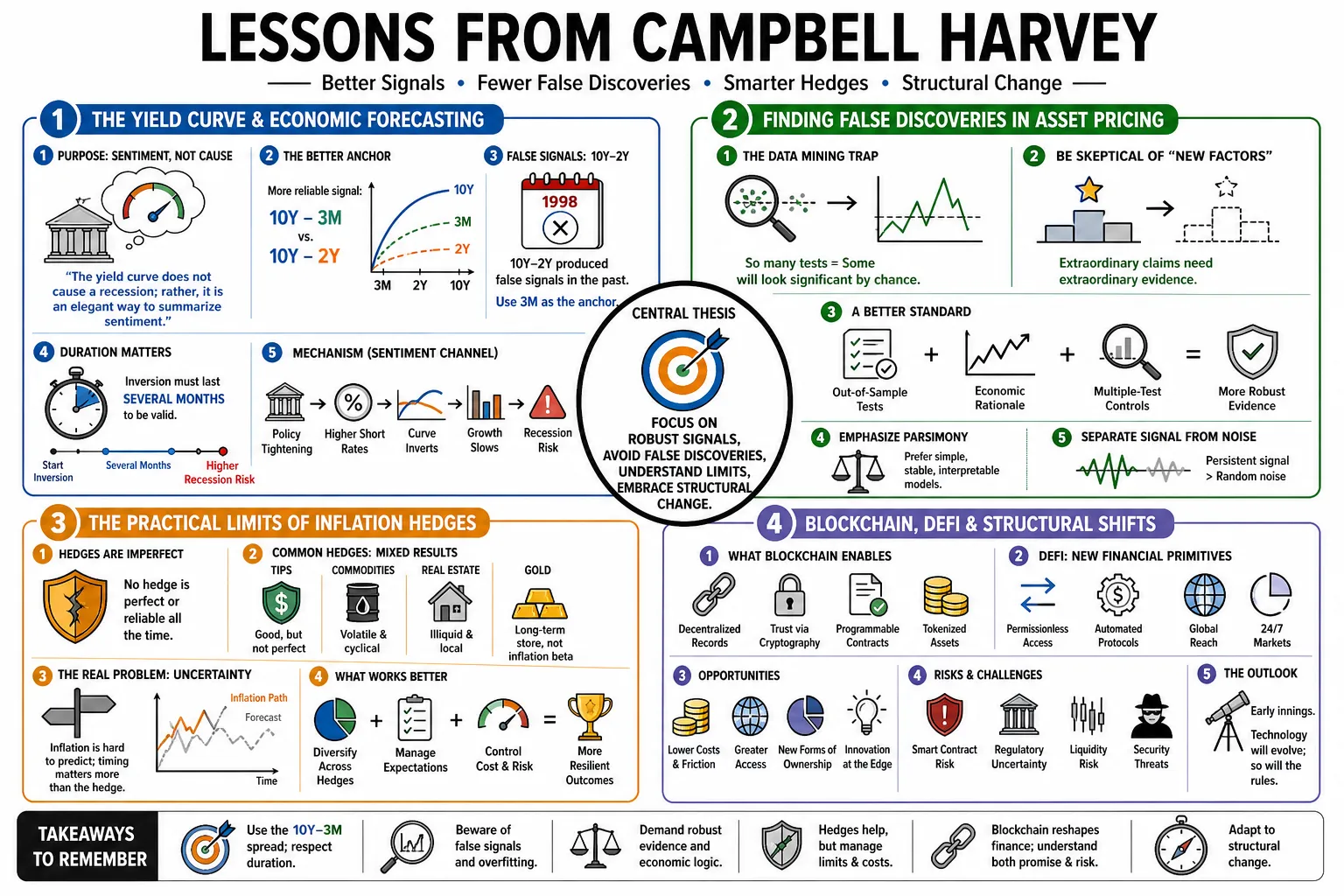
Part 1: The Yield Curve and Economic Forecasting
- On the Slope of the Curve and Growth: Campbell Harvey: "My model links the slope of the yield curve to future real economic growth." — Episode #172: Cam Harvey, Duke University, “This is a Time of Considerable Risk of a Drawdown” - Meb Faber Research - Stock Market and Investing Blog.
- On Comparing Canada and the U.S.: Campbell Harvey: "What I did was I looked at the difference between Canadian economic growth and US growth, and then looked at the difference between the Canadian yield curve and the US yield curve, and found that had predictability." — VALUE: After Hours S05 E16: Cam Harvey on 10-3 Inversions, Recession Risk, False Signals and the Fed (transcript).
- On Going to Cash in 2006: Campbell Harvey: "The best trade that I ever did was when the yield curve inverted in mid-2006, I went 100% in cash." — Episode #172: Cam Harvey, Duke University, “This is a Time of Considerable Risk of a Drawdown” - Meb Faber Research - Stock Market and Investing Blog.
- On Forecasting Turning Points: Campbell Harvey: "Whereas forecasting the turning point down, you could be out of the market five years too early or you dump your value stocks exactly at the wrong time." — Episode #172: Cam Harvey, Duke University, “This is a Time of Considerable Risk of a Drawdown” - Meb Faber Research - Stock Market and Investing Blog.
- On a Perfect Track Record: Campbell Harvey: "After the global financial crisis, people started to realize, “Oh, well, this indicator is six out of six, no false signals.” So, things actually changed." — VALUE: After Hours S05 E16: Cam Harvey on 10-3 Inversions, Recession Risk, False Signals and the Fed (transcript).
- On the Three Parts of the Curve: Campbell Harvey: "One is expected inflation, the other is expected real growth in the economy, and the third part is the expected risk." — VALUE: After Hours S05 E16: Cam Harvey on 10-3 Inversions, Recession Risk, False Signals and the Fed (transcript).
- On a Flat or Inverted Curve: Campbell Harvey: "One way to think about it is that when the yield curve flattens out or inverts, that just means slower growth." — VALUE: After Hours S05 E16: Cam Harvey on 10-3 Inversions, Recession Risk, False Signals and the Fed (transcript).
- On Picking Projects Back Up: Campbell Harvey: "If we don’t go into recession, well, we just had some slower growth and we’ll pick it up later when we retrigger some of these projects." — VALUE: After Hours S05 E16: Cam Harvey on 10-3 Inversions, Recession Risk, False Signals and the Fed (transcript).
- On the Fed Missing Permanent Inflation: Campbell Harvey: "Again, it was the Fed’s mistake not to see that the inflation was going to be way more permanent because of the housing inflation." — VALUE: After Hours S05 E16: Cam Harvey on 10-3 Inversions, Recession Risk, False Signals and the Fed (transcript).
- On Market Efficiency After Shocks: Campbell Harvey: "In my opinion, given what’s happened, I think that the market will become less efficient in the short-term, and that provides some opportunities, of course." — Transcript: Campbell Harvey.
Part 2: Decentralized Finance (DeFi)
- On Centralized Exchanges: Campbell Harvey: "FTX is a centralized exchange. Like any centralized exchange, you call your broker, you want some stock, the broker holds that stock for you, and holds it in their name, not in your name" — Professor Campbell Harvey: Web3 Affects All of Us (Duke Fuqua Insights, quoting Harvey).
- On Waiting Days to Own a Stock: Campbell Harvey: "You think you buy it instantly, but to actually get ownership took three days." — The Rise of Crypto: Campbell Harvey and Neha Narula (Knowledge at Wharton podcast transcript).
- On the Thick Middle Layer: Campbell Harvey: "Think of a retailer operating on a razor-thin margin having to pay a credit card company a 3% fee on every swipe – this is because of a thick middle layer. Why not just have the customer pay the retailer directly? That’s DeFi. It is peer to peer. It does not use the existing financial infrastructure which is essentially the same structure as a century ago." — Professor Campbell Harvey: Web3 Affects All of Us (Duke Fuqua Insights, quoting Harvey).
- On the Unbanked: Campbell Harvey: "So, in the world today, there are 1.7 billion people that are unbanked." — Transcript: Campbell Harvey.
- On the Global Financial Crisis and Bitcoin: Campbell Harvey: "Indeed, the global financial crisis was the last straw, and certainly most people know that the very first block in the bitcoin blockchain makes a reference to a second bailout from a headline in The Times of London." — The Rise of Crypto: Campbell Harvey and Neha Narula (Knowledge at Wharton podcast transcript).
- On Web3 Needing DeFi: Campbell Harvey: "There is no Web3 without DeFi" — Professor Campbell Harvey: Web3 Affects All of Us (Duke Fuqua Insights, quoting Harvey).
- On Renting Out Your Computer: Campbell Harvey: "You are not fully utilizing your computer both for CPU and storage. Why not rent it out? Why not get paid? This is Web3" — Professor Campbell Harvey: Web3 Affects All of Us (Duke Fuqua Insights, quoting Harvey).
- On Solving Problems: Campbell Harvey: "You need to be solving problems, and this new technology offers the potential to solve many problems." — The Rise of Crypto: Campbell Harvey and Neha Narula (Knowledge at Wharton podcast transcript).
- On Coming From Centralization: Campbell Harvey: "We have come from a time where we were 100% centralized, so I believe that the key word is efficiency." — The Rise of Crypto: Campbell Harvey and Neha Narula (Knowledge at Wharton podcast transcript).
Part 3: The Factor Zoo and Data Mining
- On 500 Published Factors: Campbell Harvey: "In my own research, I’ve documented 500 factors that have been published in the academic literature and make the point that that understates the number that have been discovered because many of them weren’t published because they didn’t work and let’s put work in quotations." — Episode #172: Cam Harvey, Duke University, “This is a Time of Considerable Risk of a Drawdown” - Meb Faber Research - Stock Market and Investing Blog.
- On Lucky Findings: Campbell Harvey: "The problem was that there was only three recessions in my data set and my adviser sitting there was saying, “Well, maybe this is just a lucky finding." — Episode #172: Cam Harvey, Duke University, “This is a Time of Considerable Risk of a Drawdown” - Meb Faber Research - Stock Market and Investing Blog.
- On Half of Findings Being False: Campbell Harvey: "Medicine, for example, they fully realized that half of their research findings are false." — Transcript: Campbell Harvey.
- On Factor Crash Risk: Campbell Harvey: "You still have a crash risk and that is that when one factor crashes it’s bad news for the other factors, that the correlation actually increases." — Episode #172: Cam Harvey, Duke University, “This is a Time of Considerable Risk of a Drawdown” - Meb Faber Research - Stock Market and Investing Blog.
- On Backtests and New Factors: Campbell Harvey: "Investors need to be especially careful that you get somebody that is proposing a new factor, offering this great premium, it looks great in the backtest but at a sample, it will likely fail because so many things have actually been tried." — Episode #172: Cam Harvey, Duke University, “This is a Time of Considerable Risk of a Drawdown” - Meb Faber Research - Stock Market and Investing Blog.
- On Learning Too Much From History: Campbell Harvey: "I do see the upside here and the upside is the following, that I believe that we sometimes learn too much from history and we think about economic growth and the world, the U.S. growth declining." — Episode #172: Cam Harvey, Duke University, “This is a Time of Considerable Risk of a Drawdown” - Meb Faber Research - Stock Market and Investing Blog.
- On Understanding Factor Exposures: Campbell Harvey: "You need to have these different scenarios, understand your exposure, your factor exposures." — Episode #172: Cam Harvey, Duke University, “This is a Time of Considerable Risk of a Drawdown” - Meb Faber Research - Stock Market and Investing Blog.
Part 4: Inflation Hedging and Commodities
- On Politicians Preferring Inflation: Campbell Harvey: "To raise taxes is toxic in terms of your electability. So, it’s easier to have some sort of inflation and blame it on the pandemic or something like that." — Campbell Harvey - Global Macro Series (Top Traders Unplugged, quoting Harvey).
- On Correlation Management: Campbell Harvey: "The correlation management needs to be very carefully taken into account and doing that you maximize the chance that your portfolio will outperform others in a time of stress." — Episode #172: Cam Harvey, Duke University, “This is a Time of Considerable Risk of a Drawdown” - Meb Faber Research - Stock Market and Investing Blog.
- On Improvising in Chaos: Campbell Harvey: "The worst thing that you can do as an asset manager is to improvise at the worst possible time where there’s chaos in the market." — Episode #172: Cam Harvey, Duke University, “This is a Time of Considerable Risk of a Drawdown” - Meb Faber Research - Stock Market and Investing Blog.
- On Gold Being All Over the Place: Campbell Harvey: "I’ve not looked at the commodities, but I do know for my research on gold that gold’s just all over the place." — Episode #172: Cam Harvey, Duke University, “This is a Time of Considerable Risk of a Drawdown” - Meb Faber Research - Stock Market and Investing Blog.
- On Getting Paid for Writing Options: Campbell Harvey: "You are basically just getting paid for taking the risk that is involved with writing of the option." — Episode #172: Cam Harvey, Duke University, “This is a Time of Considerable Risk of a Drawdown” - Meb Faber Research - Stock Market and Investing Blog.
Part 5: Corporate Finance and Capital Allocation
- On Going to Chicago for a PhD: Campbell Harvey: "My best investment was to kinda go against my family’s wishes and go to University of Chicago for a PhD." — Episode #172: Cam Harvey, Duke University, “This is a Time of Considerable Risk of a Drawdown” - Meb Faber Research - Stock Market and Investing Blog.
- On Technology Delivering a Surge: Campbell Harvey: "I believe that technology will deliver a surge, in particular, to emerging markets; will spill over to the developed markets; the increased productivity will be striking. We will not be working 40 hour weeks in the future." — Campbell Harvey - Global Macro Series (Top Traders Unplugged, quoting Harvey).
- On Data-Driven Policy: Campbell Harvey: "I think it’s incumbent upon our policymakers to take action that’s data driven." — VALUE: After Hours S05 E16: Cam Harvey on 10-3 Inversions, Recession Risk, False Signals and the Fed (transcript).
- On Persistent Volatility: Campbell Harvey: "You need to take basic things into account, that volatility is persistent and that is going to be an important driver of your weighing of factors." — Episode #172: Cam Harvey, Duke University, “This is a Time of Considerable Risk of a Drawdown” - Meb Faber Research - Stock Market and Investing Blog.
Part 6: Machine Learning in Finance
- On Value Out of Favor: Campbell Harvey: "Think about the 1990s where value was underperforming year after year after year, and then in the late 90s people eventually said, “I had enough." — Episode #172: Cam Harvey, Duke University, “This is a Time of Considerable Risk of a Drawdown” - Meb Faber Research - Stock Market and Investing Blog.
Part 7: Cryptocurrencies and Blockchain
- On Value Because People Believe: Campbell Harvey: "I agree fundamentally that something has got value because people believe it's got value." — The Rise of Crypto: Campbell Harvey and Neha Narula (Knowledge at Wharton podcast transcript).
- On Governments and Digital Currency: Campbell Harvey: "I think governments will embrace this technology for another reason and that is tax. So, right now with the value-added taxes, especially in Europe, there are just so many incentives to basically transact in cash to avoid the VAT." — Campbell Harvey - Global Macro Series (Top Traders Unplugged, quoting Harvey).
- On the Dollar Not Being Dominant Forever: Campbell Harvey: "I think, just looking at history, it’s really naïve to think that the U.S. will be the dominant currency forever. So, things change. So, economic tides come in and go out." — Campbell Harvey - Global Macro Series (Top Traders Unplugged, quoting Harvey).
- On Combining Centralization and Decentralization: Campbell Harvey: "I believe that there would be a combination of centralization and decentralization in the future that's really focused on efficiency." — The Rise of Crypto: Campbell Harvey and Neha Narula (Knowledge at Wharton podcast transcript).
- On Stablecoins as Efficiency: Campbell Harvey: "We could think of a stable coin that's linked to the U.S. dollar as just a more efficient mechanism for dealing with the fiat currency." — The Rise of Crypto: Campbell Harvey and Neha Narula (Knowledge at Wharton podcast transcript).
- On DeFi Relying on Centralized Stablecoins: Campbell Harvey: "Think about the reliance of decentralized protocols, like decentralized exchanges and things like that, on centralized stablecoins." — The Rise of Crypto: Campbell Harvey and Neha Narula (Knowledge at Wharton podcast transcript).
- On Negative Exposure to Crypto: Campbell Harvey: "When investors tell me they don’t have exposure to crypto, I tell them that they actually have a negative exposure" — Professor Campbell Harvey: Web3 Affects All of Us (Duke Fuqua Insights, quoting Harvey).
- On Finance Not Looking Like the Past: Campbell Harvey: "The key thing to realize, in my opinion, is that finance will not look like it has in the past in the future." — Transcript: Campbell Harvey.
- On Competing Technologies: Campbell Harvey: "Historically, we've never had, for example, decentralized technologies competing with AI and quantum technologies all at the same time." — The Rise of Crypto: Campbell Harvey and Neha Narula (Knowledge at Wharton podcast transcript).
- On the Steep Vector: Campbell Harvey: "It's small now, but the vector is very steep and positive" — Professor Campbell Harvey: Web3 Affects All of Us (Duke Fuqua Insights, quoting Harvey).
Part 8: Backtesting Protocols and False Discoveries
- On Skill and Quantitative Training: Campbell Harvey: "Even people that you might think are skilled that should be able to do it, people that might have master’s or PhDs in quantitative fields, they’re just not good at that." — Episode #172: Cam Harvey, Duke University, “This is a Time of Considerable Risk of a Drawdown” - Meb Faber Research - Stock Market and Investing Blog.
- On Missing Skilled Managers: Campbell Harvey: "I know it’s different but it gives investors different type of decision criteria so that you could have a decision criteria that I’m willing to miss five skilled managers to avoid investing in one unskilled manager." — Episode #172: Cam Harvey, Duke University, “This is a Time of Considerable Risk of a Drawdown” - Meb Faber Research - Stock Market and Investing Blog.
- On the Two Kinds of Manager Mistakes: Campbell Harvey: "When you think about the mistakes that investors make, so one mistake is you invest in a bad manager and the manager disappoints." — Episode #172: Cam Harvey, Duke University, “This is a Time of Considerable Risk of a Drawdown” - Meb Faber Research - Stock Market and Investing Blog.
- On Focusing on Unskilled Managers: Campbell Harvey: "Usually, we focus on investing in the manager that turned out to be unskilled." — Episode #172: Cam Harvey, Duke University, “This is a Time of Considerable Risk of a Drawdown” - Meb Faber Research - Stock Market and Investing Blog.
- On Passing on Good Managers: Campbell Harvey: "Another mistake that’s not as talked about is passing on a manager that turns out to be good." — Episode #172: Cam Harvey, Duke University, “This is a Time of Considerable Risk of a Drawdown” - Meb Faber Research - Stock Market and Investing Blog.
- On High Fees and Underperformance: Campbell Harvey: "It doesn’t make any sense if somebody is underperforming and they’re charging this really high fee and then trying to spoof potential investors saying that they’ve got this great product." — Episode #172: Cam Harvey, Duke University, “This is a Time of Considerable Risk of a Drawdown” - Meb Faber Research - Stock Market and Investing Blog.
- On Doing Your Job as an Asset Manager: Campbell Harvey: "If you don’t have a pretty good answer to that then you’re not doing your job as an asset manager." — Episode #172: Cam Harvey, Duke University, “This is a Time of Considerable Risk of a Drawdown” - Meb Faber Research - Stock Market and Investing Blog.