Carl Zimmer is a science columnist for The New York Times and the author of 15 books about science. — Carl Zimmer | carlzimmer.com.
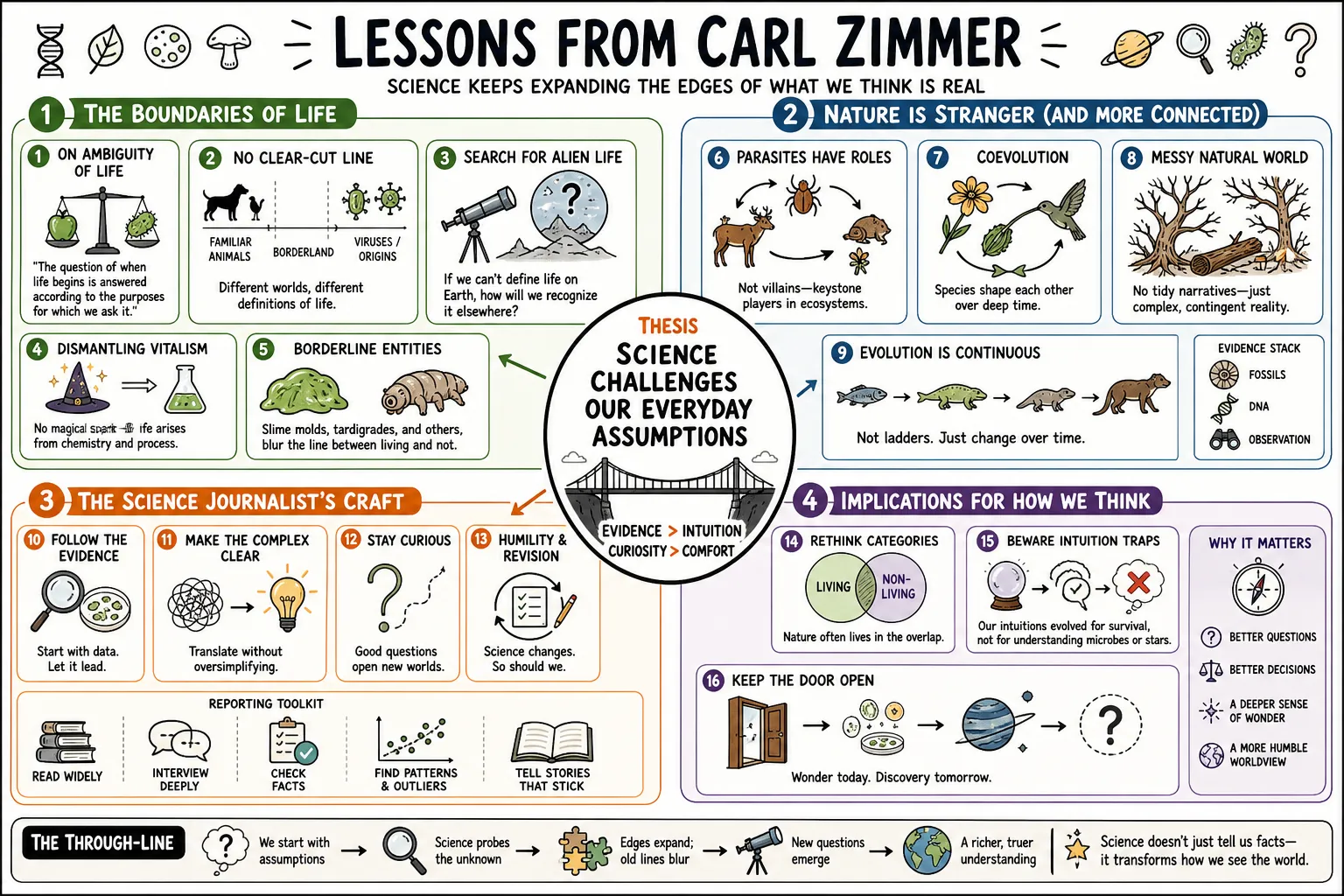
Part 1: The Boundaries of Life
- On Defining Life Without Strict Definitions: Carl Zimmer: "We can know what games are without strict definitions because we think about them as sitting in a network of connections." — The Secret Life of A Coronavirus.
- On What Viruses Lack of Life: Carl Zimmer: "The problem with viruses is they have some of the things that we think are essential for life, but not quite all of them." — Shrink - Transcript.
- On Keeping the Signal and Filtering the Noise: Carl Zimmer: "As scientists start to understand how genes work with other genes, they can see ways in which you can filter out the noise and keep the good signal, keep the music." — Stochasticity (Radiolab transcript, Carl Zimmer's turns).
- On How Anesthesia Switches Consciousness: Carl Zimmer: "When you raise the level of anesthesia in someone—and they've done studies on this—it isn't a gentle gradation down." — Black Box (Radiolab transcript, Carl Zimmer's turns).
- On Waiting for New Theories of Life to Be Tested: Carl Zimmer: "Assembly theory is new and it’s very interdisciplinary, I think it’s going to take a while for the scientific community to really engage with it and decide whether it holds up or not." — Carl Zimmer on the Hidden Life in the Air We Breathe (Ep. 235) | Conversations with Tyler.
Part 2: The World of Parasites
- On Parasite-Like DNA: Carl Zimmer: "Much (maybe most) of it is made up of dead genes and parasite-like stretches of DNA that do little more than making copies of themselves." — And the Genomes Keep Shrinking….
- On Deadliness Evolving: Carl Zimmer: "The deadliness of a parasite can evolve, and in some situations, it may pay for parasites to be milder instead of meaner." — The Germ Theory of Cancer.
- On a Wasp Enslaving a Cockroach: Carl Zimmer: "A parasitic wasp can attack a cockroach and insert its stinger into one specific part of the cockroach's brain and inject a precise little cocktail of drugs that then turns the cockroach into its slave." — In Defense of Cheats (Radiolab transcript, Carl Zimmer's turns).
- On Monogamous Parasites: Carl Zimmer: "I have to admit, I do love the thought that parasites are among the most monogamous animals on the planet." — In Defense of Cheats (Radiolab transcript, Carl Zimmer's turns).
- On Refugia and Recovery: Carl Zimmer: "Trees that survive in a refugium also may help speed the recovery of the surrounding ecosystem." — ‘Lifeboats’ Amid the World’s Wildfires.
- On Natural Selection and Scarcity: Carl Zimmer: "If the adult food gets harder to find, natural selection will favor adults that do a better job of finding what little food is left." — Why Would an Animal Trade One Body for Another?.
- On a Fungus Taking Over an Ant: Carl Zimmer: "An ant that climbs up to the top of a flower, and then a giant stalk of fungus comes out of its head and showers down on the ants below, sowing death." — Sleepless in South Sudan (Radiolab transcript, Carl Zimmer's turns).
- On the Value of Mangroves: Carl Zimmer: "In some cases the services that mangroves provide are four times more valuable than what you could get out with shrimp." — Worth (Radiolab transcript, Carl Zimmer's turns).
Part 3: Viruses and the Biosphere
- On Whether Viruses Are Alive: Carl Zimmer: "I consider whether viruses are alive–and how we set the line between the living and the non-living world." — A First Peek at Life’s Edge in the Sunday Review in the New York Times.
- On What Viruses Are: Carl Zimmer: "Viruses were just little packages of genetic material that would go from cell to cell and use the cell to make new viruses." — Shrink - Transcript.
- On the Viral Frontier: Carl Zimmer: "Viruses are the most common life form on Earth, they are by far the most genetically diverse, and we have barely started to explore the viral frontier." — Gigantic Giant Viruses and the Endless Viral Frontier.
- On Viral Fragments in Our DNA: Carl Zimmer: "There are 100,000 known fragments of viruses in the human genome, making up over 8% of our DNA." — Mammals Made By Viruses.
- On Oceans Becoming Uninhabitable: Carl Zimmer: "Rising temperatures and plunging oxygen must have made huge swaths of the oceans uninhabitable." — The Planet Has Seen Sudden Warming Before. It Wiped Out Almost Everything..
- On Pandemics Getting a Head Start: Carl Zimmer: "Time and again, pandemics have gotten a head start because we didn’t realize what we were dealing with." — Ebola, H.I.V., Spanish Flu, SARS — the 20th Century’s Deadliest Hits.
- On the Microbiome and the Brain: Carl Zimmer: "Altering appetite isn’t the only thing that the microbiome can do to the brain, it turns out." — Germs in Your Gut Are Talking to Your Brain. Scientists Want to Know What They’re Saying..
- On How Viruses Were Discovered: Carl Zimmer: "What scientists did was they discovered viruses by filtering fluid from a sick plant or a sick animal through a filter—porcelain, actually—and it was so small that—that anything the size of bacteria got trapped in the porcelain, and anything smaller came out." — Shrink - Transcript.
Part 4: Heredity and Genetics
- On Intelligence as Flexibility: Carl Zimmer: "Intelligent animals don’t rely on fixed responses to survive — they can invent new behaviors on the fly." — Yes, the Octopus Is Smart as Heck. But Why?.
- On Overreading Genetic Information: Carl Zimmer: "I think one of the dangers is that people will convince themselves that the information we have about DNA is going to ensure things about their kids that they can’t be sure about." — Carl Zimmer on the Hidden Life in the Air We Breathe (Ep. 235) | Conversations with Tyler.
- On Neanderthal DNA and Our Health: Carl Zimmer: "My experience in exploring my genome to find pieces of Neanderthal DNA has left me with a whole lot of questions because the connections between Neanderthal DNA and our health are still very, very tentative and a lot of it is just not clear at all." — A science writer’s quest to understand heredity (CSHL LabDish).
- On Intelligence Testing and Eugenics: Carl Zimmer: "Certainly, even in the early 1900s, we saw people more than willing to use ideas about inherited levels of intelligence to, for example, decide which people should be institutionalized, who should be allowed into the United States or not." — Carl Zimmer on the Hidden Life in the Air We Breathe (Ep. 235) | Conversations with Tyler.
- On Epigenetic Inheritance in Plants: Carl Zimmer: "Martienssen studies plants and in plants, it’s pretty clear that epigenetic inheritance is quite real and quite important." — A science writer’s quest to understand heredity (CSHL LabDish).
- On Where Hybrid Corn Began: Carl Zimmer: "Cold Spring Harbor actually was the place where a lot of the research for modern plant breeding got its start, breeding hybrid corn." — A science writer’s quest to understand heredity (CSHL LabDish).
- On Epigenetic Inheritance: Carl Zimmer: "Some research indicates that what is known as epigenetic inheritance may have an important role." — Let’s Not Lose Our Minds.
- On Editing Before Fertilization: Carl Zimmer: "Potentially, you could say, even before fertilization, “We’re going to just take out the sperm or the eggs that have a marker for one of these strongly inherited diseases like Huntington’s disease.”" — Carl Zimmer on the Hidden Life in the Air We Breathe (Ep. 235) | Conversations with Tyler.
Part 5: Evolution and Human Origins
- On Our Deep Common Ancestry: Carl Zimmer: "Chimpanzees may be our closest living relatives, but our common ancestor with them lived about seven million years ago." — A Most Interesting Bone.
- On Judging Neanderthals: Carl Zimmer: "One hundred years ago, there were leading experts in paleontology who would claim that Neanderthals were an inferior form of almost sub-human." — A science writer’s quest to understand heredity (CSHL LabDish).
- On Mother-Only Mitochondrial Genes: Carl Zimmer: "Mitochondria carry a set of genes distinct from those of the cell’s nucleus; these genes, unlike those in the nucleus, are inherited solely from the mother." — A Blended Family: Her Mother Was Neanderthal, Her Father Something Else Entirely.
- On Neanderthal DNA Then and Now: Carl Zimmer: "If you add up all the pieces in Neanderthal DNA in living people, there is much more Neanderthal DNA on Earth now than there was when you had real Neanderthals walking around." — A science writer’s quest to understand heredity (CSHL LabDish).
- On Imagining Intermediate Forms: Carl Zimmer: "Fossils can give our limited powers of imagination a boost, by showing us that these intermediate forms did indeed exist." — What Good Is Half A Sucker?.
- On Evolution Through Neutral Intermediates: Carl Zimmer: "A path to a new function that involves neutral intermediates is entirely accessible to the evolutionary processes of mutation, drift, and selection." — The Blind Locksmith Continued: An Update from Joe Thornton.
- On Octopus Brains: Carl Zimmer: "The animals have big brains relative to their body size, they live for a long time, and they can form long-lasting social bonds." — Yes, the Octopus Is Smart as Heck. But Why?.
- On Immune Cells and Cancer: Carl Zimmer: "Our immune cells can sometimes recognize and destroy cancer cells without assistance." — New Weapons Against Cancer: Millions of Bacteria Programmed to Kill.
Part 6: Epidemics and Public Health
- On Airplane Ventilation: Carl Zimmer: "I’ve talked to a few physicists and air-quality experts and, yes, they generally agree that most planes have really good ventilation systems and filtration systems onboard." — Carl Zimmer on the Hidden Life in the Air We Breathe (Ep. 235) | Conversations with Tyler.
- On Sensing Viruses in Real Time: Carl Zimmer: "The US government has a $150 million project underway to develop cutting-edge new sensors that would basically be able to tell you, “We’re detecting flu virus in this building” in real time." — Carl Zimmer on the Hidden Life in the Air We Breathe (Ep. 235) | Conversations with Tyler.
- On Bacteria and a Fiber Diet: Carl Zimmer: "The ability of these bacteria to survive on fiber we can’t digest ourselves has led many experts to wonder if the microbes are somehow involved in the benefits of the fruits-and-vegetables diet." — Fiber Is Good for You. Now Scientists May Know Why..
- On How Aerobiology Became Biological Warfare: Carl Zimmer: "I argue in the book that the way that aerobiology got turned into biological warfare was quite a tragedy because this was a science that, at the time, was just getting off the ground." — Carl Zimmer on the Hidden Life in the Air We Breathe (Ep. 235) | Conversations with Tyler.
- On Why People Accept Science: Carl Zimmer: "I think there's a whole world of psychological research to be done on why people accept or don't accept scientific research and I'm not just talking about the public." — Carl Zimmer: Air-Borne and the Big Miss With Covid.
- On Diseases That Spread by Water, Food and Contact: Carl Zimmer: "One thing that's really important to bear in mind is that, at this time, the prevailing view was that diseases spread by water, by food, by sex, by close contact." — Lost Women of Science Conversations: Air-Borne.
- On Natural Selection Producing Variants: Carl Zimmer: "Natural selection is unleashing surges of new variants across entire countries, raising worries that existing vaccines won’t work as well as we originally hoped." — The Secret Life of A Coronavirus.
- On Cleanliness and Allergies: Carl Zimmer: "Our obsession with cleanliness probably does play some role in the increased prevalence of allergies and autoimmunity, even if it’s not the only cause." — A Few Pounds of Microbes, Only Ounces of Insight.
Part 7: The Craft of Science Communication
- On Telling the Story of New Research: Carl Zimmer: "As new research comes out, I try to explain, essentially tell the story, in a way that non-scientists can understand." — Interview with Carl Zimmer.
- On Mapping Out a Story: Carl Zimmer: "Mapping out a story, either mentally or on a piece of paper, is incredibly important for getting that structure right." — Probing the Passions of Science: An Interview with Carl Zimmer on the Art of Science Writing.
- On Aiming High: Carl Zimmer: "I think that science writers should try to aim high rather than going for a lot of these clichés you often see both in magazines and in books." — Probing the Passions of Science: An Interview with Carl Zimmer on the Art of Science Writing.
- On the Press-Release Version of Science: Carl Zimmer: "The fact is that people will come out with an experiment and then send you a press release announcing that it’s the greatest thing ever." — Probing the Passions of Science: An Interview with Carl Zimmer on the Art of Science Writing.
- On the General Reader and the Paper: Carl Zimmer: "A general reader is never going to sit down and read an actual scientific paper from start to finish, that’s just not going to happen." — Interview with Carl Zimmer.
- On Connecting Today to Old Questions: Carl Zimmer: "You can show how the work that people are doing today is helping to address questions that people have been struggling with for decades or even centuries." — Probing the Passions of Science: An Interview with Carl Zimmer on the Art of Science Writing.
- On Readers Who Take the Time: Carl Zimmer: "I do think that if people take the time to read good science writing they can get a pretty good understanding of things." — Interview with Carl Zimmer.
- On Choosing the Next Book: Carl Zimmer: "I generally just let those ideas come to me because it’s got to be something that’s going to really be something I can live with for years, so I don’t choose the next book lightly." — Carl Zimmer on the Hidden Life in the Air We Breathe (Ep. 235) | Conversations with Tyler.
- On Expanding the Scale of a Story: Carl Zimmer: "When I can I try to expand those stories so it’s not just about a paper that was published last week, but is a story that might reach over the course of decades or centuries even." — Interview with Carl Zimmer.
- On Why Scientists Do the Work: Carl Zimmer: "I think, for the most part, scientists are doing this work because they themselves have this intense passion and because they themselves find these things marvelous." — Probing the Passions of Science: An Interview with Carl Zimmer on the Art of Science Writing.
- On Stories Taking Time to Unfold: Carl Zimmer: "These videos remind us forcefully that the real meaning of stories about science takes time to unfold." — The Second Draft of the History of Science
- On Conclusions That Get Revised: Carl Zimmer: "In reality, a lot of science-related conclusions fall apart or have to be revised in later years." — The Second Draft of the History of Science
- On Keeping Your Eyes on the Future: Carl Zimmer: "I write about new scientific research, and so my job requires me to keep my eyes locked on the future, trying to figure out what some discovery or invention will mean to generations to come." — The Second Draft of the History of Science
- On Going Back to an Old Story: Carl Zimmer: "Retro Report shows that going back to a story about science can reveal important lessons about what’s going on today, but ones you may not have predicted." — The Second Draft of the History of Science
- On More Questions Than Answers: Carl Zimmer: "As I tried to convey in the column, this is a pretty new field of research, and so there are a lot more questions than answers at this point." — Friday’s Elk January 12, 2018
- On Melville’s Whale Biology: Carl Zimmer: "I’ve grown increasingly fond of the “cetology” chapters, in which Melville veers away from the story of Ishmael to explore the biology of whales." — Friday’s Elk January 12, 2018
- On One Person’s Experience: Carl Zimmer: "One person’s experiences with Omicron can’t tell us all that much about it." — Friday’s Elk, February 4, 2022
Part 8: The Philosophy and Process of Science
- On the Air Being Alive: Carl Zimmer: "I've just written a book about aerobiology, and I say the air is alive, and people look at me like I'm a little crazy." — What's in our air: A conversation with New York Times' Carl Zimmer about airborne disease.
- On Not Expecting a Staff Job: Carl Zimmer: "Once you set off into science writing, you do not automatically receive a staff job, a retirement package, and a list of great stories to write for the next fifty years." — To Beginning Science Writers old, Carl Zimmer.
- On Writing a Good Proposal: Carl Zimmer: "Along with strong writing in articles themselves, another important skill that often goes unappreciated is learning how to write a good proposal." — To Beginning Science Writers old, Carl Zimmer.
- On Studying the Flow of Life: Carl Zimmer: "Science is really starting to come into its own of studying the planetary wide pattern of the flow of life, not just for oceans, but from the ground, things come out of the ground all of the time." — Carl Zimmer: Air-Borne and the Big Miss With Covid.
- On the News You Can Use: Carl Zimmer: "I think a lot of science writers actually try to search a little too hard for that “news you can use” when it comes to science." — Interview with Carl Zimmer.
- On Newspapers Cutting the Science Section: Carl Zimmer: "When newspapers try to stay profitable through cuts (never a wise strategy, but one that makes the books look good in the short term), the science section is often the first to go." — To Beginning Science Writers old, Carl Zimmer.
- On Steering People Into a Shrinking Field: Carl Zimmer: "I don’t see why you should encourage people to go into a field that can’t support many people." — How to be a Science Writer with Carl Zimmer | Tumble Episode.
- On Auditioning for the Job: Carl Zimmer: "If you walked up to a jazz band and announce that, after much thought, you think being a trombonist would be fun, they probably won’t hire you on the spot." — To Beginning Science Writers old, Carl Zimmer.
- On Optimism About Online Science Publications: Carl Zimmer: "I’m feeling more optimistic now, because there are a lot of new, really solid science publications online." — How to be a Science Writer with Carl Zimmer | Tumble Episode.