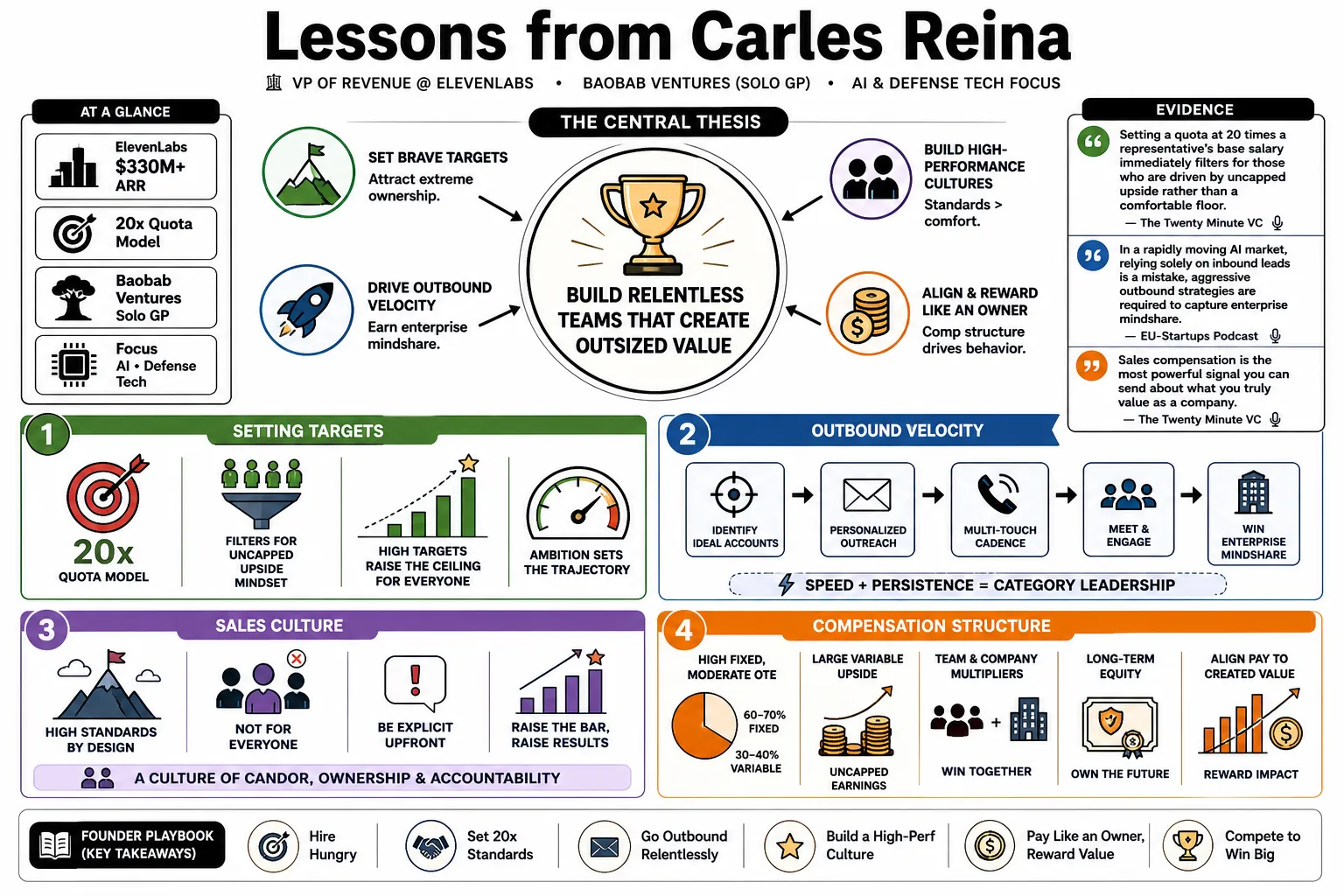
Lessons from Carles Reina
Carles Reina was the first investor in ElevenLabs, its fourth employee and its first go-to-market hire and leader. He continues to invest through his fund, Baobab Ventures. This collection gathers his own public statements on go-to-market, sales accountability, hiring and angel investing. — Carles Reina on LinkedIn: personal update after 3.5 years at ElevenLabs.
Part 1: Sales Strategy and High-Performance Cultures
- On Quota Set Against Base Salary: Carles Reina: "So if I pay you $100,000 a year, your quota is $2 million." — ElevenLabs Exec Says He Warns Candidates About a Huge Amount of Hours (Carles Reina quoted remarks).
- On Being Ruthless About Targets: Carles Reina: "And we're ruthless on that end." — ElevenLabs Exec Says He Warns Candidates About a Huge Amount of Hours (Carles Reina quoted remarks).
- On Being a Hard Company to Work For: Carles Reina: "We are a hard company to work for because we have extremely high expectations." — ElevenLabs Exec Says He Warns Candidates About a Huge Amount of Hours (Carles Reina quoted remarks).
- On Warning Candidates at the Offer: Carles Reina: "When I make an offer, I tell every single person ElevenLabs is going to be extremely difficult." — ElevenLabs Exec Says He Warns Candidates About a Huge Amount of Hours (Carles Reina quoted remarks).
- On a Unique Thesis for Each Market: Carles Reina: "Each market & product requires a unique thesis and approach." — Carles Reina on LinkedIn: unconventional GTM at ElevenLabs.
- On Crafting a Sticky Narrative: Carles Reina: "If you don't understand the market, you can't craft a narrative that will be sticky." — Carles Reina on LinkedIn: unconventional GTM at ElevenLabs.
- On Each Company Being Different: Carles Reina: "Each company is different." — Carles Reina on LinkedIn: unconventional GTM at ElevenLabs.
- On Rejecting the Playbook: Carles Reina: "In interviews, when someone tells me about their 'playbook', I reject them immediately." — Carles Reina on LinkedIn: unconventional GTM at ElevenLabs.
Part 2: The Accountability Model
- On Aligning the Team in a Vision: Carles Reina: "Aligning the team in a Vision is the glue." — Carles Reina on LinkedIn: unconventional GTM at ElevenLabs.
- On Leaders Who Fear Getting Fired: Carles Reina: "Not many companies have a crazy Revenue Vision each year; mostly because leaders fear getting fired if something doesn't pan out." — Carles Reina on LinkedIn: unconventional GTM at ElevenLabs.
- On Rejection From Unconventional Choices: Carles Reina: "Doing things unconventionally isn't easy - you face rejection internally & externally." — Carles Reina on LinkedIn: unconventional GTM at ElevenLabs.
- On Being Upfront About Expectations: Carles Reina: "If you're not upfront about the expectation, I think you end up diluting because people come with different expectations, they essentially behave in a specific way that is not the way that you wanted." — ElevenLabs Exec Says He Warns Candidates About a Huge Amount of Hours (Carles Reina quoted remarks).
- On Yearly Bets: Carles Reina: "Thinking big and placing bets yearly delivers outsized returns." — Carles Reina on LinkedIn: unconventional GTM at ElevenLabs.
- On Building a Startup for the Impossible: Carles Reina: "You build a startup to do impossible things." — Carles Reina on LinkedIn: unconventional GTM at ElevenLabs.
- On Experimenting With AI: Carles Reina: "AI has changed all dynamics." — Carles Reina on LinkedIn: unconventional GTM at ElevenLabs.
- On Being Hands-On and Pushy: Carles Reina: "Just be creative, driven, hands-on, pushy and jump through obstacles." — Carles Reina on LinkedIn: unconventional GTM at ElevenLabs.
- On Unconventional Approaches Working: Carles Reina: "Being unconventional works." — Carles Reina on LinkedIn: unconventional GTM at ElevenLabs.
- On Making the Impossible Possible: Carles Reina: "Unconventional leads to making possible the impossible." — Carles Reina on LinkedIn: unconventional GTM at ElevenLabs.
Part 3: Angel Investing and Spotting Outliers
- On Investing After 30 Minutes: Carles Reina: "We started talking, and within 30 minutes of the first conversation, I told him, 'How much money do you want?'" — Why this VC bet on $3 billion AI firm ElevenLabs after one meeting with the founder (Carles Reina quoted remarks).
- On Backing What Nobody Is Looking At: Carles Reina: "With ElevenLabs no one was looking at voice AI, literally no one wanted to give [them] money." — Why this VC bet on $3 billion AI firm ElevenLabs after one meeting with the founder (Carles Reina quoted remarks).
- On Technical Founders: Carles Reina: "If there is a product, fantastic, but if there is no product, absolutely fine for me … I love founders that are very technical." — Why this VC bet on $3 billion AI firm ElevenLabs after one meeting with the founder (Carles Reina quoted remarks).
- On Adding Value as an Angel: Carles Reina: "To have success and returns you need to add value." — Carles Reina on LinkedIn: Being an angel investor is tougher than it looks.
- On Investing Before It Is Sexy: Carles Reina: "I've done [invested in] mostly AI before it was sexy." — Why this VC bet on $3 billion AI firm ElevenLabs after one meeting with the founder (Carles Reina quoted remarks).
- On Getting Into the Weeds: Carles Reina: "Value isn't added by introducing other investors but by getting into the weeds and helping the company with GTM, legal, ops, hiring, etc." — Carles Reina on LinkedIn: Being an angel investor is tougher than it looks.
- On Investing in the Best Founders: Carles Reina: "If you add value, you can invest in the best founders in the world." — Carles Reina on LinkedIn: Being an angel investor is tougher than it looks.
- On Thinking About the Whole Ecosystem: Carles Reina: "It was really interesting to see he was thinking about the problems of the entire ecosystem before even actually having any product or before even actually talking to any real potential customer." — Why this VC bet on $3 billion AI firm ElevenLabs after one meeting with the founder (Carles Reina quoted remarks).
- On the Investment Amount: Carles Reina: "The reality is that the 'investment' amount is the least relevant part." — Carles Reina on LinkedIn: Being an angel investor is tougher than it looks.
- On Low-Performing Portfolios: Carles Reina: "The alternative is just a low-performing portfolio." — Carles Reina on LinkedIn: Being an angel investor is tougher than it looks.
Part 4: AI Go-To-Market Mechanics
- On Closing Enterprise Deals Fast: Carles Reina: "Startups can close enterprise deals in <60 days and use PLG as a catalyst for PLS." — UK’s Baobab Ventures raises $15M fund to back global deeptech seed and pre-seed startups (Carles Reina quoted remarks).
- On Robotic Voices: Carles Reina: "No one wants to talk to AI voices if they sound robotic." — Why this VC bet on $3 billion AI firm ElevenLabs after one meeting with the founder (Carles Reina quoted remarks).
- On GTM and Distribution: Carles Reina: "This means they need to nail GTM & distribution, deploy products weekly and spend extra time with customers." — UK’s Baobab Ventures raises $15M fund to back global deeptech seed and pre-seed startups (Carles Reina quoted remarks).
- On Reaching Momentum: Carles Reina: "To do so, they need to reach Momentum." — UK’s Baobab Ventures raises $15M fund to back global deeptech seed and pre-seed startups (Carles Reina quoted remarks).
- On What No Longer Works: Carles Reina: "Building companies has dramatically changed over the past 3 years." — UK’s Baobab Ventures raises $15M fund to back global deeptech seed and pre-seed startups (Carles Reina quoted remarks).
Part 5: Scaling from Pre-Seed to Enterprise
- On Learning From Your Team: Carles Reina: "I am lucky to have learnt from each of you and we, together, built something unique." — Carles Reina on LinkedIn: personal update after 3.5 years at ElevenLabs.
- On Who Will Lead Next: Carles Reina: "I am certain many of you will lead the next wave of companies in the coming years." — Carles Reina on LinkedIn: personal update after 3.5 years at ElevenLabs.
- On Leaving a Hard Decision: Carles Reina: "It was not an easy decision, mostly because I love the team, our customers, investors and partners - to all of you THANK YOU." — Carles Reina on LinkedIn: personal update after 3.5 years at ElevenLabs.
- On Global Hyper-Local: Carles Reina: "Let me tell you that most people didn't want to open markets, have teams on the ground, adapt product (incl translations) or stop being US-first, amongst many things." — Carles Reina on LinkedIn: unconventional GTM at ElevenLabs.
- On Conviction in the Company: Carles Reina: "My conviction in the company is as strong as ever." — Carles Reina on LinkedIn: personal update after 3.5 years at ElevenLabs.
Part 6: Operating in High-Growth Environments
- On the Best Time to Build: Carles Reina: "We are lucky to live the best period in history to build companies." — Carles Reina on LinkedIn: unconventional GTM at ElevenLabs.
Part 7: Hiring for Adaptability and Obsession
- On Not Hiring People With Playbooks: Carles Reina: "I hate hiring people that come with playbooks." — Carles Reina on LinkedIn: unconventional GTM at ElevenLabs.
- On Not Being Silly: Carles Reina: "But don't be silly; if a company doesn't value it, find a new challenge." — Carles Reina on LinkedIn: unconventional GTM at ElevenLabs.