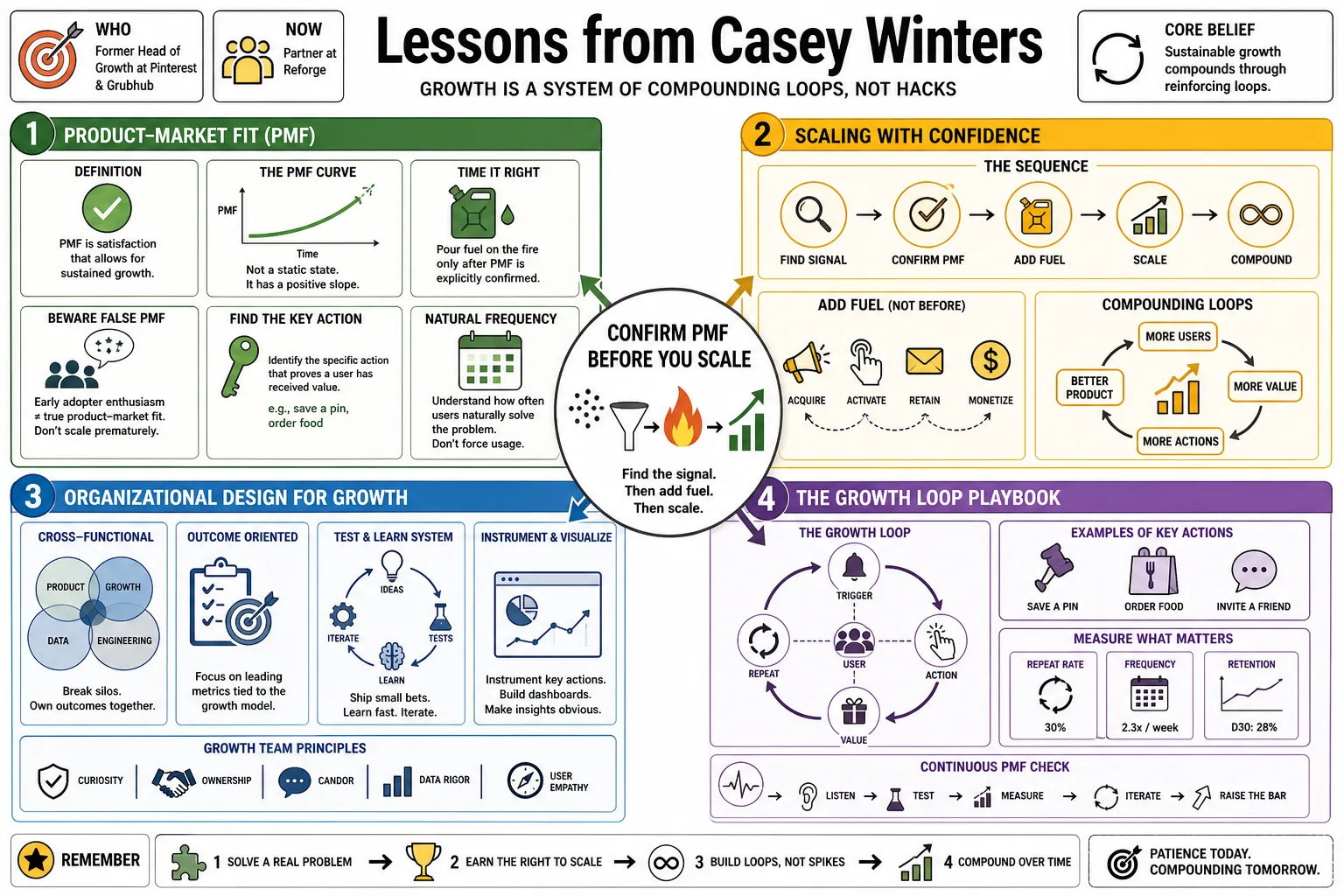
Lessons from Casey Winters
Casey Winters led growth work at Grubhub and Pinterest and later served as Eventbrite’s Chief Product Officer. His writing and interviews examine product-market fit, retention, growth systems, marketplaces, and product leadership. Casey’s PMF Guide ↗
Part 1: Product-Market Fit
- On Defining Product-Market Fit: Winters defines product-market fit as satisfaction sufficient to support sustained growth. — Casey’s PMF Guide ↗.
- On the Rising PMF Bar: Customer expectations continue to rise, so products must keep improving to remain above the product-market-fit threshold. — Casey’s PMF Guide ↗.
- On Timing Growth Investment: Product teams should invest heavily in connecting people to value only after confirming that the product delivers value. — Casey’s PMF Guide ↗.
- On Expanding Beyond Early Adopters: Early adopters tolerate more flaws; reaching broader customers usually requires better supply and a stronger product experience. — First Round Marketplace Interview ↗.
- On Identifying the Key Action: Measure the action that best represents delivered value, such as saving content at Pinterest or ordering food at Grubhub. — Casey’s PMF Guide ↗.
- On Natural Frequency: Evaluate retention at the frequency with which customers naturally solve the problem rather than imposing an arbitrary cadence. — Casey’s PMF Guide ↗.
- On Market Constraints: Marketplace design must account for supplier variety, customer frequency, order value, and take rate because those constraints shape whether the market can support a large business. — First Round Marketplace Interview ↗.
- On Extending Product-Market Fit: Broader customer segments are harder to acquire and retain, so expansion often depends on improving the product or supply rather than replaying the early-adopter motion unchanged. — First Round Marketplace Interview ↗.
- On Retention and Growth Together: A flattening retention curve is essential, but Winters also requires healthy new-customer growth to establish product-market fit. — Casey’s PMF Guide ↗.
Part 2: Growth Loops vs. Funnels
- On Acquisition Loops: Sustainable growth comes from retained customers generating word of mouth, invitations, content, or enough revenue to fund healthy paid acquisition. — Casey’s PMF Guide ↗.
- On Retained Users Driving Acquisition: Retained users can attract new customers by talking about the product, inviting others, or creating shareable content. — Casey’s PMF Guide ↗.
- On Scaling the Acquisition System: A sustainable loop must keep enlarging new-customer cohorts while the retained cohort remains stable. — Casey’s PMF Guide ↗.
- On Pinterest’s Content Loop: Pinterest’s user-added content created an SEO acquisition surface that connected searchers with relevant ideas. — Reforge Interview ↗.
- On Reinvestment Loops: A paid acquisition loop is healthy only when retained customers generate enough value to fund acquisition within a reasonable payback period. — Casey’s PMF Guide ↗.
- On Hacks versus Sustainable Growth: Short-lived tactics matter only when they help the company sequence toward a repeatable acquisition system. — Casey’s PMF Guide ↗.
- On Cohort Economics: Combine retained usage, transaction frequency, and revenue per transaction to estimate customer value, then compare it with acquisition cost and payback. — PMF Requires Arbitrage ↗.
- On Sequencing toward Sustainability: Use temporary tactics only when they unlock acquisition loops capable of supporting sustained growth. — Casey’s PMF Guide ↗.
Part 3: SEO and Content Strategy
- On Context-Specific SEO: Winters argues that companies should derive SEO strategy from their own product, mission, and value mechanics rather than copying generic advice. — Reforge Interview ↗.
- On Treating SEO as Product Work: Pinterest built an internal SEO experimentation framework and used product tests to improve both search traffic and signup conversion. — Reforge Interview ↗.
- On Supply Data as Acquisition: Marketplaces can turn supplier data—such as restaurant menus—into search pages that attract demand. — First Round Marketplace Interview ↗.
- On Crawlable Inventory: SEO can scale when valuable inventory is exposed through pages that search engines can crawl and users can understand. — A Primer on Startup SEO ↗.
- On Matching Search Intent: Useful SEO pages connect specific searches with the inventory or solution most relevant to that intent. — A Primer on Startup SEO ↗.
- On Programmatic Supply Pages: Grubhub used structured restaurant and menu data to create search surfaces that attracted local demand. — First Round Marketplace Interview ↗.
- On Traffic with Product Intent: The objective is not traffic alone but attracting people whose search maps to value the product can deliver. — A Primer on Startup SEO ↗.
- On Discovery rather than Social Connection: Pinterest measured value around people discovering and saving useful ideas, not around copying a conventional social-network model. — Reforge Interview ↗.
- On Conversion after Discovery: Pinterest allowed visitors to experience relevant content, then tested where a signup prompt could improve conversion without obscuring the initial value. — Reforge Interview ↗.
- On Scalable Content Systems: Products with large inventories can build repeatable search acquisition from structured or user-created content rather than relying only on editorial publishing. — A Primer on Startup SEO ↗.
Part 4: Organizational Design and Structure
- On Structure Following Expertise: Decide where responsibility belongs by asking where the expertise sits and what arrangement enables the best execution; both can change over time. — Centralization vs. Decentralization ↗.
- On Decentralizing Early Market Work: New local markets often need an empowered local owner to learn the market and brute-force initial liquidity. — Centralization vs. Decentralization ↗.
- On Centralizing a Proven Playbook: Once the company understands a repeatable market playbook, specialist teams at headquarters can often scale it more efficiently. — Centralization vs. Decentralization ↗.
- On Cross-Functional Growth Teams: Winters describes growth as cross-functional work that needs product, engineering, design, analytics, and marketing participation around shared outcomes. — Building Cross-Functional Teams ↗.
- On the ZIRP Product Manager: Winters warns against product managers who substitute abundant resources and borrowed frameworks for judgment about the actual problem. — Thinking Beyond Frameworks ↗.
- On Avoiding Functional Silos: Growth work suffers when participating functions optimize separately instead of working from shared goals and a common model. — Building Cross-Functional Teams ↗.
- On Resourcing Growth as Product Work: A growth team needs the engineering and product capacity to change the customer experience, not merely a reporting-line designation. — What Growth Teams Are For ↗.
- On Allocating around Constraints: Resource the part of the growth model that currently limits the system instead of spreading effort evenly across unrelated areas. — What Growth Teams Are For ↗.
Part 5: Career Development and Leadership
- On Perceived Simplicity: Advanced capabilities can remain discoverable while the default experience stays simple for people who do not need them. — How to Sell Your Ideas ↗.
- On Connecting Ideas to Strategy: When presenting upward, begin with the part of company strategy the proposal advances and adapt the story to each executive’s concerns. — How to Sell Your Ideas ↗.
- On De-Risking Important Meetings: Socialize and pressure-test a proposal before the decision meeting so predictable executive concerns are addressed in advance. — How to Sell Your Ideas ↗.
- On Thinking Beyond Frameworks: Frameworks are tools, not substitutes for understanding the particular problem, uncertainty, and business context. — Thinking Beyond Frameworks ↗.
- On Balancing Intuition and Expertise: Product decisions require judgment about when founder intuition, team expertise, customer evidence, or experimentation should carry more weight. — Thinking Beyond Frameworks ↗.
- On Interviewing for Real Decisions: Winters favors interview questions that reveal how candidates reason and make decisions over rehearsed answers about standard frameworks. — Thinking Beyond Frameworks ↗.
- On Communicating Upward: Product leaders should explain how their work connects to company strategy and surface important risks rather than merely reporting roadmap execution. — How to Sell Your Ideas ↗.
Part 6: Marketplaces and Supply Strategy
- On Linking Supply and Demand: A marketplace must build both sides together: scalable supply makes demand acquisition possible, while demand gives suppliers a reason to stay. — First Round Marketplace Interview ↗.
- On Bootstrapping Supply: Early marketplaces often make supply easy and low-risk to join, then use the resulting selection or data to attract demand. — First Round Marketplace Interview ↗.
- On Geographic Expansion: Grubhub moved from three cities to hundreds by combining local supply work with demand playbooks that could be run centrally once liquidity existed. — Centralization vs. Decentralization ↗.
- On Marketplace Selection Strategy: Marketplace value changes as it evolves from basic aggregation toward stronger selection, quality, and differentiated supply. — Three Stages of Online Marketplaces ↗.
- On Local Liquidity: A local marketplace must first create enough supply and demand in each market; company-wide totals can conceal markets that do not work. — Centralization vs. Decentralization ↗.
- On Supply Quality after Liquidity: As customers become more demanding, better and more reliable supply can improve retention more than additional software features. — First Round Marketplace Interview ↗.
- On Network Effects: A network effect exists when growth on one side improves value for participants on another side or strengthens the product’s utility. — Thinking Beyond Frameworks ↗.
- On Sequencing SaaS and Marketplace Value: Useful software can attract and retain suppliers before a marketplace has enough demand, creating a base from which the marketplace can grow. — SaaS to Marketplace ↗.
Part 7: Retention and User Engagement
- On Removing Distracting Friction: Onboarding should remove steps and features that distract new users from reaching the core product value. — Why Onboarding Is Crucial ↗.
- On Reaching Value Early: Ask only for the minimum information needed to deliver a valuable first experience, while preserving steps necessary to make that experience work. — Why Onboarding Is Crucial ↗.
- On Building the Habit: Define the key action and frequency that indicate habitual value, then design onboarding to help users reach that pattern. — Why Onboarding Is Crucial ↗.
- On Activation Milestones: Use cohort analysis to identify the action and time window associated with continued use, such as a second Grubhub order within 30 days. — Why Onboarding Is Crucial ↗.
- On Studying Churn and Retention Together: Combine interviews with people who left, observation of onboarding, and analysis of behaviors correlated with continued use. — 500 Global Q&A ↗.
- On Feature Complexity: Features built for experienced users can obscure the basics for newcomers, so delay advanced concepts until the core value is understood. — Why Onboarding Is Crucial ↗.
- On Fixing Core Value before Tactics: When users arrive and leave, the central growth problem is often onboarding and product value rather than a shortage of acquisition tactics. — Why Onboarding Is Crucial ↗.
- On Useful Onboarding Friction: An extra step can improve activation when users understand why it is required and it materially improves the value delivered later. — Why Onboarding Is Crucial ↗.
Part 8: Strategy and Scaling
- On Explicit Payback Periods: Set a payback period based on how far future customer behavior can be predicted reliably; Winters suggests starting short and extending as the business stabilizes. — PMF Requires Arbitrage ↗.
- On Strategy beyond Tactics: Growth tactics are useful only when they help build a sustainable system that expands acquisition cohorts while retention holds. — Casey’s PMF Guide ↗.
- On Distinct Growth Models for Second Products: A second product needs its own assessment of market, channel, business model, and strategic fit rather than an automatic copy of the first product’s playbook. — When and How to Build Second Products ↗.
- On Testing Best Practices against Context: Use research and frameworks to reduce uncertainty, but keep shipping and learning instead of treating conventional process as universally correct. — Thinking Beyond Frameworks ↗.
- On Unit Economics before Scale: Product-market fit requires acquiring customers within a payback period supported by retained usage and revenue; otherwise the product or economics need improvement. — PMF Requires Arbitrage ↗.
- On Aligning Pricing with Value: Choose pricing and packaging that track the value customers receive rather than a convenient internal metric disconnected from that value. — Align Revenue to Value ↗.
- On Changing the Playbook with Scale: The systems appropriate to finding traction differ from those needed to scale, so structure and operating practices must evolve with the company’s stage. — Scaling Up ↗.