Cass Sunstein is one of the most widely cited legal scholars of all time and among the most prolific writers working today. — Cass Sunstein on Liberalism and Rights in the Age of AI (Ep. 262) | Conversations with Tyler.
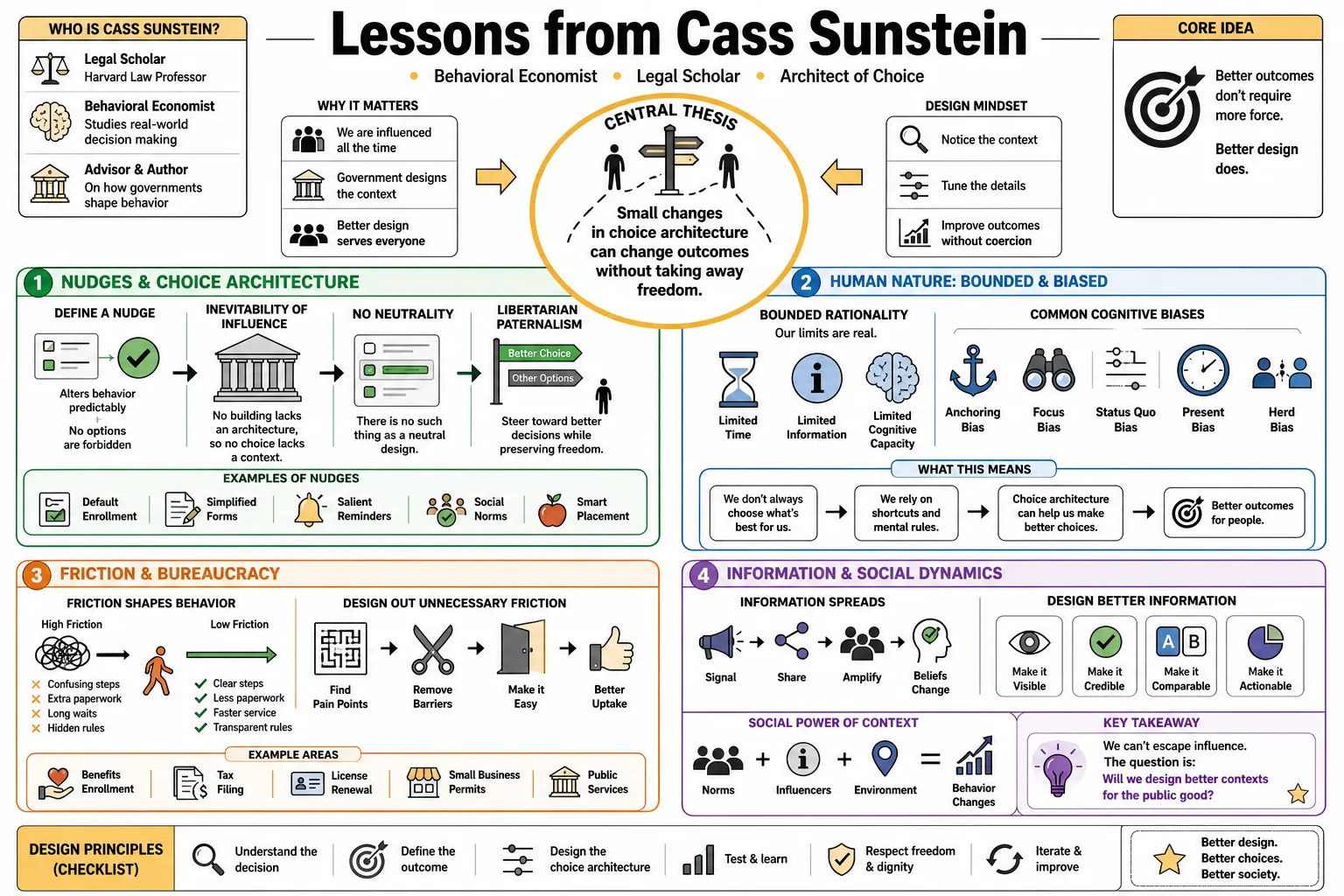
Part 1: Nudges and Choice Architecture
- On Choice Architecture Being Unavoidable: Cass Sunstein: "Choice architecture – that is, the architecture behind which you make decisions – is both exceedingly important and it’s not avoidable." — The World According to Cass Sunstein (Third Way transcript).
- On a Nudge Being Like a GPS: Cass Sunstein: "When I say GPS-like things, I mean a GPS device, it’s a nudge, it helps you get you where you want to go, it gives you the best route." — Transcript: Cass Sunstein (Masters in Business, The Big Picture).
- On the Architecture of a Government Letter: Cass Sunstein: "If there’s a letter from the government that encourages people to do or not to do things, there’s an architecture in the letter, and the effectiveness of the letter will depend on the architecture – that is, how intelligible it is, whether it’s using losses or gains, whether there are red colors or green colors." — The World According to Cass Sunstein (Third Way transcript).
- On Coercion and Mandates: Cass Sunstein: "The thought of some of our friends on the left is that we need much more in the way of coercion and mandates, and of course they have a role." — Transcript: Cass Sunstein (Masters in Business, The Big Picture).
- On Unrealistic Optimism: Cass Sunstein: "The group that is most egregiously subject to unrealistic optimism is college professors: 94 percent have been found to believe they’re better than the average college professor." — The World According to Cass Sunstein (Third Way transcript).
- On Incentives and Attention: Cass Sunstein: "Incentives may not always matter much because the people may not pay attention to them." — The World According to Cass Sunstein (Third Way transcript).
- On Changing the Default: Cass Sunstein: "Often a little nudge changing the default rule, giving some people some information, will have a very significant effect on behavior, more so than tax incentives or other economic incentives." — Cass Sunstein on Judicial Minimalism, the Supreme Court, and Star Wars (Ep. 10 - Live at Mason) | Conversations with Tyler.
- On Signing Forms at the Beginning: Cass Sunstein: "If people sign forms at the beginning – please remember this – the incidence of fraud is much lower than if people sign forms at the end." — The World According to Cass Sunstein (Third Way transcript).
- On Manipulation Without Falsehood: Cass Sunstein: "If you have no false statement, but you induce people not to use their reflective capacities, you trick them into thinking that climate change isn’t real — that would be an act of manipulation." — Cass Sunstein on Liberalism and Rights in the Age of AI (Ep. 262) | Conversations with Tyler.
- On Informative Fuel Labels: Cass Sunstein: "If you give me a fuel economy label that tells me something about how much money I’m going to pay this year — and tell me, by the way, something about the polluting content of the car — I’m for that.”" — Cass Sunstein on Judicial Minimalism, the Supreme Court, and Star Wars (Ep. 10 - Live at Mason) | Conversations with Tyler.
Part 2: The Problem of Sludge
- On Sludge Without Behavioral Economics: Cass Sunstein: "Now, you can think of sludge as a problem even if you have no interest in or enthusiasm for behavioral economics." — Episode 59: Cass Sunstein on Nudges, Behavioral Economics, Law, and Liberalism (Capitalism and Freedom).
- On Direct Certification for School Meals: Cass Sunstein: "In the United States, there's a program called Direct Certification for School Meals where if you're poor and the school knows you're poor and you're a kid, you're directly certified, meaning you don't have to apply." — Episode 59: Cass Sunstein on Nudges, Behavioral Economics, Law, and Liberalism (Capitalism and Freedom).
- On Extricating Yourself From Monthly Charges: Cass Sunstein: "If you enter into a transaction, let’s say, and you were told, but it’s not easy to see, that you are forming a long-term economic relationship in which you’re giving money every month, that should be something that you should be able to extricate yourself from." — Cass Sunstein on Liberalism and Rights in the Age of AI (Ep. 262) | Conversations with Tyler.
- On Starting With Egregious Sludge: Cass Sunstein: "I think we should start with egregious cases where people are losing money or time without getting adequate clarity on that’s what’s happening to them." — Cass Sunstein on Liberalism and Rights in the Age of AI (Ep. 262) | Conversations with Tyler.
- On Automatic Enrollment: Cass Sunstein: "People have pretty well converged on automatic enrollment on the grounds that it helps most people subject to opt out." — Episode 026: Tuning Out the Noise with Dr. Cass Sunstein (Alliance for Decision Education).
Part 3: Noise and Human Judgment
- On Aggregating the Views of Many: Cass Sunstein: "Another thing you can do in the nature of decision hygiene is just to make sure you aggregate the views of lots of people, not just rely on the views of one or two." — Episode 026: Tuning Out the Noise with Dr. Cass Sunstein (Alliance for Decision Education).
Part 4: The Spread of Falsehoods
- On Desirability Bias: Cass Sunstein: "We have recent data suggesting there’s a third thing, which is I think cooler than truth bias or confirmation bias, its name is desirability bias." — Transcript: Cass Sunstein (Masters in Business, The Big Picture).
- On Confirmation Bias: Cass Sunstein: "The other thing is confirmation bias, where if we’re told things that fit with what we think, we tend to like that, and we tend to believe it because it fits with what we think." — Transcript: Cass Sunstein (Masters in Business, The Big Picture).
- On Unspoken Beliefs and Desires: Cass Sunstein: "One thing is that people have in their heads beliefs and desires that they don’t tell anyone about." — Transcript: Cass Sunstein (Masters in Business, The Big Picture).
- On Permission Slips: Cass Sunstein: "Sometimes what happens, and this is the first moving part, is that people are given a permission slip." — Transcript: Cass Sunstein (Masters in Business, The Big Picture).
- On Echo Chambers: Cass Sunstein: "The most simple is if you are talking to people who think like you do, then you are going to hear a lot of arguments supporting your thought." — Cass Sunstein on #Republic - Econlib.
- On Telling Truth From Falsehood: Cass Sunstein: "Third, citizens should be in a position to distinguish between truth and falsehood – and to know when democratic processes are being manipulated." — Is Social Media Good or Bad for Democracy? (essay by Cass R. Sunstein, Facebook Newsroom).
Part 5: Free Speech and the Digital Filter Bubble
- On Norms That Broaden Horizons: Cass Sunstein: "What would be good, probably, is if norms, at least with respect to politics and maybe with respect to a range of things, were pressing people increasingly in the direction of broadening horizons." — Cass Sunstein on #Republic - Econlib.
- On Materials People Would Not Have Chosen: Cass Sunstein: "First, citizens should be exposed to materials that they would not have chosen in advance." — Is Social Media Good or Bad for Democracy? (essay by Cass R. Sunstein, Facebook Newsroom).
- On Information Cocoons: Cass Sunstein: "If you live in an information cocoon, you will believe many things that are false, and you will fail to learn countless things that are true." — Is Social Media Good or Bad for Democracy? (essay by Cass R. Sunstein, Facebook Newsroom).
- On Like-Minded Deliberation Going Extreme: Cass Sunstein: "What we're discussing now is a causal factor, which is: if you get like-minded people together, they typically end up in a more extreme point in line with their pre-deliberation tendency." — Cass Sunstein on #Republic - Econlib.
- On First Amendment Rights: Cass Sunstein: "People have First Amendment rights particularly in the face of viewpoint-based or content-based restrictions." — Cass Sunstein on Liberalism and Rights in the Age of AI (Ep. 262) | Conversations with Tyler.
- On Common Experiences: Cass Sunstein: "Second, many or most citizens should have a wide range of common experiences." — Is Social Media Good or Bad for Democracy? (essay by Cass R. Sunstein, Facebook Newsroom).
- On Privateness and Social Media: Cass Sunstein: "I guess I think with respect to social media the privateness is decisive, as against government intervention of the sort that we're now discussing." — Cass Sunstein on #Republic - Econlib.
- On Shared Experiences: Cass Sunstein: "Without shared experiences, a heterogeneous society will have a much more difficult time in addressing social problems." — Is Social Media Good or Bad for Democracy? (essay by Cass R. Sunstein, Facebook Newsroom).
- On Seeing Each Other as Enemies: Cass Sunstein: "People might see each other as strangers, foreigners, possibly even enemies." — Is Social Media Good or Bad for Democracy? (essay by Cass R. Sunstein, Facebook Newsroom).
Part 6: Groupthink and Deliberation
- On Deliberation Polarizing Both Sides: Cass Sunstein: "We have data on that with respect to people deliberating about climate change and affirmative action: both on the Left and the Right they end up more extreme." — Cass Sunstein on #Republic - Econlib.
- On Like-Minded Groups: Cass Sunstein: "What we know is if you get groups of like-minded people together, they tend to end up thinking a more extreme version of what they thought before they started to talk." — Episode 026: Tuning Out the Noise with Dr. Cass Sunstein (Alliance for Decision Education).
- On a Steep Learning Curve in Government: Cass Sunstein: "Having studied administrative law for more than two decades, I was amazed by how steep my own learning curve was in an area that I thought I knew well." — Cass Sunstein on Judicial Minimalism, the Supreme Court, and Star Wars (Ep. 10 - Live at Mason) | Conversations with Tyler.
- On Public-Regarding Justifications: Cass Sunstein: "The short answer to the legal question is, I do think our constitutional framework, rightly understood, requires a public-regarding justification for all legislative acts." — Cass Sunstein on Judicial Minimalism, the Supreme Court, and Star Wars (Ep. 10 - Live at Mason) | Conversations with Tyler.
- On Incompletely Theorized Agreements: Cass Sunstein: "I have enthusiasm for incompletely theorized agreements where people can say, “I like free speech because I’m a Kantian,” or “I like it because it’s the best way of discovering truth,” or “I like it because I’m a utilitarian and it’s going to maximize utility.” Lots of stools for freedom of speech." — Cass Sunstein on Liberalism and Rights in the Age of AI (Ep. 262) | Conversations with Tyler.
Part 7: Cost-Benefit Analysis and Regulation
- On Cost-Benefit Analysis Beyond Behavioral Economics: Cass Sunstein: "The idea of cost benefit analysis outruns behavioral economics, was pioneered by people who were not particularly keen necessarily on behavioral economics or didn't know what it was." — Episode 59: Cass Sunstein on Nudges, Behavioral Economics, Law, and Liberalism (Capitalism and Freedom).
- On an Arbitrary Social Cost of Carbon: Cass Sunstein: "If you say we're going to deem the social cost of carbon to be zero because we think climate change is not real, that's almost certainly arbitrary." — Episode 59: Cass Sunstein on Nudges, Behavioral Economics, Law, and Liberalism (Capitalism and Freedom).
- On Not Scolding: Cass Sunstein: "The risk is that you write about animals and people feel scolded, and I hate that." — Cass Sunstein on Liberalism and Rights in the Age of AI (Ep. 262) | Conversations with Tyler.
- On Universities and Real Influence: Cass Sunstein: "One of the lessons of I guess my experience in Washington was: Universities are important, but they are less important, in fact much less important, than the universities think." — Cass Sunstein on #Republic - Econlib.
- On Judicial Review and Self-Government: Cass Sunstein: "If the judges are exercising judicial review to make self-government better by protecting, let’s say, freedom of speech in the franchise, then hooray for judicial review on democratic grounds." — Cass Sunstein on Liberalism and Rights in the Age of AI (Ep. 262) | Conversations with Tyler.
- On Laws That Change Too Quickly: Cass Sunstein: "If the law is changing so rapidly that people can't plan, that's inconsistent with the rule of law." — Episode 59: Cass Sunstein on Nudges, Behavioral Economics, Law, and Liberalism (Capitalism and Freedom).
- On the Grounding of the Administrative State: Cass Sunstein: "We have to figure out what the grounding is for the administrative state doing one thing or another." — Episode 59: Cass Sunstein on Nudges, Behavioral Economics, Law, and Liberalism (Capitalism and Freedom).
Part 8: Star Wars, Culture, and the Human Experience
- On Darth Vader Exercising Freedom: Cass Sunstein: "Darth Vader, who’s the worst person in the universe, maybe the second worst, at the crucial moment exercises his freedom because he believes that saving his son is more important than fidelity to the emperor, and he sacrifices everything." — Transcript: Cass Sunstein (Masters in Business, The Big Picture).
- On Letting People Choose Their Own Path: Cass Sunstein: "Either for welfarist reasons or for reasons of respect for dignity …whichever one is our foundation, to let people choose their own path is — that’s the right idea." — Cass Sunstein on Judicial Minimalism, the Supreme Court, and Star Wars (Ep. 10 - Live at Mason) | Conversations with Tyler.
- On the American Revolution and Star Wars: Cass Sunstein: "My own view is that the best analogy to Star Wars is the American Revolution or the fall of communism, meaning there’s an authoritarian regime whose horribleness you don’t see constantly on screen, but you get glimpses of it." — Cass Sunstein on Judicial Minimalism, the Supreme Court, and Star Wars (Ep. 10 - Live at Mason) | Conversations with Tyler.
- On Good and Bad in Everyone: Cass Sunstein: "What George Lucas got at was the fact that there is good, even in the worst person in the universe, Darth Vader; and there’s bad, even in the most heroic and powerful Jedi of all, Luke Skywalker." — The World According to Cass Sunstein (Third Way transcript).
- On Tuning Out Politics: Cass Sunstein: "You want to focus on your family or your job or literature or poems, your reading, and not think about what's happening in D.C. or your local statehouse, that's fantastic." — Cass Sunstein on #Republic - Econlib.
- On Something Catching a Wave: Cass Sunstein: "The story of John Keats and Jane Austen is across generations, I think the story of the Beatles and Star Wars within a compressed period where something catches a wave." — Transcript: Cass Sunstein (Masters in Business, The Big Picture).
- On Pedal-to-the-Metal Progress: Cass Sunstein: "If I have a week or two weeks where I haven’t made a little progress on something that is potentially an academic article or a book, I feel, “Pedal-to-the-metal time." — Cass Sunstein on Judicial Minimalism, the Supreme Court, and Star Wars (Ep. 10 - Live at Mason) | Conversations with Tyler.