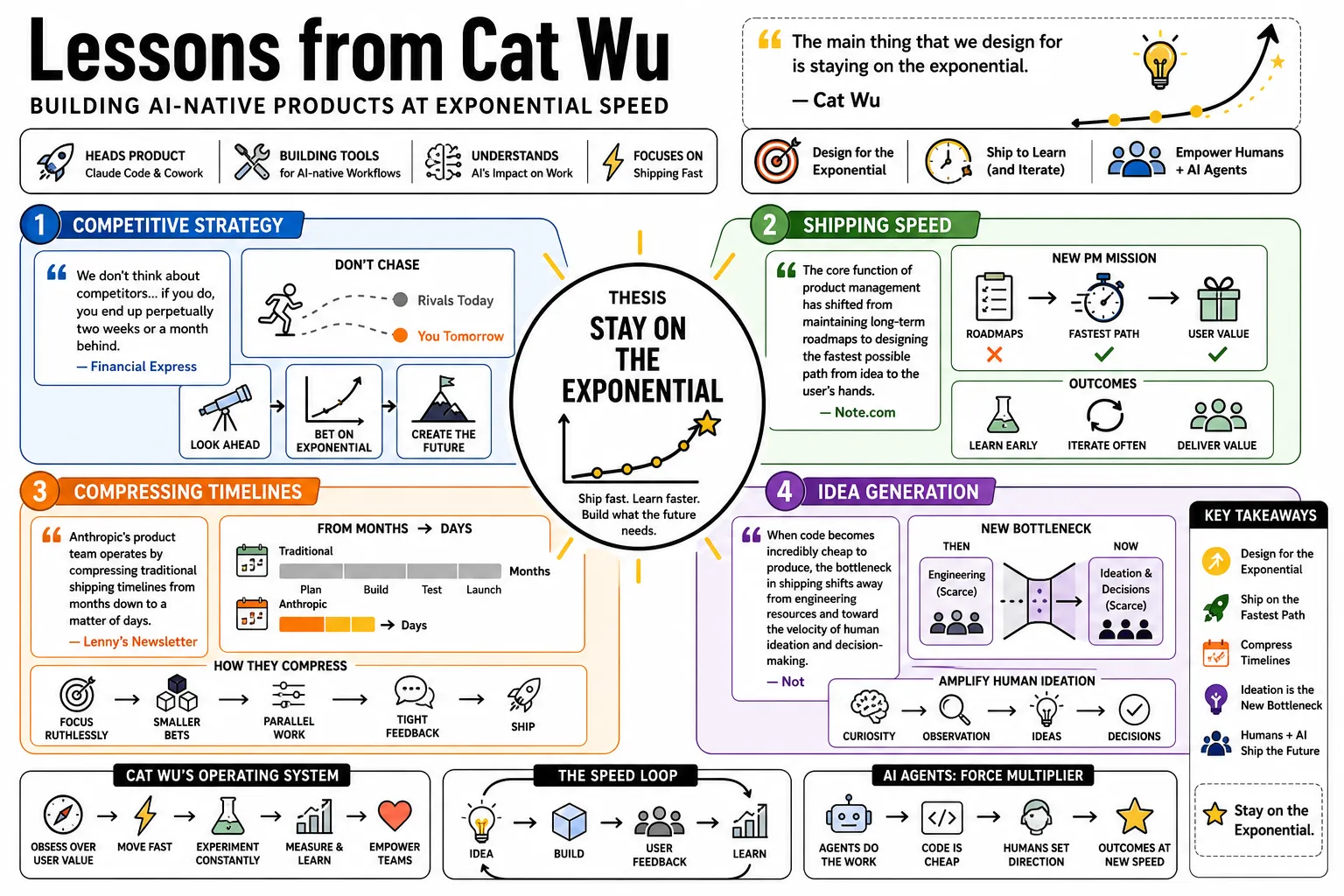
Lessons from Cat Wu
Cat Wu is the product manager for Claude Code at Anthropic, working with lead engineer Boris Cherny. — Claude Code: Anthropic's Agent in Your Terminal - Latent Space.
Part 1: Product Velocity & Shipping
- On Building Things You Expect to Throw Away: Cat Wu: "I think we build most things that we think would improve Claude Code’s capabilities, even if that means we’ll have to get rid of it in three months." — Transcript: 'How to Use Claude Code Like the People Who Built It'.
- On Pay-As-You-Go Lowering the Barrier: Cat Wu: "I think pay-as-you-go has made it really easy for people to start experiencing the product because there's no upfront commitment." — Claude Code: Anthropic's Agent in Your Terminal.
- On Dual-Use Tools: Cat Wu: "I think when it comes to whether the tool should be dual use or not, I think making them dual use actually makes the tools a lot easier to understand." — Transcript: 'How to Use Claude Code Like the People Who Built It'.
- On Designing for the Most Powerful Model: Cat Wu: "Our North Star is making sure that it works incredibly well with the absolutely most powerful model we have, which is Sonnet 4.5 right now." — Transcript: 'How to Use Claude Code Like the People Who Built It'.
- On Internal Adoption: Cat Wu: "Internally over I think 70 or 80 percent of ants—technical Anthropic employees—use Claude Code every day." — Transcript: 'How to Use Claude Code Like the People Who Built It'.
- On Using Claude Code for Market Research: Cat Wu: "I use it for a lot of just market research because at the core it’s an agent that can just go on for an infinite amount of time, as long as you give it a concrete task, and it’s able to fetch the right underlying data." — Transcript: 'How to Use Claude Code Like the People Who Built It'.
- On Why Models Are Good at Code: Cat Wu: "I think there's a lot of answers to why the model itself is good at code, but I think like one high level thing would be so much of the world is run via software and there's like immense demand for great software engineers." — Claude Code: Anthropic's Agent in Your Terminal.
- On Dogfooding New Features: Cat Wu: "Every time we are thinking about a new feature, we push it out to people internally and we get so much feedback." — Transcript: 'How to Use Claude Code Like the People Who Built It'.
- On Holding Yourself to a High Standard for Merged Code: Cat Wu: "I think in general, it's still very much up to the individual developer to hold themselves up to a very high standard for the quality of code that they merge." — Claude Code: Anthropic's Agent in Your Terminal.
- On Giving the Model Context in Its Purest Form: Cat Wu: "Ultimately we just want to make sure that the context that's given to the model is in like the purest form and that the harness doesn't intervene with the user's intent." — Claude Code: Anthropic's Agent in Your Terminal.
Part 2: Artificial General Intelligence (AGI) & The Future
- On Resuming Across Sessions: Cat Wu: "I think like our best advice now for people who want to resume across sessions is to tell Claude to, hey, like, write down the state of this session into this text doc." — Claude Code: Anthropic's Agent in Your Terminal.
- On Moving Toward Proactivity: Cat Wu: "I feel like if you trace this curve, eventually you go to even higher levels of abstraction, like even more complicated tasks, and then hopefully the next step after that is a lot more proactivity, right?" — Transcript: 'How to Use Claude Code Like the People Who Built It'.
- On Delegating Menial Work: Cat Wu: "I remember when we first came out with Claude Code and Sonnet 3.7, you would give it a task and you would have to closely monitor every single little thing it tried to do." — Fireside chat with Cat Wu and Thariq Shihipar (AI Engineer World's Fair), edited transcript.
- On Humans Out of the Loop: Cat Wu: "In general, we are trying to move to a world where humans don’t need to be in the loop." — Fireside chat with Cat Wu and Thariq Shihipar (AI Engineer World's Fair), edited transcript.
- On Models as Design Partners: Cat Wu: "I’m very excited for future models to hopefully be interaction design thought partners." — Fireside chat with Cat Wu and Thariq Shihipar (AI Engineer World's Fair), edited transcript.
- On Staying on the Exponential: Cat Wu: "The main thing that we design for is staying on the exponential, so I think, across our team, we instill in everyone the lesson that AI will just continue to get better." — Anthropic's Cat Wu says that, in the future, AI will anticipate your needs before you know what they are (quoted remarks).
- On Ignoring Competitors: Cat Wu: "I think if you do think about competitors, you end up being, like, perpetually two weeks, or like, a month behind how fast you can execute." — Anthropic's Cat Wu says that, in the future, AI will anticipate your needs before you know what they are (quoted remarks).
- On Automations Set Up for You: Cat Wu: "I think the next step is that Claude understands what you work on, and just sets up some of these automations for you." — Anthropic's Cat Wu says that, in the future, AI will anticipate your needs before you know what they are (quoted remarks).
Part 3: The Evolving Role of Product Managers
- On Blended PM Backgrounds: Cat Wu: "All the PMs on our team are this mix of engineer, designer, PM — most of them actually used to be full-time engineers." — Fireside chat with Cat Wu and Thariq Shihipar (AI Engineer World's Fair), edited transcript.
- On the Old PM Process: Cat Wu: "One of the biggest shifts we’re seeing in the eng skill set: two years ago it was pretty typical for a product manager to go talk to a bunch of customers, align over the course of six months with cross-functional teams on some PRD, and write a thorough spec on exactly how we’ll implement this before the first line of code gets written." — Fireside chat with Cat Wu and Thariq Shihipar (AI Engineer World's Fair), edited transcript.
- On Business Sense for Engineers: Cat Wu: "For a lot of engineers, the push I would give to folks in the room is to develop more of your business sense and product sense on what it is we should build, because the timeline between having an idea and building it is so much shorter — it’s down from six to twelve months to maybe even a week." — Fireside chat with Cat Wu and Thariq Shihipar (AI Engineer World's Fair), edited transcript.
- On the Gap From Idea to Customer: Cat Wu: "For us it’s very much understanding what the gap is right now between a great idea and getting something to our customers, and how do we automate it as much as possible." — Fireside chat with Cat Wu and Thariq Shihipar (AI Engineer World's Fair), edited transcript.
- On Inspiring Engineers With Prototypes: Cat Wu: "If we have an idea and we didn’t inspire any engineer to go build it, then we should just build it, put it into a notebook, and inspire people to take it to production." — Fireside chat with Cat Wu and Thariq Shihipar (AI Engineer World's Fair), edited transcript.
- On Product Taste: Cat Wu: "I think product taste is still a very rare skill to have and we’ll pretty much hire anyone who we feel has demonstrated this strongly." — Cat Wu on hiring engineers with product taste (interview excerpts).
- On Team Evals: Cat Wu: "We have evals on our team, and we run code review across every repo within Anthropic, so we have evals for that." — Fireside chat with Cat Wu and Thariq Shihipar (AI Engineer World's Fair), edited transcript.
Part 4: Building AI-Native Workflows
- On Working From Your Phone: Cat Wu: "I never have this need, because I just kick off the task directly on mobile and it runs in a cloud session without using my local environment — I think because I’m doing very easy coding tasks." — Fireside chat with Cat Wu and Thariq Shihipar (AI Engineer World's Fair), edited transcript.
- On Splitting Work Across Tools: Cat Wu: "The way we see people split work between Claude Code and Claude Tag is: Claude Code is still the best place for your most complex tasks, when you’re interactively iterating with the agent." — Fireside chat with Cat Wu and Thariq Shihipar (AI Engineer World's Fair), edited transcript.
- On Shared Sessions: Cat Wu: "Maybe I say, “Hey, I think we should implement this new feature in Cowork,” and I’ll tag in Claude Tag to do a first pass at it." — Fireside chat with Cat Wu and Thariq Shihipar (AI Engineer World's Fair), edited transcript.
- On Plain-Language Memory: Cat Wu: "If you always want it to debug outages but you don’t want it to debug warnings, just tell it that in natural language in the channel and it’ll remember it for you and everyone else on your team." — Fireside chat with Cat Wu and Thariq Shihipar (AI Engineer World's Fair), edited transcript.
- On Public Channels: Cat Wu: "Claude Tag works best when you have it in a public channel, and when most of your channels are public." — Fireside chat with Cat Wu and Thariq Shihipar (AI Engineer World's Fair), edited transcript.
- On Social Norms for Shared Agents: Cat Wu: "We’re still trying to iron out what the social dynamics are for steering the same session, but we’ve found that people just observe how others use it and follow those social norms — it’s been pretty intuitive for us to integrate Claude Tag into our teams." — Fireside chat with Cat Wu and Thariq Shihipar (AI Engineer World's Fair), edited transcript.
- On AI for Team Logistics: Cat Wu: "I also plan our team offsites, and it’s good at finding venues that can fit all of us." — Fireside chat with Cat Wu and Thariq Shihipar (AI Engineer World's Fair), edited transcript.
- On Custom Apps: Cat Wu: "With existing apps I have to manually click through Mountain Project, but with this I just put in all of our preferences and it’s a custom app for us." — Fireside chat with Cat Wu and Thariq Shihipar (AI Engineer World's Fair), edited transcript.
Part 5: Team Culture & Alignment
- On Fixing Your Own Product: Cat Wu: "Whenever there’s something we want to be able to do in our products that we’re not able to, instead of finding a different solution we fix our product so it can support that case." — Fireside chat with Cat Wu and Thariq Shihipar (AI Engineer World's Fair), edited transcript.
- On Honest Early Feedback: Cat Wu: "Before we share our products with everyone in the world, we share them with everyone within Anthropic, and with some early customers who give us very honest feedback about it — the more brutal the better — and we iterate until people love it." — Fireside chat with Cat Wu and Thariq Shihipar (AI Engineer World's Fair), edited transcript.
- On Hiring for Product Taste: Cat Wu: "On our team, we’re pretty focused on hiring engineers with great product taste." — Cat Wu on hiring engineers with product taste (interview excerpts).
- On Merging Engineer and PM Roles: Cat Wu: "You can either hire a lot more engineers who have great product taste, or you can keep your engineering hiring the same and hire a lot more PMs to help guide some of their work." — Cat Wu on hiring engineers with product taste (interview excerpts).
- On Polish: Cat Wu: "I think this also levels up our polish, because if the feature isn’t polished, people will churn — and then we shouldn’t ship that feature." — Fireside chat with Cat Wu and Thariq Shihipar (AI Engineer World's Fair), edited transcript.
Part 6: Tools & the Developer Experience
- On Deterministic Tools: Cat Wu: "The reason we had a dedicated file edit tool was so that we could deterministically know that Claude was making a file change, so we could show people this nice UI." — Fireside chat with Cat Wu and Thariq Shihipar (AI Engineer World's Fair), edited transcript.
- On Not Constraining the Model: Cat Wu: "We didn’t want to constrain the model, or confuse it into thinking it should always do this." — Fireside chat with Cat Wu and Thariq Shihipar (AI Engineer World's Fair), edited transcript.
- On Verification Instructions: Cat Wu: "Everyone here wants Claude to verify its work, and we had some instructions in the prompt that said: if you make a front-end change, always verify." — Fireside chat with Cat Wu and Thariq Shihipar (AI Engineer World's Fair), edited transcript.
- On Customer-Built Evals: Cat Wu: "We’ve considered building eval tools, but I think the limiting factor actually tends to be that it takes a long time for customers to build really high-quality evals." — Fireside chat with Cat Wu and Thariq Shihipar (AI Engineer World's Fair), edited transcript.
Part 7: Practical AI Skills & Intuition
- On Misreadable Prompts: Cat Wu: "In general, whenever you give a prompt to the model, you should think about the ways in which it could be misinterpreted by a well-intentioned human, in order to better understand how the model might interpret it — and soften the prompt so that it’s actually 100% accurate, because you’re giving this prompt to the model 100% of the time." — Fireside chat with Cat Wu and Thariq Shihipar (AI Engineer World's Fair), edited transcript.
- On Being Specific: Cat Wu: "Of course, try your best to be specific about what you want, so Claude has all the context — but even when you’re not specific, we teach Claude to make good assumptions." — Fireside chat with Cat Wu and Thariq Shihipar (AI Engineer World's Fair), edited transcript.
Part 8: Managing Teams and Agents
- On Code Owners: Cat Wu: "For the most critical changes to the core of Claude Code, and the cores of other products, there is always a code owner and they do manually review all the changes." — Fireside chat with Cat Wu and Thariq Shihipar (AI Engineer World's Fair), edited transcript.
- On Phasing Out Human Review: Cat Wu: "In the beginning we had human review for everything, and then increasingly we would say, okay, for code changes that touch these files, code review is catching 100% of the issues there — so we actually don’t need a human manually reviewing those." — Fireside chat with Cat Wu and Thariq Shihipar (AI Engineer World's Fair), edited transcript.
- On Developer Control: Cat Wu: "We think it's really important to give developers the control to say, hey, these are like the allowed permissions." — Claude Code: Anthropic's Agent in Your Terminal.