Cate Hall is the CEO of Astera Institute, a private foundation that supports high-leverage science and technology projects, and a former lawyer and professional poker player. — Cate Hall | Big Think.
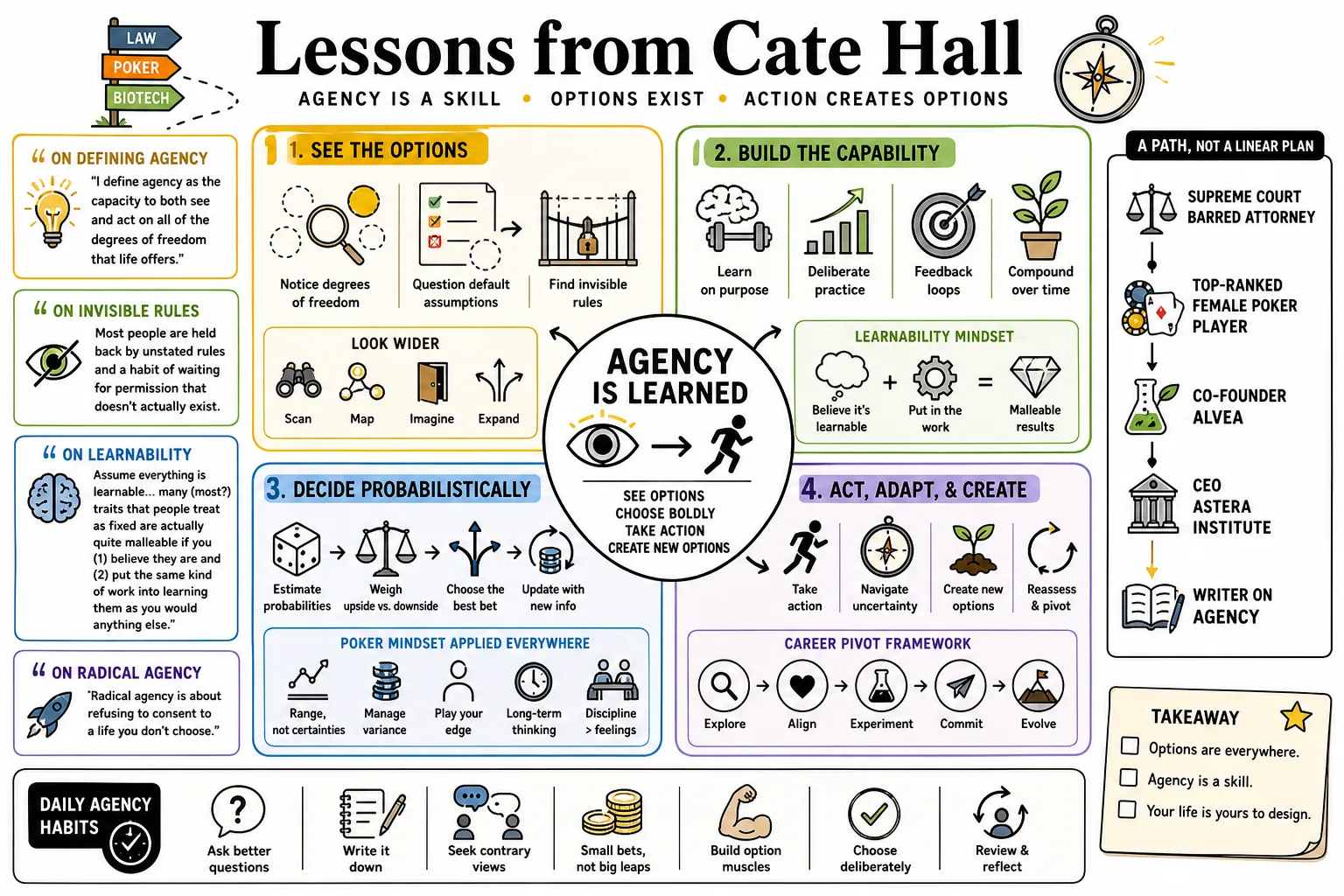
Part 1: The Nature of Agency
- On Defining Agency: cate-hall: "It was developing a sense of personal agency, which I think about as the capacity to both see and act on all of the degrees of freedom we actually have." — A Practical Guide to Taking Control of Your Life: Cate Hall (Transcript).
- On Quick Conclusions That Corrode Agency: cate-hall: "Just as in poker, or MMA, we are by default far too ready to draw conclusions from limited or skewed experiences, to concoct misleading rules that corrode our agency." — Until you get punched in the face.
- On Learnable Traits: cate-hall: "I think most traits that people treat as fixed are actually quite learnable if you both believe that they are and put the same kind of effort into learning them that you would anything else." — A Practical Guide to Taking Control of Your Life: Cate Hall (Transcript).
- On Doors Hidden Within You: cate-hall: "No matter how stuck you are, if you can learn to locate the doors hidden within you, you can unlock inconceivable kinds of freedom." — A Practical Guide to Taking Control of Your Life: Cate Hall (Transcript).
- On Mediocre Effort: cate-hall: "Putting in a mediocre effort at a given task is deeply irrational if our goal is success at that task." — Find a way.
- On Agency and Luck: cate-hall: "I don’t think agency is innate, but I do think most people learn it through sheer luck." — A Practical Guide to Taking Control of Your Life: Cate Hall (Transcript).
- On Higher-Agency Peers: cate-hall: "Definitely having the experience of having peers that are higher agency is undefeated as far as I'm concerned in developing people's personal agency." — Stacking the odds: Cate Hall on agency and outlier success.
- On Asking Stupid Questions: cate-hall: "I got comfortable asking better players stupid questions, and improved much faster because I could benefit from their experience." — Learn to love the Moat of Low Status.
- On Honesty With Others: cate-hall: "The freedom to be fully honest with other people is hard to overrate or even describe." — 50 things I know.
- On Your Brain's First Answer: cate-hall: "Refuse to accept your brain’s first-order response that you probably can’t achieve goal X because of restrictions Y and Z." — Find a way.
Part 2: Deconstructing the Default Path
- On Quitting Before Partner: cate-hall: "I quit corporate law shortly before I would have made partner, because I knew that once I did the money would be too hard to walk away from." — In praise of quitting.
- On Law and Low Agency: cate-hall: "You have something like law, which is where I was before poker, that definitely selects for low agency people." — Stacking the odds: Cate Hall on agency and outlier success.
- On Quitting Multiple Fields: cate-hall: "Success in multiple fields is only possible if you’re willing to quit multiple fields." — In praise of quitting.
- On Opportunities Others Missed: cate-hall: "If you think you see an opportunity others have missed, you should have a story for why they’re missing it, and you should ask around to stress-test that story." — The lies I used to tell myself.
- On the Blank Slate of Quitting: cate-hall: "When people think about quitting, it’s hard because they’re comparing the rich web of attachments they have now to some mostly blank slate, or, worse, the possibility of disaster." — In praise of quitting.
- On Authenticity Without Ruin: cate-hall: "You don’t need to ruin your life and then rebuild it in order to learn to be more authentic." — A Practical Guide to Taking Control of Your Life: Cate Hall (Transcript).
- On Embarrassment and Rules: cate-hall: "Remind yourself that embarrassment is simply the feeling of breaking the rules, and you want to break your previous rules." — Learn to love the Moat of Low Status.
- On Real Feedback: cate-hall: "I think that figuring out how to be comfortable getting real feedback from the world is like the highest leverage thing you can do." — Stacking the odds: Cate Hall on agency and outlier success.
Part 3: The Mechanics of Action and Friction
- On Starting a Blog: cate-hall: "In an imaginary world where God dropped me into the life of someone who didn’t have any professional connections, starting a blog is one of the first things I’d do." — How to increase your surface area for luck.
- On the Split in Burnout: cate-hall: "Part of the startling experience of burnout is a split in personality: The voice in your head can yell and yell about what’s supposed to be happening, while the body lies passive, without generating any propulsive energy whatsoever." — Burnout is breaking a sacred pact.
- On the Myth of Willpower: cate-hall: "The Myth of Willpower is the idea that virtue lies in exerting extreme effort to overcome obstacles, and that any success attained without effort is actually bad, bordering on immoral." — Fuck willpower.
- On Having Fewer Opinions: cate-hall: "If you’re unsure how to have better opinions, try just having fewer of them for a start." — 50 things I know.
- On Paradoxical Social Dynamics: cate-hall: "Many social dynamics are paradoxical — social acts that seem weak from the inside, when undertaken without apology, actually read as very strong." — 50 things I know.
- On Curiosity as the Fast Way: cate-hall: "Talking to people without an end in mind other than satisfying your own curiosity is the slow way that is the fast way." — How to increase your surface area for luck.
- On Ideas for Your Zip Code: cate-hall: "If you put a gun to their head and demanded they give you ten ideas for how to make their zip code or their country better, they would prove inventive." — Agency is for sociopaths.
- On Courage and Prosocial People: cate-hall: "If the good-hearted, prosocial people of the world took on 10 percent of the courage of ruthless antisocial powermaxxers, we would all be better off." — Agency is for sociopaths.
Part 4: Lessons from Professional Poker
- On Poker Getting Better: cate-hall: "Basically every poker pro today is better than every pro 20 years ago — and plenty of people in 2005 believed they were good at poker!" — How to instantly be better at things.
- On Rules From a Few Pots: cate-hall: "A central challenge in poker is that to become any good at all, you have to avoid hastily forming new rules based on lessons you think you’ve learned in a few high-stakes pots." — Until you get punched in the face.
- On Theoretical Learning: cate-hall: "In poker, it’s possible to improve via theoretical learning — there’s lots of online content that you can passively absorb, and some of it is useful." — Learn to love the Moat of Low Status.
- On a Pre-Competitive Field: cate-hall: "In hindsight, poker in 2005 was basically pre-competitive — people had no idea how much better they could be." — How to instantly be better at things.
Part 5: Identifying and Building Talent
- On Variance in Opinion: cate-hall: "Lots of variance in opinion about whether an idea is good means there’s a good chance the idea is good; lots of variance in opinion about whether a person is good is a warning sign." — 50 things I know.
- On Mechanics Versus Everything Else: cate-hall: "I was never exceptional at the level of the mechanics of the game." — How to instantly be better at things.
- On Inquisitive Conversations: cate-hall: "After a dozen inquisitive conversations with people in a given field, you will already have the beginnings of a good network, as well as lots of knowledge you could never accrue in a formal learning setting." — How to increase your surface area for luck.
Part 6: Navigating Risk and Capital
- On Devoting Days to What Doesn’t Matter: cate-hall: "The far, far greater danger is in devoting our days to something that fundamentally doesn’t matter to us, because we’re too afraid to cut our losses." — In praise of quitting.
Part 7: Re-evaluating Mental Health and Struggle
- On Making the Fight Easy: cate-hall: "To win against addiction, you have to make the fight as easy as possible by totally remaking your life." — Fuck willpower.
- On Trying to Make Rest Happen: cate-hall: "If you are trying to make rest happen, then you ruin all of its benefits: sanity, inspiration, wholeness." — Do Less..
- On Losing Three Years: cate-hall: "I lost more than 3 years of my life to a drug addiction that cost me my job, savings, most of my friends, and for a time the ability to walk." — Fuck willpower.
- On Being a Victim: cate-hall: "Being a victim is an easy way to stay the hero, especially if you view the game as rigged against you." — Everyone’s the hero of their own story.
- On Lessons From Charged Moments: cate-hall: "I consider it one of the central axioms of personal development that the lessons we learn in emotionally charged situations are overly strong and overly general." — Until you get punched in the face.
- On Belief in Our Own Goodness: cate-hall: "Belief in our own goodness, and therefore their badness, is the one non-negotiable, the one central pillar around which facts and positions and interests can all bend." — Everyone’s the hero of their own story.
- On Acknowledging What Is True: cate-hall: "Acknowledging what is true is so much cleaner, psychologically, than maintaining everything necessary to avoid acknowledging it." — Rightness is a prison.
- On the Elephant's Reward: cate-hall: "Burnout results when the rider asks the elephant, over and over again, to commit a tremendous amount of energy to a task, but then fails to provide the reward the elephant is expecting." — Burnout is breaking a sacred pact.
Part 8: Institutional Ambition and Metascience
- On Cold Chain Storage: cate-hall: "I felt that during COVID, as friends and I watched low-income countries struggle with vaccinations because they lacked adequate cold chain storage." — A Practical Guide to Taking Control of Your Life: Cate Hall (Transcript).