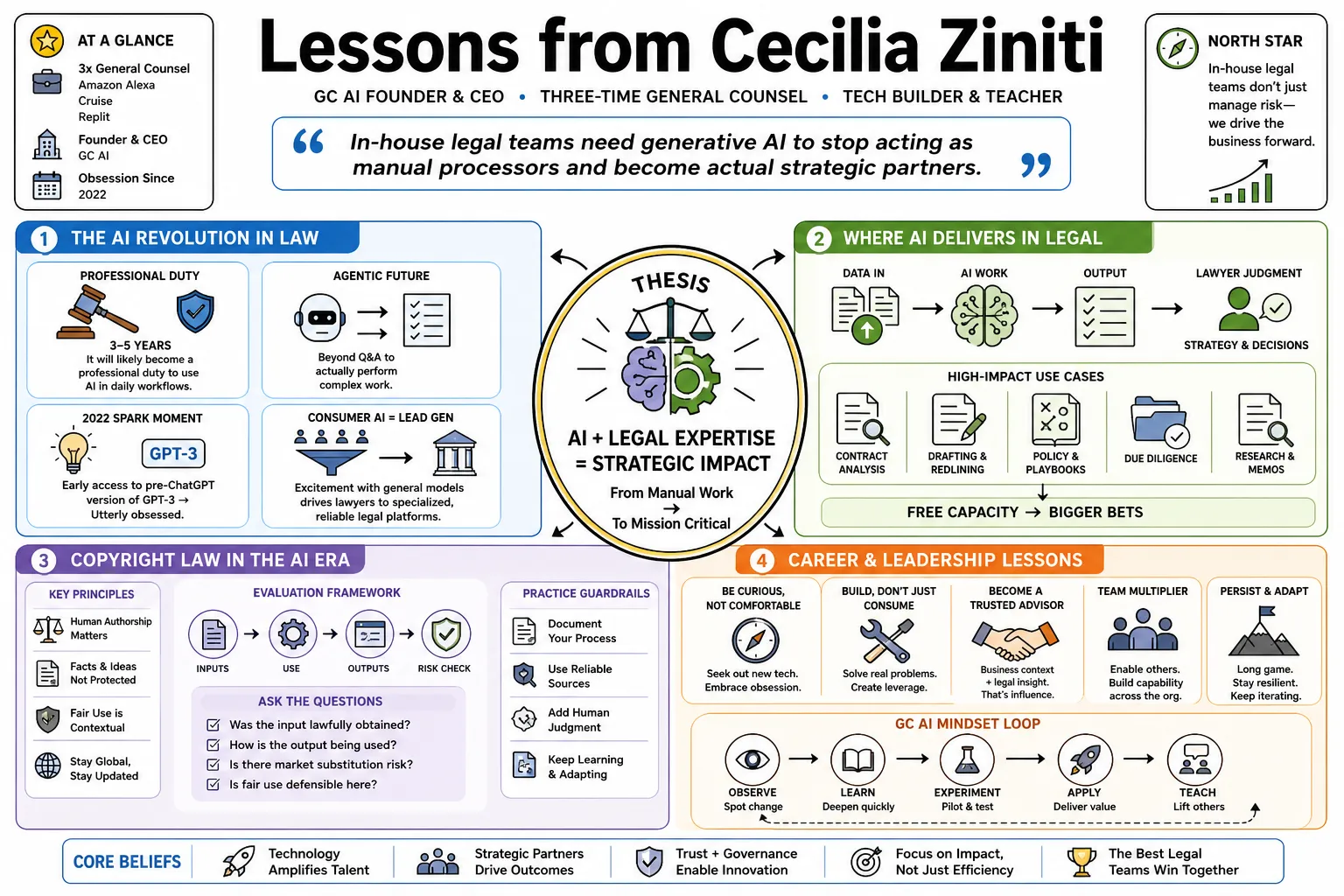
Lessons from Cecilia Ziniti
Cecilia Ziniti is the founder and CEO of GC AI, a legal AI company for in-house counsel. — NYTimes vs OpenAI: Generative AI and the Law with Cecilia Ziniti.
Part 1: The AI Revolution in Law
- On a Coming Duty to Use AI: Cecilia Ziniti: "My guess this is probably a spicy take, Dottie, but I think it's probably 3 to 5 years before it would actually be a violation of our duties not to use" — Using AI to gain a competitive edge (Diligent Corporate Director Podcast transcript).
- On Getting Obsessed Before ChatGPT: Cecilia Ziniti: "I had those experiences prior to Chat GPT, and I got honestly obsessed with it." — Reimagining the Legal Function with AI: A Conversation with Cecilia Ziniti (Data Xposure podcast transcript).
- On an Always-On, Smart Intern: Cecilia Ziniti: "Essentially, the idea is to have this incredible, always-on, smart intern to apply to your business." — Using AI to gain a competitive edge (Diligent Corporate Director Podcast transcript).
- On AI Increasing the Value of Lawyers: Cecilia Ziniti: "I can tell you with zero equivocation that AI increases the value of lawyers. It does not decrease it." — In-House Lawyers Are Already Winning the AI Transition (GC AI blog, quoting Cecilia Ziniti’s 2026 keynote).
- On Your Opponent Lifting Weights: Cecilia Ziniti: "Your opponent is lifting weights and you’re not" — In-House Lawyers Are Already Winning the AI Transition (GC AI blog, quoting Cecilia Ziniti’s 2026 keynote).
Part 2: Building Purpose-Built Legal Tech
- On Tech Companies in the Fortune 20: Cecilia Ziniti: "If you look at literally the Fortune 20 in 1980, there was not a single tech company in there." — NYTimes vs OpenAI: Generative AI and the Law with Cecilia Ziniti, Founder and CEO of GC AI.
- On Being Ahead of the Curve: Cecilia Ziniti: "You are way ahead of the curve It’s as if it's the first day of school and you’re already an honor student." — In-House Lawyers Are Already Winning the AI Transition (GC AI blog, quoting Cecilia Ziniti’s 2026 keynote).
- On Garbage Legal Answers: Cecilia Ziniti: "We see the case of the made up cases or occasionally you get maybe GPT-4.5 or future will be better, but you do occasionally get garbage in response to legal queries like fairly often." — NYTimes vs OpenAI: Generative AI and the Law with Cecilia Ziniti, Founder and CEO of GC AI.
- On Previewing Privacy and IP Issues: Cecilia Ziniti: "The privacy issues, the IP issues, very much a preview of what we see today." — Reimagining the Legal Function with AI: A Conversation with Cecilia Ziniti (Data Xposure podcast transcript).
Part 3: The General Counsel Evolution
- On Who Tells AI What to Do: Cecilia Ziniti: "There will be people that AI tells what to do, and people who tell AI what to do" — In-House Lawyers Are Already Winning the AI Transition (GC AI blog, quoting Cecilia Ziniti’s 2026 keynote).
- On Transferable Skills: Cecilia Ziniti: "The transferable skills, I would say the core lawyer skills are helpful across really anything." — Reimagining the Legal Function with AI: A Conversation with Cecilia Ziniti (Data Xposure podcast transcript).
Part 4: In-House Dynamics vs. Outside Counsel
- On the First Day of School: Cecilia Ziniti: "It’s as if it's the first day of school and you’re already an honor student." — In-House Lawyers Are Already Winning the AI Transition (GC AI blog, quoting Cecilia Ziniti’s 2026 keynote).
- On Splitting Up Rights: Cecilia Ziniti: "There's infinitely many ways that you as the owner of that right can decide to split it up." — NYTimes vs OpenAI: Generative AI and the Law with Cecilia Ziniti, Founder and CEO of GC AI.
Part 5: Career and Mindset
- On Fulfilling Your Full Potential: Cecilia Ziniti: "Underlying BloomTech’s business are two concepts I believe deeply - one - that fulfilling your full potential is, well, fulfilling, and two - that almost anything is possible with hard work" — BloomTech General Counsel Cecilia Ziniti: BloomTech Has the Potential to Change Lives (BloomTech Stories).
- On the Duty to Be Diligent: Cecilia Ziniti: "We have a duty under the professional rules to be diligent and zealous in representing our clients." — Using AI to gain a competitive edge (Diligent Corporate Director Podcast transcript).
- On Taking the Crappy Device: Cecilia Ziniti: "People were like, sure, take the crappy device, it doesn't work." — Reimagining the Legal Function with AI: A Conversation with Cecilia Ziniti (Data Xposure podcast transcript).
- On Choosing the Business Path: Cecilia Ziniti: "I considered number two lawyer or number three lawyer or really fascinating things at fascinating companies, but ultimately concluded for me that that business aspect was so important and had that entrepreneurial spirit." — Reimagining the Legal Function with AI: A Conversation with Cecilia Ziniti (Data Xposure podcast transcript).
- On Using the Product Yourself: Cecilia Ziniti: "One, try to use it and use as a good board member using your company's products is probably like the number one thing you can do." — Using AI to gain a competitive edge (Diligent Corporate Director Podcast transcript).
- On Being Happy in Many Jobs but Choosing Mission: Cecilia Ziniti: "In terms of mission, I’m somebody who loves learning and can be happy in a lot of jobs" — BloomTech General Counsel Cecilia Ziniti: BloomTech Has the Potential to Change Lives (BloomTech Stories).
Part 6: Generative AI, Copyright, and Risk
- On Training as the Core Issue: Cecilia Ziniti: "The core issue of training, the 1 that I think the reason this case has caught so much attention and I think could be a watershed, is really the training." — NYTimes vs OpenAI: Generative AI and the Law with Cecilia Ziniti, Founder and CEO of GC AI.
- On Music Licensing as an Analogy: Cecilia Ziniti: "The music industry is actually a great, analogy here because there's a very clear and robust system for how you license music." — NYTimes vs OpenAI: Generative AI and the Law with Cecilia Ziniti, Founder and CEO of GC AI.
- On Google and IP Claims: Cecilia Ziniti: "By the way, Google has had 20 years of being able to think about how to deal with IP claims." — NYTimes vs OpenAI: Generative AI and the Law with Cecilia Ziniti, Founder and CEO of GC AI.
- On Weighing the Four Factors: Cecilia Ziniti: "You've got four factors, you weigh them, you can weigh them however you want." — Reimagining the Legal Function with AI: A Conversation with Cecilia Ziniti (Data Xposure podcast transcript).
- On Whether Creators Keep Creating: Cecilia Ziniti: "Will New York Times or future journalists, future creators continue to create works if they know that they're not going to be compensated and that they'll train LLMs?" — NYTimes vs OpenAI: Generative AI and the Law with Cecilia Ziniti, Founder and CEO of GC AI.
- On Fair Use: Cecilia Ziniti: "The exclusive right in the first place doesn't stop people from using your work in a way that is deemed fair use." — NYTimes vs OpenAI: Generative AI and the Law with Cecilia Ziniti, Founder and CEO of GC AI.
- On Reasonable Measures: Cecilia Ziniti: "I expect the court would rule something like you must take reasonable measure measures to prevent it." — NYTimes vs OpenAI: Generative AI and the Law with Cecilia Ziniti, Founder and CEO of GC AI.
- On IP Protection and Silicon Valley: Cecilia Ziniti: "A lot of people say that The United States' strong intellectual property protection regime is what gave rise to Hollywood, what gave rise to Silicon Valley." — NYTimes vs OpenAI: Generative AI and the Law with Cecilia Ziniti, Founder and CEO of GC AI.
- On Why Intellectual Property Matters: Cecilia Ziniti: "Intellectual property law, you're right to ask about it because if you look at the rise of the big tech companies, they're not big property holders, right?" — NYTimes vs OpenAI: Generative AI and the Law with Cecilia Ziniti, Founder and CEO of GC AI.
Part 7: The "Vibe Lawyering" Concept
- On 150X Efficiency Gains: Cecilia Ziniti: "I've seen that deliver 150X efficiency gains on the legal side and similar across industries." — Using AI to gain a competitive edge (Diligent Corporate Director Podcast transcript).
- On Creators and Custom GPTs: Cecilia Ziniti: "The scenario where my friend, the influencer, has got people creating GPTs exclusively of their work, it feels like there should be a solution for that." — NYTimes vs OpenAI: Generative AI and the Law with Cecilia Ziniti, Founder and CEO of GC AI.
- On Giving Companies the Same Tech: Cecilia Ziniti: "One is AI gives private companies a lot of the same tech that my former clients had access to." — Using AI to gain a competitive edge (Diligent Corporate Director Podcast transcript).
Part 8: Startup Growth and Leadership
- On Quitting and Incorporating in a Week: Cecilia Ziniti: "I quit my job on November 1st and incorporated the company on November 8th." — Using AI to gain a competitive edge (Diligent Corporate Director Podcast transcript).
- On the Google Deal at Replit: Cecilia Ziniti: "I actually did a deal with Google to get what is now Gemini into Replit and to get Replit essentially software results into Gemini." — Reimagining the Legal Function with AI: A Conversation with Cecilia Ziniti (Data Xposure podcast transcript).
- On Regulators: Cecilia Ziniti: "I don't subscribe to the Silicon Valley belief that regulators are somehow stupid." — Reimagining the Legal Function with AI: A Conversation with Cecilia Ziniti (Data Xposure podcast transcript).
- On Clear Rules: Cecilia Ziniti: "Now, from a compliance standpoint, Clear rules are better than no rules, fine." — Reimagining the Legal Function with AI: A Conversation with Cecilia Ziniti (Data Xposure podcast transcript).
- On Sophisticated Users: Cecilia Ziniti: "I would say our most sophisticated users are far more sophisticated than I am, and it's incredibly rewarding." — Reimagining the Legal Function with AI: A Conversation with Cecilia Ziniti (Data Xposure podcast transcript).
- On Loving the Founder Job: Cecilia Ziniti: "I would say now, the CEO and founder job, I absolutely love it." — Reimagining the Legal Function with AI: A Conversation with Cecilia Ziniti (Data Xposure podcast transcript).