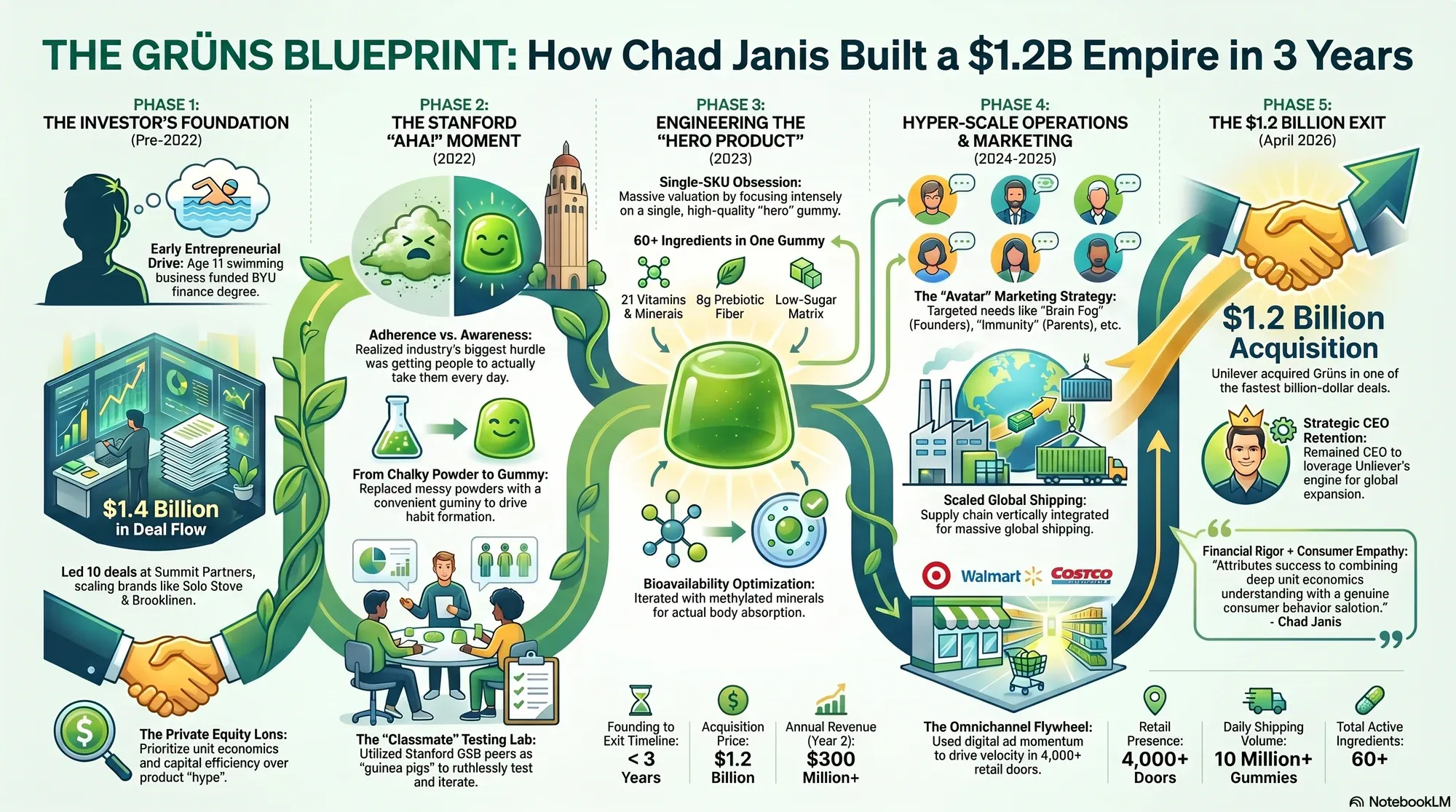
Chad Janis founded Grüns, a gummy-supplement company launched in 2023. Unilever’s half-year filing says it acquired 80% of the business on June 1, 2026 for €767 million. The lessons below trace Janis’s product-development, commerce and scaling decisions. — Unilever — Half-Year Filing.
Part 1: Early Hustle & Formative Years
- On Early Entrepreneurship: Janis began teaching private swimming lessons at age 11. — Forbes — Chad Janis Interview.
- On Funding Education: Earnings from his childhood swimming lessons helped pay for his finance degree at Brigham Young University. — Forbes — Chad Janis Interview.
- On Brand Naming: Janis says time living in Germany and Austria inspired the name Grüns, a playful variation on the German word for green. — Shopify — Grüns Case Study.
- On Content Creation: Before becoming an investor, Janis grew a YouTube channel to roughly 25,000 subscribers. — Forbes — Chad Janis Interview.
- On First Ventures: Before Summit Partners, Janis briefly founded a startup that aggregated loyalty rewards for flights. — Forbes — Chad Janis Interview.
- On an Earlier Sale: Janis says a previous startup hit setbacks and was sold quickly shortly before he conceived Grüns. — Chad Janis — Career Advice.
- On His Education: Janis studied finance at BYU, then left Summit Partners in 2022 to pursue an MBA at Stanford. — Forbes — Chad Janis Interview.
Part 2: The Private Equity Lens
- On Deal Flow: Janis says he led ten Summit Partners deals totaling about $1.4 billion. — Forbes — Chad Janis Interview.
- On Board Roles: Janis served on Solo Stove’s board and observed boards including Brooklinen and Dr. Squatch while at Summit Partners. — Forbes — Chad Janis Interview.
- On Learning from Consumer Brands: Janis says close involvement with brands such as Dr. Squatch let him study both successful and unsuccessful consumer-brand decisions before founding Grüns. — Chad Janis — Origin Story.
- On Acquisition Costs: Janis set a customer-acquisition-cost ceiling and updated it as retention data accumulated, rather than assuming future lifetime value would justify any spend. — Operators — Chad Janis Interview.
- On Unit Economics: Janis advocates evaluating acquisition spend against delivered gross-profit lifetime value over about three years, with a target of at least three times LTV to CAC. — Operators — Chad Janis Interview.
- On Investor Pattern Recognition: Janis says his investor years exposed him to many consumer-brand strategies before he applied those lessons as an operator. — Chad Janis — Origin Story.
- On Financial Discipline: Janis argues that growth, gross margins, profitability, customer economics, expansion opportunities and a strong team are fundamentals across fundraising, acquisition and long-term ownership paths. — Chad Janis — Business Fundamentals.
- On Building the Operating Base: Janis personally assembled Grüns’s early storefront, email flows, landing pages and subscription system before bringing in a dedicated development team. — Shopify — Grüns Case Study.
Part 3: Identifying the Big Problem: Adherence
- On the Catalyst: Janis traced the Grüns idea to disliking a greens powder shortly before starting his Stanford MBA. — Forbes — Chad Janis Interview.
- On Habit Friction: Janis doubted he would keep taking an unpleasant greens powder for a month and began seeking a more enjoyable daily format. — TBPN — Chad Janis Interview.
- On Adherence: Unilever describes Grüns’s founding premise as making a daily supplement easier to keep using, rather than merely increasing awareness of supplements. — Unilever — Grüns Announcement.
- On Convenience: Early Grüns advertising emphasized being able to take the product without mixing a powder or carrying a glass of water. — Modern Retail — Chad Janis Interview.
- On Campus Prototypes: Janis says roughly a quarter of his Stanford MBA class tried early versions and provided feedback before launch. — TBPN — Chad Janis Interview.
- On Format Choice: Janis positioned gummies as a portable, palatable alternative to the greens powder he disliked; this does not establish better health outcomes. — Modern Retail — Chad Janis Interview.
- On Reimagining Gummies: Janis says the team had to challenge expectations of what a gummy supplement could contain and represent. — Forbes — Chad Janis Interview.
- On Product Iteration: Before launch, the team gave hundreds of people blind samples of many formulations and used their feedback to revise the product. — Chad Janis — Origin Story.
Part 4: Product Development & Formulation
- On Ingredient Density: Unilever describes Grüns as containing more than 60 ingredients in a daily gummy pack; this is a product-composition claim, not clinical evidence. — Unilever — Grüns Announcement.
- On the Label Profile: Unilever says a Grüns serving contains 21 vitamins and minerals and six grams of prebiotic fibre, as company-stated label characteristics. — Unilever — Grüns Announcement.
- On Formulation Changes: Janis says customer feedback prompted a switch to methylated vitamins. The decision to change ingredients should not be confused with a demonstrated improvement in users’ health outcomes. — Chad Janis — Origin Story.
- On Lower-Sugar Options: Grüns added low-sugar and sugar-free adult gummy lines as the product range expanded. — Modern Retail — Chad Janis Interview.
- On Product Positioning: Janis wants each brand in the portfolio to stand for a clear consumer concept, rather than treating all gummies as interchangeable candy. — Shopify — Grüns Case Study.
- On Taste: Janis says taste became a prominent reason customers discussed and shared Grüns. — Modern Retail — Chad Janis Interview.
- On Pre-Launch Testing: The team spent about a year formulating and testing the gummies before the August 2023 launch. — TBPN — Chad Janis Interview.
- On Continuous Improvement: Janis says Grüns made five product changes in its first year in response to customer feedback. — Modern Retail — Chad Janis Interview.
Part 5: Supply Chain & Operational Excellence
- On Manufacturing Search: Janis contacted roughly twenty co-manufacturers while developing Grüns; most declined the initial concept. — Shopify — Grüns Case Study.
- On Hybrid Operations: By the Operators interview, Janis described using outside logistics providers alongside in-house fulfillment and some in-house production. — Operators — Chad Janis Interview.
- On Shipping Scale: Unilever reported that Grüns shipped about ten million gummies a day by the time of its 2026 acquisition announcement; this was not its day-one capacity. — Unilever — Grüns Announcement.
- On ERP Systems: Janis says Grüns adopted an ERP after outgrowing spreadsheets and internal workarounds, partly to support more fulfillment in-house. — Operators — Chad Janis Interview.
- On Inventory Resilience: An early inventory shortfall forced Grüns to cut marketing spend sharply; Janis presents capacity planning as a constraint on growth, not a Black Friday-specific tactic. — TBPN — Chad Janis Interview.
- On Financing Growth: Janis says financing decisions should preserve control and supply enough cash for retail payment cycles and facility investment. — Operators — Chad Janis Interview.
Part 6: Marketing Strategies & The "Avatar" Approach
- On Distinct Customer Needs: Janis says Grüns appeals to different customer groups and that its messaging must reflect varied needs. — Modern Retail — Chad Janis Interview.
- On Message Testing: Modern Retail reported Grüns creative addressing several different interests, including powder alternatives, digestion and GLP-1 users. — Modern Retail — Chad Janis Interview.
- On Serving Different Consumers: Janis says Grüns means different things to different customers and that the company must avoid siloing them while meeting their needs. — Modern Retail — Chad Janis Interview.
- On Hero-Product Sequencing: Janis describes a first year focused on revising a hero product, followed by new products and retail launches; Grüns is not currently a single-SKU business. — Modern Retail — Chad Janis Interview.
- On Measured Acquisition: Janis set a numerical acquisition-cost ceiling and adjusted it as actual retention cohorts provided better evidence. — Operators — Chad Janis Interview.
- On Customer Lifetime Value: Janis attributes much of Grüns’s growth to repeat purchases across accumulated customer cohorts while keeping acquisition within a three-times LTV-to-CAC floor. — Operators — Chad Janis Interview.
- On Scaling Spend: Janis says he would acquire more customers in a month only while maintaining his efficiency threshold, rather than chasing a fixed spend or revenue-run-rate target. — Operators — Chad Janis Interview.
- On Digital Feedback: Janis used early ad messaging and customer comments to refine the product and how it was explained online. — Modern Retail — Chad Janis Interview.
- On Brand Experience: Janis describes enjoyment and sharing as parts of the Grüns customer experience, beyond the product’s ingredient list; this is his positioning claim. — Operators — Chad Janis Interview.
Part 7: Rapid Scaling & Retail Expansion
- On Revenue Versus Run Rate: Forbes reported about $100 million in 2025 revenue and said Grüns had announced an annualized run rate above $300 million in October 2025; these are different measures. — Forbes — Chad Janis Interview.
- On Omnichannel Growth: After launching online, Grüns entered Sprouts in late 2024 and then expanded to larger national retailers during 2025. — Forbes — Chad Janis Interview.
- On Retail Doors: Janis reported about 4,000 Walmart, Target and Sprouts stores roughly 22 months after launch; this is a dated company-reported count. — Chad Janis — Origin Story.
- On Retail Partnerships: Unilever listed Target, Walmart, Costco, Sam’s Club and Sprouts among Grüns’s U.S. retail partners in 2026. — Unilever — Grüns Announcement.
- On Channel Complementarity: Janis says retail gives customers another route to discover and repurchase Grüns without necessarily displacing online subscriptions; Shopify reports the channels coexist. — Shopify — Grüns Case Study.
- On International Ambition: The company described international expansion as a future priority, not an already completed global rollout. — Shopify — Grüns Case Study.
Part 8: Leadership, Mindset & The Exit
- On Internal Transparency: Janis says he documents strategic decisions, expected outcomes and video explanations for employees so the team can understand and revisit them. — Chad Janis — Decision Transparency.
- On Setbacks: Janis says setbacks at a previous startup led to a quick sale and, soon afterward, the idea for Grüns; he advises keeping perspective when a career disappointment occurs. — Chad Janis — Career Advice.
- On Sharing the Build: Janis has publicly described Grüns’s origin, early sampling and operating lessons in his own posts; a specific build-in-public program is not documented. — Chad Janis — Origin Story.
- On the Unilever Transaction: Unilever reported acquiring 80% of Grüns on June 1, 2026 for €767 million, with a liability for the future minority buyout. — Unilever — Half-Year Filing.
- On Exit Timing: Forbes described the announced sale less than three years after the August 2023 launch as unusually quick; it did not establish a historical ranking. — Forbes — Chad Janis Interview.
- On Continuing Leadership: Shopify’s post-acquisition case study still identifies Janis as founder and CEO and describes his ongoing product and international plans. — Shopify — Grüns Case Study.
- On the Partnership Rationale: Janis frames Unilever as a partner that can help Grüns reach more consumers and expand, not merely as an exit payment. — Unilever — Grüns Announcement.
- On Strategic Optionality: Janis argues that strong operating fundamentals keep fundraising, partnership and long-term ownership options open; no formula guarantees an exit. — Chad Janis — Business Fundamentals.