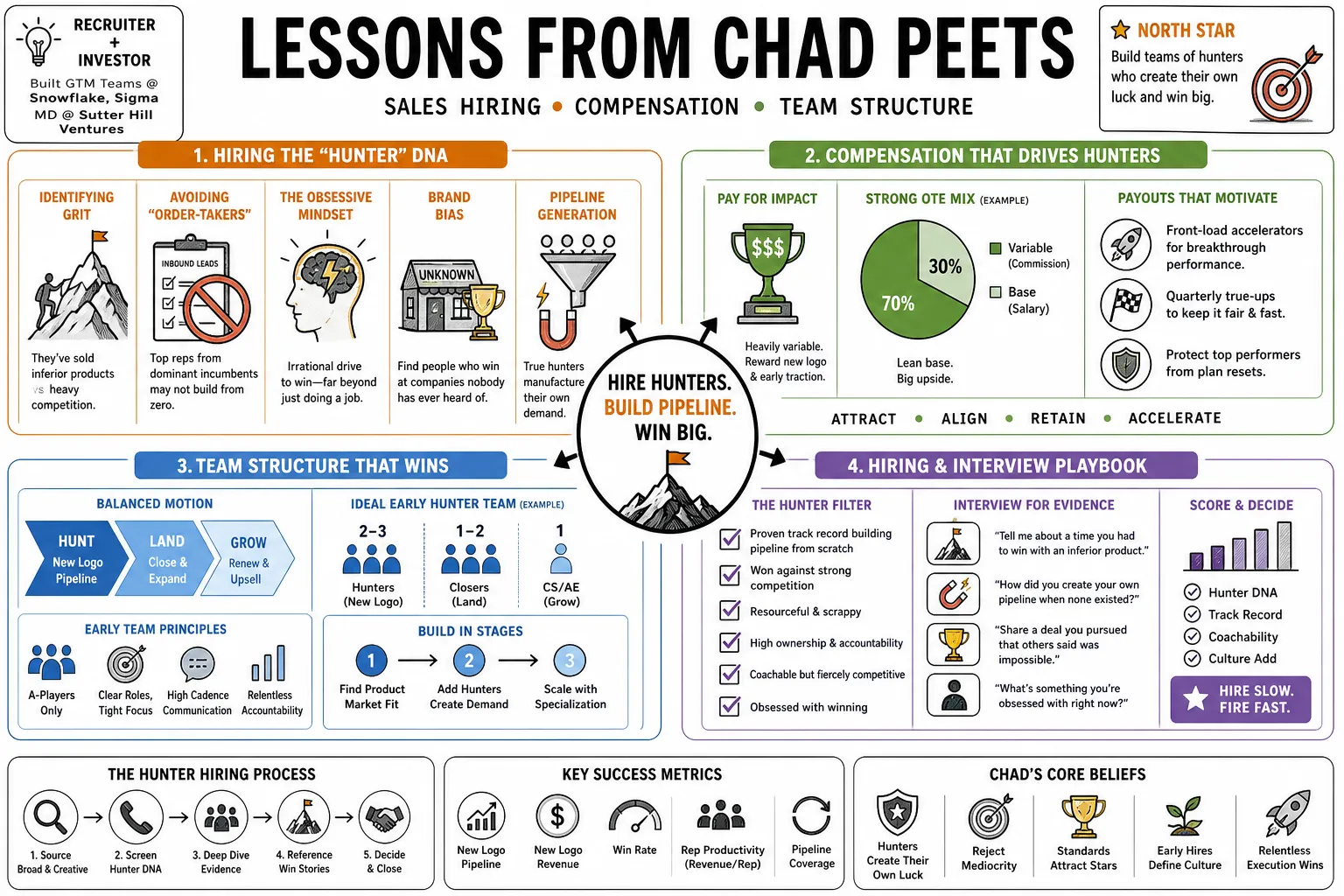
Lessons from Chad Peets
Chad Peets is a sales recruiter, investor, and former Sutter Hill Ventures managing director. His interviews discuss early-stage sales hiring, revenue leadership, compensation, and team design. — 20VC — Chad Peets Profile.
Part 1: Hiring the "Hunter" DNA
- Avoid incumbent-brand bias: A strong record at a dominant vendor does not by itself show that a salesperson can generate new pipeline for a startup. — 20VC — Peets and Degnan.
- Look for commitment to the craft: Peets says he looks for sellers who are intensely committed to improving, rather than treating sales as only a paycheck. — 20VC — Chad Peets 2026.
- Look past the company logo: Peets prefers evidence that a candidate won business at a lesser-known company or with a less advantaged product over the prestige of an employer’s name. — 20VC — Peets and Degnan.
- Test new-business generation: Peets asks whether candidates can open new customer accounts instead of depending on existing demand or installed-base expansion. — AppDynamics Sales Hiring Interview.
- Hire people who want to develop: Peets says candidates attracted to improving their sales craft are a better fit for a developmental sales organization than candidates interested only in immediate earnings. — AppDynamics Sales Hiring Interview.
- Distinguish hunting from expansion: Selling another product into an installed base is different from turning a prospect who has never heard of the company into a customer. — AppDynamics Sales Hiring Interview.
Part 2: Assessing Sales Talent
- Probe beyond quota claims: Peets recommends asking candidates precise questions about what they sold and the new business they personally created, rather than relying on an impressive quota-attainment summary. — 20VC — Chad Peets 2026.
- Read resumes in context: Peets asks when a candidate worked at a company and what kind of sales leadership and methodology existed there; a famous exit alone is not proof of individual selling skill. — AppDynamics Sales Hiring Interview.
- Use trusted leadership references: Peets says a recommendation from a sales leader whose judgment he respects can help him assess a candidate; he does not present customer back-channel calls as a universal rule. — 20VC — Chad Peets Interview.
- Pair candidate profile with a program: Peets argues that copying a successful company’s hiring profile is insufficient unless the company also has a program that can develop those hires. — AppDynamics Sales Hiring Interview.
Part 3: Building Go-To-Market Engines
- Adapt the sales playbook: Peets says the fundamentals of a sales playbook have to be adjusted for the company, market, and product instead of copied unchanged. — Revenue Builders — Hiring to Ensure Success.
- Pair product quality with selling: Peets argues that even a strong product needs salespeople who can find and win new business. — 20VC — Peets and Degnan.
- Distinguish PLG and enterprise motions: Peets treats product-led adoption and enterprise selling as different motions and argues that direct selling still matters for enterprise customers. — 20VC — Chad Peets Interview.
- Use discovery to shape product: In Peets’s pre-product CRO model, customer discovery by the revenue leader informs what the engineering team builds and which buyers to pursue. — 20VC — Chad Peets Interview.
- Build a scalable sales method: Peets asks whether a prospective leader can build a sales methodology and scalable model instead of merely chasing individual deals. — AppDynamics Sales Hiring Interview.
- Align sales capacity with product reach: Peets warns that hiring beyond the ideal-customer segments the product can serve will leave sales capacity without a workable market. — 20VC — Chad Peets Interview.
- Scale headcount against product readiness: Peets cautions against adding salespeople before the product roadmap can support expansion into the buyers those hires are expected to reach. — 20VC — Chad Peets Interview.
Part 4: The Role of the CRO
- Consider a CRO before product launch: Peets describes Sutter Hill’s model of bringing a CRO in before a product exists, so customer discovery and the initial go-to-market motion develop together. — 20VC — Chad Peets Interview.
- Question extraordinary CRO packages: Peets calls the recent surge in exceptionally large CRO compensation packages a market bubble; that is his assessment, not a measured market-wide outcome. — 20VC — Peets and Degnan.
- Separate fundraising from operating progress: Peets cautions CEOs that raising a large round is not the same as building durable revenue or a working sales organization. — 20VC — Peets and Degnan.
- Do not hire only for distant scale: Peets advises hiring the sales VP suited to the company’s current size and next 24 months, rather than choosing a large-company executive for a hypothetical five-year future. — AppDynamics Sales Leadership Interview.
- Forecast from operating evidence: Peets favors a bottoms-up sales forecast grounded in actual pipeline and conversion data over a number imposed to fit a desired valuation. — 20VC — Peets and Degnan.
Part 5: Compensation and Quotas
- Understand quota-setting asymmetry: Peets says quotas set too low can cause overpayment, while quotas set too high can damage morale and cost the company strong sellers. — 20VC — Peets and Degnan.
- Account for exceptional deals: Peets discusses windfall provisions for unusually large deals when designing a sustainable commission plan; he does not say every plan must use one. — 20VC — Peets and Degnan.
- Protect credible earning potential: Peets warns that unrealistic quotas can make top salespeople leave when they can no longer earn well; the source does not establish a burnout diagnosis. — 20VC — Peets and Degnan.
- Align pay with desired selling: Peets argues that compensation design should reinforce the sales behaviors the company needs, rather than reward activity disconnected from the go-to-market motion. — 20VC — Chad Peets Interview.
Part 6: Remote Work vs. In-Office Culture
- In-office development for inside sales: Peets believes inside sellers develop faster in an office and says he prefers candidates willing to work there; this is his judgment, not a controlled comparison. — 20VC — Chad Peets Interview.
Part 7: Managing and Scaling Sales Teams
- Correct hiring mistakes promptly: Peets says he will act quickly when a sales hire is not working; the original “quickly and kindly” formulation conflated his position with Chris Degnan’s. — 20VC — Chad Peets 2026.
- Make performance decisions deliberately: Peets advocates reviewing performance through the year and managing out roughly the bottom ten percent of a sales organization annually; this is his stated management philosophy. — 20VC — Chad Peets 2026.
- Invest in enablement as the team grows: Peets describes sales enablement as a programmatic investment that becomes more important as the organization scales, not a fixed majority-of-time coaching quota. — 20VC — Chad Peets Interview.
- Watch territory shrinkage during hypergrowth: Peets warns that rapidly adding salespeople can shrink territories too quickly; the source does not establish a general theory of perceived fairness or resentment. — 20VC — Peets and Degnan.
- Inspect leading sales indicators: Peets recommends looking beyond quota results at new meetings, progress through sales stages, and conversion rates to detect performance problems. — 20VC — Chad Peets 2026.
- Hire hands-on frontline managers: Peets looks for managers willing to work in front of customers and alongside reps, rather than manage only from a distance. — AppDynamics Sales Leadership Interview.
Part 8: Evaluating Career Opportunities
- Choose aligned recruiting partners: Peets says recruiters should focus on the long-term success of the sales organization rather than only on transaction fees. — Revenue Builders — Hiring to Ensure Success.
- Care whether the product creates value: Peets says salespeople should care whether the product genuinely helps customers, not choose a role only because a company is fashionable. — 20VC — Chad Peets Interview.
- Choose roles that develop your craft: Peets encourages salespeople to seek positions that improve their skills and career prospects instead of optimizing only for current compensation. — 20VC — Chad Peets Interview.
- Weigh opportunity above title: When recruiting an experienced leader into a smaller role, Peets advises emphasizing the market and future opportunity rather than the immediate title. — AppDynamics Sales Leadership Interview.