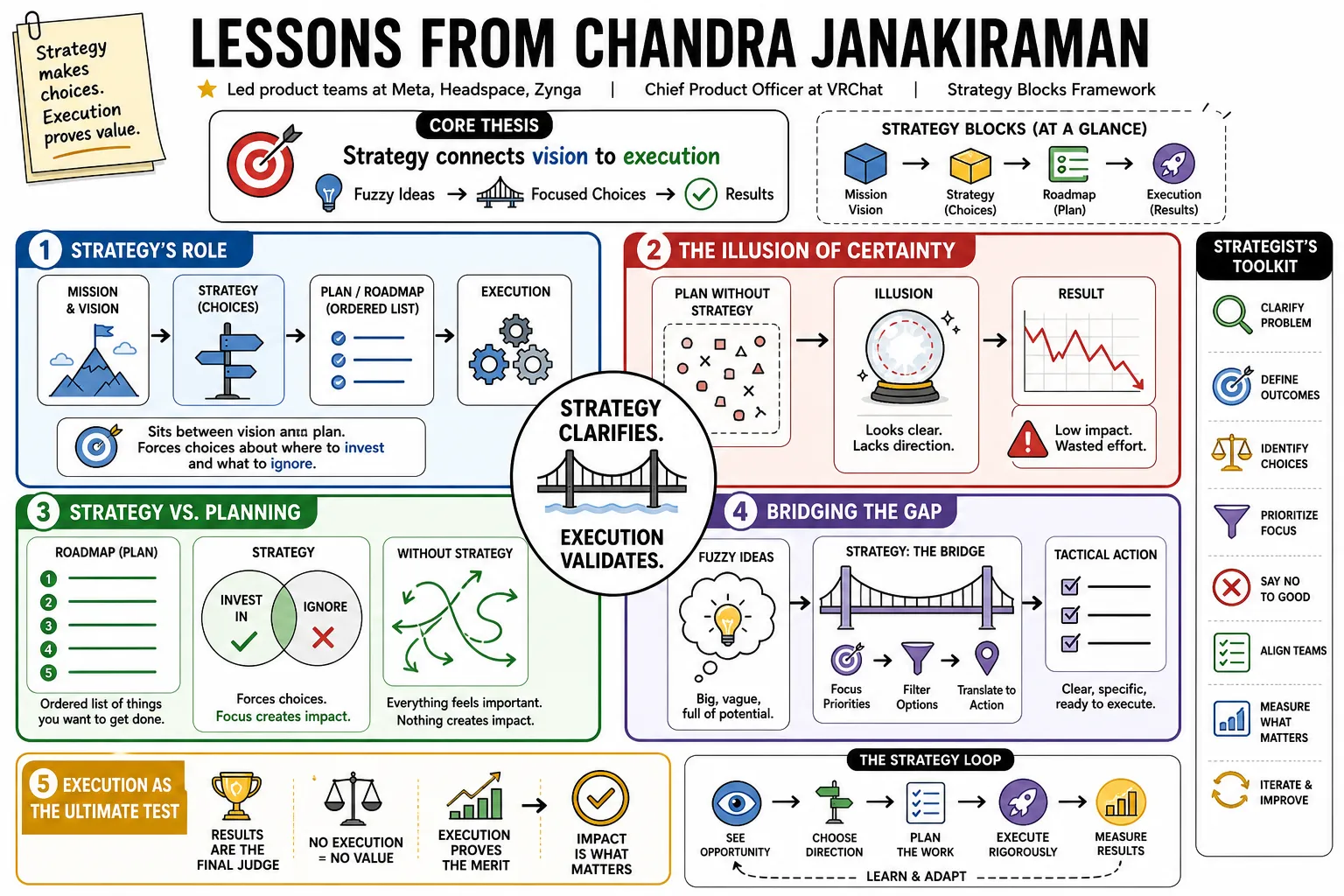
Lessons from Chandra Janakiraman
Chandra Janakiraman led product teams at Meta, Headspace, and Zynga before becoming Chief Product Officer at VRChat. His "Strategy Blocks" framework clarifies product strategy by breaking abstract goals into concrete plans. This collection gathers his methods for tying a company's high-level vision directly to actual execution.
Part 1: Defining Product Strategy
- On Strategy's Role: "Product strategy sits between mission & vision and the plan or roadmap. It forces choices about where to invest and what to ignore, so you can generate maximum impact." — Lenny's Newsletter: Archive]
- On The Illusion of Certainty: "Building a plan without a strategy often creates an illusion of certainty." — The PR FAQ: About]
- On Strategy vs. Planning: "You can call the plan the roadmap, which is basically an ordered list of things that you want to get done, but strategy forces choices." — Lenny's Podcast Archive]
- On Bridging the Gap: "Strategy serves as a critical bridge that translates fuzzy ideas into focused, tactical action." — Lenny's Newsletter: Archive]
- On Execution as the Ultimate Test: "The ultimate test of any strategy is results. A perfectly crafted strategy has no inherent business value until execution proves its merit." — Lenny's Newsletter: Archive]
- On Resource Allocation: "True strategy is about deploying scarce resources to the areas that will generate the most significant returns." — Tim Adair: About]
- On Demystifying Strategy: "Strategy is not an innate gene that only select leaders possess; it is a repeatable, step-by-step playbook that operators can learn." — Liminary: About]
- On Forced Choices: "If your strategy does not force you to make hard trade-offs on what to ignore, it is likely just a wish list." — Lenny's Podcast Archive]
- On Meaningful Impact: "The goal of strategy is to align product features with natural market needs to create a disproportionate response." — Liminary: About]
- On Cohesive Storytelling: "A good strategy document must convert isolated research blocks into a readable, cohesive story." — Gistr: About]
Part 2: "Big S" vs. "Small s" Strategy
- On Distinct Horizons: "'Small s' strategy is tactical and focused on bridging the gap over the next one to two years, whereas 'Big S' strategy focuses on a three to ten year horizon." — Aakash Gupta: Product Growth Archive]
- On Ownership: "Long-term, visionary 'Big S' direction is typically driven by CEOs and General Managers." — Aakash Gupta: Product Growth Archive]
- On Focus: "'Small s' strategy is an operational approach that guides the daily work of product teams and cross-functional working groups." — Lenny's Newsletter: Archive]
- On Design's Role: "Aspirational, long-term strategic planning is often led by design and research to envision future scenarios." — Lenny's Newsletter: Archive]
- On Bridging Horizons: "The challenge for product leaders is ensuring that the tactical 'Small s' execution consistently ladders up to the 'Big S' vision." — Lenny's Podcast Archive]
- On Process Differences: "Developing 'Small s' strategy usually takes eight to twelve weeks of data-driven prioritization, while 'Big S' requires broader market forecasting." — Lenny's Newsletter: Archive]
- On Operational Reality: "Most product managers will spend the majority of their time executing 'Small s' strategy rather than redefining the 'Big S' mission." — Liminary: About]
- On Alignment: "Ensuring that founders and product teams agree on whether they are solving a 'Big S' or 'Small s' problem prevents massive organizational friction." — Lenny's Podcast Archive]
- On Tactical Pragmatism: "When working on 'Small s' strategy, it is better to be practical and data-informed than overly theoretical." — Lenny's Podcast Archive]
Part 3: The Strategy Sprint Process
- On Structured Timelines: "A well-run strategy process typically spans eight to twelve weeks across five distinct phases." — Tim Adair: About]
- On Preparation: "The first four weeks should be dedicated to forming a working group and gathering inputs like behavioral data and user research." — Lenny's Newsletter: Archive]
- On Leadership Interviews: "Interviewing key stakeholders, including founders, early in the process is essential to unearth hidden insights and frustrations." — Lenny's Newsletter: Archive]
- On the One-Week Sprint: "The actual strategy sprint is a concentrated one-week effort to synthesize findings, identify problems, and cluster opportunities." — Lenny's Newsletter: Archive]
- On Transitioning to Design: "Following the strategy sprint, teams must run a design sprint to translate high-level choices into actionable interfaces." — Gistr: About]
- On Documenting the Strategy: "The output of a sprint must be codified into a formal strategy document that clearly articulates the choices made." — Gistr: About]
- On Stakeholder Rollout: "The final phase of the process is rollout, where leaders align the broader organization and secure necessary resourcing." — Gistr: About]
- On Building Alignment: "Even when it has not led to immediate results, it has led to good organizational buy-in on why and how we are operating." — Manus: About]
- On Using Blocks: "Employing a plug-and-play framework prevents teams from getting stuck in analysis paralysis." — Lenny's Newsletter: Archive]
- On Avoiding Shortcuts: "Skipping the preparation phase usually results in a strategy based on assumptions rather than concrete behavioral data." — Lenny's Podcast Archive]
Part 4: Aligning Stakeholders and Leadership
- On Early Inclusion: "Bringing stakeholders along for the journey during the first four weeks prevents them from rejecting the final strategy." — Lenny's Newsletter: Archive]
- On Founder Frustrations: "Understanding what currently frustrates leadership provides a clear map of what the new strategy must address." — Lenny's Newsletter: Archive]
- On Transparent Trade-offs: "When leaders see the data behind why certain features were deprioritized, they are more likely to support the focused roadmap." — Tim Adair: About]
- On the Value of Buy-In: "I would say that it’s really opened people’s eyes and it’s led to really good alignment." — Manus: About]
- On Managing Expectations: "Strategy rollouts require clear communication about what the team will explicitly not do in the upcoming cycles." — Lenny's Podcast Archive]
- On Working Groups: "Strategy should not be developed in a silo; it requires active participation from design, engineering, and data science." — Lenny's Newsletter: Archive]
- On Synthesizing Inputs: "The role of the product leader is to take conflicting stakeholder desires and cluster them into coherent strategic pillars." — Lenny's Newsletter: Archive]
- On Objective Framing: "Presenting strategy as a bridge between the founder's vision and the team's capacity helps neutralize emotional debates." — The PR FAQ: About]
- On Continuous Alignment: "Strategy is not a one-time presentation but an ongoing conversation that requires constant reinforcement with leadership." — Lenny's Podcast Archive]
Part 5: Bridging Strategy and Execution
- On Roadmaps vs. Strategy: "A roadmap is merely an ordered list; it cannot substitute for the reasoning that dictates why those items are on the list." — Lenny's Podcast Archive]
- On Focused Action: "The ultimate goal of the strategy framework is to translate abstract concepts into tangible product work." — Lenny's Newsletter: Archive]
- On the Design Handoff: "Moving from a strategy sprint to a design sprint ensures that strategic choices are physically manifested in the user experience." — Gistr: About]
- On Measurable Outcomes: "If a strategy does not include clear metrics for success, it is impossible to evaluate whether the execution proved its merit." — Lenny's Newsletter: Archive]
- On Adapting Plans: "While the strategy should remain relatively stable, the execution plan must remain flexible to accommodate new data." — Lenny's Podcast Archive]
- On Validating Assumptions: "Execution is the phase where the hypotheses formulated during the strategy sprint are put to the test in the real market." — Liminary: About]
- On Executional Discipline: "Great strategy paired with poor execution will always fail, emphasizing the need for rigorous product management." — Lenny's Podcast Archive]
- On Constraints: "Strategy becomes real the moment you have to allocate limited engineering hours to specific tasks." — Tim Adair: About]
- On Avoiding Ambiguity: "Strategy must eliminate ambiguity so that engineers know exactly what problem they are trying to solve." — Lenny's Newsletter: Archive]
- On the Feedback Loop: "Insights gained from execution must be fed back into the next preparation phase to refine the overarching strategy." — Lenny's Podcast Archive]
Part 6: Navigating Scarcity and Prioritization
- On Scarcity: "Strategy forces choices to deploy scarce resources to generate maximum impact." — The PR FAQ: About]
- On Ignoring Distractions: "The hardest part of product strategy is explicitly defining what the team will ignore." — Lenny's Newsletter: Archive]
- On Clustering Opportunities: "Instead of treating every idea equally, group similar opportunities to identify areas with the highest potential leverage." — Lenny's Newsletter: Archive]
- On Saying No: "A strategy that says yes to everything is fundamentally flawed; prioritization is an exercise in rejection." — Lenny's Podcast Archive]
- On Data-Driven Choices: "Use behavioral data and user research to ensure that prioritization decisions are objective rather than opinion-based." — Lenny's Newsletter: Archive]
- On Maximizing Returns: "Resources should only be deployed where they intersect with natural market needs to achieve a disproportionate response." — Liminary: About]
- On Resource Realities: "An aspirational vision is useless if it requires more capital or engineering talent than the company currently possesses." — Tim Adair: About]
- On Managing Scope: "Keeping the focus tight ensures that the team can deliver high-quality features rather than a multitude of mediocre ones." — Lenny's Podcast Archive]
- On Strategic Agility: "When resources change unexpectedly, a strong strategic foundation allows the team to reprioritize without losing their core direction." — Lenny's Podcast Archive]
Part 7: Lessons from Meta, Headspace, and Zynga
- On Network-Accretive Products: "At Zynga, success depended on creating products that naturally built upon and expanded the existing user network." — Podscripts: Podcasts Directory]
- On Managing Central Teams: "Central product management requires balancing the needs of individual game teams with the overarching platform strategy." — Podscripts: Podcasts Directory]
- On Social Experiences: "Leading interfaces at Facebook highlighted the importance of designing features that drive organic social engagement." — Lenny's Podcast Archive]
- On Reality Labs Growth: "Driving growth in emerging technologies like augmented and virtual reality requires bridging long-term vision with immediate, tangible use cases." — Lenny's Podcast Archive]
- On Relaunching Platforms: "The successful relaunch of Headspace required a deep understanding of user behavior to refine the core value proposition." — Lenny's Podcast Archive]
- On Subscriber Growth: "Achieving a significant boost in subscribers at Headspace was the result of aligning the product's frequency with the users' natural needs." — Liminary: About]
- On Adapting to Scale: "The strategic approaches that work for a gaming company like Zynga must be adapted when applied to a wellness platform like Headspace." — Lenny's Podcast Archive]
- On First-Principles Thinking: "Working across diverse industries proves that strong strategic frameworks are universally applicable." — Lenny's Newsletter: Archive]
- On Future Interfaces: "His transition to VRChat underscores a career-long focus on how users interact within complex, evolving digital environments." — Lenny's Podcast Archive]
Part 8: Driving Growth and Market Resonance
- On the Concept of Resonance: "True growth occurs when a product achieves resonance, a disproportionate market response to a well-aligned feature." — Liminary: About]
- On Natural Market Needs: "You cannot force growth; you must build products that tap into behaviors the market is already exhibiting." — Liminary: About]
- On Usage Frequency: "Understanding how often a user naturally wants to engage with a product is crucial for designing retention mechanisms." — Lenny's Podcast Archive]
- On Moving Beyond Tactics: "Sustainable growth comes from fundamentally sound strategy, not just a collection of disconnected growth hacks." — Lenny's Newsletter: Archive]
- On the Value of Research: "Deep user research is the bedrock of identifying the unarticulated needs that drive market resonance." — Lenny's Newsletter: Archive]
- On Measuring Impact: "The success of a growth strategy must be evaluated by the actual business results it generates, not the elegance of the plan." — Lenny's Newsletter: Archive]
- On Behavioral Data: "Observing what users actually do is far more valuable for driving growth than listening to what they say they want." — Lenny's Newsletter: Archive]
- On Iterative Growth: "Achieving resonance is rarely a one-shot endeavor; it requires continuously feeding execution data back into the strategy loop." — Lenny's Podcast Archive]
- On Product Leadership: "The best product leaders are those who can consistently guide their teams to find and capitalize on market resonance." — Refresh Miami: News]