Lessons from Charles C. Mann
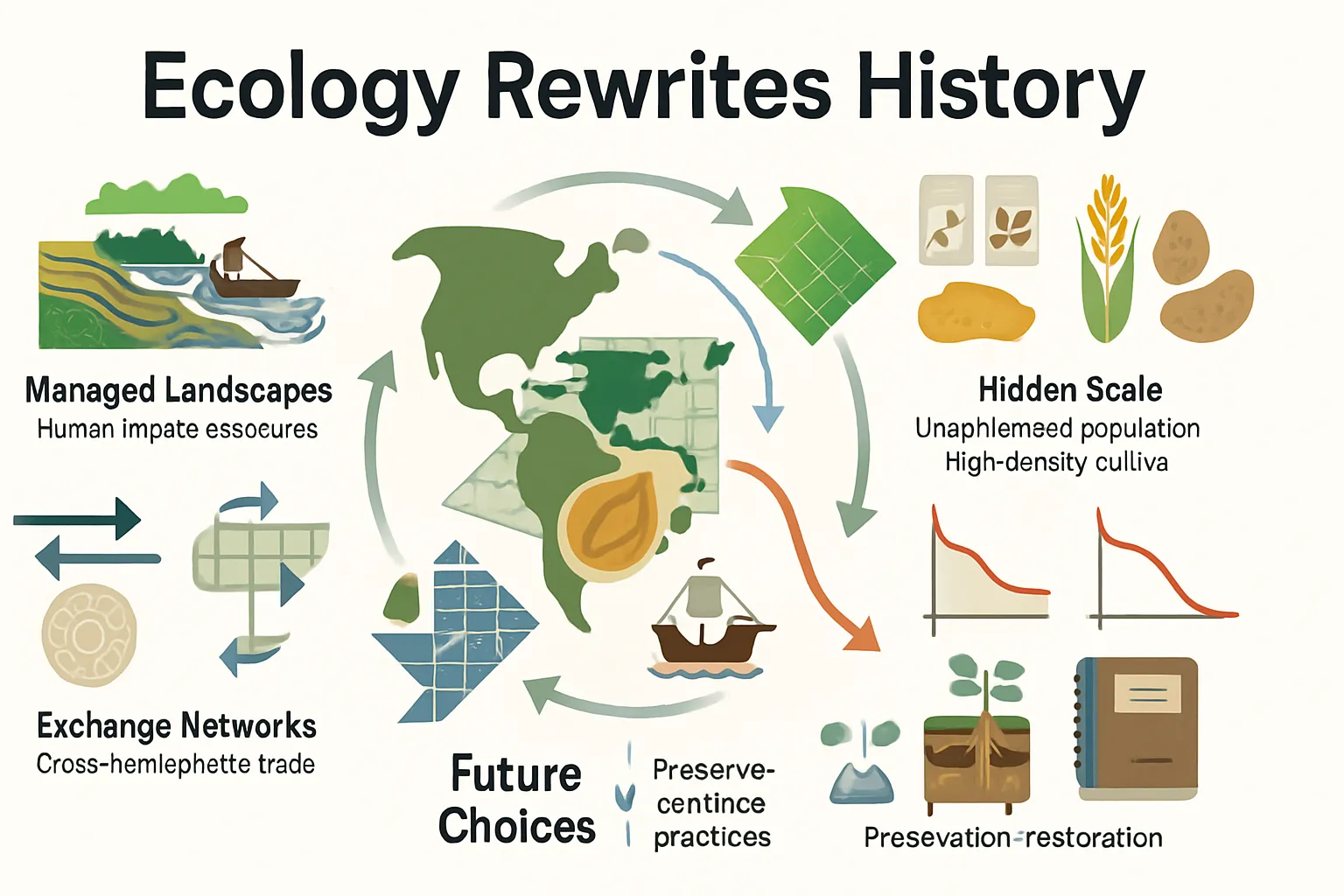
Charles C. Mann is a science journalist best known for 1491 and 1493, which dismantled the myth of an untouched pre-Columbian Americas and tracked the biological fallout of European contact. This profile covers his research on indigenous societies and disease-driven demographic collapse, as well as his later writing on competing strategies for environmental survival.
Part 1: The Pre-Columbian Americas
- On the Pristine Myth: "Carrying their flints and torches, Native Americans were living in balance with Nature—but they had their thumbs on the scale." — Source: [Goodreads]
- On the Inka Empire: "Bigger than Ming Dynasty China, bigger than Ivan the Great's expanding Russia... the Inka dominion extended over a staggering thirty-two degrees of latitude." — Source: [Goodreads]
- On Identity: "Tisquantum was not an Indian... But 'Indian' was not a category that Tisquantum himself would have recognized, any more than the inhabitants of the same area today would call themselves 'Western Hemisphereans'." — Source: [SuperSummary]
- On Pre-Columbian Population: "Dobyns argued that the Indian population in 1491 was between 90 and 112 million people... when Columbus sailed, more people lived in the Americas than in Europe." — Source: [Goodreads]
- On the Eastern Forest: "Rather than the thick, unbroken, monumental snarl of trees imagined by Thoreau, the great eastern forest was an ecological kaleidoscope." — Source: [Goodreads]
- On Amazonian Terra Preta: "The Amazon basin was not a fragile, untouched jungle, but a heavily managed landscape where indigenous farmers created nutrient-rich dark earth to sustain large populations." — Source: [1491]
- On Cahokia: "Centuries before European contact, the city of Cahokia on the Mississippi River was larger and more densely populated than London was at the same time." — Source: [UMass]
- On the Maya Collapse: "The Maya collapsed because they overshot the carrying capacity of their environment. They exhausted their resource base, began to die..." — Source: [Goodreads]
- On North American Nomads: "The idea of scattered, horse-riding nomads is largely an artifact of post-contact societal collapse rather than the historical norm of settled, agricultural societies." — Source: [1491]
- On European Assumptions: "Early European colonists consistently underestimated the scale of Native American civilization because they arrived after the peak of demographic collapse." — Source: [Indian Country Today]
Part 2: The Columbian Exchange
- On Global Ingredients: "The Columbian Exchange... is the reason there are tomatoes in Italy, oranges in the United States, chocolates in Switzerland, and chili peppers in Thailand." — Source: [SuperSummary]
- On the Homogenocene: "With the Columbian Exchange, places that were once ecologically distinct have become more alike. ...Colón's voyages marked the beginning of a new biological era: the Homogenocene." — Source: [Goodreads]
- On Hidden Passengers: "Colón and his crew did not voyage alone. They were accompanied by a menagerie of insects, plants, mammals, and microorganisms." — Source: [SuperSummary]
- On Global Trade: "The founding of Manila in 1571 marked the first time that continuous trade spanned the entire globe, linking the silver mines of the Americas to the markets of China." — Source: [1493]
- On Silver: "Potosí in Bolivia became one of the largest and richest cities in the world, pumping out silver that financed European empires and triggered global inflation." — Source: [1493]
- On Earthworms: "The northern forests of North America were devoid of earthworms due to glaciation; their reintroduction by Europeans fundamentally altered the soil chemistry and forest undergrowth." — Source: [1493]
- On the Potato: "The introduction of the potato to Europe provided a massive calorie boost that ended centuries of recurring famine and fueled the rise of Northern European powers." — Source: [1493]
- On Rubber: "The global spread of rubber seeds from the Amazon allowed for the industrialization of mobility, but also birthed horrific exploitation in places like the Congo and Southeast Asia." — Source: [1493]
- On Ecological Shock: "To ecologists, the collision of these separated hemispheres is arguably the most important biological event since the death of the dinosaurs." — Source: [SuperSummary]
- On Globalization: "The world began to change in 1493. It's tempting to think that Columbus's first voyage... caused this change, but the truth is more complicated." — Source: [Medium]
Part 3: The Wizards and Techno-Optimism
- On the Wizard's View: "Wizards regard Earth as a toolbox, its contents freely available for use." — Source: [Goodreads]
- On Norman Borlaug: "Borlaug became the emblem of techno-optimism or cornucopianism, demonstrating that applied science could drastically multiply wheat yields and save millions from starvation." — Source: [Goodreads]
- On Solutions: "The Wizard believes that science and technology, when properly applied, can help humanity produce its way out of biological bottlenecks." — Source: [Goodreads]
- On Food Production: "To the Wizard, the answer to a growing population is smarter, more intensive farming that maximizes output on less land rather than reducing consumption." — Source: [The Wizard and the Prophet]
- On Nuclear Energy: "Wizards often view next-generation nuclear power as a necessary tool to generate abundant, carbon-free energy for a thriving global population." — Source: [The Wizard and the Prophet]
- On Desalination: "Instead of rationing water, Wizards advocate for engineering solutions like large-scale desalination to ensure an endless supply for agriculture and cities." — Source: [The Wizard and the Prophet]
- On Genetic Modification: "The Wizard sees genetic engineering not as a violation of nature, but as a critical extension of traditional breeding necessary to feed ten billion people." — Source: [The Wizard and the Prophet]
- On Scarcity: "Techno-optimists operate on the premise that human ingenuity is the ultimate resource, rendering physical scarcity a temporary challenge rather than a permanent limit." — Source: [The Wizard and the Prophet]
- On Scale: "To address climate change, Wizards look to massive interventions like carbon capture or solar geoengineering to manipulate the Earth's systems in our favor." — Source: [The Wizard and the Prophet]
- On the Future: "Wizards argue that pulling back on industrialization would condemn billions to poverty; the only way out of the environmental crisis is forward." — Source: [The Wizard and the Prophet]
Part 4: The Prophets and Ecological Limits
- On the Prophet's View: "Prophets think of the natural world as embodying an overarching order that should not casually be disturbed." — Source: [Goodreads]
- On William Vogt: "Vogt crystallized the modern environmental movement by arguing that humans have no special dispensation to escape the fundamental biological constraints of the planet." — Source: [Goodreads]
- On Carrying Capacity: "The Prophet warns that every environment has a hard limit on the population it can support; exceeding it leads to inevitable ecological collapse." — Source: [The Wizard and the Prophet]
- On Consumption: "Prophets argue that technological fixes only delay the inevitable; the only sustainable path is reducing consumption and living within ecological boundaries." — Source: [The Wizard and the Prophet]
- On Agriculture: "Industrial agriculture, with its heavy reliance on synthetic fertilizers and pesticides, is seen by Prophets as mining the soil rather than farming it." — Source: [The Wizard and the Prophet]
- On Population: "Prophets are deeply concerned by exponential population growth, viewing it as the root driver of deforestation, species loss, and resource depletion." — Source: [The Wizard and the Prophet]
- On Natural Order: "The Prophet believes that human attempts to dominate nature frequently result in catastrophic unintended consequences." — Source: [The Wizard and the Prophet]
- On Renewable Energy: "Prophets favor decentralized, community-scale renewable energy systems that align with local environments, rather than massive industrial power plants." — Source: [The Wizard and the Prophet]
- On Survival: "For the Prophet, survival depends not on asserting human mastery over the earth, but on learning humility and practicing restraint." — Source: [The Wizard and the Prophet]
Part 5: Disease and Demographic Catastrophe
- On Malaria: "As it does today, malaria played a huge role in the past... Socially speaking, malaria—along with another mosquito-borne disease, yellow fever—turned the Americas upside down." — Source: [Goodreads]
- On African Slavery: "The transatlantic slave trade was massively accelerated because enslaved Africans possessed genetic and acquired immunities to malaria that European colonists and indigenous peoples lacked." — Source: [1493]
- On Empty Landscapes: "The image of the Americas as an unpopulated wilderness was a direct result of European diseases wiping out up to 90% of the indigenous population before colonizers ever pushed inland." — Source: [1491]
- On Smallpox: "Viral diseases like smallpox raced ahead of European explorers, destabilizing powerful empires like the Inka by triggering succession crises and civil wars." — Source: [1491]
- On Colonial Mortality: "A new bishop finally had the courage to land in São Tomé in 1675. He was dead in two months." — Source: [Goodreads]
- On Immunological Isolation: "The pre-Columbian Americas were largely free of epidemic diseases because they had few domesticated animals, which are the primary source of human viral pathogens." — Source: [1491]
- On Yellow Fever: "The introduction of the Aedes aegypti mosquito on slave ships established yellow fever in the Americas, fundamentally shaping the political geography of the Caribbean and South America." — Source: [1493]
- On Jamestown: "The English settlement at Jamestown struggled immensely not just because of native resistance, but because they established their colony in a malarial tidal zone." — Source: [1493]
- On the Conquest: "The subjugation of the Americas was less a military victory than a biological one; without disease, early European colonization efforts routinely ended in failure." — Source: [Indian Country Today]
Part 6: Indigenous Complexity and Engineering
- On Maize: "The development of maize from wild teosinte is considered by biologists to be the most impressive feat of genetic engineering by ancient humans." — Source: [1491]
- On Haudenosaunee Society: "Compared to the despotic societies that were the norm in Europe and Asia, Haudenosaunee was a libertarian dream." — Source: [Goodreads]
- On Milpa Agriculture: "The Mesoamerican system of intercropping corn, beans, and squash creates a self-sustaining ecological loop that can be farmed continuously for thousands of years without degrading the soil." — Source: [1491]
- On Urban Planning: "In its dystopic way, [sixteenth-century Mexico City] was an amazingly contemporary place... It was the first twenty-first-century city, the first of today's modern, globalized megalopolises." — Source: [Goodreads]
- On Fire Management: "Native peoples actively managed the plains and forests with controlled burns to clear underbrush, hunt, and promote the growth of specific plant species." — Source: [1491]
- On Terracing: "The Inka transformed the steep, challenging terrain of the Andes with massive stone terraces that controlled erosion, managed water, and created microclimates for agriculture." — Source: [1491]
- On Metallurgy: "Andean cultures developed highly sophisticated metallurgy that prioritized the aesthetic and ceremonial qualities of metal—color, sound, and reflectivity—over the hardness needed for weapons." — Source: [1491]
- On Water Systems: "Indigenous societies in the Amazon and the Maya lowlands constructed elaborate raised fields and canal systems to manage seasonal flooding and guarantee food security." — Source: [1491]
- On Mathematics: "The Maya developed a complex writing system and a sophisticated understanding of mathematics and astronomy, independently inventing the concept of zero long before Europe." — Source: [1491]
Part 7: Human Nature and Innovation
- On Historical Bias: "It is always easy for those living in the present to feel superior to those who lived in the past." — Source: [Goodreads]
- On Good Fortune: "The human propensity is to believe that flukes of good fortune will never come to an end." — Source: [AZQuotes]
- On Scientific Focus: "A prerequisite for a successful scientific career is an enthusiastic willingness to pore through the minutiae of subjects that 99.9 percent of Earth's population find screamingly dull." — Source: [Goodreads]
- On Technology and Malice: "The embrace of a new technology by ordinary people leads inevitably to its embrace by people of malign intent." — Source: [AZQuotes]
- On Cultural Inertia: "The adoption of new crops and ideas during the Columbian Exchange was rarely smooth; people stubbornly clung to their familiar diets and agricultural traditions even in the face of starvation." — Source: [1493]
- On Ideological Conflict: "The debate between Prophets and Wizards is difficult to resolve because it is not fundamentally a disagreement about facts, but a clash of underlying moral values regarding the human place in nature." — Source: [The Wizard and the Prophet]
- On Biological Success: "Human beings are arguably the most successful species on the planet, but in biology, rapid and unchecked success often precipitates a sudden and catastrophic crash." — Source: [The Wizard and the Prophet]
- On Isolation: "Technologically speaking, China was so far ahead of the rest of Eurasia that foreign lands had little to offer except raw materials, which could be obtained without going to the bother of dispatching gigantic flotillas." — Source: [Goodreads]
- On Slavery's Banality: "Slavery was part of the furniture of daily life—at that time almost every minister, usually the most important man in town, had one or two." — Source: [Goodreads]
Part 8: The Craft of History and Journalism
- On Cross-Disciplinary Research: "To understand pre-Columbian history, one must look beyond written documents and synthesize findings from archaeology, anthropology, genetics, and epidemiology." — Source: [1491]
- On Predicting the Future: "The Wizard and the Prophet is a book about the way knowledgeable people might think about the choices to come, rather than what will happen in this or that scenario. It is a book about the future that makes no predictions." — Source: [QuoteFancy]
- On Changing Narratives: "The shift in our understanding of the Americas is a testament to how science operates: steadily accumulating evidence eventually overturns even the most entrenched cultural myths." — Source: [1491]
- On Historiography: "History is often written by the victors, but in the case of the Americas, it was written by the survivors of a continent-wide demographic collapse." — Source: [1491]
- On Intellectual Honesty: "Framing environmental issues through the lens of Wizards and Prophets allows for a more honest examination of the tradeoffs inherent in every potential solution to climate change." — Source: [The Wizard and the Prophet]
- On the Patsy Stereotype: "Modern research has forced historians to discard the old, condescending view of indigenous peoples as static, ineffectual patsies waiting for European arrival." — Source: [Penguin Random House]
- On Nuance: "Journalism often seeks simple answers, but historical ecology reveals that human impacts on the environment are always a complex mix of beneficial management and unintended destruction." — Source: [1491]
- On Columbus's Legacy: "The true significance of Columbus's voyage was not the discovery of a new world, but the sudden, violent sewing together of two ancient, entirely separate biospheres." — Source: [1493]
- On Human Agency: "Both the history of the Americas and the debate over the Anthropocene underscore that humans have never been passive participants in nature; we have always been the active architects of our environment." — Source: [The Wizard and the Prophet]