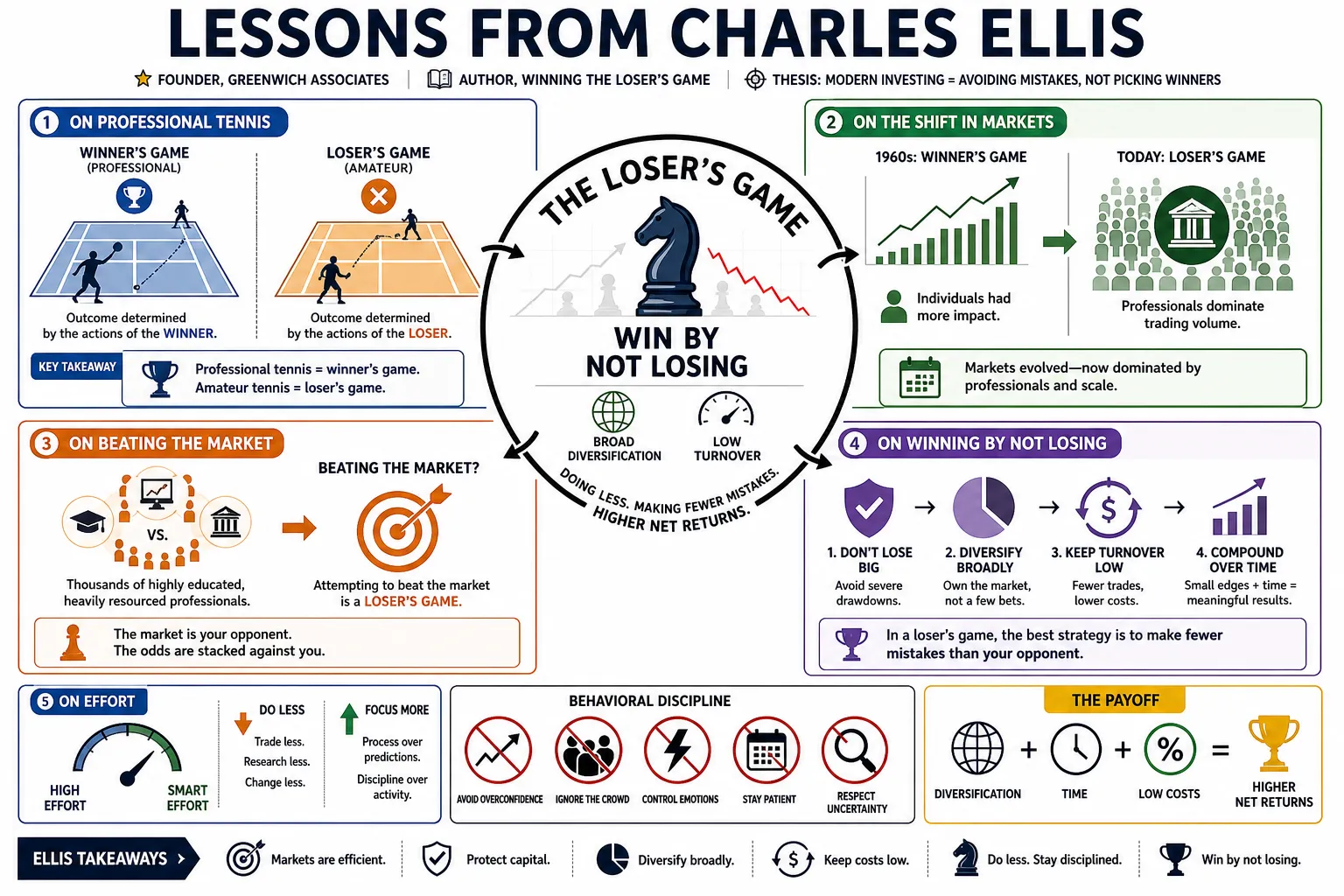
Lessons from Charles Ellis
Charles D. Ellis founded Greenwich Associates and wrote Winning the Loser’s Game. Drawing on decades around institutional investors, he argues that intense professional competition, trading costs and human behavior make consistent outperformance difficult; he urges investors to set a policy around their own long-term goals. — Rational Reminder — Charles Ellis.
Part 1: The Loser's Game
- Professional Tennis: Ellis borrows Simon Ramo’s distinction: elite tennis players win points with strong shots, while amateur matches are usually decided by errors. — Financial Analysts Journal — The Loser’s Game.
- A Changed Market: Ellis argues that as institutions came to dominate trading, professional managers increasingly competed against one another rather than against less-informed individuals. — Financial Analysts Journal — The Loser’s Game.
- The Difficulty of Beating the Market: Ellis says active managers face many well-trained, well-resourced competitors, so working hard alone does not create a durable edge. — Rational Reminder — Charles Ellis.
- Win by Making Fewer Mistakes: In Ellis’s loser’s-game framework, avoiding unnecessary errors is often more useful than attempting a brilliant investment play. — Financial Analysts Journal — The Loser’s Game.
- Effort Can Backfire: Ellis warns that extra activity can add mistakes and costs when an investor is competing in a game that does not reward more effort by itself. — Rational Reminder — Charles Ellis.
- The Golf Analogy: Ellis uses high-scoring amateur golf to show how recurring mistakes can determine the result; reducing those mistakes matters more than chasing spectacular shots. — Rational Reminder — Charles Ellis.
- Skill Raises the Bar for Everyone: Ellis’s doubts about active management grew as the quality and quantity of competing investment talent increased. — Wiley — The Index Revolution.
- Protect Yourself from Your Own Errors: Ellis urges investors to recognize their systematic mistakes, understand their own circumstances and write down a suitable policy. — Rational Reminder — Charles Ellis.
- Pay Attention to Existing Risks: Ellis argues that defensive review of problems already in a portfolio may matter more than searching for the next winning purchase. — Financial Analysts Journal — The Loser’s Game.
Part 2: Market Efficiency and Competition
- Know Your Competition: Ellis notes that a professional investor today is usually trading in a market populated by other capable experts, not by an easy field of amateurs. — Financial Analysts Journal — The Loser’s Game.
- Information Is Widely Shared: Ellis points to broad access to data and computing power as reasons a proprietary informational advantage has become harder to sustain. — Rational Reminder — Charles Ellis.
- Competitive Price Discovery: Ellis describes security prices as the product of many informed, price-sensitive participants competing as buyers and sellers. — Wiley — The Index Revolution.
- Institutional Trading Grew: Ellis documented institutions’ rising share of market transactions in the 1960s and 1970s, a structural shift that changed the economics of active management. — Financial Analysts Journal — The Loser’s Game.
- Public Information Is Hard to Monopolize: Ellis argues that important market information is now widely available to many investors, making a repeatable edge from ordinary public information difficult. — Wiley — The Index Revolution.
- Long-Run Active-Manager Odds: In a 2023 interview, Ellis estimated that 85–90% of active mutual funds in a 20-year sample fell short of their chosen benchmarks. — Rational Reminder — Charles Ellis.
- Competition Plus Costs: Ellis explains that when equally capable professionals trade against one another, their average result is reduced by the cost of playing. — Wiley — The Index Revolution.
- Hard Work Is Not a Moat: Ellis observes that a manager may be talented and diligent yet still fail to outperform because rival managers are talented and diligent too. — Rational Reminder — Charles Ellis.
Part 3: The Indexing Advantage
- Why Indexing Appeals to Ellis: For most investors, Ellis favors low-cost indexing because it removes many opportunities to mistime trades, overtrade or overpay for management. — Rational Reminder — Charles Ellis.
- Why Vanguard Endured: Ellis attributes Vanguard’s growth partly to a client-serving purpose, low-cost offerings and a culture committed to that mission. — Rational Reminder — Charles Ellis.
- Keep the Strategy Simple: Ellis advises investors without a strong contrary conviction to consider broad, diversified index funds and hold a coherent long-term course. — Rational Reminder — Charles Ellis.
- Predictable Benchmark Exposure: Ellis sees an index strategy as a more predictable way to participate in a chosen market than trying to identify an active manager who will keep outperforming. — Wiley — The Index Revolution.
- A Potential Tax Advantage: Ellis includes lower tax costs among the potential long-term advantages of low-turnover index investing over active management. — Rational Reminder — Charles Ellis.
- Manager-Selection Risk: Ellis argues that identifying active managers who will outperform in the future is difficult, even when their past records look compelling. — Wiley — The Index Revolution.
- Ask for Proof of an Edge: Ellis places the burden on a manager claiming repeatable outperformance to explain how the edge survives competition and costs. — Financial Analysts Journal — The Loser’s Game.
- Indexing Became Mainstream Slowly: Ellis recounts how index investing moved from skepticism toward wider use as evidence accumulated and competition made active outperformance harder. — Wiley — The Index Revolution.
Part 4: Time Horizon and Long-Term Investing
- Plan Beyond the Daily Market: Ellis contrasts the daily fixation on price moves with the much longer horizon over which many investors and their families actually need the money. — Jason Zweig — Wall Street’s Wisest Man.
- Keep a Multigenerational Horizon in View: Ellis describes investments intended for children and grandchildren, whose spending horizons can be far longer than today’s market cycle. — Rational Reminder — Charles Ellis.
- Benign Neglect: Ellis calls benign neglect a useful long-term discipline when it follows a considered investment policy rather than frequent reactive changes. — Jason Zweig — Wall Street’s Wisest Man.
- Review the Policy Deliberately: Ellis recommends writing a short investment policy and revisiting it at regular intervals rather than judging every market move as a new instruction. — Rational Reminder — Charles Ellis.
- Do Not Predict the End of a Bear Market: Ellis says the exact end date of a bear market is not the central question for an investor whose true horizon is measured in decades. — Jason Zweig — Wall Street’s Wisest Man.
- Account for Family Time Horizons: Ellis notes that an investor’s effective time horizon can extend beyond their own life when assets are meant for children or other heirs. — Jason Zweig — Wall Street’s Wisest Man.
Part 5: Avoiding Mistakes and Defensive Play
- Avoid Emotionally Timed Losses: Ellis distinguishes ordinary market fluctuation from the lasting damage an investor can cause by taking decisive action at the worst time. — Jason Zweig — Wall Street’s Wisest Man.
- Beware Overconfidence: Ellis warns that rising markets and apparent expertise can make investors confident just when they are at risk of serious mistakes. — Jason Zweig — Wall Street’s Wisest Man.
- Capital Group as an Exception: Ellis cites Capital Group as an unusually consistent active-management organization and emphasizes low turnover, long horizons and a collegial research culture when evaluating managers. — Jason Zweig — Wall Street’s Wisest Man.
- Be Selective About Exotic Assets: Ellis describes private-market strategies as requiring unusually skilled selection, patient capital and resources not available to every retail investor. — Rational Reminder — Charles Ellis.
- Market Timing Adds Decisions: Ellis cautions that trying to time the market creates additional choices, trading costs and opportunities for error. — Rational Reminder — Charles Ellis.
Part 6: Human Behavior and Psychology
- Do Not Invest for Excitement: Ellis describes investing as a steady responsibility and warns against using the stock market as a source of excitement. — Jason Zweig — Wall Street’s Wisest Man.
- You May Ignore Mr. Market: Ellis invokes Graham and Buffett’s Mr. Market analogy to remind investors that they do not have to accept every price offered to them. — Jason Zweig — Wall Street’s Wisest Man.
- A Fall in Price Is Not a Cue to Panic: Ellis argues that a long-term buyer should examine lower stock prices rather than automatically selling after a drop. — Jason Zweig — Wall Street’s Wisest Man.
- Beware the Stock-Picking Pitch: Ellis says Wall Street encourages the perception that investors can consistently win at stock picking, even though professional competition and costs make it difficult. — Jason Zweig — Wall Street’s Wisest Man.
- Keep Policy Through Social Excitement: Ellis says a written policy should be one an investor can hold when other people are euphoric or frightened by the market. — Jason Zweig — Wall Street’s Wisest Man.
- Do Not Extrapolate Manager Returns: Ellis argues that a manager’s recent past performance offers little reliable guidance about future outperformance. — Wiley — The Index Revolution.
- Advisers Can Help Discover Value: Ellis says advisers can contribute by helping clients clarify what they actually want their long-term investment program to accomplish. — Rational Reminder — Charles Ellis.
Part 7: Fees, Costs, and Taxes
- See Fees Relative to Returns: Ellis asks investors to compare a management fee with the return they expect to earn, not just with the dollar value of assets. — Rational Reminder — Charles Ellis.
- Judge the Fee Against Added Value: Ellis argues that an active manager’s fee should be evaluated against any incremental return above a low-cost index alternative. — Rational Reminder — Charles Ellis.
- Commercial and Professional Incentives Differ: Ellis says investment firms combine professional service with commercial obligations to owners, which can pull decisions toward asset growth and profit. — Rational Reminder — Charles Ellis.
- Trading Friction Counts: Ellis’s original analysis counts spreads, commissions and turnover alongside management fees when estimating the hurdle facing active managers. — Financial Analysts Journal — The Loser’s Game.
- Low Costs Strengthened Indexing: Ellis credits very low operating costs as one reason index funds—and Vanguard’s scaled offerings—became attractive to investors. — Rational Reminder — Charles Ellis.
- Measure the Gross Hurdle: Ellis’s 1975 analysis shows that trading and management costs require an active manager to outperform before clients merely match the market net of costs. — Financial Analysts Journal — The Loser’s Game.
Part 8: Investment Policy, Planning, and the Industry
- Match the Asset Mix to the Investor: Ellis rejects a one-size-fits-all stock-and-bond rule: the right mix depends on the investor’s age, savings capacity, obligations and actual spending horizon. — Rational Reminder — Charles Ellis.
- Write an Investment Policy: Ellis recommends a short written account of what an investor is trying to accomplish and how they intend to invest, then reviewing it periodically. — Rational Reminder — Charles Ellis.
- Define Risk in Personal Context: Ellis says risk tolerance and financial obligations differ across investors, so a portfolio should be designed around the investor’s own situation. — Rational Reminder — Charles Ellis.
- Give Committees the Policy Role: Ellis’s earlier work distinguished an investment committee’s policy-setting role from the operational decisions of active portfolio managers. — Wiley — The Index Revolution.
- Include Savings Capacity in the Plan: Ellis includes a person’s ability to save among the facts that should shape an individual investment program, rather than starting from a generic asset mix. — Rational Reminder — Charles Ellis.
- Discover What Value Means to You: Ellis distinguishes market price discovery from personal value discovery: defining what the long-term investment program is meant to accomplish. — Rational Reminder — Charles Ellis.