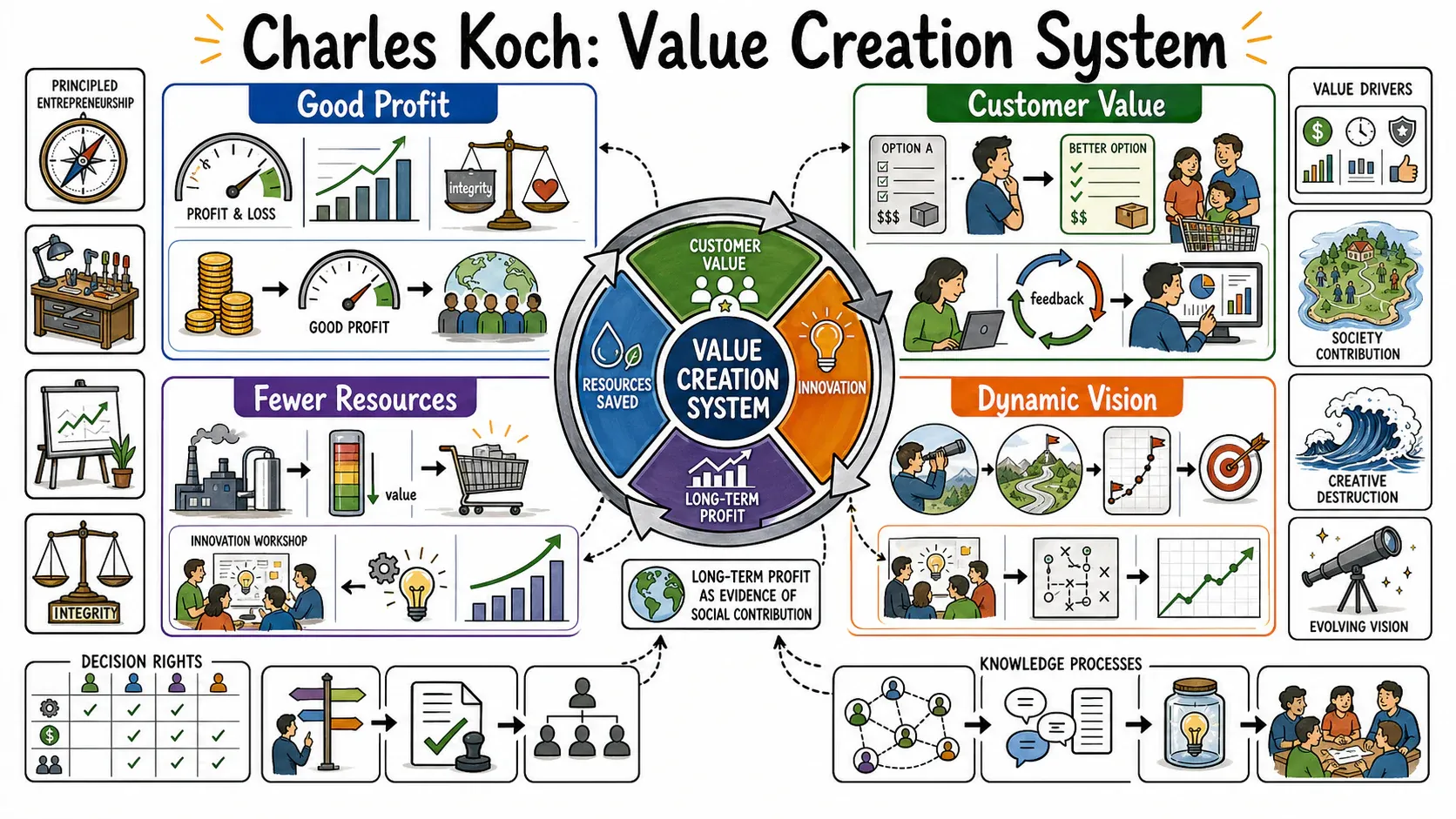
Charles Koch developed Market-Based Management at Koch Industries and wrote about its evolution into Principle Based Management. His framework emphasizes creating value for others, learning through challenge and experimentation, and helping people develop their abilities. — Charles Koch — Continually Transforming.
On Business Philosophy and Value Creation
- The Purpose of Business: Koch argues that a business should improve lives through products and services people value, while using resources responsibly and acting with integrity. — Charles Koch — Continually Transforming.
- Good Profit: Koch distinguishes profit earned by creating value for customers while using fewer resources and acting with integrity from profit gained through corporate welfare. — Charles Koch — Biography.
- Customer Value and Resources: Koch says companies create value when customers prefer their offerings to alternatives and those offerings use resources responsibly. — Koch — Our Long-Term Vision.
- Measure What Creates Value: Koch says employees need measures relevant to their work so that decisions can be guided by whether they create value, not merely by activity. — Charles Koch — Continually Transforming.
- Mutual Benefit: Koch frames durable success as a cycle in which a company builds capabilities that benefit customers and other constituencies as well as itself. — Charles Koch — Continually Transforming.
- Profit as a Conditional Signal: In Koch’s stated vision, profitability can indicate social value when the business wins customers by serving them better and uses resources responsibly; profit alone is not proof. — Charles Koch — Continually Transforming.
- Vision as a Guide: Koch calls an effective vision a continuing guide rather than a destination; it should describe a credible path grounded in the organization’s capabilities. — Charles Koch — Continually Transforming.
- Contribution Before Short-Term Gain: Koch argues that a business must keep improving what it offers customers rather than treating current profit as a reason to stop innovating. — Charles Koch — Continually Transforming.
On Success, Failure, and Humility
- Success Can Breed Hubris: Koch recounts that success in the late 1990s led his company to overestimate its capabilities and give its management principles lip service. — Charles Koch — Continually Transforming.
- Real Experimentation Includes Failure: Koch says that if experiments never fail, a company probably is not testing genuinely new possibilities. — Fortune — Charles Koch Interview.
- Invite Challenge: Koch says leaders should welcome challenges from employees because no one has all the knowledge needed to solve a problem alone. — Washington Post — Charles Koch Interview.
- Learn from Failed Ventures: Koch lists ventures that failed when his firm overestimated its capabilities or misjudged opportunities and says those failures taught difficult lessons. — Charles Koch — Continually Transforming.
- His Father’s View of Adversity: Koch reads from a letter in which his father Fred describes adversity as a potential character builder. This is Fred’s advice that Charles received, not Charles’s original maxim. — Fox News — Charles Koch Interview.
- Stay Open to Outside Knowledge: Koch warns that an organization declines when it stops learning, sharing knowledge and accepting challenge from outside its familiar view. — Washington Post — Charles Koch Interview.
- Keep Learning After Success: Koch advises continued learning and improvement even after success, rather than allowing achievement to harden into complacency. — Charles Koch — Continually Transforming.
- Hire for Humility to Be Challenged: Koch says he seeks people who will challenge ideas and accept challenges themselves, along with sound values. — Washington Post — Charles Koch Interview.
On Leadership and Management
- Hire for Values First: Koch says his company hires first for compatible values, then works to put people in roles that fit their talents and interests. — Fortune — Charles Koch Interview.
- Leaders Must Model Principles: Koch says leaders should live the principles they expect from others and foster an environment where employees can develop their abilities. — Charles Koch — Continually Transforming.
- Place Decisions Where Knowledge Lives: Koch describes centralizing some decisions and decentralizing others according to who has the relevant knowledge, then revisiting that balance through trial and error. — Freakonomics Radio — Charles Koch, Part 1.
- Culture Shapes Performance: Koch says changing a business requires changing the culture as well as making investments; he describes replacing hierarchy with challenge and employee empowerment at Georgia-Pacific. — Charles Koch — Continually Transforming.
- Reward Created Value: Koch describes rewarding employees for real value they create for customers and the company, instead of for flattering but misleading scorecards. — Charles Koch — Continually Transforming.
- Incentives Should Encourage Contribution: Koch’s framework links incentives to entrepreneurship, innovation and contributions that benefit employees, customers and the company. — Charles Koch — Continually Transforming.
- Choose Complementary Partners: Koch says strong partnerships require shared vision, shared values and complementary capabilities. — Koch — Our Long-Term Vision.
- Do Not Chase Credit: Koch says he follows the saying that there is no limit to what one can accomplish when one does not care who gets the credit; he presents it as an adopted saying, not his invention. — Washington Post — Charles Koch Interview.
- Correct Misleading Measures: Koch recounts replacing scorecards that rewarded units despite poor underlying performance with accounts reflecting actual economic value. — Charles Koch — Continually Transforming.
- Freedom with Responsibility: Koch links the opportunity to develop one’s abilities with freedom to choose and experiment, bounded by respect for other people’s rights. — Charles Koch — Continually Transforming.
On Innovation and Change
- Transform Before Change Overtakes You: Koch argues that businesses must keep improving their capabilities and offerings as customer needs and competitive alternatives change. — Charles Koch — Continually Transforming.
- Build a Challenge Culture: Koch says employees should be able to question leaders and combine diverse knowledge to find better answers, rather than deferring to rank. — Washington Post — Charles Koch Interview.
- Treat Failed Experiments as Information: Koch says trial-and-error is part of discovering what people value; a disciplined experiment can teach something even when it does not succeed. — Reason — Market-Based Manager.
On Free Markets and Cronyism
- Cronyism Restricts Competition: Koch argues that political favors for incumbents can shut out new entrepreneurs and reduce the pressure to serve customers better. — Freakonomics Radio — Charles Koch, Part 2.
- Political Privilege Can Block Entry: Koch argues that privileged incumbents and occupational restrictions can prevent new competitors and entrepreneurs from serving customers. — Washington Post — Charles Koch Interview.
- Advocate Competition Even When Costly: Koch says he favors removing special tax breaks and import barriers even when his company benefits from them; this is his stated position, not independent proof of every policy effect. — Freakonomics Radio — Charles Koch, Part 2.
- Beware Cascading Interventions: Koch argues that one policy intervention can create secondary effects that prompt further interventions, making reform harder. — Washington Post — Charles Koch Interview.
On Personal Values and Learnings
- His Father Urged Lifelong Learning: Koch recalls his father encouraging him to learn wherever he could because knowledge might prove useful later. — Washington Post — Charles Koch Interview.
- His Father Taught the Value of Work: Koch says his father taught him that work builds discipline and mutual benefit; he also recalls his father’s wish that his sons know the fulfillment of accomplishment. — Washington Post — Charles Koch Interview.
- Principles Guide Methods: Koch cites Harrington Emerson’s maxim about understanding principles before choosing methods and describes principles as the basis of his management framework. — Charles Koch — Continually Transforming.
- Fulfillment Through Contribution: Koch argues that a meaningful purpose draws on one’s abilities to benefit others, rather than merely maximizing consumption or money. — Charles Koch — Continually Transforming.
- Give People a Chance to Contribute: Koch describes supporting programs that help young people develop entrepreneurial abilities, values and a sense of purpose. — Washington Post — Charles Koch Interview.
- Respect What Others Value: Koch’s social philosophy starts from equal rights and voluntary cooperation; he links a free society to respecting individuals and the value they seek to create. — Freakonomics Radio — Charles Koch, Part 1.
- Let People Make Choices: Koch says people need room to discover, develop and apply their abilities, including the freedom to experiment and learn from mistakes. — Charles Koch — Continually Transforming.
- Practice the Values You Teach: Koch says children notice the gap between a parent’s stated values and conduct; he credits his parents for living the principles they taught. — Washington Post — Charles Koch Interview.
- Meaningful Work Is Contribution: Koch connects meaningful work with developing one’s abilities and using them to improve other people’s lives. — Charles Koch — Continually Transforming.
- Help Employees Self-Actualize: Koch describes leaders’ responsibility to help employees discover and use their abilities so work can be both fulfilling and valuable to others. — Charles Koch — Continually Transforming.
- Education Should Fit the Learner: Koch argues that education should help each student discover their aptitudes and develop the abilities and values needed to contribute. — Washington Post — Charles Koch Interview.
Learn more:
- Charles Koch, “Biography” (including Good Profit excerpts)
- Fortune, “Full Transcript of Charles Koch’s Interview with Fortune”
- Charles G. Koch, Continually Transforming Koch Industries Through Virtuous Cycles of Mutual Benefit
- The Washington Post, “Charles Koch, Unfiltered” (Direct Interview)
- Freakonomics Radio, “Why Hate the Koch Brothers? (Part 1)”
- Freakonomics Radio, “Why Hate the Koch Brothers? (Part 2)”
- Reason, “Market-Based Manager” (Charles Koch Interview)
- Koch, “Our Long-Term Vision and Purpose”
- Fox News, “A Kelly File Special: Charles Koch” (Interview and Fred Koch Letter)