Chip Wilson founded lululemon. In May 2026, lululemon announced a cooperation agreement with him that provided for two of his proposed directors to join the board. This collection examines his stated views on product, leadership, entrepreneurship and work. — lululemon–Wilson Cooperation Agreement.
Brand, Customer and Product Innovation
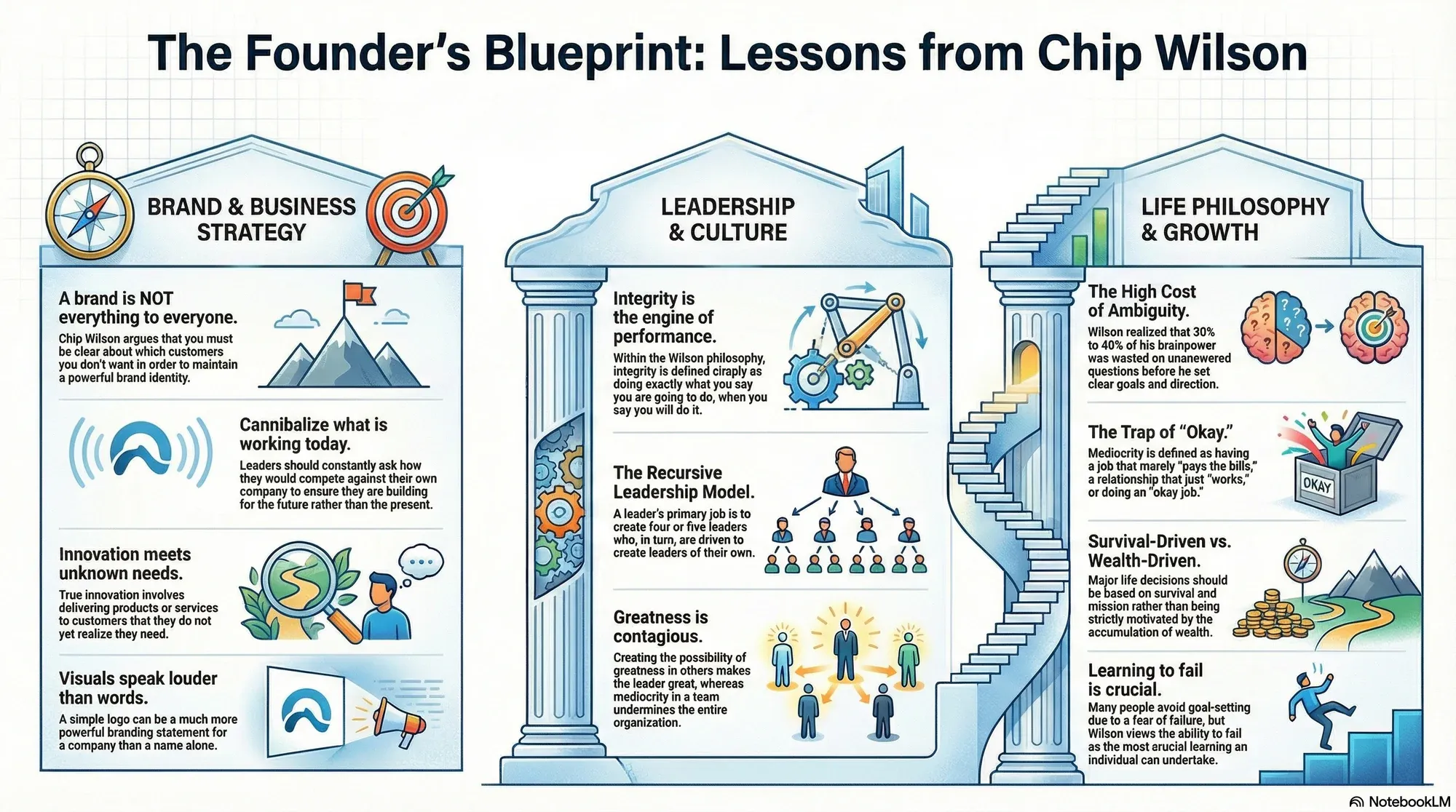
- Choose a defined customer: Wilson argues that a brand works best when it has a clear target market and resists trying to serve everyone; this is his view of positioning, not a company policy. — Tim Ferriss Show #514 Transcript.
- Challenge what is working: Wilson says he regularly asked how a competitor would attack lululemon, then reconsidered existing products and practices before they became stale. — The Story of lululemon.
- Let the logo carry the brand: Wilson describes preferring a discreet logo to a store name because he believed that subtlety matched the customer he sought. — The Story of lululemon.
- Anticipate unspoken needs: Wilson defines product innovation as delivering something customers do not yet know they need; he applies this idea to apparel design. — The Story of lululemon.
- Identify the emerging customer: Wilson says he recognized a growing cohort of educated professional women taking up yoga, then designed both the product and in-store experience around that customer. — Thought Economics Interview.
- Keep the core customer in view: In his 2026 shareholder letter, Wilson describes the core customer as a design muse and argues that losing that focus leads to brand drift. — Chip Wilson’s Shareholder Letter.
- Protect product details: Wilson argues that technical-product details matter to a premium brand and asks leadership to preserve that attention rather than optimize it away. — Chip Wilson’s Shareholder Letter.
- Leave room for creative risk: Wilson contends that prioritizing efficiency over creative experimentation can weaken an apparel brand; this is his criticism, not an established finding about current lululemon performance. — Chip Wilson’s Shareholder Letter.
- Discounting can spend brand equity: Wilson argues in a 2026 campaign statement that money given up through discounts could instead fund brand building. — Chip Wilson’s Brand Strategy Statement.
- Explain product failures: Wilson asks lululemon’s board to explain what it learned from unsuccessful launches and what changed in product oversight. — Chip Wilson’s Brand Strategy Statement.
Entrepreneurship, Strategy and Long-Term Thinking
- Entrepreneurial independence: Wilson jokes that he was too ill-suited to work for someone else and connects entrepreneurship with his need for independence. — The Story of lululemon.
- Design years ahead: Wilson describes entrepreneurs as building for a future several years away rather than only for the present. — The Story of lululemon.
- Choose direction at growth inflections: Wilson recounts how lululemon’s growth forced him to decide whether it would remain local or become a larger international brand. — The Story of lululemon.
- Experiment instead of only taking safe bets: Wilson argues that a creative board should permit experimentation, iteration and discarding failed ideas rather than treating safe bets as the only responsible choice. — Chip Wilson’s Shareholder Letter.
- Make optimism conditional on change: During his 2026 campaign, Wilson said lululemon’s best years could lie ahead if strategic and governance changes were made quickly. — Chip Wilson’s Campaign Statement.
Leadership, Governance and Culture
- Make commitments operational: Wilson explains his adopted integrity standard as doing what one promised by the agreed time and taking responsibility when a commitment cannot be met. — Tim Ferriss Show #514 Transcript.
- Develop leaders who develop others: Wilson describes investing in employees so they could become leaders themselves and then develop the people around them. — The Story of lululemon.
- Treat transformation as Wilson’s philosophy: Wilson says personal development can help employees lead themselves, their families and communities; this is his leadership philosophy, not a measured universal outcome. — The Story of lululemon.
- Make greatness a cultural aim: Wilson lists developing people and resisting mediocrity among lululemon’s original core values, while noting that those values were written in 1998. — The Story of lululemon.
- Match a CEO with a capable board: In a 2026 open letter, Wilson argues that a qualified CEO needs a board with the product and creative experience to support and challenge the company’s vision. — Chip Wilson’s CEO and Board Letter.
- Plan for internal succession: Wilson faults the board’s CEO succession planning and asks how it will support internal talent and the next generation of leadership. — Chip Wilson’s CEO and Board Letter.
Personal Growth, Goals and Meaningful Work
- An epigraph on meaningful work: Wilson opens his memoir with a Jim Collins passage about meaningful work; it is Collins’s wording, selected as an epigraph, not a quotation spoken by Wilson. — The Story of lululemon.
- Survival before wealth: Wilson says many of his decisions were driven by survival rather than wealth and describes the security he felt after selling a stake in the company. — The Story of lululemon.
- Accept help before burnout: Wilson reflects that trying to manage Westbeach alone led to mistakes, and that committed colleagues often wanted to help. — The Story of lululemon.
- Use goals to create direction: Wilson describes setting concrete goals for himself and lululemon employees; the original 30–40% brainpower claim has no verified primary match and is removed. — The Story of lululemon.
- Give full effort to avoid regret: Wilson tells Ferriss that giving full effort, despite a greater chance of failure, matters to him because he does not want to regret holding back. — Tim Ferriss Show #514 Transcript.
- Learn from stretch-goal failure: Wilson argues that people should set specific goals and learn from missing ambitious ones rather than avoid goals out of fear of failure. — The Story of lululemon.
- Practice attention to the present: Wilson links lessons from competitive swimming and his father to the idea that the present moment is where life occurs. — The Story of lululemon.
Learn more:
- lululemon Enters into Cooperation Agreement with Chip Wilson (May 27, 2026)
- Chip Wilson on Building lululemon and Athleisure — Thought Economics
- The Tim Ferriss Show #514: Chip Wilson — Full Interview Transcript
- The Story of lululemon by Founder Chip Wilson (2021 PDF)
- Chip Wilson Issues Letter to lululemon Shareholders (May 6, 2026)
- Chip Wilson Launches Campaign for Change at lululemon (March 5, 2026)
- Chip Wilson Puts Focus on lululemon’s Brand and Creative Strategy (March 17, 2026)
- Chip Wilson to lululemon CEO Candidates: Beware a Board Unfit to Support Visionary Leadership (March 12, 2026)