Lessons from Chris Blattman
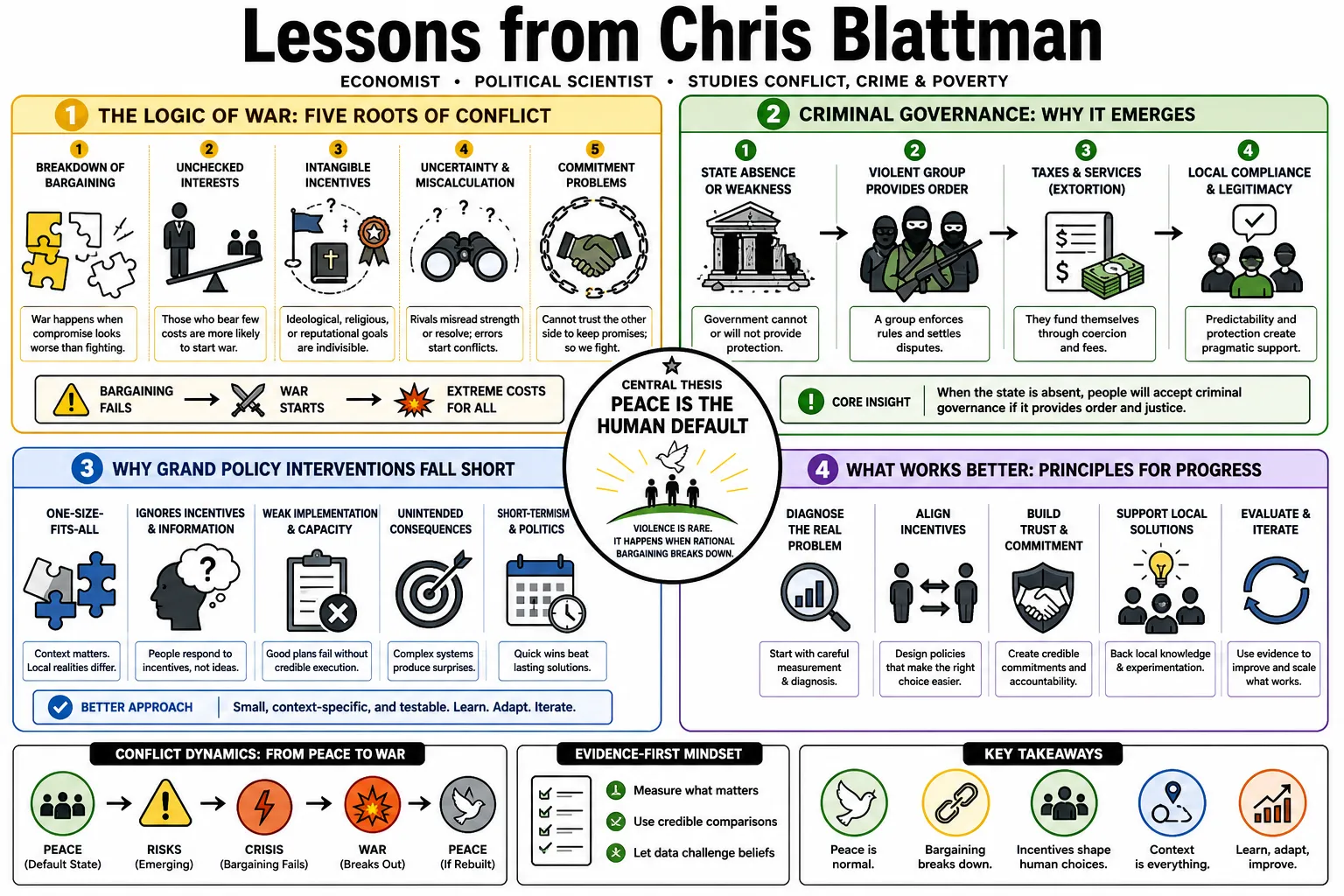
Chris Blattman is an economist and political scientist whose research examines conflict, crime, and poverty. In Why We Fight, he argues that the costs of fighting usually favor compromise, then identifies five mechanisms that can make violence occur despite those costs. — Why We Fight.
Part 1: The Logic of War and the Five Roots of Conflict
- Why Bargaining Usually Wins: Because fighting destroys lives and resources, rivals usually have room to reach a settlement each prefers to war. Blattman studies the mechanisms that can close that bargaining space. — 80,000 Hours interview.
- Unchecked Interests: When a small group can choose war without bearing its full costs, its private incentives may diverge from the people who will suffer most from fighting. — Conversations with Tyler interview.
- Intangible Incentives: Some political or moral commitments matter enough to people that they may knowingly reject a materially advantageous compromise; this is not necessarily a bargaining mistake. — 80,000 Hours interview.
- Uncertainty: Uncertainty about an adversary's strength or resolve can make a settlement harder to identify and can sometimes make escalation look strategically useful. — 80,000 Hours interview.
- Commitment Problems: If one side expects the balance of power to shift, it may doubt that a future-stronger rival can credibly promise not to exploit its advantage later. — 80,000 Hours interview.
- Misperceptions: Biases in how leaders or groups interpret an opponent can contribute to conflict, though Blattman cautions that evidence for specific biases is uneven and their effects in organizations remain poorly understood. — 80,000 Hours interview.
- Look Beyond Accidents and Emotion: Blattman's framework asks analysts to look for strategic, ideological, and institutional pressures behind violence, rather than explain war only as accident or passion. — Why We Fight.
- Study the Conflicts That Stayed Peaceful: To identify why some rivalries become wars, compare them with hostile rivalries that did not fight; otherwise shared grievances can be mistaken for causes. — The Roots of War.
- The News Makes War Salient: Visible wars draw attention while many tense disputes end without fighting, which can distort our sense of how often violence occurs. — 80,000 Hours interview.
Part 2: The Gravitational Pull of Peace
- War Costs Pull Toward Peace: The expected loss of lives and resources from fighting creates a strong incentive for rivals to settle their differences without war. — 80,000 Hours interview.
- Hostility Without War: Rivals can remain deeply opposed while avoiding violence; peace in Blattman's account often means grudging coexistence, not friendship. — Why We Fight.
- Deterrence Has a Dark Side: More destructive weapons can make rivals less willing to fight, but if conflict occurs, they can make the outcome far worse. — 80,000 Hours interview.
Part 3: Peacemeal Engineering and Incremental Change
- Tinker With the Causes of Fighting: Blattman argues that peacemakers can make compromise more likely by targeting the specific mechanisms pushing rivals toward violence, often through incremental adjustments. — Why We Fight.
- Be Cautious With Grand Plans: Blattman warns that sweeping development plans can create unexpected harms, while acknowledging that larger-scale planning can work in some contexts; the relevant lesson is humility about risks. — Blattman on development planning.
- Piecemeal Engineering in Fragile States: Where conflict drivers and policy effects are poorly understood, Blattman recommends small-scale trials and a process for learning and adapting before scaling. — Blattman on fragile-state aid.
- Learn From Failed Trials: Testing policy is useful only if governments and aid organizations use the results to revise or stop programs that do not work. — Blattman on development reform.
- Understand Local Conflict: Blattman argues that outside peacebuilding can miss neighborhood-level tensions; in the settings he studied, locally led initiatives deserved better information and steadier support. — Peacebuilding from the Bottom Up.
- Target the Mechanism: A peace intervention should ask which of Blattman's five mechanisms is blocking compromise, then address that specific obstacle rather than assume the same remedy fits every conflict. — Why We Fight.
- Ask About Process Before Program: In fragile settings where the causes of conflict and effects of aid are uncertain, Blattman argues that agencies need a way to learn and change course before choosing a fixed program. — Blattman on fragile-state aid.
Part 4: Unconditional Cash Transfers and Poverty Relief
- Cash Can Unlock Productive Work: In Uganda's Youth Opportunities Program, grants enabled many young adults to enter skilled trades and raised earnings over four years; a later follow-up found those income gains had faded by year nine. — Nine-year Uganda grants study.
- Cash as a Benchmark: Blattman proposes comparing many poverty programs with the cost and outcomes of giving cash, while acknowledging that other interventions can outperform it, especially for public goods or market failures. — Are Cash Transfers Overrated?.
- Test Paternalistic Fears: In the cash-transfer studies Blattman and Niehaus reviewed, fears that recipients would routinely waste grants were not supported; even the studied high-risk Liberian men mostly spent them on necessities or small businesses. — Show Them the Money.
- Recipients Choose Different Investments: The Ugandan grant recipients studied bought tools and materials for skilled trades, while evidence from other cash programs shows spending on necessities such as food and shelter. Cash lets needs vary across households. — Show Them the Money.
- Let Recipients Choose When Appropriate: Direct transfers let people choose among their own priorities, often using information outside donors lack; Blattman and Niehaus still identify public goods that cash alone may not provide. — Show Them the Money.
- Make Costly Add-ons Earn Their Place: When programs add expensive training or supervision, Blattman argues that their extra benefits should be tested against their costs and against simpler cash-based alternatives. — Blattman on aid paternalism.
- Follow Outcomes Long Enough: Short-run gains need long-run checks: Uganda's grants raised earnings at four years, but treatment and control incomes converged by year nine even as some asset and skilled-work effects remained. — Nine-year Uganda grants study.
- Cash Depends on Context: Cash grants may work well where people lack capital for productive work, but they are not a substitute for every public good and small trials do not establish what will happen at national scale. — Show Them the Money.
- Count the Full Cost of Aid: Comparing an in-kind program with direct cash makes its procurement, delivery and supervision costs visible, giving donors a better basis for judging value. — Show Them the Money.
Part 5: Gangs, Cartels, and Criminal Governance
- Diagnose the City Before Copying Policy: Organized crime differs sharply across cities; a tactic suited to dispersed offenders may fail where hierarchical gangs govern neighborhoods. — Criminal Malpractice white paper.
- Organizational Form Matters: Blattman distinguishes atomized offenders, neighborhood gangs, confederations and city-level cartels because each structure creates different incentives and policy responses. — Criminal Malpractice white paper.
- Follow the Revenue: A gang's main revenue source—such as local drug sales or extortion—helps explain how it organizes and when it may prefer restraint or violence. — Criminal Malpractice white paper.
- The Cartel Peace Trade-off: City-wide criminal coordination can suppress gang wars, but the resulting stability may also strengthen extortion, monopoly pricing and political influence. — Blattman on criminal peace.
- Why Gangs Govern: In Medellín, gangs sometimes settle disputes and provide security partly to protect drug rents and civilian loyalty; stronger state presence did not automatically displace those services. — Gang Rule study.
- Extortion Follows Territorial Control: In some urban criminal systems, gangs use territorial control and threats to charge households and businesses; Blattman treats this as a distinct, often unpopular revenue source. — Criminal Malpractice white paper.
- Fragmentation Can Backfire: Breaking a criminal hierarchy can provoke succession fights and localized retaliation, although Blattman notes that the long-run effect varies by city and intervention. — Criminal Malpractice white paper.
- Expect Strategic Adaptation: Even a well-diagnosed intervention may lose effectiveness as criminal groups adjust, so cities need repeated measurement and policy revision. — Criminal Malpractice white paper.
- Leader Arrests Have Mixed Effects: Removing criminal leaders can spark short-run succession violence, yet Blattman cautions that the longer-term consequences depend on local organization and how enforcement is carried out. — Criminal Malpractice white paper.
- Map the Criminal System: Before choosing a security intervention, identify who controls local territory, how groups earn revenue and how they coordinate; those features shape likely responses. — Criminal Malpractice white paper.
Part 6: Crime, Violence, and Behavioral Constraints
- Poverty Is Not the Whole Intervention: In a Liberia trial among 999 high-risk men, the researchers tested behavioral therapy alongside cash, treating self-regulation and identity as possible levers beyond changing economic incentives. — Reducing Crime and Violence trial.
- Train Self-Control and Planning: The Liberia therapy curriculum focused on forward-looking behavior, planning and self-control; those were intervention targets, not a universal explanation for violence. — Reducing Crime and Violence trial.
- Therapy Can Reduce Antisocial Behavior: In the Liberia study, men offered cognitive behavioral therapy were less likely than controls to report several antisocial behaviors ten years later; the result belongs to this high-risk sample. — Ten-year CBT follow-up.
- Pair Therapy With Cash Carefully: In the initial Liberia trial, therapy followed by a cash grant sustained lower antisocial behavior after a year; the proposed mechanism—that cash gave men time to practice new habits—remained a hypothesis. — Reducing Crime and Violence trial.
- Target the Highest-Risk Participants: The ten-year follow-up found that impacts were concentrated among men at highest initial risk, with the most robust results in the therapy-plus-cash arm. — Ten-year CBT follow-up.
- Practice a Different Social Identity: The STYL curriculum encouraged men to imagine and rehearse a noncriminal identity through ordinary interactions and more cooperative behavior; this describes the intervention, not proof that every participant changed identity. — Reducing Crime and Violence trial.
- Practice Emotional Regulation: The intervention taught planning, reflection and control of emotions and impulses as skills to practice, rather than assuming a single de-escalation technique would prevent violence everywhere. — Reducing Crime and Violence trial.
- Interrupt Automatic Responses: Cognitive behavioral therapy in the Liberia study aimed to make harmful automatic thoughts more visible and to replace them through repeated practice of alternative responses. — Reducing Crime and Violence trial.
- Long-Term Effects Are Possible: The Liberia follow-up found lower reported antisocial behavior in therapy arms about a decade later, especially when therapy was paired with cash; it did not establish permanent change in all settings. — Ten-year CBT follow-up.
Part 7: State Capacity and Urban Policing
- Watch for Nearby Displacement: In a Bogotá trial, intensified patrols and services produced no meaningful overall crime reduction; estimates suggested some property crime moved nearby, though that spillover estimate was uncertain. — Place-Based Interventions at Scale.
- Civilian Presence Is Not an Automatic Fix: A 20-month Medellín experiment greatly increased nonpolice state presence, yet found negligible average gains in perceived security or state legitimacy. — State-Building in the City.
- Initial Governance Matters: Medellín’s state-building experiment found gains in perceived security and legitimacy only in neighborhoods where state governance started relatively stronger. — State-Building in the City.
- Understand Why Gangs Govern: Interviews with Medellín gangs suggest local rule can keep police out and sustain civilian loyalty around other business lines; state presence alone did not crowd out gang governance. — Gang Rule study.
- Test Combined Services, Too: Bogotá randomized both extra police patrols and municipal services, alone and together; the package did not produce a meaningful aggregate crime reduction in that setting. — Place-Based Interventions at Scale.
- Build the Capacity to Learn: Blattman argues that security policy needs local diagnosis, implementation capacity and trial-and-error learning; even a careful initial diagnosis can be wrong. — Criminal Malpractice white paper.
Part 8: The Limits and Practice of Social Science
- Average Effects Can Hide Policy Fit: Blattman argues that reviews of crime programs often focus on average effects while saying too little about the criminal structures and local capacities needed for an intervention to work. — Criminal Malpractice white paper.
- Expect to Learn From Surprise: Blattman says his field experiments often ended differently than he expected; he argues that governments should use those surprises to revise and discard weak programs. — Mistakes Made by Development Reformers.
- Test Ideas, Not Only Packages: Blattman argues that randomized evaluations are most informative when they test the assumptions behind a program, rather than only asking whether the whole package worked in one place. — Evaluating Ideas, Not Programs.
- State the Strength of the Evidence: When discussing misperceptions in conflict, Blattman distinguishes the strength of the conceptual case from the more suggestive psychological evidence. — 80,000 Hours interview.
- Take Local Politics Seriously: Blattman argues that reform proposals should account for the institutions and political conditions actually in place, then adapt through implementation. — Mistakes Made by Development Reformers.
- Triangulate Rather Than Trust One Story: Blattman describes weighing theory, historical cases and empirical research together when judging which psychological biases might matter in conflict. — 80,000 Hours interview.