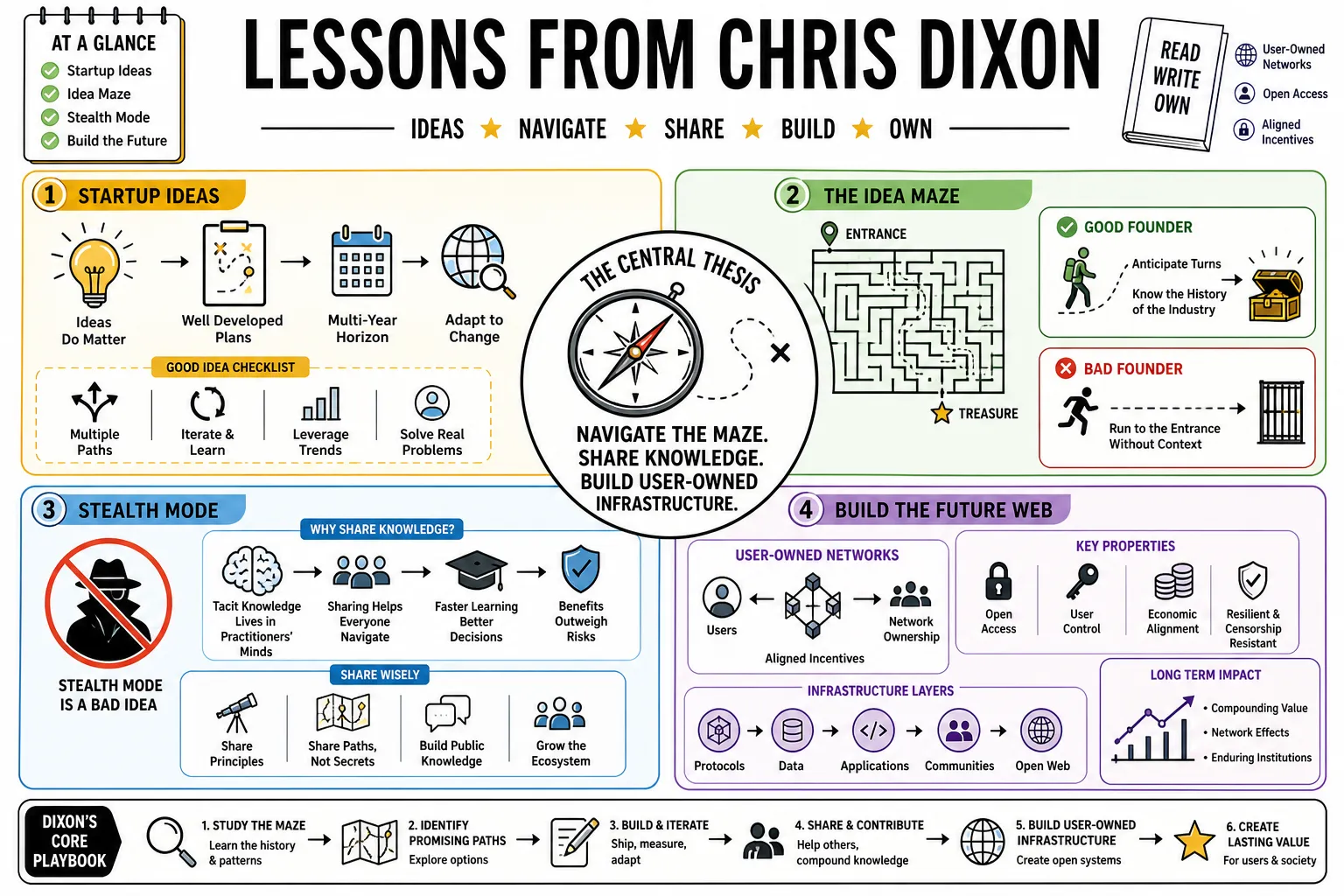
Lessons from Chris Dixon
Chris Dixon has been a venture investor at Andreessen Horowitz and wrote about startup idea mazes and emerging internet technologies. He is the author of Read Write Own. These existing lessons cover his writing on startups, venture investing, technology adoption, and network ownership. — Read Write Own Announcement. — The Idea Maze.
Part 1: Startups & The Idea Maze
- On Startup Ideas: Dixon argues that strong startup ideas are developed plans spanning years and multiple possible paths, not isolated eureka moments. — The Idea Maze.
- On The Idea Maze: Dixon uses Balaji Srinivasan’s idea-maze metaphor to emphasize studying an industry’s history, players, prior failures and changing technologies before committing to a path. — The Idea Maze.
- On Stealth Mode: He advises founders to learn from practitioners and earlier attempts rather than stay in stealth out of fear that an idea will be stolen. — The Idea Maze.
- On Non-Consensus Ideas: Dixon says broad enthusiasm for an early idea can be a warning that it is not sufficiently forward-looking; he does not treat initial skepticism as automatic validation. — Startup Idea Secrecy.
- On Pivot Psychology: An idea maze changes as technologies, distribution and competitors change. Dixon recommends mapping plausible paths and revising them as new information arrives. — The Idea Maze.
- On Building Moats: Dixon argues that an end-to-end product can bypass incumbent resistance and, if executed well, assemble interlocking capabilities that are difficult to copy. — The Full-Stack Startup.
- On Early Adopters: For a user-generated network, Dixon recommends starting with a connected community whose need is strong enough to tolerate an initially sparse product. — The Bowling Pin Strategy.
- On Founder Resilience: Dixon cautions that apparent overnight successes often endured years of weak traction; founders may need to survive long enough for the product to work. — The Myth of the Overnight Success.
- On Competition: He considers time spent pursuing the wrong path a more serious risk than nearby startups exploring the same idea maze. — The Idea Maze.
- On Market Timing: Dixon argues that timing depends on enabling conditions such as broadband and distribution, and recommends longer runway when betting on an emerging trend. — Timing Your Startup.
Part 2: Venture Capital & Investing Mental Models
- On The Babe Ruth Effect: Dixon’s venture-return analysis shows that exceptional funds have larger winning investments, even while accepting many losses. — The Babe Ruth Effect.
- On Skewed Returns: In historical Horsley Bridge data Dixon examined, about 6% of investments produced about 60% of aggregate returns—a striking example of skew, not a universal rule. — The Babe Ruth Effect.
- On Judging Potential: He advises judging an early technology by the forces likely to improve it over time, not only by its initial feature set. — The Next Big Thing Starts as a Toy.
- On Contrarian Investing: Dixon uses Google’s early search strategy to illustrate Reid Hoffman’s idea of an accurate contrarian theory: a non-obvious business hypothesis must also be right. — Accurate Contrarian Theories.
- On Founder Intuition: Dixon values founders who deeply understand and continue to care about their market; that fit can be built through experience and research. — Founder/Market Fit.
- On Market Size: For new markets, Dixon argues that a plausible narrative about a broad secular trend is more informative than a speculative bottom-up spreadsheet. — Sizing Markets with Narratives.
- On Optionality: Dixon describes an option for product evolution: attract people with a useful standalone tool, then build a network that creates longer-term value and defensibility. — Come for the Tool, Stay for the Network.
- On Tech Cycles: Dixon separates volatile financial sentiment from longer product cycles, in which enthusiast experimentation can precede mainstream growth. — Toys, Secrets, and Cycles.
- On Early Flaws: An early product can look inadequate yet improve as components and infrastructure advance; Dixon warns that not every toy becomes disruptive. — The Next Big Thing Starts as a Toy.
Part 3: Technology Adoption & Toys
- On The Next Big Thing: Dixon argues that important technologies can initially look like toys to incumbents because they undershoot mainstream needs. — The Next Big Thing Starts as a Toy.
- On Hobbies: He treats technically curious people’s weekend projects as potential seeds of future industries, while presenting this as a heuristic rather than a guarantee. — Weekend Hobbies and Future Industries.
- On Dismissive Critics: Incumbents can underestimate a product by comparing its current limitations with mature offerings instead of its likely improvement path. — The Next Big Thing Starts as a Toy.
- On Sustaining vs. Disruptive Tech: Dixon distinguishes disruptive technologies, which initially undershoot customers’ needs, from sustaining technologies that are useful immediately but easier for incumbents to copy or acquire. — The Next Big Thing Starts as a Toy.
- On Weekend Projects: In Dixon’s account, enthusiasts often explore a product category on nights and weekends before technology, talent and community knowledge make mainstream adoption possible. — Toys, Secrets, and Cycles.
- On Microcomputers: Dixon cites mainframe companies’ dismissal of the microcomputer as an example of incumbents missing a technology that later improved beyond its early limitations. — The Next Big Thing Starts as a Toy.
- On Open Source: Dixon identifies open-source software among technologies that often began with hobbyists; the lesson is to watch experiments outside formal corporate roadmaps. — Weekend Hobbies and Future Industries.
- On Niche Communities: Dixon suggests that an initial community should have frequent interaction and a particularly strong need, so members will help a thin early network reach critical mass. — The Bowling Pin Strategy.
- On Compounding Improvements: Dixon says external improvements such as cheaper chips, wider bandwidth and better mobile devices can lift an initially toy-like product toward useful performance. — The Next Big Thing Starts as a Toy.
Part 4: Decentralization & Network Lifecycles
- On Why Decentralization Matters: Dixon argues that centralized platforms often attract users and partners first, then use their growing power to extract data or compete with those partners. — Why Decentralization Matters.
- On Platform Bait-and-Switch: The shift from cooperation to competition on a centralized platform can feel like a bait-and-switch to developers and creators who built on it. — Why Decentralization Matters.
- On Network Effects: Dixon proposes temporary token rewards as one way to attract early network participants before a service’s own utility and network effects are strong. — Token Incentives and Networks.
- On Trust: Dixon argues that open-source rules, community governance and the ability to exit or fork can constrain a cryptonetwork operator more than a corporate platform. — Why Decentralization Matters.
- On the Developer Exodus: In Dixon’s account, developers and investors can become wary of building on a platform that may later compete with or restrict them. — Why Decentralization Matters.
- On Protocol Innovation: Dixon argues that open networks can improve through contributions from independent developers, applications and service providers, though this depends on attracting them. — Why Decentralization Matters.
- On Web2 Monopolies: Dixon’s thesis is that concentrated corporate control can weaken the open internet’s incentives for independent builders; blockchain networks are his proposed counterweight. — Read Write Own Announcement.
- On Digital Governance: Dixon describes blockchain rules as network constitutions: designers can encode commitments that participants can inspect and debate. — Read Write Own Excerpts.
- On The Take Rate: Dixon uses platform take rates to show how intermediaries divide value with creators, and argues that lower-fee network designs could change that balance. — Conversations with Tyler.
Part 5: Blockchain & The Computer vs. Casino
- On Two Crypto Cultures: Dixon distinguishes a computer culture focused on building networks from a casino culture focused on speculation; he argues the latter should not define the technology. — Read Write Own Excerpts.
- On Financial Infrastructure: Dixon identifies payments and financial services as nearer-term areas where he expects blockchain adoption, while acknowledging that many consumer-network use cases remain uncertain. — Conversations with Tyler.
- On Tokens as Primitives: Dixon argues that fungible tokens and NFTs are flexible digital building blocks that can represent many kinds of value, access and ownership, beyond trading or digital art. — Tokens as Digital Primitives.
- On Blockchain's Core Utility: Dixon believes blockchains offer a plausible route to sustaining an open internet that rewards creativity and entrepreneurship; this is his investment thesis, not an established necessity. — Read Write Own Announcement.
- On Smart Contracts: Dixon describes smart contracts as code that can administer a blockchain network’s rules and resources without a conventional corporate intermediary. — Conversations with Tyler.
- On The Gap in Perception: Dixon calls blockchains a non-consensus technology bet: he sees architectural potential that many established tech voices dismiss. — Read Write Own Excerpts.
- On Statefulness: Dixon contrasts early internet protocols with cryptonetworks that maintain shared state and can enforce programmable rules and incentives. — Why Decentralization Matters.
- On Building During Bear Markets: During a financial downturn, Dixon recommends preserving capital while staying focused on the longer product cycle rather than treating negative sentiment as the end of innovation. — Toys, Secrets, and Cycles.
- On Composability: Dixon argues that composability lets developers reuse open components, allowing work by one team to become a building block for others. — Conversations with Tyler.
Part 6: The Evolution of the Internet
- On The Read Era: Dixon describes an early read era that widened access to information through open internet protocols. — Read Write Own Announcement.
- On The Read-Write Era: In Dixon’s read-write era, corporate services made publishing and interaction much easier while accumulating control over the resulting networks. — Read Write Own Announcement.
- On The Read-Write-Own Era: Dixon’s proposed read-write-own era would combine modern internet functionality with user and builder ownership mediated by tokens. — Why Web3 Matters.
- On Internet Architecture: Dixon argues that early choices in network architecture influence who can participate and where economic and governance power accumulates. — Read Write Own Excerpts.
- On Technological Pendulums: Dixon frames internet development as shifts among open protocols, centralized corporate services and a proposed user-owned architecture, not an inevitable recurring pendulum. — Why Web3 Matters.
- On the Cost of Centralization: Dixon credits corporate platforms with better services while warning that their control over audiences, data and rules imposes costs on independent builders. — Why Decentralization Matters.
- On Code as Law: Dixon argues that blockchains can encode enforceable network rules, in contrast to platform terms that a controlling company can change unilaterally. — Read Write Own Excerpts.
- On The Promise of Web3: Dixon advocates blockchain networks as a way to give users and builders more ownership and influence over the internet services they help create. — Read Write Own Announcement.
Part 7: Creators, Ownership & The Passion Economy
- On Digital Ownership: Dixon uses familiar property-rights analogies to argue that people should be able to own and carry digital objects rather than merely rent them within one app. — Read Write Own Excerpts.
- On True Fans: Building on Kevin Kelly’s thousand-true-fans thesis, Dixon argues that direct fan payments and low-intermediary models can let some creators sustain a living without a mass audience. — NFTs and a Thousand True Fans.
- On Rent-Seeking: Dixon argues that powerful creator platforms can place themselves between artists and audiences and keep a significant share of the revenue. — NFTs and a Thousand True Fans.
- On Portability: Dixon describes tokens as portable digital objects that users can hold in a wallet and potentially bring across compatible applications. — Tokens as Digital Primitives.
- On NFTs as Primitives: Dixon treats NFTs as flexible digital-property primitives, not merely art collectibles; they can represent many kinds of media, access and in-app objects. — Tokens as Digital Primitives.
- On Removing Intermediaries: Dixon proposes that NFTs can improve creator economics by reducing intermediaries, enabling more pricing tiers and giving fans an ownership stake. — NFTs and a Thousand True Fans.
- On Audience Building: Dixon contrasts platform-held followers and game items with his proposed model of user-controlled inventories that can move between services. — Conversations with Tyler.
- On Community Ownership: Dixon argues that token ownership can give early participants a stake in a network’s success and a stronger incentive to contribute. — Why Web3 Matters.
- On the Creator Middle Class: Dixon sees low-fee direct relationships and token-based ownership as potential routes for more creators to earn a living; he does not claim that this outcome is already universal. — NFTs and a Thousand True Fans.
Part 8: Founder Psychology & Career Strategy
- On Career Choices: Dixon warns that incremental progress in an ill-fitting field can keep ambitious people on the wrong career path; early exploration can reveal a better hill. — Some Lessons Learned.
- On Intellectual Honesty: Dixon urges founders to be honest about their own weaknesses and recruit complementary people rather than assume they can personally solve every startup risk. — Founder/Market Fit.
- On Persistence: Dixon cautions that many apparent overnight successes followed years of struggle, so founders should not mistake an early slow start for proof of failure. — The Myth of the Overnight Success.
- On Asymmetric Bets: Dixon says some career and startup opportunities have winner-take-best-outcome payoffs, making ambitious attempts worthwhile even when many attempts are rejected. — Some Lessons Learned.
- On Curiosity: Dixon pays attention to projects technically curious people pursue voluntarily, treating their unconstrained interest as a clue to future product categories. — Weekend Hobbies and Future Industries.
- On Execution vs. Idea: Dixon rejects both the eureka-moment myth and the claim that ideas do not matter: founders must develop the idea through years of work and changing information. — The Idea Maze.