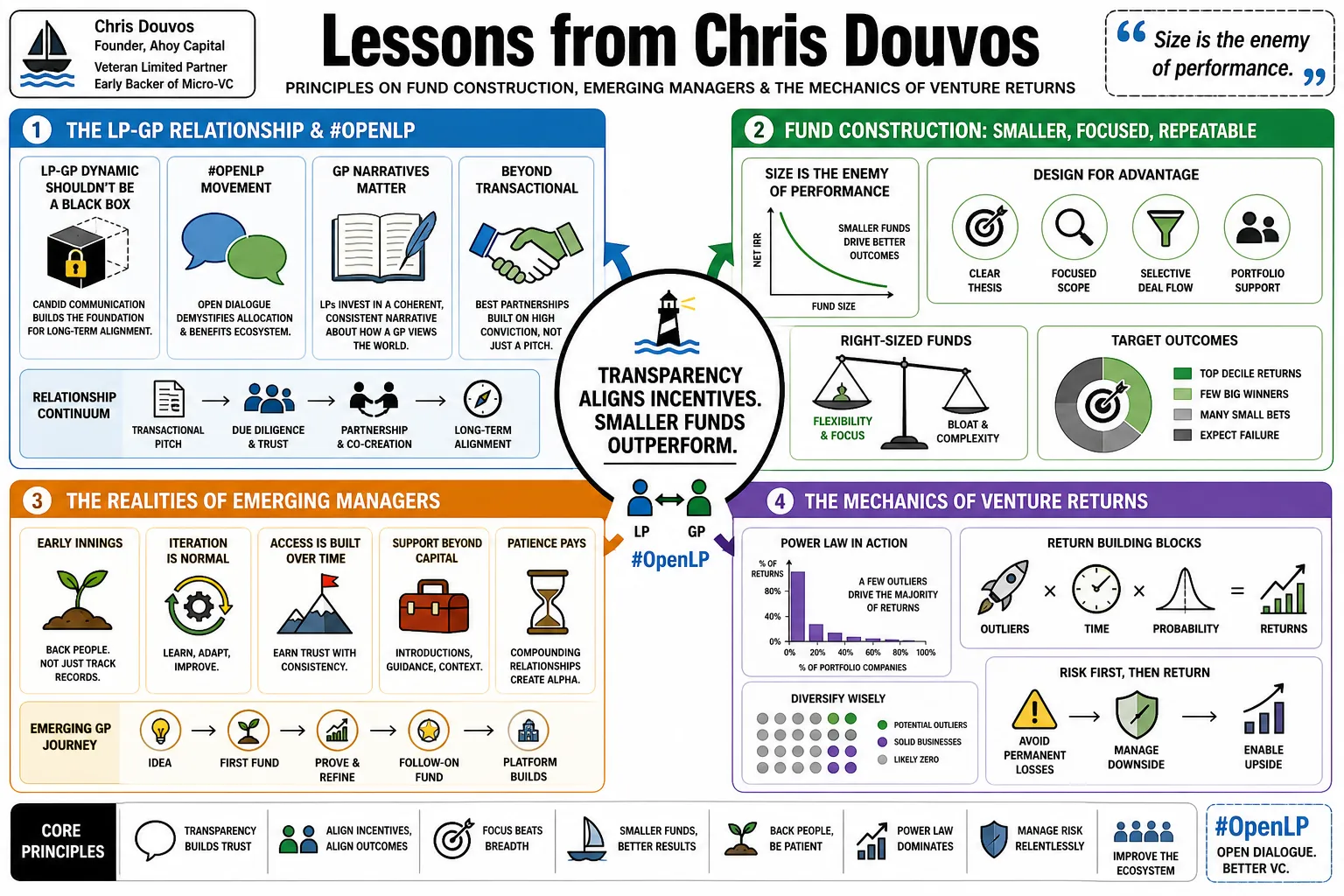
Lessons from Chris Douvos
Chris Douvos founded Ahoy Capital after years as a venture limited partner and early micro-VC backer. He co-founded OpenLP to improve understanding between GPs and LPs; his writing emphasizes fund-size discipline, manager selection and long-duration partnerships. — EVCA LP Spotlight.
Part 1: The LP-GP Relationship & #OpenLP
- On Transparency: When a fund struggles, Douvos urges GPs to acknowledge mistakes directly; transparent dialogue supports the long LP–GP relationship. — DC-8s and Tigers and GPs!.
- On the #OpenLP Movement: Douvos and Beezer Clarkson helped launch OpenLP to foster understanding among entrepreneurs, GPs and LPs. — The Money Behind the Money.
- On GP Narratives: Douvos wants GP updates to explain what happened to previously discussed portfolio companies and how the investment hypotheses evolved, not just introduce fresh winners. — Superclusters El Pack.
- On Transactional Relationships: Douvos argues that sustained, high-trust LP–GP relationships can provide more than the minimum rights in fund documents. — Moving Parts.
- On the Principal-Agent Problem: Douvos asks emerging managers to understand whether an LP behaves like a long-term principal or is merely rewarded for taking meetings. — Swimming with Allocators.
- On Bad News: Douvos tells GPs facing trouble to be straightforward about errors rather than offer only excuses for a weak fund. — DC-8s and Tigers and GPs!.
- On LP Empathy: In a downturn, Douvos asks GPs to consider an LP's liquidity constraints before calling capital without a compelling investment opportunity. — Full Ratchet Crisis Coverage.
- On Fund Reporting: Douvos criticizes upbeat quarterly letters that obscure difficult portfolio developments; he wants updates that show progress and setbacks over time. — Superclusters El Pack.
- On Reference Calls: Douvos uses off-list reference calls to form an independent view of managers rather than rely solely on their chosen contacts. — The ’86 Mets of Investing.
Part 2: Fund Sizing & "Diworseification"
- On Performance: Douvos's fund arithmetic shows that a large early-stage fund needs correspondingly large exits and sufficient ownership to deliver an attractive net multiple; size is a constraint, not an absolute verdict. — Justify My Love.
- On Right-Sizing: Douvos describes Ahoy as intentionally right-sized for investment excellence and partnership with its constituencies. — EVCA LP Spotlight.
- On Over-Capitalization: Douvos argues that conviction should drive meaningful concentration; excessive diversification can dilute the effect of the best manager decisions. — Superclusters LP Game Show.
- On Micro-VC: Douvos backed micro-VC because capital-efficient startups and nimble early investors created a gap that smaller funds could exploit; modest exits could still matter to small funds. — Summertime and Micro-VC.
- On Strategy Drift: Douvos asks how a GP's move into later investment stages fits the fund's original expertise and LP expectations. — Superclusters El Pack.
- On Discipline: Douvos's size analysis suggests GPs should test a proposed fund size against plausible exit outcomes and ownership, not growth in assets alone. — Justify My Love.
- On The Solo GP: Douvos evaluates solo GPs by their commitment and behavior; he distinguishes enduring investors from people attracted to temporary deal-flow monetization. — How I Invest: Chris Douvos.
Part 3: Value vs. Perception in Venture
- On The Formula for Opportunity: Douvos uses opportunity as value minus perception to distinguish intrinsic prospects from market enthusiasm; he does not claim certainty about who coined the formula. — Secondhand Flowers.
- On Market Hype: Douvos warns that Silicon Valley self-promotion can push valuations ahead of a startup's medium-term fundamentals. — Ability, Sensibility, Repeatability, and Authenticity.
- On Contrarianism: Douvos favors investors who form their own thesis and accept the career risk of being wrong and alone over copying consensus. — Over-Done Diligence.
- On Price Sensitivity: Douvos argues that richly priced private companies can leave less prospective upside for their eventual public-market buyers. — Secondhand Flowers.
- On Heat-Seeking Missiles: Douvos cautions that reactive, crowd-following diligence can substitute borrowed opinions for an investor's own thesis. — Over-Done Diligence.
- On Fundamentals: Douvos expects a final acquirer or public investor to value a company with reference to fundamentals, not hype alone. — Ability, Sensibility, Repeatability, and Authenticity.
- On Valuation Discipline: Douvos treats valuation as the expression of market perception, which can narrow an otherwise attractive investment opportunity. — Secondhand Flowers.
Part 4: The Realities of Being an Emerging Manager
- On The Hustle: Douvos warns emerging managers that raising a first fund often takes longer and yields less capital than expected. — EVCA LP Spotlight.
- On Specialization: Douvos and Clarkson ask GPs to articulate a durable edge—potentially geographic, thematic, sectoral or organizational—rather than assume every fund needs the same specialization. — The Money Behind the Money.
- On Track Records: Douvos weighs manager motivations, strategy fit and the existing portfolio before treating performance, which he calls a lagging indicator, as proof of skill. — The ’86 Mets of Investing.
- On Sourcing: Douvos looks for a repeatable unfair advantage or ecosystem that helps a manager find and support distinctive opportunities. — Ability, Sensibility, Repeatability, and Authenticity.
- On First Funds: Douvos tells emerging managers that effective stewardship of their first fund can improve the case for a later fund. — EVCA LP Spotlight.
- On Co-investments: Ahoy selectively co-invests alongside managers to learn about their sourcing and company-support work, rather than treating co-investment rights as an automatic LP sales tool. — EVCA LP Spotlight.
- On Authenticity: Douvos looks for managers whose actions match their ideas and who recognize their limitations while acting with conviction. — Ability, Sensibility, Repeatability, and Authenticity.
- On Longevity: The AdvancingVC conversation frames firm architecture, culture and generational transition as tests of an enduring venture organization. — AdvancingVC Episode 20.
Part 5: The Power Law & Venture Math
- On Returns: Douvos's fund-level examples assume a minority of portfolio companies generate most of the gains needed for an attractive net return. — Justify My Love.
- On Portfolio Construction: Douvos suggests testing each investment against the exit size needed to return a meaningful fraction of the fund. — All About the Benjamins.
- On Entry Prices: Douvos warns that paying for a company's hoped-for future execution can leave too little room for the actual investment return. — Ability, Sensibility, Repeatability, and Authenticity.
- On Secondary Sales: Douvos discusses secondary sales as one possible liquidity tool, with timing and retained upside requiring case-specific judgment. — Superclusters El Pack.
- On Ownership: Douvos's venture arithmetic shows how ownership percentage changes the exit value required to deliver a target fund return. — Justify My Love.
- On Pro-rata Rights: Douvos says early-stage managers need to decide how reserves and follow-on investing will protect ownership within their fund-size constraints. — Summertime and Micro-VC.
- On Loss Ratios: Douvos designs exit-hurdle tests for venture portfolios around high expected loss rates and the need for a few substantial wins. — All About the Benjamins.
- On Capital Recycling: Douvos identifies recycling capital as one lever that can ease a fund's return hurdle, alongside ownership and capital-per-company choices. — Justify My Love.
- On Multiples vs. IRR: Douvos treats early paper valuations and reported IRRs cautiously, placing greater weight on cash actually distributed to LPs. — Syndrome Syndrome.
Part 6: Firm Building & Culture
- On Principles: Douvos and Clarkson argue that clear firm principles should guide decade-long investment behavior while leaving room for strategy to evolve. — The Money Behind the Money.
- On Team Dynamics: Douvos urges LPs to understand how partners' motivations, biases and behavioral footprints will interact long after fundraising. — Tradecraft, AE.
- On Decision Making: The AdvancingVC episode frames Douvos's approach as high-conviction decision-making with careful selection rather than spray-and-pray investing. — AdvancingVC Episode 20.
- On Mentorship: Douvos says his team spends time mentoring VCs on portfolio construction, a craft that can be overlooked by successful entrepreneurs entering investing. — Ability, Sensibility, Repeatability, and Authenticity.
- On GP Commitment: Douvos tests both financial and personal commitment to the investing craft when evaluating a manager's long-term alignment. — EVCA LP Spotlight.
- On Differentiation: Douvos looks for a sustainable and repeatable manager advantage grounded in actual experience, work and outlook, not differentiation as a slogan. — EVCA LP Spotlight.
- On Brand Building: Douvos assesses a manager's behavioral footprint and genuine engagement with entrepreneurs, not merely a polished pitch. — Ability, Sensibility, Repeatability, and Authenticity.
- On Evolving Strategies: Douvos and Clarkson say a firm's guiding principles should be durable while allowing opportunistic adaptation as markets change. — The Money Behind the Money.
Part 7: Avoiding Hype & The Crowd
- On Tourist Investors: Douvos distinguishes lasting fund builders from tourists who entered venture chiefly to monetize a favorable deal-flow market. — How I Invest: Chris Douvos.
- On Fear of Missing Out (FOMO): Douvos warns that FOMO can compress LP decision time and crowd out the trust-building needed for careful partnership diligence. — Tradecraft, AE.
- On Market Cycles: Douvos observes that successful fund models attract imitators, so he tests whether newcomers have the qualifications and background to execute. — Summertime and Micro-VC.
- On Entrepreneurship: Douvos likens entrepreneurship to a gas that becomes most energetic when compressed, in a discussion of pressure and venture opportunity. — Superclusters El Pack.
- On Capital as a Commodity: Douvos and Clarkson warn that fast fundraising can make GPs treat LP capital as interchangeable, weakening a potentially valuable partnership. — The Money Behind the Money.
- On Sector Rotation: Douvos notes that fashionable technologies quickly attract many new VC funds; he favors a lasting edge over a topical label. — Ability, Sensibility, Repeatability, and Authenticity.
- On Diligence: Douvos favors a prepared thesis and independent questions over copying the crowd or outsourcing judgment to a large diligence binder. — Over-Done Diligence.
- On Staying Grounded: Douvos expects specialized technology clusters outside Silicon Valley to create opportunities rooted in local industry expertise. — How I Invest: Chris Douvos.
Part 8: The "Heartbreak Business" & LP Psychology
- On The Nature of VC: Douvos repeats another investor's description of venture as a heartbreak business and uses it to temper the industry's focus on headline wins. — Swimming with Allocators.
- On Emotional Resilience: Douvos says long venture careers involve repeated setbacks as well as wins, making resilience and realism important. — Swimming with Allocators.
- On Founder Empathy: Douvos describes watching founders put their own savings and years of work into a struggling company, a reminder to understand the human stakes of investing. — Swimming with Allocators.
- On LP Patience: Douvos explains that longer private-company holding periods delay distributions and complicate LP cash-flow planning for future commitments. — The Circle of Life and the Exit Sphincter.
- On Celebrating Wins: Douvos encourages managers to be proud of genuine progress, while keeping early paper gains in perspective until cash is distributed. — Syndrome Syndrome.
- On the Burden of Capital: Douvos says managers must be thoughtful stewards of the capital entrusted to them by long-term LP partners. — Ability, Sensibility, Repeatability, and Authenticity.
- On Enduring Relationships: Douvos says venture is a repeated-relationship business in which a manager's integrity and behavior matter over a fund's long life. — Swimming with Allocators.
- On The Long Game: Douvos wants emerging managers to commit to the investing craft for the long term, not treat a first fund as a brief option on a fashionable market. — EVCA LP Spotlight.