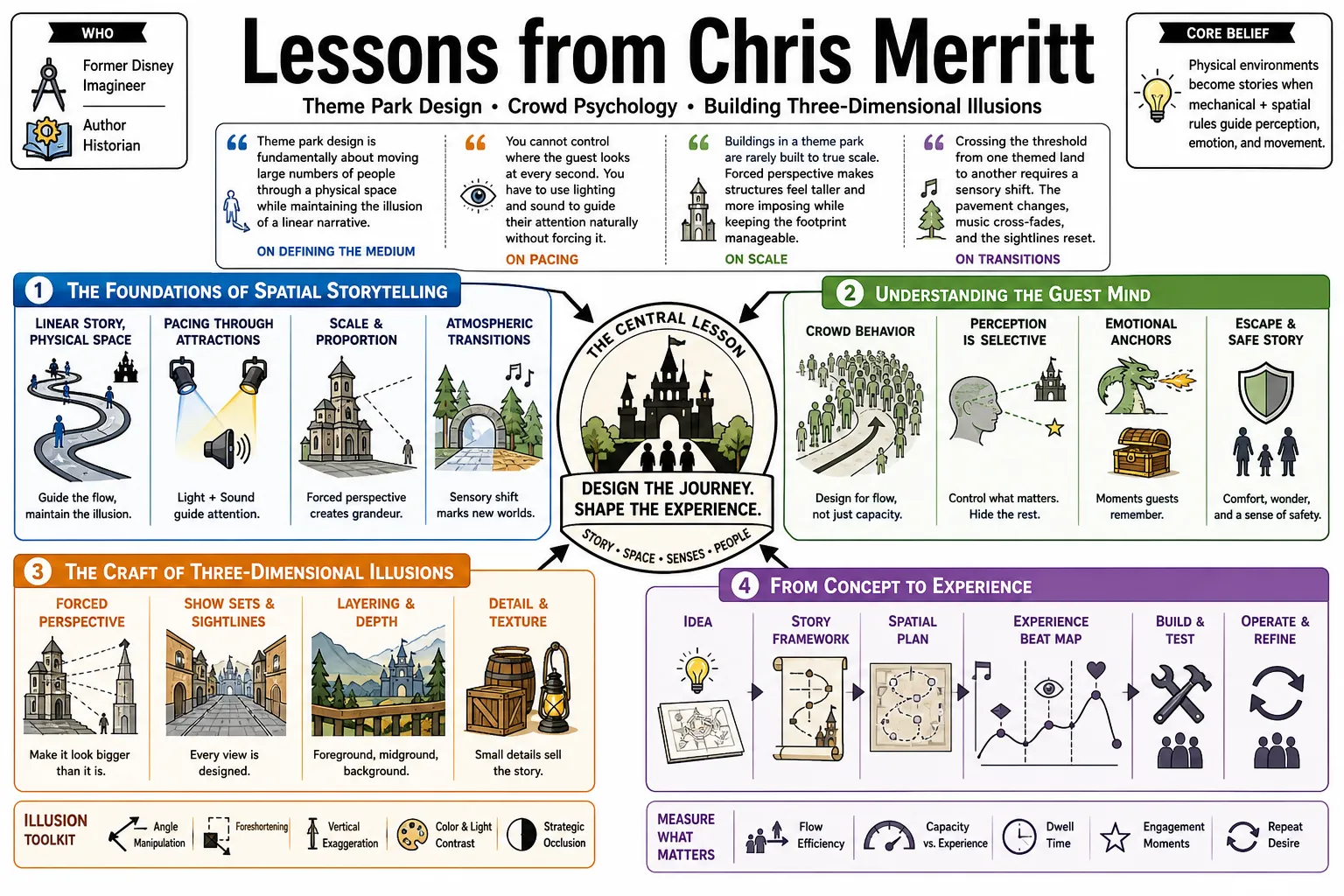
Visual summary of operating lessons from Chris Merritt.

Lessons from Chris Merritt

Former Walt Disney Imagineer and author Chris Merritt spent his career building theme park attractions and documenting their history. He maps the specific mechanical and spatial rules that turn physical environments into stories. This profile details his approach to themed design, crowd psychology, and the practical work of building three-dimensional illusions.

Part 1: The Foundations of Spatial Storytelling

  1. On defining the medium: "Theme park design is fundamentally about moving large numbers of people through a physical space while maintaining the illusion of a linear narrative." — Source: [The Tomorrow Society Podcast]
  2. On pacing an attraction: "You cannot control where the guest looks at every second. You have to use lighting and sound to guide their attention naturally without forcing it." — Source: [Mousetalgia]
  3. On scale and proportion: "Buildings in a theme park are rarely built to true scale. Forced perspective makes structures feel taller and more imposing while keeping the footprint manageable." — Source: [The Happiest Place on Earth]
  4. On atmospheric transitions: "Crossing the threshold from one themed land to another requires a sensory shift. The pavement texture changes, the background music cross-fades, and the sightlines deliberately obscure what you just left behind." — Source: [Dreamfinders Podcast]
  5. On passive storytelling: "The environment must communicate the premise before any characters speak. If a guest does not understand the setting immediately, the scene has failed." — Source: [Dizney Coast to Coast]
  6. On designing for crowds: "A beautiful space is useless if it creates a bottleneck. Practical capacity constraints drive the geometry of the area long before the art direction begins." — Source: [The Tomorrow Society Podcast]
  7. On the role of color: "Color scripts in physical spaces differ from film because the lighting changes throughout the day. A facade must read correctly under bright noon sun and artificial nighttime illumination." — Source: [Mousetalgia]
  8. On wayfinding: "Guests rarely read signs. They navigate by landmarks, light sources, and intuition. We design paths that naturally draw people toward the next story beat." — Source: [Dreamfinders Podcast]
  9. On audio environments: "Background loops are the glue of a themed space. They set the tone and mask the mechanical noise of the park infrastructure." — Source: [Dizney Coast to Coast]
  10. On suspension of disbelief: "The illusion breaks the moment a guest sees something that belongs to their everyday reality. Hiding mundane elements like air conditioning vents is a constant requirement." — Source: [The Tomorrow Society Podcast]

Part 2: Lessons from Marc Davis

  1. On readable character design: "Marc Davis understood that theme park figures need to be read instantly. Guests only have a few seconds to understand who a character is and what they are doing." — Source: [Marc Davis in His Own Words]
  2. On staging scenes: "Every scene in a dark ride should function like a single panel in a comic strip. The action must be frozen at the exact moment of maximum narrative clarity." — Source: [Mousetalgia]
  3. On visual hierarchy: "Davis taught us to simplify the background so the moving figures pop. Too much detail in the set distracts from the action you want the audience to focus on." — Source: [Dreamfinders Podcast]
  4. On avoiding exposition: "You cannot rely on dialogue to explain a dark ride scene because the sound mix is often chaotic. The gag must work visually first." — Source: [Marc Davis in His Own Words]
  5. On costume design: "Fabric on an animatronic figure has to move realistically, but the colors and patterns must be exaggerated to register from the ride vehicle." — Source: [The Tomorrow Society Podcast]
  6. On physical composition: "Marc applied classical painting composition to physical sets. He arranged figures in triangular groupings to lead the eye to the central joke." — Source: [Mousetalgia]
  7. On timelessness: "The best attractions avoid contemporary pop culture references. Davis based his humor on fundamental human behavior, which is why those rides still work decades later." — Source: [Marc Davis in His Own Words]
  8. On iteration: "Marc drew dozens of variations for a single figure. He studied how a character would hold a prop, shift their weight, and react to their environment before settling on the final pose." — Source: [Dreamfinders Podcast]
  9. On the transition from animation: "Animation allows you to manipulate reality freely. When working with physical robotics, Davis had to find ways to suggest that same vitality within the limits of mechanics." — Source: [The Tomorrow Society Podcast]

Part 3: Historical Preservation and Research

  1. On documenting lost parks: "When a theme park closes, the physical structures disappear quickly. Capturing the oral histories of the people who built it is the only way to preserve the true story." — Source: [Pacific Ocean Park]
  2. On archival constraints: "Theme park companies rarely saved concept art in the early days. Much of our design history was thrown in the dumpster once a project was built." — Source: [Mousetalgia]
  3. On the importance of blueprints: "Art tells you what the designers wanted. Construction blueprints tell you what they actually had the budget and technology to build." — Source: [The Happiest Place on Earth]
  4. On separating myth from fact: "Corporate mythology often smooths out the rough edges of history. True research requires looking past the PR narratives to find the messy reality of how these places were made." — Source: [Dizney Coast to Coast]
  5. On studying old photos: "Background details in family vacation photos are goldmines for researchers. They show us what the park actually looked like on a typical weekday, rather than the idealized promotional shots." — Source: [Pacific Ocean Park]
  6. On the origins of Knott's Berry Farm: "Walter Knott did not set out to build a theme park. He built a ghost town to give people something to look at while they waited in line for chicken dinners." — Source: [Knott's Preserved]
  7. On physical models: "Old scale models are fragile and often discarded. When you find one, you get a rare glimpse into the spatial problem-solving that happened before ground was broken." — Source: [Mousetalgia]
  8. On uncovering abandoned concepts: "The ideas that never got built are sometimes more interesting than the ones that did. They show the unfiltered ambition of the designers." — Source: [The Tomorrow Society Podcast]
  9. On the value of ephemera: "Ticket books and old menus tell us how the park operators expected guests to behave and spend their money." — Source: [Dreamfinders Podcast]
  10. On interviewing veterans: "You have to ask the older generation questions while they are still here. Their institutional knowledge explains the underlying reasons behind design choices that confuse us today." — Source: [The Happiest Place on Earth]

Part 4: Humor and Character in Three Dimensions

  1. On visual gags: "A successful three-dimensional gag works from multiple angles. It has to be funny for the person in the front row and the person in the back of the boat." — Source: [Marc Davis in His Own Words]
  2. On the element of surprise: "Humor in a ride relies on timing. The layout of the track must hide the punchline until the vehicle is in the perfect position." — Source: [Mousetalgia]
  3. On animal characters: "Animals are highly effective in theme parks because they cross cultural barriers. A bear scratching its back is universally understood." — Source: [Dreamfinders Podcast]
  4. On contrasting elements: "Comedy often comes from putting a serious character in an absurd situation. The contrast between rigid animatronic movement and a silly scenario creates the laugh." — Source: [The Tomorrow Society Podcast]
  5. On audio repetition: "If a gag repeats every ten seconds, the audio has to be mixed so it does not become annoying to the ride operators who hear it all day." — Source: [Dizney Coast to Coast]
  6. On establishing character relationships: "When placing two figures in a scene, their eye lines must connect. The audience needs to instantly grasp the power dynamic between them." — Source: [Marc Davis in His Own Words]
  7. On the use of props: "A character's prop tells their backstory. A pirate holding a silk umbrella communicates his recent looting activities without a word of dialogue." — Source: [Mousetalgia]
  8. On exaggerated anatomy: "Realism is often boring. Enlarging a character's hands and facial features ensures their expressions read clearly under theatrical lighting." — Source: [Dreamfinders Podcast]
  9. On balancing fear and fun: "Dark rides often start with spooky environments and resolve with humor. The laugh releases the tension built up in the earlier scenes." — Source: [The Happiest Place on Earth]

Part 5: Designing for the Guest Experience

  1. On queue design: "The line is part of the attraction. It should establish the tone and provide enough visual interest to make a long wait feel tolerable." — Source: [The Tomorrow Society Podcast]
  2. On kinetic energy: "A successful land needs movement. Spinning rides and moving vehicles make the space feel alive." — Source: [Mousetalgia]
  3. On the importance of shade: "You can design a beautiful plaza, but if there are no trees or awnings, guests will abandon it in the afternoon sun." — Source: [Dreamfinders Podcast]
  4. On sightlines: "Controlling what the guest sees in the distance pulls them deeper into the park. The visual magnet at the end of the street is a proven navigational tool." — Source: [The Happiest Place on Earth]
  5. On ride vehicles: "The vehicle is a moving theater seat. Its height, speed, and field of view dictate everything we build in the show building." — Source: [Dizney Coast to Coast]
  6. On interactive elements: "When guests can influence the environment, they feel a sense of ownership. Even simple tactile elements in a queue keep people engaged." — Source: [The Tomorrow Society Podcast]
  7. On managing fatigue: "Theme parks are exhausting. Designing quiet, slower-paced zones gives families a place to decompress without leaving the property." — Source: [Mousetalgia]
  8. On retail architecture: "Shops must feel like an organic extension of the land's story. The transition from the ride exit to the merchandise area should be seamless." — Source: [Dreamfinders Podcast]
  9. On lighting for safety and mood: "The ground must be lit well enough to prevent tripping, but dim enough to allow the theatrical lighting on the buildings to stand out." — Source: [The Happiest Place on Earth]
  10. On crowd flow: "Dead ends are dangerous in park design. Every path should loop back to a main artery to keep foot traffic moving continuously." — Source: [The Tomorrow Society Podcast]

Part 6: Mentorship and the Imagineering Process

  1. On learning from veterans: "The older generation of designers did not have software to solve their problems. They relied on physical mockups and practical illusions." — Source: [Mousetalgia]
  2. On collaborative friction: "The best attractions come from the tension between the art directors who dream big and the engineers who have to make the mechanics work safely." — Source: [The Tomorrow Society Podcast]
  3. On pitching ideas: "You have to sell the emotion of the attraction first. If the executives do not feel anything from the concept art, they will not fund the engineering." — Source: [Dreamfinders Podcast]
  4. On the reality of budgets: "Designers must know what elements to fight for and what to compromise on. You protect the gags and the sightlines, even if you have to use cheaper materials on the hidden facades." — Source: [Dizney Coast to Coast]
  5. On cross-disciplinary respect: "An art director relies on lighting designers and structural engineers. The process requires trusting experts in fields you do not fully understand." — Source: [The Happiest Place on Earth]
  6. On passing the baton: "We have a responsibility to document our process. The next generation of designers needs to know how we arrived at our decisions, rather than simply what the final product looked like." — Source: [Marc Davis in His Own Words]
  7. On embracing failure: "Many concepts look great on paper but fail in the mock-up phase. You have to be willing to throw away months of work if the physical reality does not match the drawing." — Source: [Mousetalgia]
  8. On field art direction: "The design is never finished in the studio. You have to be on the construction site with a hard hat, adjusting colors and angles as the steel goes up." — Source: [The Tomorrow Society Podcast]
  9. On maintaining enthusiasm: "Theme park projects take years to build. The hardest part of the job is keeping the team excited about the original vision through endless budget reviews and technical delays." — Source: [Dreamfinders Podcast]

Part 7: The Evolution of Mid-Century Amusements

  1. On the space age aesthetic: "Parks in the mid-century reflected a deep cultural optimism. Architecture featured sweeping curves and futuristic materials like fiberglass and aluminum." — Source: [Pacific Ocean Park]
  2. On regional competition: "Before corporate consolidation, small regional parks pushed innovation because they had to compete for local dollars with wild, untested ride concepts." — Source: [The Tomorrow Society Podcast]
  3. On the decline of seaside piers: "Oceanfront amusement parks faced a losing battle against salt air corrosion and changing real estate values. Maintenance costs usually killed them before lack of attendance did." — Source: [Pacific Ocean Park]
  4. On Knott's influence: "Knott's Berry Farm proved that a highly themed environment could succeed without a gate admission. People came for the atmosphere and spent money on food and crafts." — Source: [Knott's Preserved]
  5. On the shift to steel coasters: "The introduction of tubular steel tracks changed park layouts entirely. Designers could weave rides through buildings and over pathways in ways wooden coasters never allowed." — Source: [Mousetalgia]
  6. On mid-century graphic design: "The typography and signage of early parks were bold and optimistic. They used neon and atomic motifs to signal that the park was a modern destination." — Source: [Dreamfinders Podcast]
  7. On animatronic pioneers: "Before computers, animation figures were programmed using cams and levers. The mechanical limitations defined the pacing of the shows." — Source: [The Happiest Place on Earth]
  8. On the World's Fair impact: "The 1964 World's Fair proved that high-capacity ride systems could handle massive crowds efficiently. That event permanently changed the scale of theme park operations." — Source: [Dizney Coast to Coast]
  9. On lost architecture: "Many mid-century park structures were built cheaply and quickly. We lost incredible examples of Googie architecture simply because they were not built to last more than a decade." — Source: [Pacific Ocean Park]

Part 8: The Craft of Themed Environments

  1. On material selection: "You cannot use real wood in a humid environment because it rots. The craft is in painting fiberglass to look identical to distressed oak from two feet away." — Source: [The Tomorrow Society Podcast]
  2. On artificial foliage: "Real plants grow and block sightlines. Artificial leaves are often wired into live trees to guarantee the canopy looks exactly the same in winter as it does in summer." — Source: [Mousetalgia]
  3. On weathering effects: "A new building looks fake. Scenic painters use washes and glazes to add decades of simulated dirt and rust to make the space feel lived-in." — Source: [Dreamfinders Podcast]
  4. On acoustics: "Hard surfaces in a queue bounce sound around and exhaust the guests. We hide acoustic dampening panels in the ceiling and behind themed grates to absorb the noise." — Source: [The Happiest Place on Earth]
  5. On rockwork: "Carving plaster over rebar allows us to build mountains that weigh a fraction of real stone. The artistry is in studying actual geological formations so the fissures look authentic." — Source: [Dizney Coast to Coast]
  6. On the psychology of color: "Cool tones recede and warm tones advance. We paint the upper levels of show buildings in atmospheric blues and grays so they blend into the sky." — Source: [Marc Davis in His Own Words]
  7. On hiding show lighting: "If a guest sees a modern theatrical fixture clamped to a wall in a historic setting, the illusion is ruined. Fixtures must be concealed inside themed lanterns or hidden behind beams." — Source: [The Tomorrow Society Podcast]
  8. On texture gradients: "Details matter most at eye level. Above ten feet, you can simplify the textures and reduce the structural detail because the guests will never be able to inspect it closely." — Source: [Mousetalgia]
  9. On the final polish: "An attraction is never truly finished. The real test begins on opening day when you watch how the first thousand people interact with the space and immediately start making adjustments." — Source: [Dreamfinders Podcast]