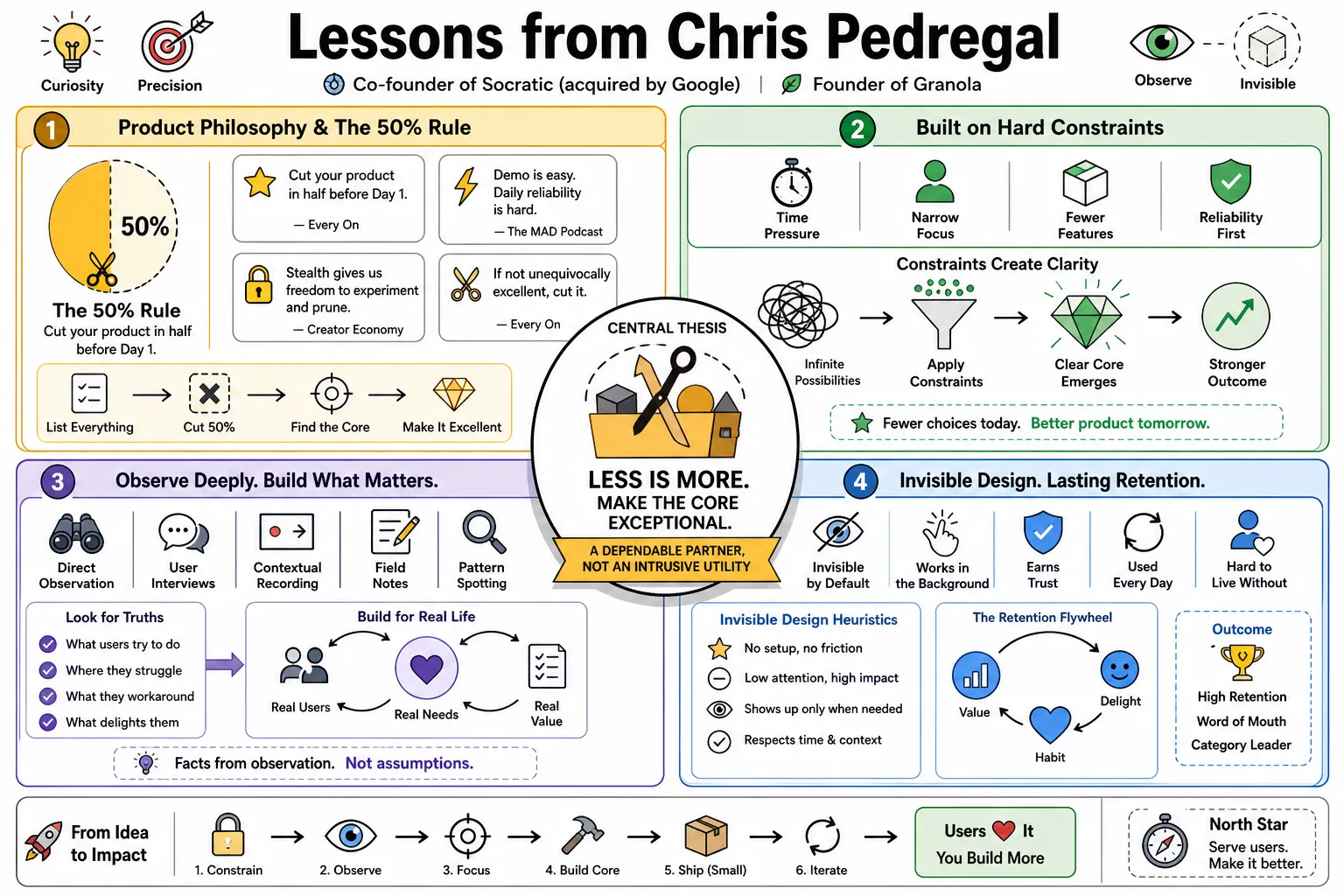
Lessons from Chris Pedregal
Chris Pedregal co-founded the education app Socratic before building Granola with Sam Stephenson. Granola began as a focused AI notepad for meetings: people write what matters, while the software fills in details afterward. In direct interviews, Pedregal describes a long private beta, close observation of users, and a substantial feature cut after the team found its core interaction. The lessons below separate those documented choices from broader claims about AI products. — Ness Labs Interview.
Part 1: Product Philosophy & The 50% Rule
- Cut around the core interaction: After Granola found its central interaction—people writing their own meeting notes while AI filled in the rest—the team removed roughly half the features it had built. This was a specific product decision, not a universal instruction to cut every product in half before launch. — Every Interview.
- A demo is not a dependable feature: Pedregal distinguishes an impressive AI demonstration from a feature that works consistently enough for people to use and trust repeatedly. — Every Interview.
- Use a private beta to learn: Granola spent about a year in a closed beta so the team could watch people use the product, fix rough edges quickly, and learn before a wider launch. — Silicon Valley Girl Interview.
- Quality differentiates a crowded product: In a market already full of AI note takers, Pedregal argues that a product must work materially better for its users; a polished experience can matter more than another feature. — Silicon Valley Girl Interview.
- Protect the note-taking interaction: Granola centers the interaction on the user’s own notes: the AI enhances and completes what the person chose to capture instead of replacing their judgment with a generic summary. — Ness Labs Interview.
- Explore first, then polish: Pedregal describes Granola’s first nine or ten months as a period of trying many features. Once the team understood the useful shape of the product, it switched to polishing that shape and removed features that did not fit. — EO Interview.
- Constrain AI output for dependable notes: Granola gives models task and meeting context, then evaluates note quality with human judgment because useful notes depend on which details matter to a particular person. — Creator Economy Interview.
- Avoid work the next model will erase: Pedregal separates product problems that stronger models are likely to solve soon from enduring user needs, so Granola does not spend its roadmap on temporary model limitations. — Creator Economy Interview.
Part 2: Designing "Invisible AI"
- Augment the person in the meeting: Pedregal frames Granola as a tool that helps people think and write during meetings, rather than automating away their judgment. — Hallway Chat.
- Use system audio instead of a meeting bot: Granola’s no-bot design began with a reliability goal: system audio lets it work across Zoom, Slack huddles and in-person conversations. Pedregal also disliked the social awkwardness of visible meeting bots, while acknowledging that users must disclose transcription appropriately. — Platformer Interview.
- Keep the user’s notes as the guide: The person writes the important points during a meeting; Granola uses those notes to organize and expand the result afterward, rather than offering only a generic bot summary. — Ness Labs Interview.
- Sweat the non-AI details: To make a narrow AI product feel effortless, Granola built its own echo-cancellation system for people using different audio setups, including with and without headphones. — Creator Economy Interview.
- Start from a familiar notepad: Granola was deliberately designed to feel like a familiar note-taking app, so users can focus on the meeting instead of learning a new interface ritual. — Ness Labs Interview.
- Hide complexity until it is useful: Pedregal favors a minimal default interface while allowing people to reach more control when they need it; restraint should not eliminate useful depth for expert users. — Hallway Chat.
- Treat privacy choices as tradeoffs: Granola does not store meeting audio and keeps notes private by default, but Pedregal says a bot-free recorder can be invisible to other participants. The product therefore needs clear disclosure practices rather than assuming invisibility itself creates trust. — Platformer Interview.
- Be a handrail, not the star: Pedregal wants Granola to be unobtrusive until a user needs it, then dependable enough to support that moment; the person should remain the focus of the workflow. — Silicon Valley Girl Interview.
Part 3: The "Second Brain" and Knowledge Management
- Make past meetings available on demand: Pedregal describes being able to ask Granola about meetings from the preceding two years. The value is not constant rereading; it is knowing the conversation can be revisited when a specific question arises. — Silicon Valley Girl Interview.
- Use conversation as AI context: Pedregal argues that ordinary work conversations can supply an AI agent with context it otherwise lacks, provided the user controls what is shared. — Platformer Interview.
- Build a living conversation archive: Pedregal describes Granola as a living archive of meetings that can be searched, queried and shared, while the person remains in control of what to share. — Granola Series A Post.
- Share team knowledge deliberately: Pedregal has described cross-meeting and team-wide insights as a product direction, but the value depends on which private meeting context people choose to share—not blanket organizational access. — Platformer Interview.
- Build tools that extend judgment: Pedregal places Granola in the tradition of tools that extend what a person can think and do, while distinguishing augmentation from replacing the person’s work. — Hallway Chat.
- Keep knowledge connected to its context: Rather than treating a static summary as the full record, Granola lets users revisit the underlying conversation when they need to check what was discussed. Pedregal also sees potential in selectively carrying that context into other tools. — Platformer Interview.
- Be present without perfect transcription: Pedregal says people can focus on the person in front of them and jot only what matters because Granola can complete the details in their notes afterward. — Ness Labs Interview.
Part 4: Listening to Users (and When Not To)
- Know when your intuition is not the user’s: Socratic taught Pedregal that founder intuition is less reliable when the end users are high-school students with different needs; Granola’s long beta similarly helped the team build context from real users. — Every Interview.
- Fix one observed point of confusion: Pedregal says that when one person clearly struggles with a confusing prototype button and the reason is evident, he would fix it before the next user test rather than wait for ten people to repeat the same feedback. — EO Interview.
- Build intuition from user context: Pedregal favors a coherent product point of view informed by continuous contact with users, rather than either copying each feature request or designing entirely from the founder’s instincts. — Creator Economy Interview.
- Talk to the whole person, not a request queue: Pedregal says written feedback is useful but speaking with a person in context better informs a founder’s internal model of what feels right or wrong for users. — Every Interview.
- Lower the friction of user contact: Pedregal recommends making conversations with users easy and systematic across the team; if arranging a call takes too much effort, it will happen less often. — EO Interview.
- Keep customer context close: Pedregal says he tries to speak with a user each day, while the team also sees real-time feedback and regular digests so product decisions are informed by actual customer situations. — Creator Economy Interview.
- Interpret requests through the underlying job: Pedregal warns against simply implementing every requested feature; Granola instead asks which user problem will endure as models improve and which interaction genuinely helps people. — Creator Economy Interview.
- Keep a coherent point of view: Pedregal argues that products with “soul” need a consistent worldview; reacting to users matters, but unfiltered requests can leave the experience incoherent. — Creator Economy Interview.
Part 5: Competing Against Giants
- Win by serving a specific workflow: Pedregal sees room for a focused startup product if it solves an important professional task materially better than a broad AI assistant or a general-purpose meeting feature. — Creator Economy Interview.
- Build deeply for professional users: Pedregal is more optimistic about specialized AI tools for people who depend on them at work than about a startup trying to be the default general-purpose consumer assistant. — Every Interview.
- Recognize product-market fit cautiously: Pedregal says he later concluded Granola had product-market fit on its first public launch day, but he did not recognize it for about six months. For him, the difficulty was reading real user behavior, not reaching a valuation by ignoring competitors. — EO Interview.
- The application must supply useful context: Pedregal argues that a strong model alone is not enough: the application has to understand who is meeting, what each person is trying to accomplish, and which details will make the output useful. — Creator Economy Interview.
- Build for users beyond your city: Granola’s founders built in London while serving many US technology users. Pedregal presents that as their company’s situation, not as a general rule that London location or “underdog energy” produces product quality. — MAD Podcast.
Part 6: Building in the "AI Era"
- Productize repeated AI tasks: Pedregal expects common AI tasks to become more proactive, purpose-built product experiences rather than asking every user to compose a fresh prompt in a generic chat window. — Platformer Interview.
- Route work across suitable models: Granola can assign different tasks to different model providers and adapt as frontier capabilities change. Routing is a product implementation choice, not proof that all models are interchangeable. — MAD Podcast.
- Give AI the right human context: Pedregal says note quality depends on context about participants, their roles and what they need from a meeting; Granola tries to supply that context instead of relying on a raw transcript alone. — Creator Economy Interview.
- Evaluate a model before adopting it: Before a model change reaches users, Granola evaluates whether the resulting notes still match its expected quality and characteristic voice. — MAD Podcast.
- Plan for falling model costs: Pedregal expects frontier-model capability to become cheaper over time. A smaller startup can temporarily afford richer inference for a focused user base, but its economics must work as usage scales; intelligence is not already free. — Creator Economy Interview.
Part 7: The Art of the Startup
- Start with a small, product-minded team: Pedregal and Stephenson assembled a small group of designers and engineers to refine Granola with beta users before public launch. The documented advantage was staying close to what users did with the product. — Granola Series A Post.
- Keep room for drastic changes before launch: Pedregal says a year without public launch let Granola experiment and then remove roughly half its built features; making that cut later, after many users depended on the app, would have been much harder. — EO Interview.
- Report retention by its actual cohort: In January 2025, Pedregal said about 70% of people returned to Granola a week after installation. That is a self-reported one-week return figure, not proof of continuing 70% weekly retention. — Creator Economy Interview.
- Combine a strategic bet with short feedback loops: Pedregal says founders should decide whether a market has a future, then put a prototype in front of people and follow their reactions rather than over-plan in the abstract. — Silicon Valley Girl Interview.
- Prototype with a complementary cofounder: Pedregal and Sam Stephenson shared an interest in productivity tools, built several early prototypes, and found that a real-time meeting notepad drew a stronger reaction than other ideas. — Silicon Valley Girl Interview.
- Date growth claims to the 2024 snapshot: In his October 2024 Series A post, Pedregal reported that Granola’s weekly users had grown sixfold since its May launch and that half of people who tried it were still using it ten weeks later. These are historical company-reported figures. — Granola Series A Post.
- Start with the work meetings create: Pedregal says early user conversations surfaced a pileup of follow-up work after back-to-back meetings—summaries, scheduling, action items, support tickets and memos—making meetings a focused starting point for Granola. — Ness Labs Interview.
- Let useful notes spread inside teams: Pedregal reported that Granola often entered an organization through a senior user and then spread to colleagues, alongside strong early usage among founders and investors. This was a 2024 observation, not a universal distribution formula. — Granola Series A Post.
Part 8: Finding the Product's "Soul"
- Give the product a coherent character: Pedregal uses “soul” for a product whose parts reflect a consistent worldview, rather than a collection of disconnected features assembled to satisfy every request. — Creator Economy Interview.
- People form relationships with products: Pedregal observes that users assign traits to software much as they do to people; a consistent product experience can feel more considered than one assembled without a point of view. — Creator Economy Interview.
- Let design intent be felt: For Pedregal, product taste includes whether users can sense what the makers cared about and intended them to feel; consistency matters more than a patchwork of unrelated features. — Creator Economy Interview.
- Preserve human control as Granola expands: Pedregal’s stated direction is to help with work that follows meetings while keeping the person’s priorities and judgment in charge of the output. — Granola Series A Post.
- Support thinking rather than replace it: Pedregal’s earlier Socratic product tried to help students work through homework; at Granola, he explicitly argues that AI tools should extend a person’s thinking instead of outsourcing their judgment. Those are related ambitions, not a verified single lifelong mission quotation. — Hallway Chat.