Lessons from Chris Williamson
Chris Williamson hosts the Modern Wisdom podcast and writes essays about work, relationships and the choices that shape everyday life. This profile examines selected ideas from his own writing and solo reflections, with attribution when he draws on other thinkers. — Modern Wisdom Podcast.
Part 1: Productivity and Focus
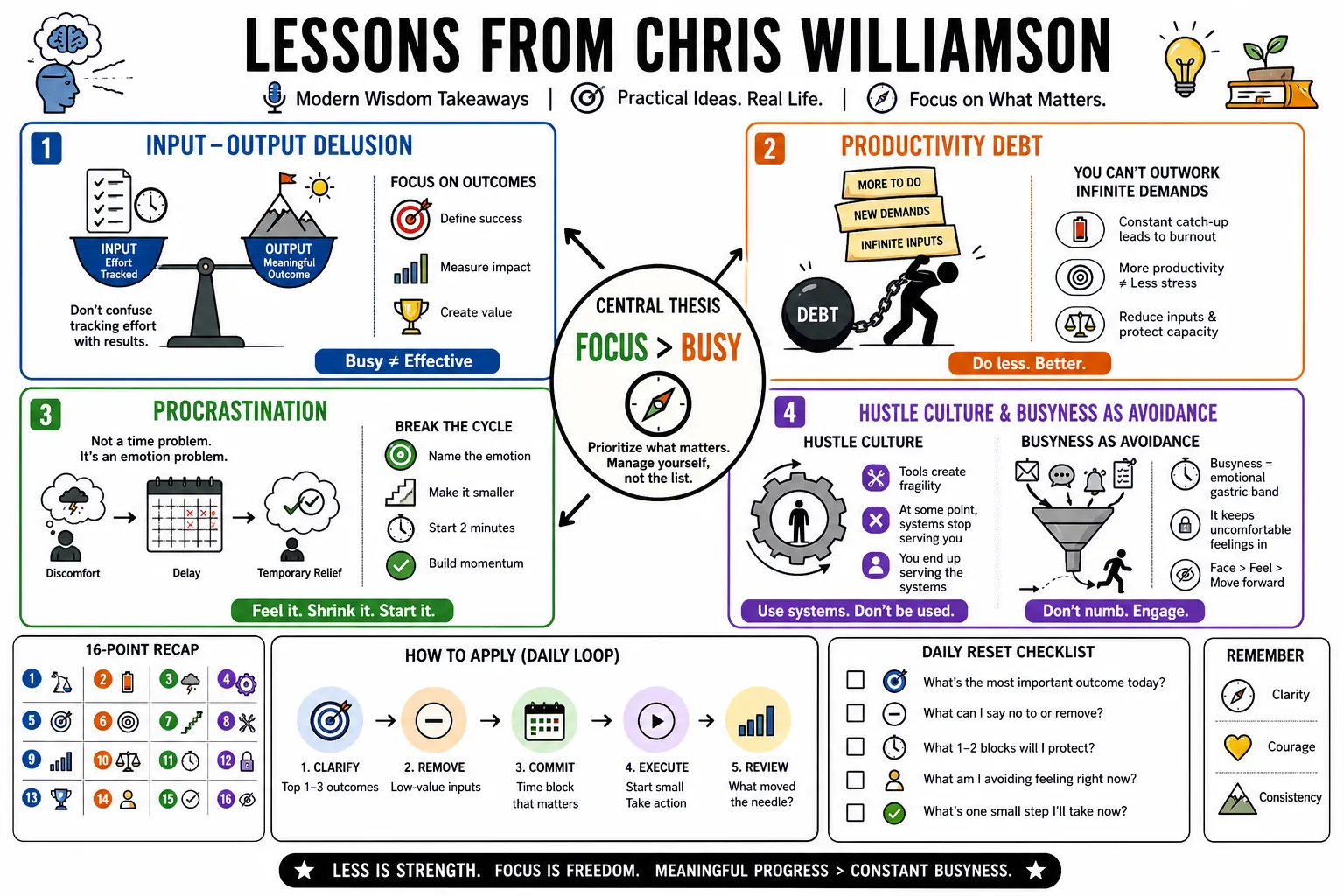
- On the Input-Output Delusion: Williamson separates effort, completed work and real-world results. He recommends asking whether the activity actually moved you toward the goal, rather than treating hours worked or tasks finished as proof of impact. — Inputs, Injuries & Violence.
- On Productivity Debt: Williamson says Oliver Burkeman's idea of productivity debt resonates with him: when work can always expand, trying to earn a feeling of being fully caught up may become an impossible standard. — Productivity Debt, Taboos & Anxiety.
- On Procrastination: Williamson argues that procrastination can be a way to protect self-worth: delaying a task avoids the risk of visible failure, but also prevents the attempt that could move it forward. — Procrastination, Anxiety & Polyamory.
- On Over-Optimization: Williamson warns that an approach that helps in a few important pursuits can spread into an exhausting attempt to optimize everything. He recommends deliberately letting lower-stakes areas be good enough to protect attention for what matters most. — Over-Optimisation, Divorce & Regrets.
- On Busyness as Avoidance: Williamson warns that a full calendar can provide a reassuring feeling of importance while leaving little room to ask whether the work is useful or whether it serves as a distraction from feelings of insufficiency. — Busyness & Favourable Conditions.
- On Getting Started: Williamson recommends starting with an extremely small action when a task feels daunting. Taking the step comes before waiting to feel confident about the whole undertaking. — Diary of a CEO Moment 127.
- On Work Trajectory: Williamson argues that the direction of progress can matter more to satisfaction than a current ranking or milestone. He suggests that slow, consistent improvement may be more sustainable than success that arrives all at once. — Red Flags, Success & Time.
- On True Effectiveness: As a career changes, Williamson suggests shifting attention from visibly completing every task to the strategic work that actually advances the mission. — Busyness & Favourable Conditions.
- On Action: Williamson argues that intentions become visible to other people through what we do. When an idea matters, he recommends identifying and taking the next physical step instead of stopping at thought or talk. — Execution, Clinking & Sam Harris.
- On Hesitation: Williamson urges weighing errors of omission alongside visible mistakes of action: avoiding a risky decision can quietly cost work, relationships or opportunities too. — Errors, Sex & Jerks.
Part 2: The Psychology of Success
- On Defining Success: Williamson cautions that achievement does not necessarily resolve an internal feeling of insufficiency. He recommends asking what kind of life the pursuit of success is meant to serve, rather than assuming another milestone will settle that feeling. — Success, Tax Fraud & Status.
- On Obsession and Discipline: Williamson distinguishes obsession from the effort of discipline: an intense interest can establish skills, routines and an identity that keep a practice going after the original intensity fades. — Modern Wisdom #1100.
- On Self-Worth: Williamson says praise can feel hollow when it is directed at a role you are performing rather than a self you actually show to others. Authenticity matters for being able to receive both connection and recognition. — Truth, Schools & Da Vinci.
- On Weirdness as an Advantage: Building on a line he attributes to Naval Ravikant, Williamson argues that embracing what is genuinely yours can make your contribution more distinctive than playing a borrowed role. — Truth, Schools & Da Vinci.
- On the Price of Ambition: Williamson describes a tension between aiming high and feeling sufficient when you fall short. His advice on supporting men pairs encouragement to grow with acceptance that is not conditional on achieving the next goal. — Support, Sex & Sheep.
- On Disapproval: Williamson argues that even unfair criticism can sting when others might believe it. He suggests treating that reaction with some gentleness and protecting confidence that took effort to build. — Criticism, Facts & Marriage.
- On the Future Illusion: Williamson warns against trading away present time and happiness for money or success on the assumption that those achievements will automatically make it possible to enjoy life later. — Presence, Racists & Compliments.
Part 3: Habit Formation and Consistency
- On Showing Up: In Williamson's experience, continuing a worthwhile practice over time can be a stronger advantage than an early burst of enthusiasm. Motivation varies, but repeatedly showing up is a choice he urges readers to make. — Consistency, Loneliness & Drugs.
- On the Two-Day Rule: Williamson recommends returning to a habit after one missed day rather than letting a single interruption turn into an all-or-nothing abandonment of the practice. — Williamson on the Two-Day Rule.
- On Small Promises: Williamson suggests making promises to yourself that are small enough to keep. Repeated follow-through then gives you evidence of your own reliability, a different point from merely making the first task step smaller. — Diary of a CEO Moment 127.
- On Relying on Feelings: Relaying a lesson from Jocko Willink, Williamson distinguishes fleeting motivation from the more repeatable choice to do a needed task even when you do not feel like it. — Modern Wisdom #500.
- On Building a Baseline: Williamson credits James Clear for the distinction between goals and systems, then uses David Allen's Next Action method to make a strategy executable through a concrete physical step. — Execution, Marriage & Allergies.
- On Identity and Habits: Williamson describes a difficult transition when old habits and self-descriptions stop fitting but a new way of acting still feels exposed. He calls this the shedding chapter and suggests fear of being seen trying can keep someone in the old pattern. — Growth, Unmarried Mothers & Fun.
- On Imperfection: Williamson argues that waiting until you feel completely prepared can become a form of procrastination. A workable first attempt can be more useful than prolonged mental rehearsal for perfect conditions. — Overthinking, Questions & Political Correctness.
- On Daily Joy: Williamson suggests lowering the amount of stimulation needed to feel present, using an ordinary coffee and an extravagant yacht to illustrate that attention can matter more than the setting. — Presence, Racists & Compliments.
- On Long-Term Thinking: Williamson argues for investing years in a craft you care about rather than chasing quick recognition. Even if public success never arrives, the time can still have value because it was spent on meaningful work. — Murder, Fame & Reading.
Part 4: Relationships and Vulnerability
- On Psychological Stability: When considering a partner, Williamson suggests noticing how they respond to a setback and how long it takes to return to emotional balance. He offers this as one practical consideration for a relationship that feels safe. — Diary of a CEO Interview.
- On Conflict Resolution: Williamson shares Visakan Veerasamy's observation that early excitement can be less telling over time than how two people handle misunderstandings, disagreement and conflict. It is Veerasamy's formulation, not an original Williamson quote. — Bad Things, Conspiracies & Relationships.
- On Choosing a Partner: In his newsletter, Williamson shares Rob Henderson's advice to pay attention to a prospective partner's agreeableness and conscientiousness. The point is attributed to Henderson, not presented as Williamson's research finding. — Criticism, Facts & Marriage.
- On Modern Dating: Williamson warns that someone used to earning love may read emotional distance as familiar and pursue a partner who does not attend to their needs. He describes a possible pattern, not a diagnosis of all modern relationships. — Psychological Strength, Alpha Males & Immigrants.
- On Vulnerability: Williamson argues that hiding feelings to avoid shame can also block intimacy. He encourages speaking honestly even when it feels frightening, while crediting Joe Hudson and others for formulations that inform the essay. — Vulnerability, Manhood & Mothers.
- On Relationship Evaluation: Among relationship questions he shared from Reddit, Williamson asks whether being told you resemble your partner would feel like a compliment. It is a prompt for reflection, not a test that determines whether to stay together. — Future-You, Breakups & Cinderella.
- On Fear of Loneliness: Another Reddit-derived question Williamson shares asks whether a relationship feels fulfilling or merely less lonely. It invites a distinction between connection and relief from being alone, without assuming the answer. — Future-You, Breakups & Cinderella.
- On Family as Priority: Williamson reports that some fathers he spoke with found starting a family changed their priorities: impressing distant high-status people mattered less than the people at home. He presents this as an observation, not a universal outcome. — Freedom, Liberals & Love.
- On Men and Love: In a solo Modern Wisdom episode, Williamson presents men's need for love as one of his lessons about relationships. That is his stated perspective, not a universal clinical finding. — Modern Wisdom #999.
- On Authentic Connection: Drawing on a Mark Manson observation, Williamson argues that changing your words or behavior mainly to win approval can cost self-respect. External validation is a poor bargain if you must conceal your real preferences to receive it. — Neediness, Strippers & Obeying.
Part 5: Personal Growth and The "Lonely Chapter"
- On the Lonely Chapter: Williamson calls the stretch after outgrowing old friends but before finding a new circle a lonely chapter. He treats that gap as a possible part of change, not proof that isolation is required for growth. — Introverts, Shadowbans & Bears.
- On Loneliness and Finding Your People: Williamson says he borrowed Alain de Botton's loneliness-as-a-tax metaphor, but later found that his own isolation eased when he connected with people who shared his interests. He cautions against assuming an unusual mind must remain lonely. — Eric Jorgenson Interview.
- On Outgrowing Circles: Williamson argues that social energy depends partly on fit: spending time with people you no longer connect with may feel draining, while the right company can feel easier. A changing circle need not define your personality. — Introverts, Shadowbans & Bears.
- On the Discomfort of Growth: Williamson describes a vulnerable interval when an old identity or routine no longer fits but a new one has not yet taken shape. Discomfort can accompany change; he does not say every painful experience produces growth. — Growth, Unmarried Mothers & Fun.
- On Hard Times: Williamson reflects that a difficult period can reveal capacities you did not know you had. That possibility is not a claim that hardship or trauma is always beneficial. — Modern Wisdom #1100.
- On Changing Your Mind: Williamson treats a willingness to revise a belief when new evidence appears as a strength. In his essay, admitting an error matters more than defending a view merely to appear consistent. — Charlatans, TikTok & Stupid People.
- On the Parental Attribution Error: Williamson asks readers to examine a double standard: tracing flaws to upbringing while claiming strengths as entirely self-made. He explicitly says this does not excuse abuse or neglect. — Parents, Champions & Blandness.
- On Time-Limited Solitude: Williamson found that a period of concentrated solo work helped him make progress. He cautions that isolation can become comfortable in its own way and crowd out relationships, so he recommends treating Monk Mode as a bounded phase rather than a permanent lifestyle. — Monk Mode, Students & Hard Things.
Part 6: Navigating Modern Anxiety and Mindset
- On Problems as Features: Williamson argues that there is no final, problem-free stage of life. Particular difficulties change, so the aim is to handle the ones in front of you rather than expect problems to disappear altogether. — Problems, Police & Letters.
- On Overthinking: Williamson argues that waiting to feel fully prepared can consume hours without improving the eventual action. His gym example contrasts prolonged internal debate with simply going when the time arrives. — Overthinking, Questions & Political Correctness.
- On Taking Things Too Seriously: Williamson suggests that remembering life's finitude can loosen the grip of a current worry and make room to enjoy the process, rather than treating every problem as permanent. — Problems, Police & Letters.
- On Pleasing an Online Audience: Williamson argues that a large online audience will always include people who object to what you say. Instead of tailoring every statement to avoid disapproval, he recommends saying what you believe is true and stepping away from the reaction cycle. — Offence, Short Men & Ignorance.
- On Novelty and Memory: Williamson suggests that introducing new experiences can make life more memorable when routine causes days to blend together. This concerns how time is remembered, not a literal way to slow it down. — Routines and Memorable Time.
- On the Limits of Control: Explaining the Stoic dichotomy of control, Williamson suggests directing attention to your effort, attitude and response rather than trying to dictate markets, weather or other people's behavior. The distinction does not promise relief from every anxiety. — Stoicism, Testicles & Revenge.
- On Self-Talk: Williamson observes that people often speak to themselves more harshly than they would to a friend facing the same difficulty. Drawing on a conversation with Sam Harris and a Jordan Peterson formulation, he recommends combining high standards with self-encouragement rather than abuse. — Advice, Mothers & Liberals.
- On Difficulty and Value: Williamson observes that convenience can make avoiding discomfort easy, and that worthwhile goals may require effort. He cautions against treating difficulty itself as evidence of value: some hard things are not worth pursuing, and good relationships need not be hard. — Difficulty, IQ & Firehoses.
Part 7: Freedom, Discipline, and Choices
- On Discipline and Freedom: In conversation with Jocko Willink, Williamson explores Willink's 'discipline equals freedom' idea: repeating chosen actions can create more practical options than relying on passing motivation. The formulation is Willink's, not an original Williamson quote. — Modern Wisdom #502 with Jocko Willink.
- On Making Choices: Williamson recommends asking what your tomorrow-self would want you to do today. The question creates distance from an immediate impulse and focuses attention on how you will live with the decision later. — Future-You, Breakups & Cinderella.
- On Saying No: Because time and attention are finite, Williamson argues for choosing a small number of important projects and saying no to others. He frames this as making meaningful progress, not rejecting every merely good opportunity by rule. — Marriage, Anything vs Everything & Regions.
- On Delayed Gratification: Williamson cautions that delay can go too far: pursuing future achievement without ever enjoying the present may leave no moment to receive the reward. He credits Bill Perkins for warning about extreme delay. — Meaning, Boys & Critics.
- On Preparing Like an Athlete: Williamson suggests treating a serious pursuit as an athlete treats competition: sleep, training, self-talk, the people nearby, recovery and what one consumes can all affect performance. He credits David Perrell's related 'Learn Like An Athlete' essay as the spark for his framing. — Excellence, Criticism & BMTH.
- On the Limits of Ownership: Williamson asks Jocko Willink whether extreme ownership can go too far—whether someone might assume responsibility for events they did not cause. The conversation treats responsibility as a tool for agency, not proof that every misfortune is one's fault. — Modern Wisdom #502 with Jocko Willink.
- On the Cost of Avoidance: Williamson argues that fear of a conspicuous failure can lead people to put off a change they already know they need to make. In his view, the regret of not trying may ultimately hurt more than a failed attempt. — Chris Williamson on Avoided Decisions.
Part 8: Philosophy and The Meaning of Life
- On Meaning vs. Pleasure: Building on Viktor Frankl's meaning-and-pleasure idea, Williamson proposes a reverse possibility: some people pursue difficulty and purpose so relentlessly that they avoid the challenge of finding ordinary joy. Neither meaning nor pleasure is sufficient as a simple rule for everyone. — Meaning, Boys & Critics.
- On the Present Moment: Williamson recommends occasionally setting aside future-planning and distraction to notice a few uninterrupted breaths. He treats presence as a practice available in ordinary moments, not as a reason to abandon planning. — Presence, Racists & Compliments.
- On Seeking Truth: Williamson suggests judging a thinker by whether they acknowledge mistakes, engage with disagreement and update a view when evidence changes. That matters more to him than projecting permanent certainty. — Charlatans, TikTok & Stupid People.
- On the Movie-Audience Question: Williamson suggests asking what an audience watching the movie of your life would urge you to do right now. He uses the question to surface a decision, conversation or change that feels obvious from a distance but frightening up close. — Chris Williamson's Movie Question.
- On Learning from Pain: Reflecting on a painful recovery from surgery, Williamson suggests that an unwanted hardship can sometimes teach something useful or help another person facing adversity. He does not claim trauma is required for a meaningful life. — Resilience, Psychopaths & Tinder.
- On the Legacy of a Difficult Period: Writing during lockdown, Williamson asks what one would want loved ones to remember about how one behaved under strain. His examples are keeping promises, helping people close to you and acting with integrity—not seeking public fame. — How to Rewrite Your Lockdown Experience.
- On Chosen and Unchosen Hardship: In his conversation with Cameron Hanes, Williamson distinguishes hardship deliberately undertaken for a goal from suffering imposed by circumstances. The distinction makes room to choose some challenges; it does not imply that all pain is voluntary. — Keep Hammering Collective with Chris Williamson.