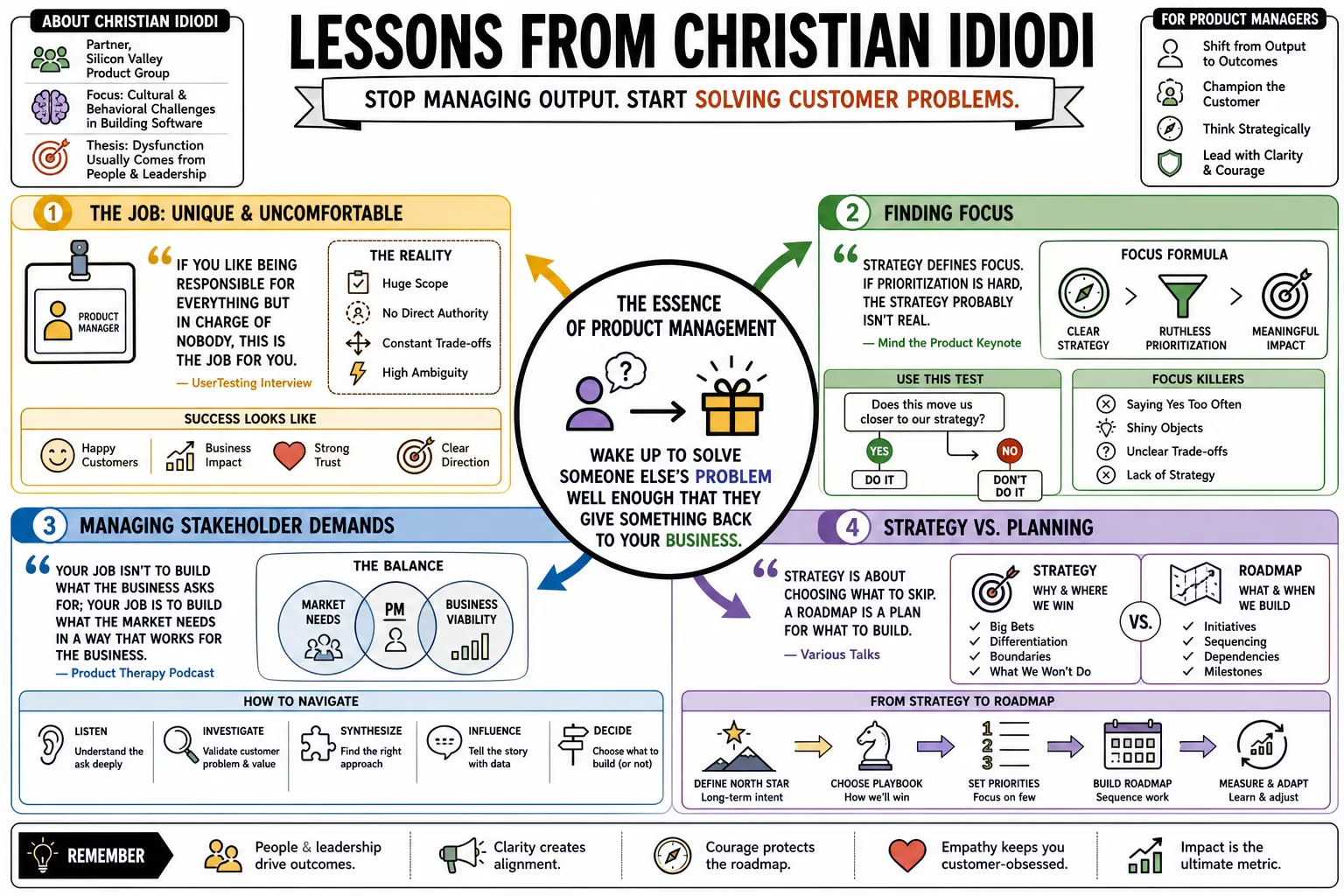
Lessons from Christian Idiodi
Christian Idiodi is a partner at Silicon Valley Product Group. In direct interviews, he describes product management as solving customer problems while addressing value, usability, feasibility and business viability. He also argues that many product-organization difficulties arise when leaders fail to coach people or provide clear context. The lessons below draw on his interviews, talks and signed writing. — The Product Experience — What Is the Job, Really?.
Part 1: The Essence of Product Management
- On the Job Description: A PM can be accountable for customer and business results without personally building the product or directing everyone who contributes to it. — The Product Experience — What Is the Job, Really?.
- On the Core Goal: Idiodi frames product work as discovering solutions to other people’s problems that create value for customers and, in turn, help the business succeed. — Mik + One — Christian Idiodi Transcript.
- On Finding Focus: A product strategy gives teams focus by clarifying which problems matter and which work the organization will not pursue. — The Product Experience — What Is the Job, Really?.
- On Managing Stakeholder Demands: When a leader requests a feature, Idiodi asks what problem the request is meant to solve and holds the team accountable for the outcome rather than the requested output. — The Product Experience — What Is the Job, Really?.
- On Strategy vs. Planning: Strategy connects a vision to the problems assigned to teams; without it, prioritization becomes a substitute for clear choices. — The Product Experience — What Is the Job, Really?.
- On Problem Obsession: After a streak of failed product ideas, Idiodi returned to customers and engineers to understand problems and validate possible solutions before building. — Mik + One — Christian Idiodi Transcript.
- On Output vs. Outcomes: To judge whether an organization has shifted to product, Idiodi looks for discovery before delivery and rewards tied to outcomes rather than dates and features. — Mik + One — Christian Idiodi Transcript.
- On Defining Value: In Idiodi’s account, value risk asks whether people will choose or buy a proposed product; discovery should test that assumption before delivery. — The Product Experience — What Is the Job, Really?.
- On Product Sense: Idiodi says strong product managers develop deep knowledge of customers, data, the business and the industry instead of relying on a supposed innate product instinct. — The Product Experience — What Is the Job, Really?.
Part 2: Mitigating Core Product Risks
- On the Four Risks: Product teams must address value, usability, feasibility and business viability risks before assuming an idea is worth building. — The Product Experience — What Is the Job, Really?.
- On Value Risk: Value risk is whether people will choose or buy the product; Idiodi treats that question as distinct from whether a team can build it. — The Product Experience — What Is the Job, Really?.
- On Usability Risk: Usability risk asks whether customers can use the proposed solution, even if its underlying idea is valuable. — The Product Experience — What Is the Job, Really?.
- On Feasibility Risk: Feasibility risk asks whether the team can build the solution and what way of building it is practical. — The Product Experience — What Is the Job, Really?.
- On Viability Risk: Viability risk asks whether a proposed solution works for the business as well as for its customers. — The Product Experience — What Is the Job, Really?.
- On Sequencing Risk: Idiodi learned to validate ideas with customers and engineers before committing to build, rather than treating internal assumptions as proof. — Mik + One — Christian Idiodi Transcript.
- On Discovery vs. Delivery: He distinguishes discovery, which tests important questions before building, from delivery, which follows once a team has learned enough to proceed. — Mik + One — Christian Idiodi Transcript.
- On Assumptions: His early failures showed him that decisions made from a conference room and untested assumptions could be obsolete almost immediately. — Mik + One — Christian Idiodi Transcript.
- On Cross-functional Collaboration: Idiodi argues for cross-functional teams of product, design and engineering people solving customer problems together instead of receiving top-down instructions. — Mik + One — Christian Idiodi Transcript.
Part 3: Empowered Teams and Culture
- On Team Anatomy: An empowered product team receives a problem to solve and is accountable for the resulting customer or business outcome, not merely a feature list. — The Product Experience — What Is the Job, Really?.
- On Coaching vs. Managing: He treats coaching and candid feedback as a product leader’s core work: the manager helps each product person improve at doing the job. — The Product Experience — What Is the Job, Really?.
- On Psychological Safety: Idiodi sees a learning culture without fear of failure as part of an environment where teams can try approaches to create customer value. — The Product Experience — What Is the Job, Really?.
- On Autonomy: Teams need a product vision, strategy and clear objectives so they can make decisions with context rather than guess what leaders want. — The Product Experience — What Is the Job, Really?.
- On Accountability: Empowerment pairs freedom to choose solutions with accountability for outcomes such as revenue growth or customer satisfaction. — The Product Experience — What Is the Job, Really?.
- On Shared Understanding: Idiodi contrasts sequential handoffs between product, design and engineering with people coming together to solve a customer problem. — Mik + One — Christian Idiodi Transcript.
- On Practice Space: In his onboarding program, new hires practice decisions with the people they will work with before carrying the full weight of the role. — SVPG — New Employee Bootcamp.
- On Continuous Learning: He looks for teams that test ideas, learn and adjust quickly instead of measuring progress only by completed activities. — Mik + One — Christian Idiodi Transcript.
- On Diversity of Thought: Idiodi credits a school with children from different languages and backgrounds for teaching him to connect across differences; he later treated collaboration as central to product work. — Make Things That Matter — Telling the Story of Transformation.
- On Celebrating Failure: In his Datasite account, Idiodi describes a culture that gave employees freedom to question old ways, collaborate and learn through failure. — SVPG — The Freedom to Grow.
Part 4: Leadership and the Work Environment
- On Designing Environments: Product leaders provide vision, strategy, objectives and a workable environment so teams can succeed. — The Product Experience — What Is the Job, Really?.
- On Managing Minds: Rather than directing smart engineers and designers task by task, Idiodi urges leaders to equip teams with a meaningful problem and trust them to devise solutions. — Mik + One — Christian Idiodi Transcript.
- On the Root of Dysfunction: Idiodi traces many product-organization problems to leadership gaps, especially failing to coach people or provide context and an environment for good work. — The Product Experience — What Is the Job, Really?.
- On the Leader's Product: As Idiodi moved into leadership, he came to value the people he coached more than the products he personally built. — Make Things That Matter — Telling the Story of Transformation.
- On Trust: Idiodi connects useful coaching with trust: feedback works when the employee knows the manager is invested in their growth. — The Product Experience — What Is the Job, Really?.
- On Providing Context: A leader must communicate the reasoning behind vision and strategy; a document that teams do not understand does not provide useful context. — The Product Experience — What Is the Job, Really?.
- On Servant Leadership: Idiodi says leaders should create the conditions for product teams to succeed, including context, coaching and a culture where teams can solve problems. — The Product Experience — What Is the Job, Really?.
Part 5: Reference Customers and Product-Market Fit
- On The Path to Fit: Idiodi recommends working toward a set of reference customers as a direct route to product-market fit, rather than relying only on a survey score. — Lenny's Podcast — The Essence of Product Management.
- On Target Numbers: His rule of thumb is six to eight willing-to-recommend B2B customers or fifteen to twenty-five such B2C customers. — Lenny's Podcast — The Essence of Product Management.
- On Customer Advocacy: A reference customer is not merely a user: they value the product enough to recommend it to others. — Lenny's Podcast — The Essence of Product Management.
- On Building Alongside: Idiodi advises involving prospective reference customers in discovery so the team can learn whether it is solving a problem people actually value. — Lenny's Podcast — The Essence of Product Management.
- On Iteration: He learned to bring customers and engineers together, test ideas before building and keep updating his understanding as customer needs changed. — Mik + One — Christian Idiodi Transcript.
- On Saying No: A clear strategy helps teams decide which problems to pursue and which requests to leave aside. — The Product Experience — What Is the Job, Really?.
- On Sales Alignment: Willingness to recommend a product offers evidence beyond a single satisfied user, because prospective customers can hear from peers who value it. — Lenny's Podcast — The Essence of Product Management.
Part 6: Navigating Stakeholders and the First Team
- On The First Team Mindset: Idiodi urges product people to understand their business and build relationships across departments rather than acting as a self-contained 'CEO of the product.' — The Product Experience — What Is the Job, Really?.
- On Internal Discovery: His onboarding method includes learning how stakeholders work and practicing engagement with a particularly vocal stakeholder. — The Product Experience — Onboarding New Product Hires.
- On Emotional Intelligence: Idiodi names empathy, communication and collaboration with stakeholders as important capabilities that formal business training often neglects. — Mik + One — Christian Idiodi Transcript.
- On Managing Expectations: Product leaders should explain why a team is pursuing its work so stakeholders understand the purpose instead of encountering decisions as surprises. — The Product Experience — What Is the Job, Really?.
- On Building Trust: Idiodi describes stakeholder trust as a relationship built through shared context and coaching, not simply by asserting authority. — The Product Experience — Onboarding New Product Hires.
- On Communicating Progress: When judging a product organization, Idiodi asks whether engineers can explain the customer and business outcomes they seek rather than just their next backlog task. — Mik + One — Christian Idiodi Transcript.
- On Cross-department Empathy: Product managers need to understand the business and maintain relationships across functions, including the stakeholders affected by their decisions. — The Product Experience — What Is the Job, Really?.
- On Earning a Seat: Idiodi says product managers earn credibility by developing deep knowledge of customers, data, the business and the industry. — The Product Experience — What Is the Job, Really?.
Part 7: Product Transformation
- On True Transformation: For Idiodi, genuine transformation changes organizational behavior and culture; adopting a framework is not enough. — Make Things That Matter — Telling the Story of Transformation.
- On Executive Sponsorship: He describes meaningful transformation as requiring courage from the CEO and changes across finance, hiring, sales, marketing and technology. — Mik + One — Christian Idiodi Transcript.
- On Unlearning: Idiodi’s transformation examples require people to examine how they currently work, learn new capabilities and replace old habits with a different culture. — Make Things That Matter — Telling the Story of Transformation.
- On Product Management Theater: He warns against mistaking new labels or ceremonies for change when teams are still funded to deliver outputs rather than solve customer problems. — Mik + One — Christian Idiodi Transcript.
- On Organizational Friction: Idiodi presents transformation as a change journey with discomfort, setbacks and learning, not a frictionless rollout. — Make Things That Matter — Telling the Story of Transformation.
- On Measuring Transformation: He looks for discovery before delivery, teams working together, and incentives tied to customer outcomes as evidence of a real product-model shift. — Mik + One — Christian Idiodi Transcript.
- On Patience: Moving from project work to product work means acknowledging unanswered questions and testing them before committing to delivery. — Mik + One — Christian Idiodi Transcript.
Part 8: Personal Growth and Hiring
- On Premature Promotion: Idiodi warns that premature promotion can set a person up to fail; the manager who promoted them bears responsibility for preparing them. — Lenny's Podcast — The Essence of Product Management.
- On Interviewing PMs: He argues that past employment at a prestigious product company does not by itself equip a hire to succeed in a new organization. — SVPG — New Employee Bootcamp.
- On Becoming a Customer Expert: In Idiodi’s description, a strong product manager understands the customer, data, business and industry deeply enough to make sound decisions. — The Product Experience — What Is the Job, Really?.
- On Imposter Syndrome: Idiodi says imposter syndrome can reflect humility and preparation, but unclear expectations or an unsupportive environment can intensify it. — The Product Experience — What Is the Job, Really?.
- On Career Progression: He advises choosing a manager who will coach and develop you, since that support can matter more to growth than the company name. — The Product Experience — What Is the Job, Really?.
- On Self-Reflection: Idiodi urges leaders to examine why they make decisions and what they do not know, using reflection and humility to improve judgment. — Make Things That Matter — Telling the Story of Transformation.
- On Hiring for Potential: Idiodi’s bootcamp gives new product hires organizational history, customer knowledge, peer relationships and practice before expecting independent results. — SVPG — New Employee Bootcamp.
- On Mentorship: He distinguishes mentors from managers who coach: an internal coach shares responsibility for a team member’s results and can give feedback in that context. — The Product Experience — What Is the Job, Really?.
- On Onboarding: He says onboarding should build knowledge of customers, business context and working relationships, not stop at a welcoming orientation packet. — SVPG — New Employee Bootcamp.
- On The Privilege of the Role: Idiodi calls product work rewarding because it lets a team understand people’s needs and solve problems that improve their lives. — Mik + One — Christian Idiodi Transcript.