Lessons from Christine Edmonds
As ICONIQ Growth’s Head of Analytics, Christine Edmonds helped develop research on SaaS scaling, growth, and capital efficiency. This profile distills lessons from ICONIQ’s Enterprise Five and Resiliency Rubric research, her published analysis, and direct interviews about the path to the public markets. — Edmonds on SaaS Resilience.
Part 1: Scaling Milestones
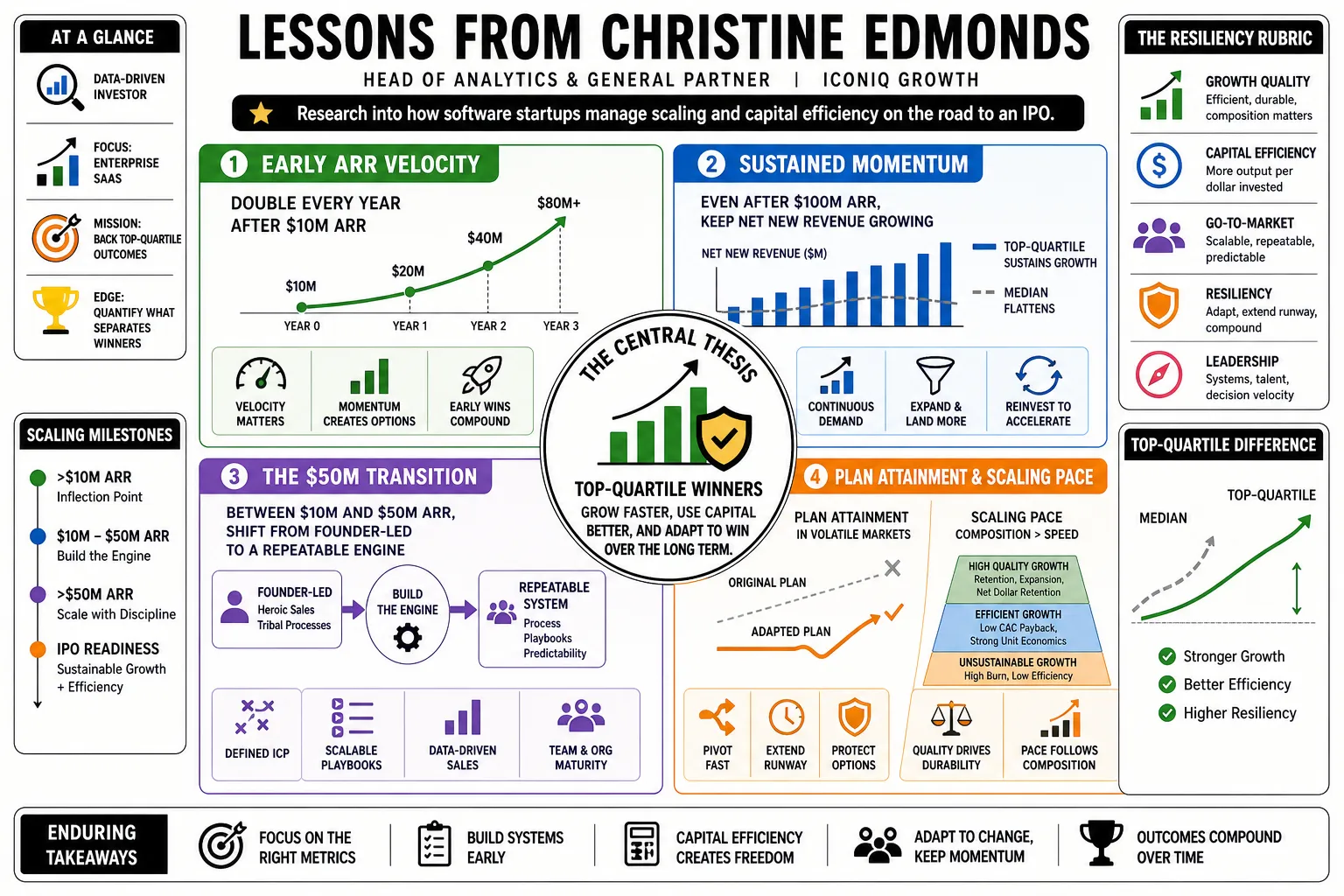
- On Early ARR Velocity: Top-quartile companies in ICONIQ’s 2019 portfolio data often doubled ARR in their first two to three years after reaching roughly $10 million ARR. — The ICONIQ Enterprise Five.
- On Sustained Momentum: In ICONIQ’s sample, stronger companies continued to add substantial net new ARR after reaching $100 million rather than relying on a fixed growth-rate target. — SaaStr Podcast 637.
- On the $50M Transition: As founder-led sales begins to plateau, companies need a more repeatable go-to-market organization and dedicated sales leadership. — SaaStr GTM Through IPO.
- On Plan Attainment: In ICONIQ’s 2022 sample, most companies missed their original topline plans but many reduced burn and extended runway through scenario planning. — SaaStr Scaling Workshop.
- On Scaling Pace: ICONIQ evaluates both ARR growth and its drivers, including the mix of new-logo and expansion revenue, rather than relying on growth rate alone. — The ICONIQ Enterprise Five.
- On Compound Growth: Net dollar retention incorporates expansion, downsell, and churn, making customer-base growth an important ingredient in durable ARR. — The ICONIQ Enterprise Five.
Part 2: Net Dollar Retention (NDR)
- On NDR as a North Star: ICONIQ describes net dollar retention as one of its most important gauges of SaaS business health and revenue-generation efficiency. — The ICONIQ Enterprise Five.
- On the 120% Baseline: ICONIQ’s 2020 analysis said mid-market and enterprise software companies should aim for about 120% or higher net retention in early growth; this is a stage-specific benchmark, not a universal lifecycle floor. — The ICONIQ Enterprise Five.
- On Hyper-Growth NDR: In ICONIQ’s 2021 best-in-class dataset, companies sustained approximately 135–150% net dollar retention while scaling from $10 million to $50 million ARR. — 2021 ICONIQ Enterprise Five.
- On Post-$100M Retention: In the same 2021 dataset, best-in-class companies sustained roughly 125% or higher NDR after reaching about $100 million ARR; the figure describes that sample, not all SaaS companies. — 2021 ICONIQ Enterprise Five.
- On Gross vs. Net Retention: Because NDR includes expansion as well as downsell and churn, teams should examine its components to see whether expansion is offsetting customer losses. — The ICONIQ Enterprise Five.
- On Expansion Dynamics: As enterprise software companies scale, existing-customer expansion and upsell can contribute an increasing share of new ARR. — The ICONIQ Enterprise Five.
- On Pricing Levers: Edmonds argues that usage-based pricing can align payment more closely with value and support expansion where it fits the product and customer; she also cautions that it can make retention more volatile. — Edmonds on SaaS Resilience.
Part 3: The Burn Multiple & Capital Efficiency
- On Defining the Burn Multiple: Burn multiple compares cash burn with net new ARR to show how much capital is consumed for each incremental dollar of recurring revenue. — ICONIQ Resiliency Rubric.
- On the 2.0x Target: In ICONIQ’s 2023 discussion, the team recommends burn multiples below 2x while scaling; its later rubric suggests targeting below 1.5x or even 1x where feasible. — ICONIQ Resiliency Rubric.
- On High-Demand Anomalies: The SaaStr conversation describes some companies increasing burn multiples to 3–5x during unusually strong demand before reassessing that spending as conditions changed. — SaaStr Podcast 637.
- On Shifting Focus: ICONIQ’s 2023 research describes a shift from growth-at-all-costs toward balancing growth with cash efficiency and runway. — ICONIQ Resiliency Rubric.
- On Extending Runway: Reducing burn relative to net new ARR can help a company extend runway; the right action depends on its growth and cash position. — ICONIQ Resiliency Rubric.
- On Resource Allocation: ICONIQ advises companies facing uncertainty to evaluate spending for clear return on investment rather than assuming every growth investment should continue. — ICONIQ Resiliency Rubric.
- On Early Inefficiency: ICONIQ’s metric guidance treats efficiency benchmarks as stage-dependent; early investment and revenue scale should be considered when interpreting burn multiple. — ICONIQ Resiliency Rubric.
- On Efficiency as a Habit: The 2023 SaaStr workshop describes efficiency as an operating discipline involving hiring pace, discretionary spend, GTM adjustments, and forecasting. — SaaStr Scaling Workshop.
Part 4: The Resiliency Rubric & Quick Ratios
- On the Resiliency Framework: ICONIQ’s Resiliency Rubric groups quick ratio, topline attainment, burn multiple, CAC payback, and productivity ratio to help teams assess performance amid uncertainty. — ICONIQ Resiliency Rubric.
- On the Quick Ratio: The SaaS quick ratio compares new-logo and expansion ARR with downsell and churn ARR, offering a directional view of growth efficiency. — ICONIQ Resiliency Rubric.
- On Late-Stage Quick Ratios: ICONIQ found top-quartile companies in its dataset could maintain quick ratios above 4x after reaching $100 million ARR—not the 7x claimed here. — ICONIQ Resiliency Rubric.
- On the Rule of 40: ICONIQ notes that Rule of 40 can be less useful for very early-stage companies whose growth and spending are unusually volatile. — ICONIQ Resiliency Rubric.
- On Balancing Levers: ICONIQ describes several context-dependent levers for improving resilience, including hiring slowdowns, expense reductions, GTM changes, and forecasting discipline. — SaaStr Scaling Workshop.
- On Contraction Pressures: ICONIQ says quick ratio can reveal whether new-logo and expansion ARR are outpacing customer contraction; it is a directional measure rather than a full efficiency score. — ICONIQ Resiliency Rubric.
- On The Enterprise Five: ICONIQ’s Enterprise Five assesses ARR growth, net dollar retention, Rule of 40, net magic number, and ARR per employee together. — The ICONIQ Enterprise Five.
- On Defensive Positioning: A stronger quick ratio indicates more gross new ARR relative to downsell and churn, but ICONIQ cautions that it does not by itself capture capital efficiency. — ICONIQ Resiliency Rubric.
- On Granular Tracking: ICONIQ’s GTM reporting guidance emphasizes regular data-driven review of funnel, pipeline, and forecasting measures, with monthly and quarterly views tailored to scale. — ICONIQ GTM Reporting Guide.
Part 5: Top-Quartile SaaS Benchmarks
- On Dataset Reliability: ICONIQ’s 2023 Resiliency Rubric drew on quarterly operating and financial data from 96 B2B SaaS companies; this is a defined sample, not hundreds of companies. — ICONIQ Resiliency Rubric.
- On Defining Excellence: ICONIQ cautioned that its pre-pandemic top-quartile benchmarks became harder to reach during COVID, illustrating why historical performance ranges need market context. — 2021 ICONIQ Enterprise Five.
- On Benchmark Utility: ICONIQ cautions that benchmarks are directional and should be interpreted alongside business model, stage, and other operating metrics. — ICONIQ Resiliency Rubric.
- On Margin Expansion: Edmonds says investors look for the ability to expand margins as revenue growth naturally compresses at scale. — NYSE: Going Public with ICONIQ Growth.
- On PLG Benchmarks: ICONIQ says CAC payback varies with sales motion and segment; product-led growth companies in its analysis generally had shorter payback periods than enterprise-focused sales motions. — ICONIQ Resiliency Rubric.
- On Payback Periods: ICONIQ’s 2023 rubric calls a CAC payback period under 12 months exceptional, while observing paybacks closer to 20–30 months in its then-current sample; it does not establish an 18-month top-quartile rule. — ICONIQ Resiliency Rubric.
- On Self-Deception: ICONIQ notes that companies calculate CAC and net retention in different ways, so benchmark comparisons require an explicit, consistent formula. — ICONIQ Resiliency Rubric.
Part 6: Go-To-Market & Revenue Health
- On Customer Acquisition Cost: ICONIQ describes net magic number as a way to assess revenue generation relative to sales-and-marketing expense as sales motions mature. — The ICONIQ Enterprise Five.
- On Rep Productivity: The SaaStr GTM discussion notes that quota attainment and ramp time can worsen as teams expand, making individual sales productivity worth watching alongside aggregate growth. — SaaStr GTM Through IPO.
- On Attainment to Plan: ICONIQ defines topline attainment as actual net new ARR against the original plan, a measure of both performance and forecast predictability. — ICONIQ Resiliency Rubric.
- On Pipeline Coverage: A later ICONIQ Growth survey found average pipeline coverage around 3.5–4x or higher in its sample, with variation by ARR scale and growth rate; it is a benchmark, not a universal guarantee of bookings. — ICONIQ Marketing Benchmarks.
- On Sales Capacity: ICONIQ’s GTM discussion treats hiring as part of a broader system: leadership, segmentation, enablement, and demand generation must develop together. — SaaStr GTM Through IPO.
- On Segmenting Data: ICONIQ recommends segmenting GTM reporting by relevant customer and market characteristics rather than relying only on company-wide averages. — ICONIQ GTM Reporting Guide.
- On Marketing Contribution: A later ICONIQ Growth survey found marketing generated about 25–35% of pipeline on average in its sample; the contribution varies with customer segment and sales motion. — ICONIQ Marketing Benchmarks.
- On Cross-Selling: ICONIQ says mature SaaS companies often rely more heavily on upsell and cross-sell from existing customers while still sustaining new-logo acquisition. — SaaStr GTM Through IPO.
Part 7: Navigating Macroeconomic Uncertainty
- On Target Revisions: ICONIQ’s 2023 workshop reports that many companies used scenario planning and adjusted spending when their 2022 topline plans proved too optimistic. — SaaStr Scaling Workshop.
- On Cash Preservation: In a constrained market, ICONIQ describes preserving runway through slower hiring, reduced discretionary spending, and more selective investment. — SaaStr Scaling Workshop.
- On Scenario Planning: The 2023 SaaStr workshop describes scenario planning as a practical response to weaker demand; the source does not prescribe a universal three-scenario trigger system. — SaaStr Scaling Workshop.
- On Ideal Customer Profiles: ICONIQ suggests refining ideal-customer and product focus when resources are constrained, while choosing changes according to a company’s own growth and runway position. — SaaStr Scaling Workshop.
- On Churn Volatility: ICONIQ’s 2023 research reports weaker expansion and elevated churn in its SaaS sample, making customer-health trends important to monitor. — ICONIQ Resiliency Rubric.
- On Product Defensibility: ICONIQ’s workshop describes customers reassessing discretionary software and encourages vendors to establish must-have value; it does not claim every system of record is protected from cuts. — SaaStr Scaling Workshop.
Part 8: Predictability and the Path to Public Markets
- On IPO Readiness: In an NYSE interview, Edmonds says there is no single ARR threshold that makes an IPO viable; sufficient scale helps make revenue more predictable. — NYSE: Going Public with ICONIQ Growth.
- On the Beat and Raise Motion: Edmonds explains that a larger, more predictable customer base helps a company develop a beat-and-raise record around its public offering. — NYSE: Going Public with ICONIQ Growth.
- On Forecasting Rigor: ICONIQ recommends building a rigorous forecasting process one to two years before a potential IPO so companies can perform reliably against guidance. — ICONIQ Resiliency Rubric.
- On Public Market Scrutiny: Edmonds says investors increasingly scrutinize both sustained growth and margin expansion, with their relative weighting changing with market conditions. — NYSE: Going Public with ICONIQ Growth.
- On Mindset Shifts: The NYSE discussion emphasizes modeling the path from private scale to a durable public-company growth and efficiency profile. — NYSE: Going Public with ICONIQ Growth.
- On Managing Expectations: Edmonds links public-market credibility to predictable performance against revenue guidance; she does not advise manipulating analyst expectations. — NYSE: Going Public with ICONIQ Growth.
- On Enduring Growth: Edmonds presents sustained growth and improving efficiency as complementary dimensions of public-company performance. — NYSE: Going Public with ICONIQ Growth.