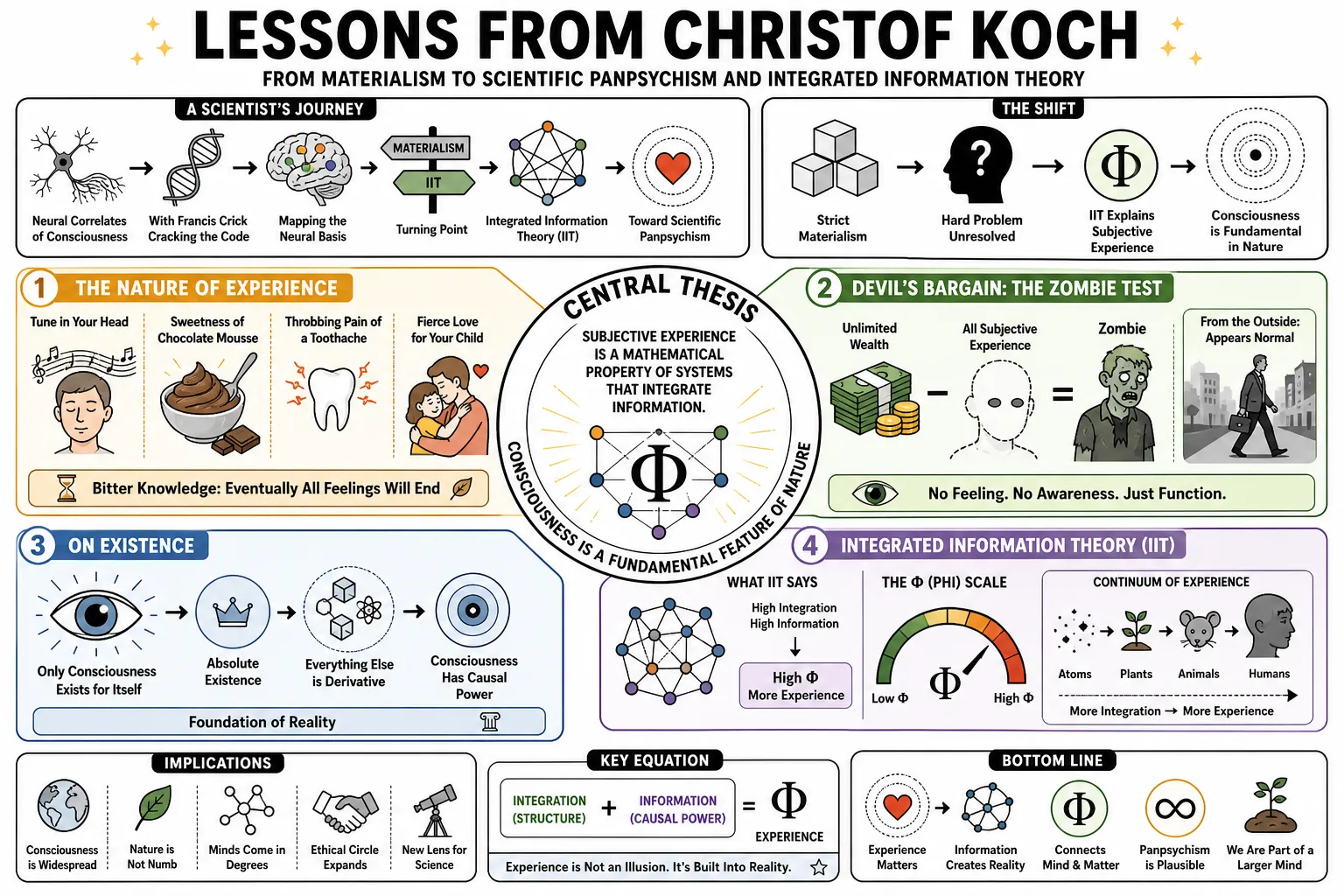
Lessons from Christof Koch
Christof Koch worked with Francis Crick to investigate neural correlates of consciousness and later advocated Integrated Information Theory (IIT). His work combines empirical brain research with a contested theory of how intrinsic causal structure might relate to experience; IIT should not be equated with a proven mathematical measure or with the claim that every particle is conscious. — Then I Am Myself the World — Introduction.
Part 1: The Nature of Experience
- On Subjectivity: Koch defines consciousness as lived experience: sensations, thoughts, emotions and the awareness of them. — Scientific American — What Is Consciousness?.
- On the Value of Experience: His discussion of consciousness treats the presence of experience—not merely outward behavior or material circumstance—as the phenomenon that needs explaining. — The Feeling of Life Itself — Author Overview.
- On Existence for Itself: In Koch’s account of IIT, a conscious system has intrinsic causal power: it exists for itself rather than only for an outside observer. This is the theory’s claim, not an established metaphysical fact. — Nautilus — What Counts as Consciousness?.
- On Illusionism: Koch argues that calling consciousness an illusion does not remove the need to explain the experience of that illusion. — Scientific American — What Is Consciousness?.
- On the Explanatory Gap: Koch distinguishes finding neural correlates of an experience from explaining why those physical processes are accompanied by feeling. — Then I Am Myself the World — Introduction.
- On the Structure of Experience: IIT begins with proposed features of experience—including specificity, integration and exclusion—and seeks corresponding physical properties. — PLOS Computational Biology — IIT 4.0.
- On Attention and Consciousness: Koch and Tsuchiya argue that top-down attention and visual consciousness are distinct processes; attention to an unseen stimulus and experience with little focal attention can dissociate. — Scholarpedia — Consciousness and Attention.
- On Constructed Perception: Koch describes perception as the brain’s interpretation of sensory input shaped by prior expectations, rather than a transparent copy of the external world. — Then I Am Myself the World — Introduction.
- On Why Feeling Matters: Koch places subjective feeling at the center of the scientific problem: behavior and neural processing alone do not tell us what an experience is like. — The Feeling of Life Itself — Author Overview.
Part 2: The Neural Correlates of Consciousness
- On Neural Correlates: Koch and colleagues define the neural correlates of consciousness as the minimal neuronal mechanisms jointly sufficient for a particular conscious percept. — Nature Reviews Neuroscience — Neural Correlates of Consciousness.
- On Crick’s Influence: Koch’s collaboration with Francis Crick helped make consciousness a subject of testable neuroscience rather than only philosophical debate. — Allen Institute — Exploring the Mind’s Mysteries.
- On the Posterior Cortex: Koch argues that posterior cortical regions are especially important for many reported conscious contents; their precise role remains disputed by competing theories and experiments. — Nature — Adversarial Test of Consciousness Theories.
- On the Cerebellum: Koch contrasts the cerebellum’s enormous neuron count with its limited apparent contribution to conscious contents, while treating circuit organization—not neuron number alone—as relevant. — Scientific American — What Is Consciousness?.
- On Brain Complexity: Koch describes the brain as exceptionally complex active matter, while emphasizing that sheer complexity by itself does not settle which systems are conscious. — The Feeling of Life Itself — Author Overview.
- On Recurrent Causation: Under IIT, the way a physical system’s parts exert causal influence on one another matters more than its input-output performance alone. — PLOS Computational Biology — IIT 4.0.
- On Lesions and Experience: Koch reviews evidence that lesions in different cortical regions can selectively impair experiences such as motion, faces or color; such findings constrain, but do not finish, an explanation of consciousness. — Scientific American — What Is Consciousness?.
- On the Claustrum Hypothesis: Crick and Koch proposed that the densely connected claustrum might help integrate information across cortex. They presented this as a hypothesis, not a demonstrated consciousness conductor. — Crick and Koch — What Is the Function of the Claustrum?.
- On the Limits of Correlation: Mapping a brain pathway associated with seeing red is not the same task as explaining why the resulting state feels like something. — Then I Am Myself the World — Introduction.
Part 3: Integrated Information Theory
- On IIT’s Starting Point: IIT starts from proposed properties of experience and derives postulates about the causal structure a physical system would need to instantiate them. — PLOS Computational Biology — IIT 4.0.
- On Phi: In IIT, phi is a theoretical measure of irreducible causal information; equating a computed value with actual felt experience remains contested. — PLOS Computational Biology — IIT 4.0.
- On Tononi’s Framework: Giulio Tononi developed IIT as a formal, testable account of consciousness, but its predictions and assumptions remain under active empirical challenge. — Nature — Adversarial Test of Consciousness Theories.
- On Experience as Structure: IIT models an experience as a structured set of causal distinctions and relations, sometimes represented geometrically; this is a proposal within the theory. — PLOS Computational Biology — IIT 4.0.
- On Exclusion: IIT’s exclusion principle selects a maximally irreducible complex rather than assigning a separate experience to every overlapping subsystem. — PLOS Computational Biology — IIT 4.0.
- On Clinical Measurement: Koch discusses perturbation-based brain-complexity measures, sometimes called “zap-and-zip,” as promising tools for assessing otherwise unresponsive patients; they are not direct proofs of IIT or infallible consciousness tests. — Allen Institute — Exploring the Mind’s Mysteries.
- On Intrinsic Causal Power: Koch describes IIT’s proposed basis of consciousness as a system’s intrinsic cause-effect power over itself. — Nautilus — What Counts as Consciousness?.
- On Feed-Forward Systems: IIT predicts that a purely feed-forward system lacks the recurrent causal integration it says is needed for consciousness, regardless of sophisticated output. — PLOS Computational Biology — IIT 4.0.
- On Broad Theoretical Scope: IIT offers formal criteria that could, in principle, be applied beyond human brains, but actually calculating and validating consciousness across arbitrary systems remains difficult. — PLOS Computational Biology — IIT 4.0.
- On Risky Predictions: IIT makes predictions that can be tested: a 2025 preregistered adversarial experiment supported some aspects yet challenged key tenets, including sustained posterior synchronization. — Nature — Adversarial Test of Consciousness Theories.
Part 4: Panpsychism and the Widespread Mind
- On Panpsychism and IIT: Koch has explored panpsychist intuitions, but he explicitly distinguishes IIT from the claim that every physical object or particle is conscious. — Nautilus — What Counts as Consciousness?.
- On Degrees of Experience: Under IIT, different causal organizations could support different kinds or degrees of experience; this is a theoretical prediction, not an observed sentience scale for all organisms. — Nautilus — What Counts as Consciousness?.
- On Continuity: In a signed essay, Koch considers widespread consciousness a philosophically attractive alternative to an arbitrary biological threshold, while acknowledging uncertainty. — Scientific American — Is Consciousness Universal?.
- On Physical Causation: Koch characterizes IIT as an account based on physical systems’ intrinsic causal properties, not an appeal to immaterial souls. — Nautilus — What Counts as Consciousness?.
- On Disagreement: Koch acknowledges strong criticism of IIT and its panpsychist implications; he treats the theory as scientifically testable, not a settled defeat of other physical theories. — Nautilus — What Counts as Consciousness?.
- On Human Exceptionalism: Koch argues against assuming human beings are the only animals with subjective lives, drawing on evolutionary and behavioral continuities. — Scientific American — Is Consciousness Universal?.
- On the Combination Problem: IIT’s exclusion principle proposes a way to identify one integrated complex among overlapping candidates; whether it resolves panpsychism’s combination problem is disputed. — PLOS Computational Biology — IIT 4.0.
- On Two Perspectives: In a 2014 essay, Koch describes the objective and phenomenal perspectives associated with panpsychist thinking, but defends a narrower view in which only suitably complex systems might have a minimal mind. — Scientific American Mind — Is Consciousness Universal?.
Part 5: Artificial Intelligence and Computation
- On Simulation and Experience: Koch argues that simulating a brain’s behavior does not by itself reproduce the simulated system’s intrinsic physical causal powers. — The Feeling of Life Itself — Author Overview.
- On Behavioral Tests: For Koch, fluent behavior or a passed Turing-style test does not by itself establish whether a machine has subjective experience. — Nautilus — What Counts as Consciousness?.
- On Current Language Models: Koch predicts under IIT that conventional large language models lack the relevant intrinsic causal organization; this is a theory-dependent claim, not a measured absence of experience. — Allen Institute — Exploring the Mind’s Mysteries.
- On Physical Substrate: Koch’s IIT-based position makes consciousness depend on the physical system’s causal structure, not solely on the algorithm or behavior it implements. — The Feeling of Life Itself — Author Overview.
- On Neuromorphic Possibilities: Koch allows that a differently organized physical computer, including neuromorphic designs, might have the causal properties IIT associates with experience. — The Feeling of Life Itself — Author Overview.
- On Intelligence Without Experience: Koch warns that artificial systems could become highly capable without, under his theory, necessarily being conscious; capability and experience should not be equated. — Allen Institute — Exploring the Mind’s Mysteries.
- On Intelligence and Consciousness: Koch distinguishes the ability to perform intelligent tasks from the presence of subjective feeling, especially when considering AI. — Nautilus — What Counts as Consciousness?.
Part 6: Agency, Free Will, and Mysticism
- On Determinism: Koch notes that classical physical determinism creates a challenge for libertarian free will, while distinguishing that issue from practical forms of agency. — Scientific American — Finding Free Will.
- On Quantum Randomness: Koch argues that introducing quantum indeterminacy alone would not give a person the kind of authorship required by strong libertarian free will. — Scientific American — Finding Free Will.
- On Practical Agency: Koch describes compatibilist freedom in terms of acting from one’s own reasons without coercion, rather than escaping every physical cause. — Scientific American — Finding Free Will.
- On Living as an Agent: Koch’s direct interview presents agency as a practical stance even amid unresolved philosophical debates; the circulated imperative quotation is not retained as a verified quote. — Allen Institute — Exploring the Mind’s Mysteries.
- On Perceptual Constraints: Koch describes experience as shaped by the brain’s prior models and sensory constraints; recognizing this construction can change how one interprets perception. — Then I Am Myself the World — Introduction.
- On Psychedelic Experience: Koch recounts altered states, including psychedelic experience, as first-person evidence that the felt self can change dramatically; his testimony does not establish a specific brain-network mechanism or treatment effect. — Then I Am Myself the World — Introduction.
- On Self-Transcendent States: Koch reports experiences in which the ordinary sense of self diminished, including a near-death event; these are personal reports, not proof of a universal mystical mechanism. — Allen Institute — Exploring the Mind’s Mysteries.
- On the Sense of Self: Koch describes the everyday sense of self as a brain-constructed aspect of experience that can change under unusual conditions. — Then I Am Myself the World — Introduction.
Part 7: Animal Sentience and Ethics
- On Evolutionary Continuity: Koch argues that evolutionary and neural continuities make it difficult to draw a sharp consciousness boundary around humans alone. — Scientific American — Is Consciousness Universal?.
- On Dogs: Koch points to dogs’ behavior and mammalian physiology as reasons to take seriously the possibility that they feel pain and other experiences. — For the Sake of Animals.
- On Nonmammalian Minds: Koch cautions against making a mammalian neocortex a universal requirement for experience, while treating consciousness in birds and other animals as an empirical question. — Scientific American — Is Consciousness Universal?.
- On Bees: Koch describes sophisticated learning in bees but explicitly says those experiments do not establish that bees are conscious; his conclusion is cautious agnosticism. — What Is It Like to Be a Bee?.
- On Moral Consideration: Koch argues that credible evidence of animals’ capacity to suffer creates a moral reason to take their welfare seriously. — For the Sake of Animals.
- On Eating Animals: In his animal-ethics essay, Koch concludes that evidence of mammalian pain and emotion weighs against eating their flesh; this is his ethical position, not a proven scientific mandate. — For the Sake of Animals.
- On Vegetarianism: Koch says his dog’s death in 2005 helped prompt his decision to become vegetarian, connecting his personal conduct to his view of animal sentience. — For the Sake of Animals.
- On Anthropocentrism: Koch challenges the assumption that only humans have inner lives, pointing to shared evolutionary history and animal behavior. — Scientific American — Is Consciousness Universal?.
- On Animal Pain Evidence: Koch cites anatomy, behavior and physiology together when arguing that many mammals can feel pain; none of those signals alone is an infallible consciousness test. — For the Sake of Animals.
Part 8: Life, Mortality, and Meaning
- On Mortality: Koch’s direct interview describes confronting his own mortality and finding value in the finite experiences and relationships of life; the long circulated quotation is not retained as verified verbatim. — Allen Institute — Exploring the Mind’s Mysteries.
- On Faith and Inquiry: Koch’s account of his intellectual life describes the loss of belief in a personal God while retaining a sense of wonder about consciousness; it does not prove a blanket rejection of spirituality. — Christof Koch — My Books and Papers.
- On Romantic Reductionism: Koch’s work combines empirical decomposition of brain mechanisms with the search for a theory explaining how a whole system’s causal organization could matter to experience. — Christof Koch — My Books and Papers.
- On Facing Mortality: Koch discusses accepting mortality rather than treating indefinite technological survival as an established solution to the problem of experience. — Allen Institute — Exploring the Mind’s Mysteries.
- On Meaning in Experience: Koch describes conscious life, relationships and inquiry as personally meaningful; the broader claim that experience is the sole possible source of cosmic meaning is not attributed to him. — Allen Institute — Exploring the Mind’s Mysteries.