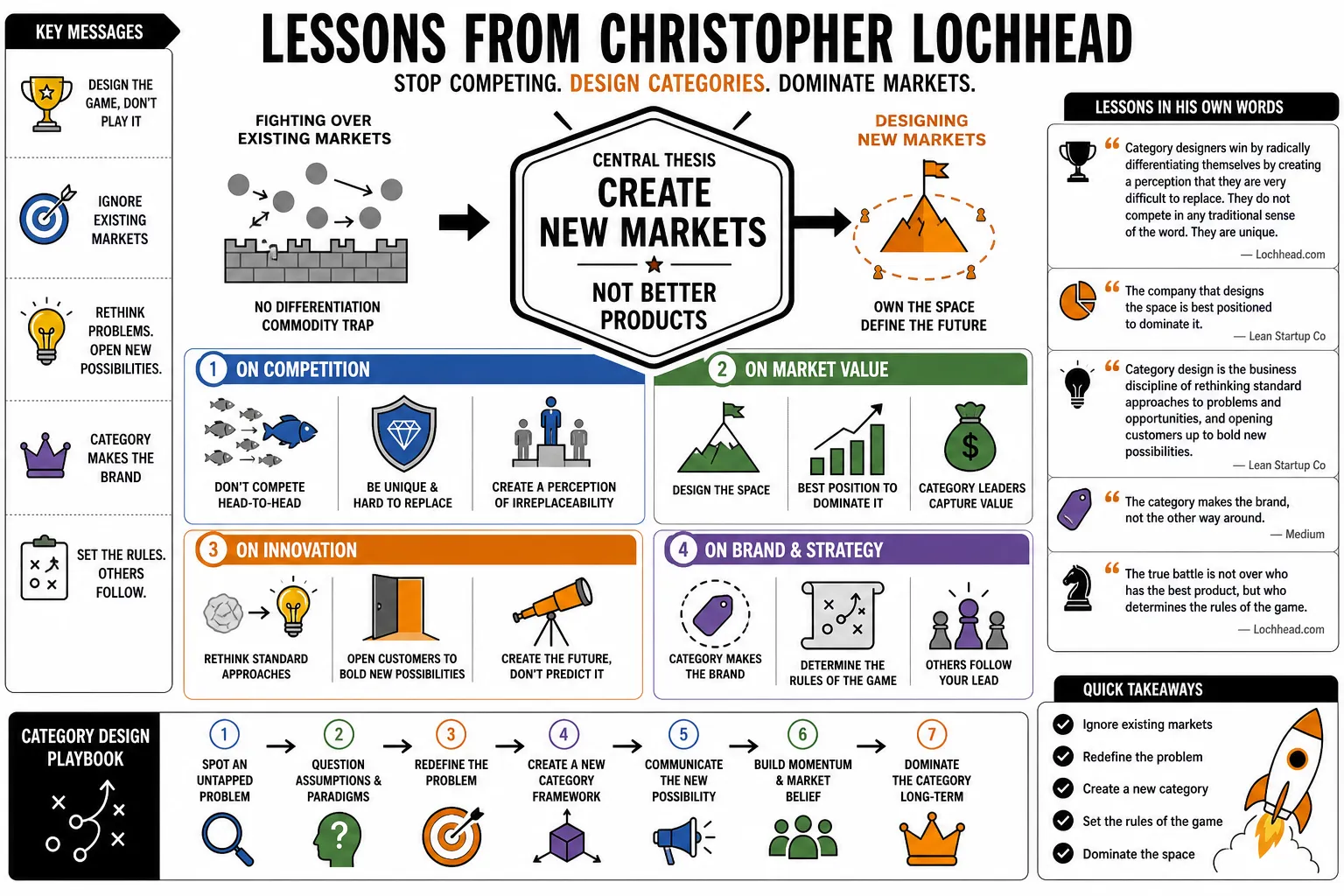
Lessons from Christopher Lochhead
Former technology CMO Christopher Lochhead co-authored Play Bigger and advocates category design: defining a new market around a different problem and solution rather than merely improving an established offering. — Why Every Marketer Should Be Thinking About Category Creation.
Part 1: The Category Design Mindset
- On Competition: Lochhead argues that category creators aim to be perceived as radically different so customers do not compare them on the usual competitive terms. — Why Every Marketer Should Be Thinking About Category Creation.
- On Market Value: He argues that the company that defines a new category is well placed to become its reference point and leader. — Why Every Marketer Should Be Thinking About Category Creation.
- On Innovation: For Lochhead, category design means creating a market segment and teaching customers a new way to understand a problem and its solution. — Why Every Marketer Should Be Thinking About Category Creation.
- On Brand vs. Category: The Category Pirates argue that customers first need to understand what kind of thing an offering is before its brand becomes meaningful. — The Category Makes the Brand.
- On Strategy: Lochhead and his coauthors emphasize designing the market and its business model, not simply shipping a superior product into an existing one. — The Difference Between a First Mover and a Category Creator.
- On Thinking: The Category Pirates describe category design as a shift in how people think; deliberate language helps explain the move from an old approach to a new one. — Languaging: The Strategic Use of Language.
- On Winning: Lochhead advises creators to establish a distinct category rather than fight only for a share of an incumbent’s market. — Why Every Marketer Should Be Thinking About Category Creation.
- On The Magic Triangle: A strong product is only part of the Category Pirates’ magic triangle; company design and category design matter as well. — The Big Product Lie.
Part 2: Escaping The Better Trap
- On The Better Trap: The Better Trap is the attempt to win an existing category through feature, price or brand comparisons, a strategy the authors say can compress margins. — The Better Trap.
- On Product Superiority: The Category Pirates reject the claim that the best product automatically wins; buyers must also understand its category and value. — The Big Product Lie.
- On Legacy Markets: Incremental comparison keeps a company inside the incumbent category’s frame instead of establishing a distinct market choice. — The Better Trap.
- On Being Different: Lochhead and Clancy present originality, not modest improvement, as the defining trait of the people and companies they call legendary. — Niche Down: Why Legends Are Different.
- On Feature Wars: Competing on features and price asks customers to compare near substitutes; the Better Trap article argues that this weakens differentiation. — The Better Trap.
- On Comparison: The authors warn that comparison marketing can reinforce the established leader’s frame; category design instead seeks a distinct choice. — The Better Trap.
- On The Status Quo: Lochhead’s category-creation argument starts from the possibility that a new offering changes what customers perceive as the relevant problem. — If You Don’t Want to See the World Differently.
Part 3: Loving The Problem
- On Empathy: The Category Pirates place identifying the customer’s real problem before refining the product, message or sales tactics. — The Problem Is Your Problem.
- On Articulation: The authors argue that articulating a customer problem clearly is a prerequisite to making a new solution understandable and compelling. — The Problem Is Your Problem.
- On Market Readiness: Lochhead says customers need to recognize a problem before a proposed solution can matter to them. — Marketing the Problem, Not Your Solution.
- On Framing: Framing and naming a problem shape how buyers evaluate a solution; the Category Pirates treat this as a central category-design task. — The Problem Is Your Problem.
- On Product-Market Fit: Lochhead questions using fit with an existing market as the sole test for a breakthrough that may first require customers to learn a new category. — If You Don’t Want to See the World Differently.
- On Customer Intent: Lochhead contrasts marketing the customer’s problem with leading on the seller’s brand or solution: the former can signal useful understanding rather than a sales pitch. — Marketing the Problem, Not Your Solution.
- On Urgency: His marketing advice is to explain why the problem matters now before asking customers to value the solution. — Marketing the Problem, Not Your Solution.
- On Problem Discovery: The Category Pirates say a category creator may reveal a problem customers had not previously recognized or reframe a familiar one. — The Business Case for Becoming a Category Creator.
- On Thought Leadership: The authors advise teaching the market to recognize the relevant problem, not relying on product claims alone. — The Problem Is Your Problem.
Part 4: Niching Down
- On Specialization: Personal category design begins by identifying a distinctive specialty that solves a valuable problem for a recognizable group. — Position Yourself or Be Positioned.
- On Ownership: The Category Pirates describe personal category design as becoming known for a differentiated niche through results valued by its superconsumers. — Position Yourself or Be Positioned.
- On Positioning: Niching down concentrates attention on a specific problem and audience, making a person’s value easier for that audience to recognize. — Position Yourself or Be Positioned.
- On Target Audiences: The authors say clear category language should speak directly to intended customers, including by clarifying whom an offering is not for. — Languaging: The Strategic Use of Language.
- On Defensibility: A defined specialty can make a person’s contribution easier to remember and recommend than an undifferentiated general offering. — Position Yourself or Be Positioned.
- On Standing Out: Lochhead and Clancy argue that being visibly different can be an asset, even when that means not fitting an established market convention. — Niche Down: Why Legends Are Different.
- On Focus: The languaging essay warns that broadening a message indiscriminately can make it too vague to resonate with any particular audience. — Languaging: The Strategic Use of Language.
- On The Hustle Myth: The personal category-design approach prioritizes finding a distinctive problem to solve over trying to outwork undifferentiated competitors. — Position Yourself or Be Positioned.
Part 5: The Power of Languaging
- On Naming: Naming a new category helps customers understand the move from an old way of doing things to a different one. — Languaging: The Strategic Use of Language.
- On Lexicon: The authors show how a new category vocabulary can spread beyond its creator and influence how customers discuss the market. — Languaging: The Strategic Use of Language.
- On Clear Communication: The essay treats languaging as the deliberate expression of a category point of view, not a substitute for deciding what the company stands for. — Languaging: The Strategic Use of Language.
- On Evangelism: The Category Pirates link category language and point of view to the words that enthusiastic customers use when recommending an offering. — Word of Mouth Marketing 101.
- On Perception: The authors argue that language can create a new distinction in customers’ minds and change how they perceive an offering. — Languaging: The Strategic Use of Language.
- On Point of View (POV): A category point of view frames both a problem and a proposed new solution, giving marketing a coherent claim beyond product features. — Languaging: The Strategic Use of Language.
- On Re-framing: The Netflix example shows how naming both the old experience and the new one can help customers recognize a reason to change. — Languaging: The Strategic Use of Language.
- On The Manifesto: Rather than a generic manifesto requirement, Lochhead’s framework calls for a stable point of view before choosing specific marketing messages. — Languaging: The Strategic Use of Language.
- On Differentiation via Words: Category creators can strengthen a distinct position by using words that explain the new choice rather than defaulting to inherited industry terms. — Languaging: The Strategic Use of Language.
- On Education: In his conversation with Lenny Rachitsky, Lochhead presents “Frame It, Name It, Claim It” alongside languaging as a way to teach a market its new category. — Lenny’s Podcast — Christopher Lochhead.
Part 6: Category Economics
- On The 76% Rule: Lochhead and coauthors report that category creators in their study captured about 76% of total category market capitalization; this is their historical research claim, not a guarantee for every market. — The Difference Between a First Mover and a Category Creator.
- On Valuation: Their analysis found that companies with a product, business-model and data flywheel contributed disproportionate market-cap growth within the studied fast-growth group. — The Difference Between a First Mover and a Category Creator.
- On First Mover Advantage: Being first with a product is not the same as creating a category; the authors emphasize market education and a working business-model flywheel. — The Difference Between a First Mover and a Category Creator.
- On Pricing Power: The Better Trap argument is that direct price-and-feature comparison can constrain margins; a distinct category changes the terms of comparison. — The Better Trap.
- On Market Cap: The authors’ studies suggest that a small subset of category creators accounted for a disproportionate share of growth and market value in their samples. — The Difference Between a First Mover and a Category Creator.
- On Moats: Their account of defensibility emphasizes a reinforcing combination of product innovation, business-model innovation and customer data rather than technology alone. — The Difference Between a First Mover and a Category Creator.
- On Investment: Lochhead argues that early investors can be persuaded by a company’s potential to create a large new category, not only by its current performance. — Niche Down: Why Legends Are Different.
- On Scarcity: The category-design thesis is that the company that defines a valuable new choice can become the reference point against which later entrants are compared. — Why Every Marketer Should Be Thinking About Category Creation.
Part 7: Legendary Marketing
- On The Purpose of Marketing: The Category Pirates distinguish marketing a customer problem and category from simply promoting a brand; the existing profane quote is not established by this source. — The Category Makes the Brand.
- On Conventional Wisdom: Lochhead urges marketers to consider creating a distinct market category rather than defaulting to conventional competitive marketing. — Why Every Marketer Should Be Thinking About Category Creation.
- On Market Creation: In Lochhead’s account, marketing helps people understand a new problem and way forward, rather than only harvesting demand for an existing solution. — Why Every Marketer Should Be Thinking About Category Creation.
- On Storytelling: His category story starts with a point of view about the old problem and a different future, then chooses language that makes the transition legible. — Languaging: The Strategic Use of Language.
- On B2B vs B2C: Lochhead’s languaging examples in consumer and enterprise markets both focus on changing how people understand the old and new choice. — Languaging: The Strategic Use of Language.
- On Demand Generation: Lochhead recommends generating recognition of the customer’s problem before pushing a poorly understood solution. — Marketing the Problem, Not Your Solution.
- On The Competition: The Better Trap essay warns that making a rival the reference point can reinforce the rival’s category instead of establishing a new one. — The Better Trap.
- On True Difference: The Category Pirates argue that marketing cannot compensate for a product whose problem, category and value remain unclear. — The Big Product Lie.
Part 8: Life and Entrepreneurship
- On Self-Determination: Lochhead contrasts finding an existing place in the world with making one for yourself through a distinctive category. — Join Up Dots — Christopher Lochhead Interview.
- On Leadership: Lochhead connects category creation with the courage to depart from familiar conventions and build around a genuine difference. — Follow Your Different — Jessica Miller Conversation.
- On Accountability: Lochhead argues that an excuse does not substitute for a result, and that reliable results shape a person’s reputation. — Maybe the Most Important Equation Ever.
- On Legacy: Lochhead says that once someone has reached a position of success, they should help others climb rather than guard their advantage. — Kara Goldin Show — Christopher Lochhead.
- On Taking Risks: Lochhead and Clancy describe entrepreneurial breakthroughs as creating different value rather than only incrementally improving what came before. — Niche Down: Why Legends Are Different.
- On Following Your Different: Drawing on his own experience, Lochhead urges people who do not fit established paths to make a place through their distinctive contribution. — Join Up Dots — Christopher Lochhead Interview.
- On Perseverance: The authors say unfamiliar category ideas often meet disbelief before customers learn to see the new problem and solution. — If You Don’t Want to See the World Differently.
- On Authenticity: Lochhead’s advice is to connect a genuine difference to a valuable problem rather than manufacture a superficial pose of uniqueness. — Follow Your Different — Jessica Miller Conversation.
- On Impact: The Category Pirates portray category design as creating new value for customers and a wider ecosystem, not merely capturing share of an existing market. — The Business Case for Becoming a Category Creator.