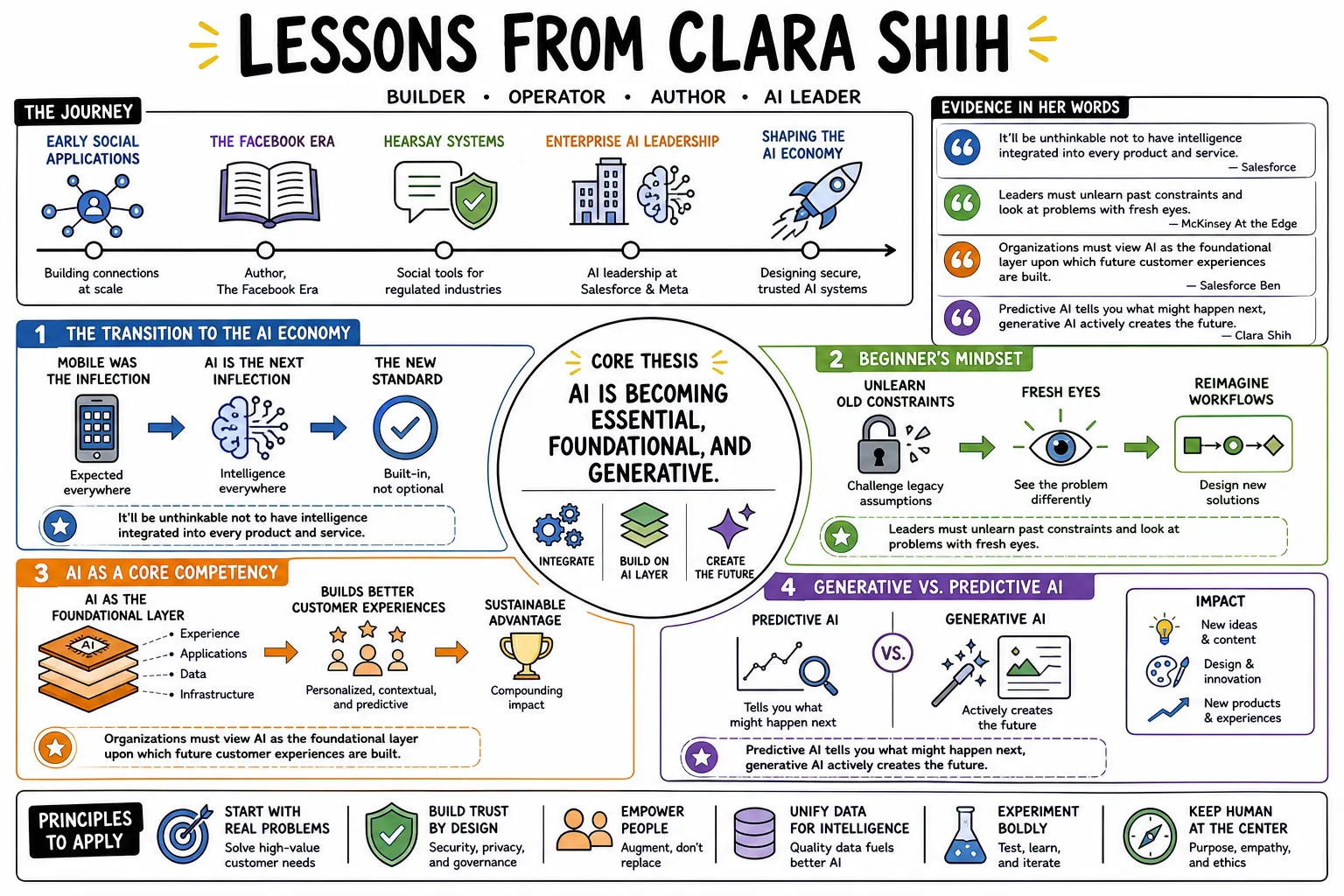
Lessons from Clara Shih
Clara Shih wrote The Facebook Era and co-founded Hearsay Systems to bring social customer relationships into regulated industries. She later led AI work at Salesforce and Meta. Her original interviews and talks explore customer needs, trusted data, founder focus and how leadership changes as organizations grow. — Stanford eCorner — What No One Tells You About Entrepreneurship.
Part 1: The Transition to the AI Economy
- Revisit Old Constraints: Shih urges leaders to question inherited workflows and test how data, trust and contextual UX together can move AI from pilots into useful work. — Clara Shih — Data, Trust and Contextual UX.
- Treat AI as a Business Capability: Her Salesforce AI remit joined models, trusted customer data and CRM workflows to solve operational bottlenecks, not to showcase AI in isolation. — Salesforce — Clara Shih Interview.
- Distinguish AI Uses: Shih describes both predictive AI and generative tasks such as service summaries, sales drafts and developer assistance. — Salesforce — Clara Shih Interview.
- Prototype Agentic Workflows: Shih said Salesforce was prototyping autonomous agents alongside search and generative assistance; production use requires trusted data and safeguards. — Salesforce — Clara Shih Interview.
- Combine AI, Data and CRM: She framed AI, unified customer data and CRM as a way to personalize and automate interactions across sales, service, marketing and commerce. — Salesforce — Clara Shih Interview.
- Start with Trusted Data: Shih’s direct framework begins with complete, relevant enterprise data before expecting reliable AI outputs. — Clara Shih — Data, Trust and Contextual UX.
- Bring AI into Workflows: Shih argues AI becomes more useful when grounded in business context and delivered in the sales or service workflow rather than a disconnected screen. — Clara Shih — Data, Trust and Contextual UX.
- Solve Operational Bottlenecks: Her team asked which customer pain points AI could address and developed concrete sales, marketing, service and coding examples. — Salesforce — Clara Shih Interview.
Part 2: Designing Trust and Safety in Tech
- Make Trust a Prerequisite: Shih said customers worried about sensitive data leakage, so privacy and safe deployment were first-order conditions for enterprise AI. — Salesforce — Clara Shih Interview.
- Build a Trust Architecture: Shih described data masking, zero retention, audit trails and human control as parts of Salesforce’s enterprise AI trust layer. — Clara Shih — Data, Trust and Contextual UX.
- Ground Outputs in Good Data: She warned that irrelevant, incomplete or unrepresentative data can produce hallucinations, bias and other unreliable results. — Salesforce — Clara Shih Interview.
- Design for Regulation: Hearsay’s compliance software answered a real need for financial institutions; compliance became part of the product’s value rather than a late add-on. — Masters of Scale — Clara Shih Transcript.
- Unify Relevant Enterprise Data: Shih described connecting and harmonizing structured and unstructured enterprise data so AI can act with useful context. — Clara Shih — Data, Trust and Contextual UX.
- Keep Decisions Auditable: Her trust framework includes an LLM audit trail and humans at the helm, rather than asking customers to accept opaque outputs on faith. — Clara Shih — Data, Trust and Contextual UX.
- Augment Employees: Shih pointed to customer-service pilots in which AI supplied in-the-moment knowledge and helped employees take on new work. — Salesforce — Clara Shih Interview.
Part 3: Solving Urgent Needs with Painkillers and Vitamins
- Turn an Optional Tool into a Necessity: At Hearsay, solving financial firms’ compliance need made its social-selling product mission-critical instead of merely nice to have. — Masters of Scale — Clara Shih Transcript.
- Stay Focused on the Core Problem: Shih describes declining attractive requests outside Hearsay’s mission and later correcting an overly broad product expansion. — Clara Shih — Seven Questions.
- Ask Customers About Bottlenecks: Shih said her Salesforce AI team asked customers which operational pain points mattered before building use cases. — Salesforce — Clara Shih Interview.
- Let Regulation Shape the Sale: Hearsay won relevance with banks and insurers by addressing the concrete compliance barrier to advisor social selling. — Masters of Scale — Clara Shih Transcript.
- Fit AI into Existing Work: Shih’s contextual-UX principle is to deliver AI inside employees’ actual tools and workflows, not demand a separate new habit. — Clara Shih — Data, Trust and Contextual UX.
- Balance Vision and Focus: Her Hearsay account favors sustaining the social-selling mission while declining misfit opportunities and solving the immediate regulated-industry need. — Clara Shih — Seven Questions.
Part 4: Social Business and Network Dynamics
- See the Web of People: Shih’s book described online social graphs as a map of relationships, distinct from the earlier web of linked information. — Clara Shih — The Facebook Era Excerpt.
- Use Relationships, Not Just Targeting: Her book argues social context can make outreach more personal and relevant; it does not establish that every friend recommendation beats all ads. — Clara Shih — The Facebook Era Excerpt.
- Make CRM More Interactive: Shih contrasted static contact databases with bidirectional social networks where customers can supply context and participate. — Clara Shih — The Facebook Era Excerpt.
- Balance Authenticity and Controls: Shih described letting local representatives personalize approved content while the firm checks and archives it for compliance. — Social Media Today — Clara Shih Interview.
- Follow Unexpected Market Paths: Shih’s Stanford talk traces how a social-network observation became Faceconnector, a book and then Hearsay. — Stanford eCorner — What No One Tells You About Entrepreneurship.
- Learn from Consumer Products: Shih noticed that Facebook’s self-updating relationship context could inform enterprise CRM and built Faceconnector around that insight. — Masters of Scale — Clara Shih Transcript.
- Enable Local Voices: Her Hearsay approach let local advisors choose and customize corporate-suggested content for their communities within guardrails. — Social Media Today — Clara Shih Interview.
- Turn Social Signals into Useful Context: Shih described using natural-language processing and predictive models to flag relevant network updates for salespeople. — Stanford eCorner — What No One Tells You About Entrepreneurship.
- Replace Blind Calls with Warmer Context: Shih said Hearsay aimed to help salespeople use shared connections and timely signals instead of relying solely on cold calls. — Stanford eCorner — What No One Tells You About Entrepreneurship.
Part 5: Navigating the Founder's Journey
- Expect an Uphill Start: Shih likened starting a company to swimming upstream and described help from investors and customers, not a guaranteed lone-founder triumph. — Stanford eCorner — What No One Tells You About Entrepreneurship.
- Protect Founder Stamina: Shih connected entrepreneurial endurance to energy, mental health and supportive relationships rather than technical brilliance alone. — Stanford eCorner — What No One Tells You About Entrepreneurship.
- Take Early Hires Seriously: She warned that the first employees establish habits and cultural norms that are difficult to replace later. — Stanford eCorner — What No One Tells You About Entrepreneurship.
- Maintain Supportive Friendships: Shih described founder loneliness and said longstanding friends helped her through burnout and pressure. — Stanford eCorner — What No One Tells You About Entrepreneurship.
- Learn from Customer Friction: Hearsay’s early customer and corporate responses exposed the need for compliant social selling, changing the company’s focus. — Masters of Scale — Clara Shih Transcript.
- Delegate as the Company Scales: Shih’s Stanford framework asks founders to stop low-priority work and hand off important tasks others can do. — Stanford eCorner — What No One Tells You About Entrepreneurship.
- Take Burnout Seriously: She said a founder’s stamina and mental health can become a binding constraint even when product or technical problems are solvable. — Stanford eCorner — What No One Tells You About Entrepreneurship.
- Make Compliance Core Value: Hearsay’s regulated-industry workflows made a compliance solution indispensable to financial firms. — Masters of Scale — Clara Shih Transcript.
- Value Complementary Partners: Shih described choosing Steve Garrity as a co-founder because they trusted each other and brought complementary sales and technical skills. — Stanford eCorner — Young Entrepreneurs Panel.
Part 6: Rethinking Organizational Structure
- Build a New AI Organization: Shih described building a new AI organization at Salesforce while combining startup speed with the resources and trust requirements of a large company. — Stanford eCorner — What No One Tells You About Entrepreneurship.
- Join Product, Data and Trust: Shih’s direct AI priorities span product use cases, trusted customer data, privacy and measurable business outcomes. — Salesforce — Clara Shih Interview.
- Prototype Responsibly: Shih describes testing generative search, autonomous agents and service workflows while emphasizing safety and customer value. — Salesforce — Clara Shih Interview.
- Re-interview Your Leadership Fit: Shih advised founders to rewrite their job descriptions as a company changes and to assess whether they remain right for the next stage. — Stanford eCorner — What No One Tells You About Entrepreneurship.
- Hire Versatile Early Builders: For a young startup without departments, Shih recommended smart utility players who can take on unfamiliar tasks; later functions need specialists. — Stanford eCorner — What No One Tells You About Entrepreneurship.
- Connect Fragmented Data: Shih said disconnected and incomplete enterprise data impedes trustworthy AI, so harmonization is part of the foundation. — Clara Shih — Data, Trust and Contextual UX.
Part 7: Enduring Career Setbacks
- Allow Career Redirection: At a 2026 Stanford discussion, Shih described detours as chances to focus elsewhere and return with new experience. — Stanford Daily — Clara Shih Fireside Chat.
- Learn from Rejection: Shih said banking and consulting rejections led her to Google and helped redirect a career she had not planned. — Stanford Daily — Clara Shih Fireside Chat.
- Test Customer Assumptions: Shih recounted initially targeting real-estate agents before listening to the market and finding a stronger regulated-industry need. — Stanford eCorner — What No One Tells You About Entrepreneurship.
- Expect Unexpected Paths: Her Stanford talk presents entrepreneurship as a sequence of consequential decisions rather than a fixed plan. — Stanford eCorner — What No One Tells You About Entrepreneurship.
- Acknowledge Self-Doubt: Shih described anxiety and self-doubt when deciding whether to start Hearsay; that personal experience does not prove every founder feels the same. — Masters of Scale — Clara Shih Transcript.
- See Career Paths as Nonlinear: Shih’s own path crossed Google, Salesforce, Hearsay and Meta; she told Stanford students her early career goals were not the right map. — Stanford Daily — Clara Shih Fireside Chat.
- Invite Specific Feedback: Shih asks candidates how they have changed in a role and whether they actively seek feedback and learn from it. — Clara Shih — Seven Questions.
- Adapt When Plans Fail: Shih’s career advice stresses learning from changes in circumstances and pursuing authentic work rather than clinging to inherited goals. — Stanford Daily — Clara Shih Fireside Chat.
- Evolve Your Identity: Shih cautioned that founders can let ego and identity trap them, and encouraged evolving their self-story as circumstances change. — Clara Shih — Seven Questions.
Part 8: The Compound Interest of Professional Growth
- Keep Learning Deliberately: Shih looks for learning speed when hiring and uses regular reflection to understand what worked and what needs to change. — Clara Shih — Seven Questions.
- Ask Trusted People for Help: In her Stanford talk, Shih described investors and customers who helped with recruiting, deals and product direction. — Stanford eCorner — What No One Tells You About Entrepreneurship.
- Combine Technical and Customer Insight: Shih’s own Faceconnector path joined software skill with an observation about social relationships and enterprise CRM; it is an example, not a universal career-moat formula. — Masters of Scale — Clara Shih Transcript.
- Invest in Culture as You Grow: Shih said early hires set cultural norms and leaders must maintain personal connection as an organization expands. — Stanford eCorner — What No One Tells You About Entrepreneurship.
- Change Course When Evidence Changes: Shih describes correcting Hearsay’s real-estate targeting and later narrowing a product expansion when market feedback showed the path was wrong. — Stanford eCorner — What No One Tells You About Entrepreneurship.