Claude Hopkins (1866–1932) described advertising as salesmanship measured through results. His books Scientific Advertising and My Life in Advertising recount how he tested copy, offers, sampling, and campaign appeals for products including Pepsodent and Puffed Wheat. — My Life in Advertising.
Part 1: Salesmanship
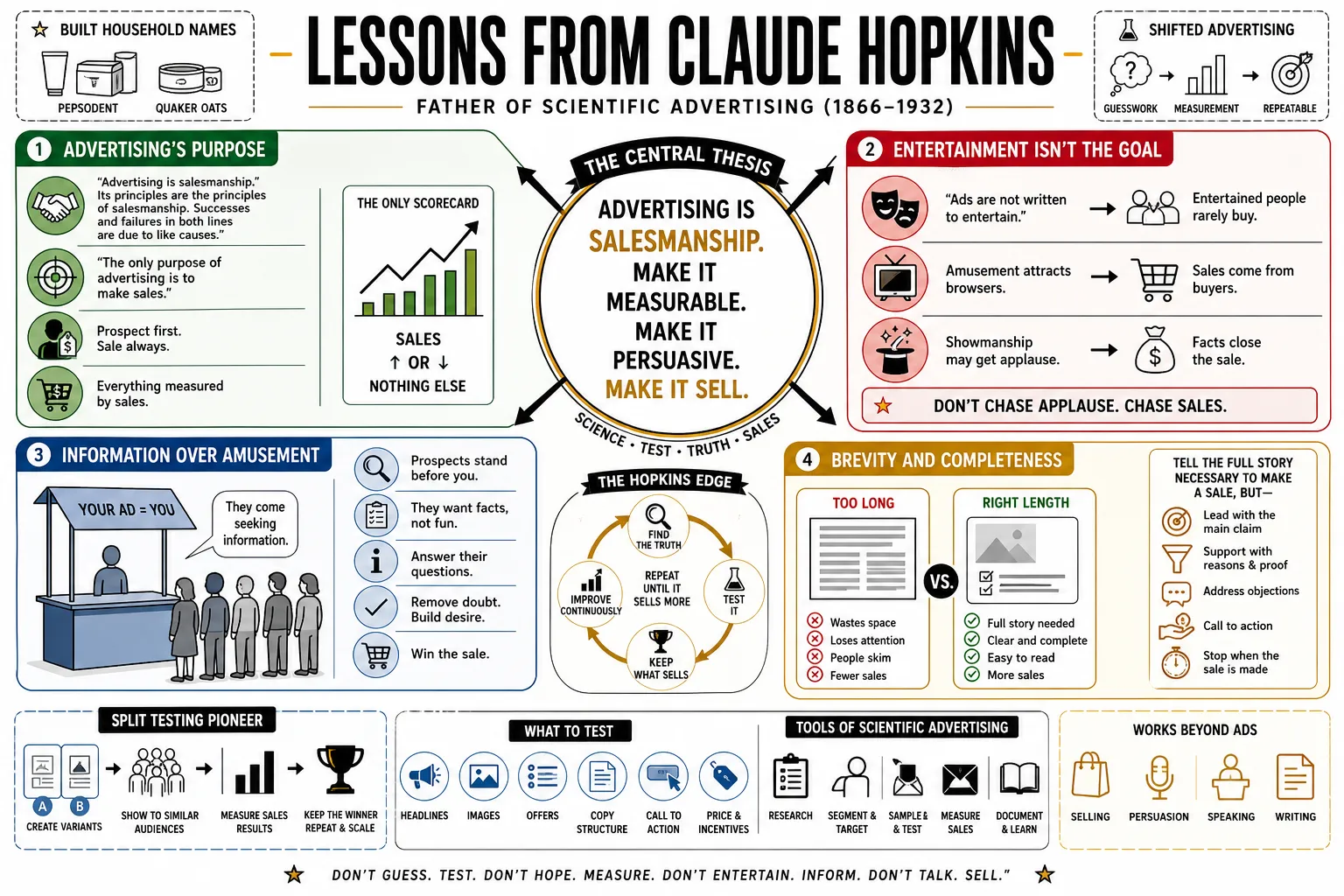
- Treat Advertising as Salesmanship: Hopkins frames an advertisement as a salesperson in print, to be judged by whether it persuades a buyer. — Scientific Advertising.
- Judge Advertising by Sales: He says the purpose of advertising is to make sales, not merely to please its creator. — Scientific Advertising.
- Do Not Mistake Entertainment for Selling: Hopkins warns that copy written chiefly to entertain can win attention from people who will not buy. — Scientific Advertising.
- Offer Information Worth Reading: Readers choose ads that appear to offer something relevant; Hopkins says they do not read advertisements simply for amusement. — Scientific Advertising.
- Tell a Complete Sales Story: Hopkins favors including the claims a prospective buyer needs, even when that takes more space than a short ad. — Scientific Advertising.
- Write to One Prospect: Hopkins advises picturing a typical interested prospect and weighing each sentence for its service to that person. — My Life in Advertising.
- Use Natural, Simple Language: He advises short words and unobtrusive language so that the product, rather than the writer, remains the focus. — My Life in Advertising.
- Lead with the Customer’s Interest: Hopkins says buyers seek service for themselves, not the advertiser’s profit; useful information or a trial can give them a reason to engage. — Scientific Advertising.
- Keep Cleverness Subordinate: Hopkins cautions that conspicuously brilliant or unusual writing can draw attention away from the product. — My Life in Advertising.
Part 2: Consumer Psychology
- Study the Buyer’s Position: He urges advertisers to place themselves in the buyer’s position rather than confuse their own interests with the consumer’s. — Scientific Advertising.
- Coax Rather Than Drive: Hopkins argues that people act to please themselves, so a useful offer works better than demands to buy. — Scientific Advertising.
- Avoid an Indistinct Mass Audience: Hopkins warns that thinking of people only as a mass blurs the view of individual buyers and their motives. — Scientific Advertising.
- Test Appeals Against Human Motives: Hopkins treats recurring motives such as curiosity as useful advertising insights, though his broad claim that human nature never changes is his view, not a universal fact. — Scientific Advertising.
- Use Curiosity When It Fits: He credits curiosity about how puffed grains were made with helping the Puffed Wheat and Puffed Rice campaigns. — Scientific Advertising.
- Show the Desired State: Hopkins recommends depicting what people want to become rather than dwelling on an unwanted present condition. — Scientific Advertising.
- Notice the Pull of the Crowd: In his account of automobile advertising, Hopkins says perceived popularity can influence buyers who cannot judge value independently. — My Life in Advertising.
- Stay Close to Ordinary Buyers: Hopkins warns that success can distance advertisers from ordinary customers, leading them to mistake a narrow circle for the public. — My Life in Advertising.
- Find a Tangible Product Problem: For Pepsodent, Hopkins found an account of the film on teeth and used that visible idea to explain the toothpaste’s appeal; he did not present a modern habit-loop theory. — My Life in Advertising.
- Lead with the Reward Buyers Wanted: Hopkins says the Pepsodent campaign emphasized attractive teeth and beauty after tests showed that appeal drew more response than preventive warnings. — My Life in Advertising.
Part 3: Strategy & Testing
- Build on Traced Results: Hopkins attributes durable advertising success to tested principles and strategy rather than unproved theories. — My Life in Advertising.
- Replace Guesswork with Comparisons: Hopkins argues that recorded results let advertisers compare methods and learn which approaches work. — Scientific Advertising.
- Test Before Broad Rollout: Hopkins advocates trying an approach on a smaller scale, measuring results, and expanding only after it proves worthwhile. — Scientific Advertising.
- Key Responses to Their Ads: Coupons or other keyed responses let Hopkins connect a response to the advertisement or offer that produced it. — Scientific Advertising.
- Track Cost per Response: Mail-order results gave Hopkins an immediate comparison of the cost of responses from competing ads. — Scientific Advertising.
- Learn from Mail-Order Advertising: Because mail-order ads require traceable responses, Hopkins treats them as a practical school for evaluating copy and cost. — Scientific Advertising.
- Improve Proven Methods with Local Tests: Hopkins says he hesitates to abandon a profitable method until a better one has been proved by local tests. — My Life in Advertising.
Part 4: Headlines & Hooks
- Use Headlines to Find Interested Readers: Hopkins says a headline should identify the people likely to care about the offer, not simply attract the largest crowd. — Scientific Advertising.
- Earn the Right Reader’s Attention: He says even persuasive copy fails if a headline does not first win a hearing from the relevant prospect. — Scientific Advertising.
- Reveal the Relevant Interest: Hopkins compares headlines to newspaper headings: they should reveal the subject or benefit to readers who would care. — Scientific Advertising.
- Use Curiosity in a Relevant Headline: Hopkins used curiosity in product appeals, but his headline advice still requires signaling why the right reader should care. — Scientific Advertising.
- Put the Appeal Up Front: The headline should show the product’s relevant attraction clearly enough that interested readers recognize it at a glance. — Scientific Advertising.
Part 5: Specificity & Evidence
- Replace Generalities with Details: Hopkins says broad superlatives leave little impression while definite claims give readers something to evaluate. — Scientific Advertising.
- Give Figures When They Matter: He argues that measured figures, such as a stated price reduction, carry more weight than vague claims of improvement. — Scientific Advertising.
- Make Claims as Specific as Evidence Allows: Hopkins advises stating a worthwhile claim in a definite form rather than relying on generic sales language. — Scientific Advertising.
- Quantify a Price Reduction: His example contrasts saying prices were reduced with stating the precise percentage reduction. — Scientific Advertising.
- Use Verifiable Facts, Not Empty Proof Language: Hopkins argues that concrete facts can lend a claim weight; specificity alone does not make an unsupported claim true. — Scientific Advertising.
- Choose Details That Matter to Buyers: His examples use figures and process details to make a product benefit intelligible rather than merely decorate the copy. — Scientific Advertising.
Part 6: Offers & Risk Reversal
- Show the Product in Use: Hopkins’s early silver-polish demonstrations taught him that trials can persuade where verbal selling alone does not. — My Life in Advertising.
- Let the Product Demonstrate Its Value: In the silver-polish story, Hopkins says a good article can be its own best salesman when prospects can see it work. — My Life in Advertising.
- Use Samples to Encourage Trial: Hopkins recommends samples where a trial can demonstrate a product’s merits more effectively than assertions alone. — Scientific Advertising.
- Offer Service Before Demanding a Sale: His examples include samples and approval trials that let customers test a claim with little or no initial risk. — Scientific Advertising.
- Create Demand Dealers Can See: Hopkins describes sample offers and advertising as ways to build demand before or alongside wider dealer distribution. — Scientific Advertising.
- Make the Trial Offer Concrete: Hopkins’s sampling examples specify what the prospect receives and how to obtain or try it. — Scientific Advertising.
- Explain the Purpose of a Sample: Hopkins says a sample should serve a clear sales purpose and be presented as a useful chance to test the product. — Scientific Advertising.
- Give Readers a Response Mechanism: He describes coupons as a convenient reminder and action device for readers who decide to respond. — Scientific Advertising.
Part 7: Campaign Lessons
- Explain What Rivals Merely Assert: Hopkins contrasts brewers’ generic purity claims with a campaign that described the production process behind one brewer’s claim. — Scientific Advertising.
- Make an Ordinary Process Visible: In his Schlitz account, Hopkins described filtered air, cleaned bottles, and other standard brewing practices to give substance to a purity claim. — My Life in Advertising.
- Make the Benefit Easy to Picture: Hopkins built Pepsodent copy around visible tooth film and attractive teeth rather than an unsupported claim about creating a habit ritual. — My Life in Advertising.
- Give a Reason for the Claim: In the beer example, Hopkins explains why factual process details can make a generic claim more persuasive. — Scientific Advertising.
Part 8: Life & Business Philosophy
- Treat Campaigns as Strategy: Hopkins likens advertising to strategy requiring knowledge of competitors, preparation, distribution, and sufficient resources. — Scientific Advertising.
- Do the Research Behind the Ad: Hopkins says effective ads may require extensive investigation; he warns that an advertiser unwilling to work late will not get far. — Scientific Advertising.
- Keep Hidden Research Behind Simple Copy: Hopkins notes that a simple ad may rest on weeks of work, extensive data, and months of research. — Scientific Advertising.
- Prove the First Sale Before Scaling: Hopkins says a campaign should learn how to win one customer before attempting to reach thousands. — Scientific Advertising.
- Take Advice from Measured Returns: His warning not to follow the blind concerns untraced advertising advice: prefer evidence from actual returns. — Scientific Advertising.
- See Useful Work as a Game: Hopkins recounts an early mentor’s view that the line between work and play can depend on attitude; the quoted words were the mentor’s, not Hopkins’s. — My Life in Advertising.
- Help Others Who Work to Succeed: Hopkins writes that his own success made him want to help industrious younger people succeed. — My Life in Advertising.