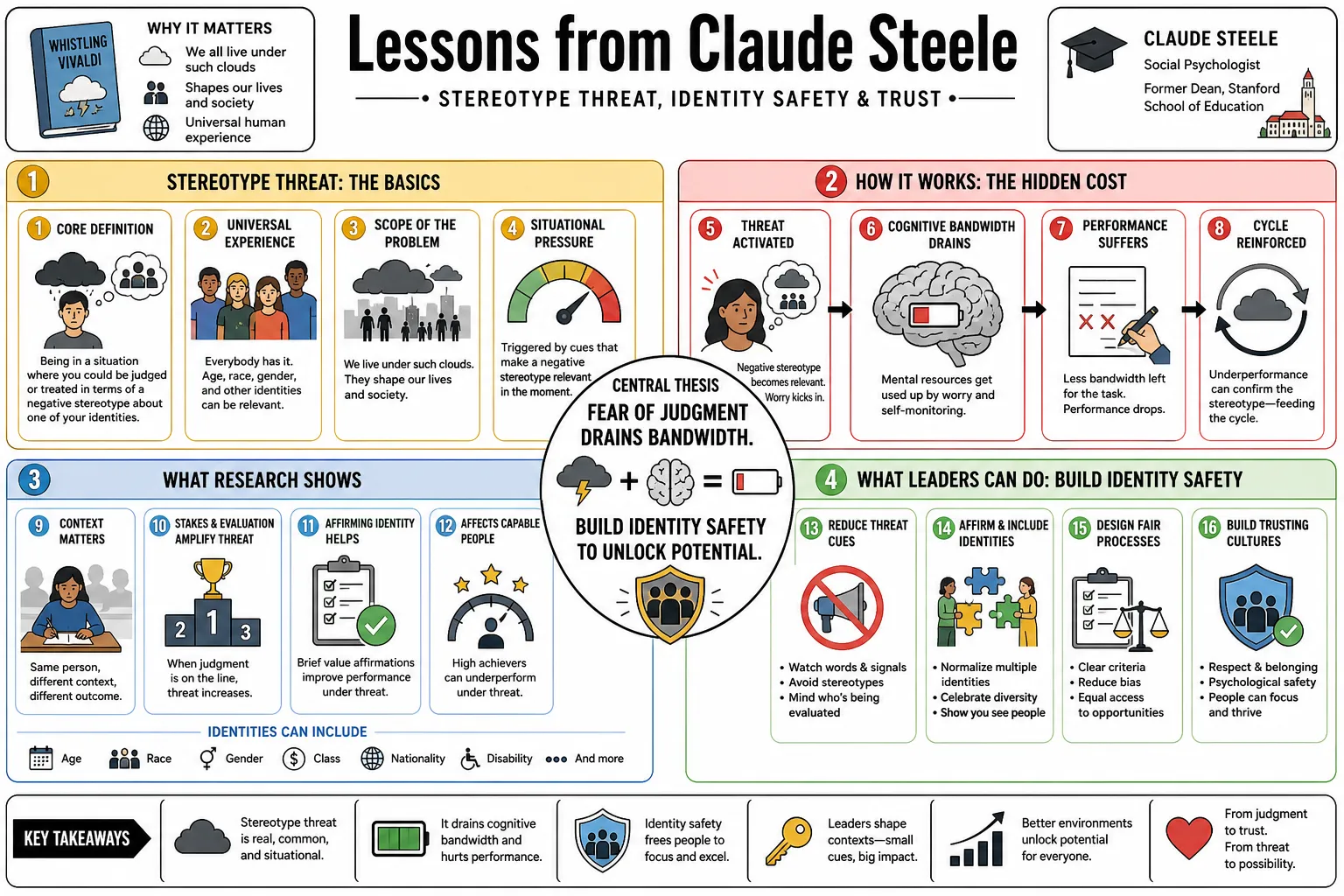
Lessons from Claude Steele
Social psychologist and former Stanford education dean Claude Steele is best known for defining "stereotype threat." His research explains why highly capable people underperform when they worry about confirming negative assumptions about their group. This profile covers his findings on how the fear of judgment drains cognitive bandwidth, and what leaders can do to build environments grounded in identity safety and trust.
Part 1: Stereotype Threat
- On the core definition: "Stereotype threat is the experience of being in a situation where you know you could be judged or treated in terms of a negative stereotype about one of your identities." — Source: [Frontline Interview]
- On the universal experience: "Stereotype threat is a very simple experience that everybody has. It refers to being in a situation or doing something for which a negative stereotype about one of your identities—your age, your race, your gender—is relevant to you." — Source: [Interview with Henry Louis Gates Jr.]
- On the scope of the problem: "Whistling Vivaldi is about the experience of living under such a cloud—an experience we all have—and the role such clouds play in shaping our lives and society." — Source: [Whistling Vivaldi]
- On situational pressure: Stereotype threat is not an internalized belief about one's own inferiority; it is a situational pressure that arises directly from the environment. — Source: [American Psychological Association]
- On the actor versus the observer: There is a disconnect between how an observer views poor performance—often attributing it to a lack of innate ability—and how the actor experiences it as a chronic, situational pressure to avoid confirming a bias. — Source: [Whistling Vivaldi]
- On women in quantitative fields: "But when women drop out of quantitative majors in college it usually has nothing to do with their grades. The culprit, in their case, is not their quantitative skills but, more likely, the prospect of living a significant portion of their lives in a domain where they may forever have to prove themselves." — Source: [Whistling Vivaldi]
- On the Sisyphean task: "Disproving a stereotype is a Sisyphean task; something you have to do over and over again as long as you are in the domain where the stereotype applies." — Source: [Whistling Vivaldi]
- On the age stereotype in tech: Visiting a young tech startup with bicycles on the walls and loud music can trigger stereotype threat in an older professional, causing them to worry their contributions will be dismissed due to their age. — Source: [School's In Podcast]
- On the inevitability of threat: "If you are a member of a group about which there is a negative stereotype, then whenever you are in a situation where that stereotype is applicable, you are at risk of being judged by it." — Source: [The Atlantic Interview]
- On shifting the burden: The threat operates by making the individual responsible for managing the discomfort of the stereotype, shifting their focus away from the actual task they are trying to perform. — Source: [Whistling Vivaldi]
Part 2: Identity Contingencies
- On defining contingencies: Identity contingencies are the specific circumstances, conditions, or rules of the road you have to deal with in a given situation simply because you have a given social identity. — Source: [Whistling Vivaldi]
- On prejudice versus conditions: "It’s sad, but true: identity threat is not the threat of prejudice alone; it’s the threat of contingencies." — Source: [Whistling Vivaldi]
- On the first realization of identity: Steele realized his racial identity at age seven when he learned that Black children in his Chicago neighborhood could only swim at the local park pool on Wednesday afternoons. — Source: [Whistling Vivaldi]
- On whistling Vivaldi: The title of Steele's book comes from journalist Brent Staples, who discovered that whistling classical music signaled refinement and altered the dangerous contingencies he faced as a young Black man walking at night. — Source: [NPR Interview]
- On modifying the environment: Brent Staples did not change who he was; he changed the cues in his environment by whistling, which immediately altered the contingencies that other pedestrians imposed on him. — Source: [Whistling Vivaldi]
- On internal versus external adaptation: "If you want to change the behaviors and outcomes associated with social identity... don't focus on changing the internal manifestations of the identity, such as values and attitudes. Focus instead on changing the contingencies to which all of that internal stuff is an adaptation." — Source: [Whistling Vivaldi]
- On the cloud of contingencies: These identity rules hang over people like a cloud, dictating where they can go, how they must speak, and what they must prove to get what they want in a specific setting. — Source: [Columbia University Lecture]
- On intersectionality of contingencies: A person does not face just one contingency; they navigate a complex web of them based on the intersection of their race, gender, class, and the specific environment they enter. — Source: [Whistling Vivaldi]
- On the psychological weight: The heaviest contingencies are not always overt discrimination, but the subtle, everyday behavioral adjustments required to make other people comfortable with your identity. — Source: [Whistling Vivaldi]
Part 3: The Caring Requirement and John Henryism
- On the paradox of caring: Stereotype threat does not affect those who are indifferent; it most severely impacts the "vanguard"—the highly motivated individuals who care the most about succeeding in the domain. — Source: [Frontline Interview]
- On over-efforting: "The detriment in performance comes from the attempt to disprove the stereotype. It doesn't come from giving up. It comes from the person saying ‘I’m going to beat this thing,’ because the person cares about it." — Source: [Interview with Henry Louis Gates Jr.]
- On the wrong assumption about motivation: "People experiencing stereotype threat are already trying hard. They’re identified with their performance. They have motivation. It’s the extra ghost slaying that is in their way." — Source: [Whistling Vivaldi]
- On John Henryism: Steele uses the concept of "John Henryism" to describe the physiological and psychological toll on minorities who strive for success against societal prejudices through intense, solitary over-exertion. — Source: [Whistling Vivaldi]
- On isolated effort: Students facing threat often adopt a strategy of intense, isolated effort to succeed, which perversely sets them up for defeat because they miss out on collaborative learning and shared problem-solving. — Source: [Whistling Vivaldi]
- On physiological reactivity: The sheer effort required to combat a stereotype in real-time causes a measurable spike in blood pressure and heart rate, reflecting the physical cost of over-efforting. — Source: [Interview with Henry Louis Gates Jr.]
- On the irony of trying harder: In testing environments, the harder that stereotyped students thought about the problems to avoid confirming a bias, the worse they actually performed. — Source: [Whistling Vivaldi]
- On the vulnerability of the invested: Because they have tied their self-worth to their performance in a specific domain, high achievers have the most to lose if a stereotype is applied to them. — Source: [The Atlantic Interview]
- On stereotype reactance: In some scenarios, individuals experience "stereotype reactance," an intense burst of motivation to disprove the assumption, though sustaining this state leads to rapid exhaustion. — Source: [ReThinking with Adam Grant]
- On misdiagnosing failure: When highly motivated students fail under stereotype threat, observers often misdiagnose the failure as a lack of preparation or ability, rather than the collapse that follows unsustainable over-effort. — Source: [Whistling Vivaldi]
Part 4: Cognitive Load and Multitasking
- On the ghost in the room: "The problem is that the pressure to disprove a stereotype changes what you are about in a situation. It gives you an additional task... you are also trying to slay a ghost in the room." — Source: [Whistling Vivaldi]
- On mental multitasking: Stereotype threat forces a person to multitask; they must simultaneously process the complex task at hand while also monitoring the environment for cues of bias. — Source: [Frontline Interview]
- On working memory depletion: The vigilance required to scan a room for identity threats consumes critical working memory, leaving fewer cognitive resources available for problem-solving. — Source: [ReThinking with Adam Grant]
- On the distraction of anxiety: The anxiety generated by the prospect of confirming a stereotype is highly distracting, pulling focus away from the test or the conversation and onto the self. — Source: [Whistling Vivaldi]
- On the speed of processing: Because working memory is tied up in threat management, individuals under stereotype threat often process information more slowly and make more careless errors. — Source: [American Psychological Association]
- On the invisibility of the load: The cognitive load imposed by stereotype threat is completely invisible to the observer, making the resulting performance drop seem like a pure reflection of the person's natural limits. — Source: [Whistling Vivaldi]
- On executive function impairment: The mere possibility of being stereotyped is enough to temporarily impair executive function, hindering the ability to plan, focus attention, and regulate emotions. — Source: [ReThinking with Adam Grant]
- On the cost of vigilance: Constant vigilance for bias is a survival mechanism in hostile environments, but it exacts a heavy tax on a person's bandwidth and energy over the course of a day. — Source: [Whistling Vivaldi]
- On returning resources: When the situational threat is removed or neutralized, working memory is instantly freed up, and the individual's performance immediately rebounds to its true baseline. — Source: [Whistling Vivaldi]
Part 5: Standardized Testing and the Achievement Gap
- On the SAT's legacy: Steele views the SAT not as a pure measure of merit, but as the historical legacy of Francis Galton, designed originally as an ideology of dominance to rationalize subordination. — Source: [Interview with Henry Louis Gates Jr.]
- On underperformance: "Among students with comparable academic skills, as measured by the SAT, black students got less of a return on those skills in college than other students. Something was suppressing the yield they got from their skills." — Source: [Whistling Vivaldi]
- On what tests actually measure: For ability-stereotyped students, standardized tests often measure the situational pressure of the testing environment and their ability to navigate a threat-filled space, rather than their innate knowledge. — Source: [A Threat in the Air]
- On the gender gap in math: When women were told a difficult math test showed "gender differences," they underperformed men; when the same test was introduced as "gender-neutral," their scores matched the men's. — Source: [Whistling Vivaldi]
- On the limits of instruction: "No amount of instruction, no matter how good it is, can reduce these deficits if it doesn't also keep identity threat low. Without that, threat will always have first claim on students' attention." — Source: [Whistling Vivaldi]
- On test framing: Simply moving the demographic questionnaire to the end of a standardized test, rather than having students fill it out before beginning, can significantly reduce the activation of stereotype threat. — Source: [Whistling Vivaldi]
- On the achievement gap's real cause: The achievement gap is often not a gap in preparation or ability, but a gap in the psychological safety of the environments where students are asked to perform. — Source: [School's In Podcast]
- On reframing the assessment: Describing a complex test as a "problem-solving exercise" rather than a "diagnostic measure of ability" can completely eliminate the performance gap between groups. — Source: [Whistling Vivaldi]
- On the tragedy of lost potential: The most significant cost of the testing gap is the systematic loss of talent and contributions from individuals who are discouraged from pursuing fields where they face chronic identity threat. — Source: [The Atlantic Interview]
Part 6: "Churn" in Diverse Settings
- On defining churn: "Churn is the quiet psychological agitation that arises in identity-diverse interactions, shaped by concerns about how we are seen and judged." — Source: [Stanford GSE News]
- On the internal tension: Churn is the constant internal debate over whether to interpret an interaction through the lens of one's group history, or to ignore that history and trust the immediate situation. — Source: [Commonwealth Club Interview]
- On churn affecting everyone: Churn is not synonymous with prejudice; it affects both the prejudiced and the non-prejudiced alike, arising from the identity threat that all parties in a diverse setting can feel. — Source: [PsychSessions Podcast]
- On the distraction of diversity: In diverse scenarios, churn acts as a physical and mental distraction, undermining performance, damaging relationships, and eroding trust in the fairness of the situation. — Source: [Stanford GSE News]
- On the avoidance instinct: People often choose to avoid diverse settings or difficult conversations entirely, not out of malice, but to escape the exhausting psychological churn those environments produce. — Source: [Lives Well Lived Interview]
- On background processing: Churn operates as a continuous background processing program in the brain, evaluating whether the individual is safe or about to be devalued based on their identity. — Source: [PsychSessions Podcast]
- On the need for intentionality: Diversity is a powerful resource, but putting diverse people in a room is not enough; managing the inevitable churn requires intentional trust-building strategies. — Source: [Commonwealth Club Interview]
- On the friction of interaction: The wariness caused by historical social identities creates a friction in everyday interactions, from teacher-student dynamics to doctor-patient consultations. — Source: [Lives Well Lived Interview]
- On the antidote to churn: "The bright side, the optimistic side, is that I think churn has an antidote, a remedy... and that’s trust." — Source: [Stanford GSE News]
- On overcoming wariness: Overcoming churn requires explicit actions that assure people they will not be reduced to a stereotype, allowing them to drop their defensive vigilance. — Source: [PsychSessions Podcast]
Part 7: Providing Feedback and Building Trust
- On the Mentor’s Dilemma: Evaluators face the "Mentor's Dilemma"—the tension between offering rigorous, honest criticism and the risk that the feedback will be interpreted as biased or discouraging. — Source: [American Psychological Association]
- On the wise feedback formula: The most effective way to deliver criticism across divides is to state: "I'm giving you these comments because I have very high expectations and I know that you can reach them." — Source: [Whistling Vivaldi]
- On the two pillars of feedback: Wise feedback requires two explicit signals to build trust: a clear invocation of high standards, and an unequivocal assurance that the evaluator believes the person is capable of meeting them. — Source: [University of Michigan Teaching Guidelines]
- On trust as the engine: "Trust was the engine of their performance. When they trusted that they weren't being seen through the lens of a negative stereotype, they could devote their full attention to the task at hand." — Source: [Whistling Vivaldi]
- On resolving the interpretive quandary: Wise feedback works because it resolves the student's internal debate; it clarifies that the criticism is driven by exacting standards, not by a negative belief about their group. — Source: [Whistling Vivaldi]
- On eliminating racial differences in response: The racial gap in how students responded to critical feedback was totally eliminated only when the criticism was buffered with the wise combination of high standards and explicit assurance. — Source: [Whistling Vivaldi]
- On who offers trust first: In hierarchical relationships, the burden is on the person in the position of power (the manager, the teacher) to make the first move in offering trust to mitigate the threat. — Source: [Commonwealth Club Interview]
- On long-term impact: Students who receive wise feedback are not only more likely to revise their current work, but they also report significantly higher levels of trust in their institutions months later. — Source: [American Psychological Association]
- On avoiding false praise: Simply watering down criticism or offering unearned praise is counterproductive; it signals low expectations and actually deepens the recipient's suspicion of bias. — Source: [Whistling Vivaldi]
Part 8: Environmental Cues and Identity Safety
- On defining identity safety: Identity safety is an environment where an individual feels secure that their social identity will not be used to judge them, allowing them to focus entirely on their work. — Source: [Whistling Vivaldi]
- On the power of environmental cues: "If enough cues in a setting can lead members of a group to feel 'identity safe,' it might neutralize the impact of other cues in the setting that could otherwise threaten them." — Source: [Brown Daily Herald]
- On critical mass: Critical mass is not a specific demographic quota; it is the psychological threshold at which minorities no longer feel uncomfortable or conspicuous because of their identity. — Source: [Whistling Vivaldi]
- On the danger of solo status: Being the only person of your identity in a room—like Justice Sandra Day O'Connor in her early years on the Supreme Court—makes your identity highly conspicuous and triggers intense stereotype threat. — Source: [Whistling Vivaldi]
- On the argument for diversity: The most compelling argument for diversity is that when multiple ways of being are valued, minorities can trust the environment, drop their vigilance, and actually succeed. — Source: [Whistling Vivaldi]
- On the accumulation of cues: One negative environmental cue might be ignored, but when a lack of diverse leadership is combined with subtle social exclusions and biased feedback, the cues compound into a massive psychological barrier. — Source: [Whistling Vivaldi]
- On self-affirmation: Allowing individuals a brief moment to reflect on their core personal values before entering a high-stakes environment serves as a powerful buffer against identity threat. — Source: [Berkeley News]
- On the necessity of safety: "For ability-stereotyped students, reducing identity threat is just as important as skill and knowledge instruction. It may not be sufficient, but it is necessary." — Source: [Whistling Vivaldi]
- On designing better spaces: Effective identity-safe practices actively avoid cues that instantiate a sense of threat, aiming instead to make everyone feel valued and contributive regardless of their background. — Source: [Whistling Vivaldi]