Despite having zero culinary background, Stephen Starr built a hugely profitable group of independent restaurants. This profile examines how his early career as a music promoter led him to treat dining rooms like concert stages, where lighting and sound matter just as much as the food.
Part 1: The Show and the Experience
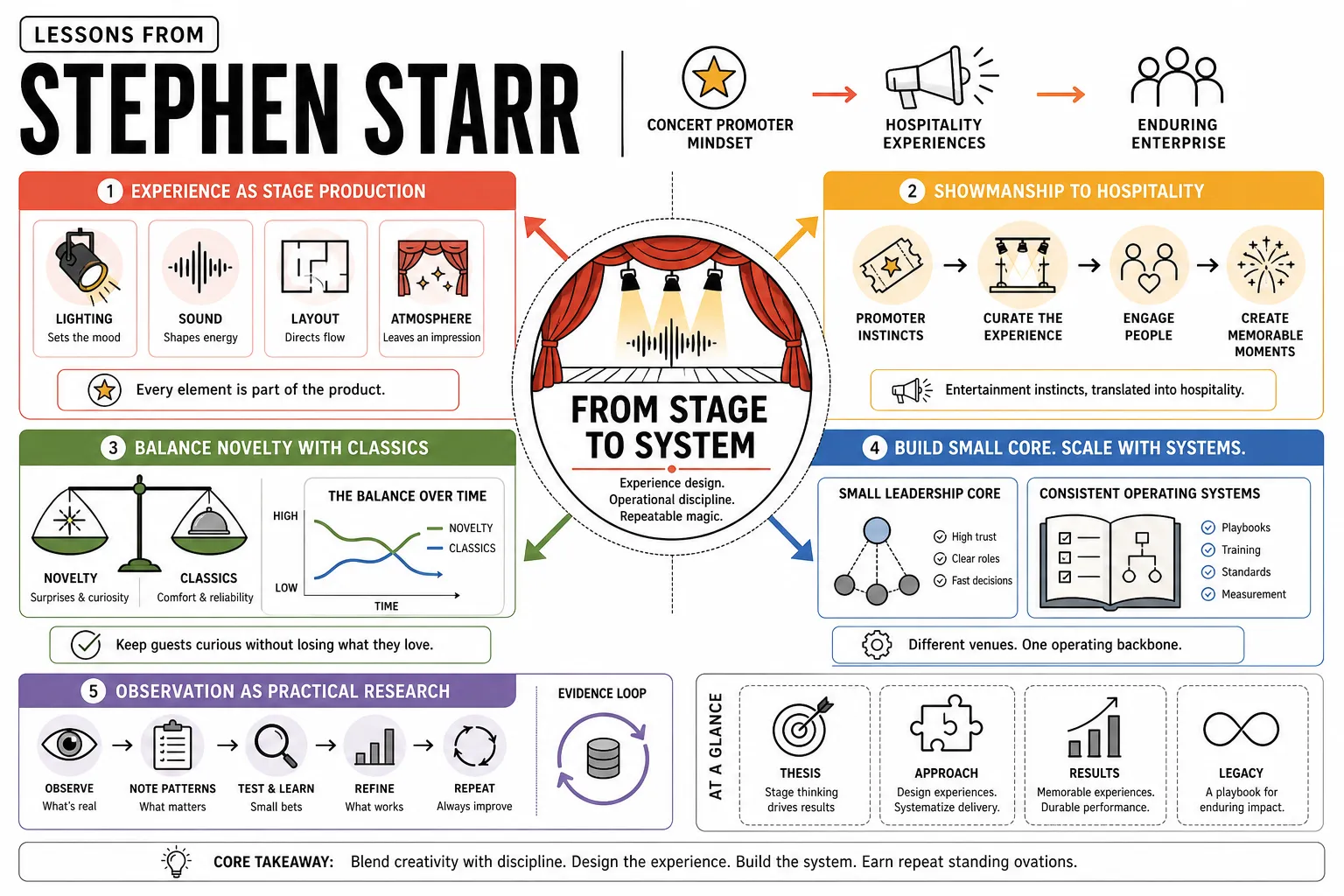
- On the theater of dining: He recognized early on that a restaurant is essentially a stage production, where every detail—from lighting and music to upholstery—contributes to the emotional experience of the guest. — Reference: LinkedIn
- On what customers actually buy: People aren't merely paying for a product on a plate; they are paying for how that entire environment makes them feel. — Reference: LinkedIn
- On standing out through aesthetics: "It wasn’t so much that I was that good, it was that things here in Philly were very boring. And I had an eye for design, so design kind of became my main thing." — Source: Philadelphia Magazine
- On applying the concert model to food: Drawing from his background as a promoter, he realized that whether the act is a solo acoustic musician or a massive rock band with pyrotechnics, everything relies on putting on a great show. — Reference: CBS News
- On practical market research: True market research often just means walking into a room, paying close attention to how the atmosphere makes you feel, and determining if that exact feeling can be successfully transplanted to a new city. — Reference: Guy Raz Newsletter
- On balancing a menu: "It's a balance you have to come up with of staying fresh but not disappointing people that have their classic hits" — Source: CBS News
Part 2: Building and Managing the Team
- On assembling a leadership core: Keep your inner circle small and specific. By defining exactly what each person is responsible for—like having one dedicated design partner and one focused entirely on finances—you can maintain trust and make decisions quickly as you scale. — Reference: Guy Raz Newsletter
- On identifying culinary talent: He viewed his role as akin to an A&R executive at a record label, relying on an innate, gut-level sense to discover and foster the right chefs and managers. — Reference: CBS News
- On collaborative brilliance: Drawing a parallel to the Beatles, he understood that while individual team members might be brilliant on their own, the work they produce together can be exponentially greater. — Reference: Podbrain
- On gathering feedback: The most valuable insights in a restaurant come directly from the waitstaff. Talking to the boots on the ground at the end of the night is the best way to learn what customers are really saying. — Reference: Philadelphia Magazine
- On leadership styles: Managing a restaurant often requires the structure of a "benevolent dictator" to maintain operational order, as a pure democracy is incredibly difficult to sustain in that environment. — Reference: Philadelphia Magazine
- On basic respect: No matter how furious a situation makes you, correct employees in the privacy of an office and never embarrass them in front of others. — Reference: Philadelphia Magazine
- On maintaining an executive view: He likened his function to a film's executive producer—he didn't need to cook or design the space himself, but rather needed the aesthetic sense to hire the right director, the right stars, and select the right soundtrack. — Reference: Podbrain
Part 3: Strategy, Risk, and the Underdog Advantage
- On outgiving the competition: When competing against bigger players early in his career, he won loyalty by giving artists more than they asked for—upgrading their requested chicken to lobster and caviar to build unshakeable trust. — Reference: Guy Raz Newsletter
- On strategic short-term losses: Booking unknown bands at a deliberate financial loss can be a smart long-term investment if it earns you the goodwill of major agencies who will later send you massive acts. — Reference: Guy Raz Newsletter
- On avoiding the coolness trap: "I made tons of mistakes and acted too much on gut feeling and what was cool, as opposed to what would make money." — Source: Philadelphia Magazine
- On the modern cost barrier: "It’s not a worthwhile investment anymore to open a fairly large restaurant" — Source: Restaurant Business
- On landlord partnerships: The economics of launching a new restaurant today are so challenging that expanding is nearly impossible without securing a significant financial contribution from the property owner. — Reference: Restaurant Business
- On the ideal modern footprint: Due to soaring construction and kitchen expenses, the sweet spot for a profitable new restaurant today is keeping it smaller, ideally around 85 to 95 seats, and turning those tables multiple times a night. — Reference: Podbrain
- On leveraging existing infrastructure: To launch his first comedy venue affordably, he partnered with an existing deli, taking the door revenue while letting the owner keep the bar profits. — Reference: Podbrain
- On operational logistics: You can sell out a room entirely, but if you put the cover charge on the servers' checks instead of taking it at the door, an ill-prepared staff will cause guests to walk out without paying. — Reference: Philadelphia Magazine
Part 4: Expansion and Reinvention
- On ignoring political noise: When opening a high-profile restaurant steps from the White House, he actively avoided taking political stances, choosing instead to simply provide a glamorous meeting space for anyone in power. — Reference: Restaurant Business
- On reviving tainted brands: By purchasing iconic but scandal-plagued properties and bringing back the celebrated original chefs, you can re-establish trust and reset the narrative under a new regime. — Reference: Restaurant Business
- On challenging naming conventions: When naming a new steakhouse, he specifically avoided generic tropes like "prime" or "steak" in favor of something with a cinematic feel that broke away from ultra-masculine traditions. — Reference: Restaurant Business
- On scaling without losing identity: As the business grows into a massive entity, it's vital to retain the ethos of a mom-and-pop operation by staying true to yourself and your core instincts. — Reference: Philadelphia Magazine
- On community-wide planning: Attempting to revitalize a struggling city through piecemeal restaurant openings is ineffective; success requires a coordinated, grand master plan for the entire destination. — Reference: Reporter Gourmet
- On adapting to new economies: To attract broader audiences in transitioning markets, he shifted toward offering simpler, more accessible dining experiences with elevated culinary attention, stepping back from overt celebrity-chef branding. — Reference: Reporter Gourmet
- On surviving a cash crisis: Facing millions in accounts payable and dwindling cash during COVID, his team rapidly raised $10 million in 36 hours by selling buy-one-get-one gift certificates. — Reference: Podbrain
Part 5: Instincts and Personal Philosophy
- On defensive pessimism: "The glass if half empty, and it's probably poisoned." — Source: CBS News
- On managing expectations: By viewing the world through a deeply pessimistic lens, you ensure that you will rarely be disappointed by unexpected negative outcomes. — Reference: CBS News
- On playing the host: He recognized that his role in life wasn't to participate in the revelry, but to be the person responsible for throwing the party while remaining strictly outside of it. — Reference: Guy Raz Newsletter
- On the anti-climax of success: Despite the outward glamour, opening night is actually a deeply sad experience for him, prompting an urge to retreat home and watch television rather than celebrate. — Reference: CBS News
- On early sales training: Working on a boardwalk as a teenager served as a grueling boot camp that taught him the raw realities of human nature and the essential mechanics of persuasion. — Reference: Podbrain
- On the ignorance of youth: Not having a formal business education allowed him to take wild risks, primarily because he simply didn't know enough to realize his ideas were supposedly impossible. — Reference: Podbrain
- On proving people wrong: After being kicked out of a shared venue by a partner who wanted to run the shows himself, Starr used pure competitive fury as fuel to build his own club and put his rival out of business. — Reference: Podbrain
Part 6: Additional lessons on Additional lessons on The Show and the Experience
- On crafting an immediate emotional response: The goal is to design a space so striking that it evokes a physical reaction, forcing a sharp intake of breath or a tearful moment of awe the moment you look through the window. — Reference: Apple Podcasts
- On standing out in a dull market: His initial success in Philadelphia wasn't merely due to perfection, but because the existing dining scene was full of boring, old-school establishments, making a vibrant new concept feel revolutionary. — Reference: Apple Podcasts
- On drawing inspiration from nightlife: Instead of relying on traditional culinary templates, he drew inspiration from New York's buzzing martini bars and nightclub energy to inform his first major restaurant concept. — Reference: Apple Podcasts
Part 7: Additional lessons on Additional lessons on Building and Managing the Team
- On retaining a hands-on hiring approach: Even as his company grew massive, he continued to personally interview every server and host in his home base of Philadelphia to ensure the right cultural fit. — Reference: Philadelphia Magazine
Part 8: Additional lessons on Additional lessons on Expansion and Reinvention
- On proving yourself in major markets: To be taken seriously by the wider culinary establishment, he felt he had to move beyond his regional dominance in Philadelphia and succeed on the grand stage of New York City. — Reference: Apple Podcasts
Part 9: Additional lessons on Additional lessons on Instincts and Personal Philosophy
- On learning from early failures: Getting fired from a radio job for daring to mix a Joan Baez track into a song by the Doors proved that pushing creative boundaries sometimes carries a real cost. — Reference: Philadelphia Magazine
Part 10: Additional lessons on Additional lessons on Design and Atmosphere
- On achieving visual impact on a budget: He managed to transform an aging diner into an iconic martini bar for just $90,000 by creatively repurposing existing elements, such as encasing a Formica bar in concrete and recovering old booths. — Reference: Apple Podcasts
- On trusting aesthetic vision: Even without formal culinary training, a strong visual sense and a keen understanding of what environments make people feel sexy and escaped can drive a restaurant's success. — Reference: Apple Podcasts
- On respecting creative designers: Rather than viewing expensive design choices merely as a drain on the budget, he respected the artistic process, sometimes pushing for even more extravagant visual statements. — Reference: Apple Podcasts
- On creating an immersive environment: He is known for an almost cerebral approach to hospitality, building complete environments where the aesthetic vision supports every aspect of the dining experience. — Reference: To Dine For
Part 11: Additional lessons on Additional lessons on Adapting to the Modern Economy
- On shifting toward accessibility: In markets recovering from economic downturns, he found success by moving away from celebrity-driven venues and instead opening bright, inviting concepts with a more accessible price point. — Reference: Reporter Gourmet
Part 12: Additional lessons on Additional lessons on The Customer Service Imperative
- On the fragility of hospitality: He noted the stressful reality that a single dissatisfied employee, like a dishwasher walking out, can bring an entire massive restaurant operation to a grinding halt. — Reference: Apple Podcasts
- On maintaining standards: Even with thousands of employees, he remains relentlessly obsessed with tasting the food and checking the lighting to ensure consistent execution. — Reference: Apple Podcasts
- On the unforgiving nature of diners: A customer can have five flawless experiences, but a single mistake on their sixth visit is often enough to lose their business forever. — Reference: Apple Podcasts
- On controlling the intangibles: A great dining experience requires meticulous attention to the unseen elements that guests absorb subconsciously, such as the room's temperature and the exact volume of the music. — Reference: Apple Podcasts
Part 13: Additional lessons on Additional lessons on Mentorship and Identifying Talent
- On fostering local talent: By mentoring young chefs and offering them a platform to grow within his organization, he helped seed the broader culinary landscape with highly skilled professionals who went on to open their own concepts. — Reference: Restaurant Business
- On looking beyond the resume: He trusted his instinct to evaluate a person's underlying charisma and potential rather than strictly demanding a traditional culinary background. — Reference: Apple Podcasts
- On giving early opportunities: He proved willing to take a chance on unproven talent, once paying a young Jerry Seinfeld $75 to host a comedy show. — Reference: Apple Podcasts
- On recognizing limits: He understood early on that he was terrified of managing food operations himself, leading him to seek out culinary experts to handle the kitchen while he focused on the overarching concept. — Reference: Apple Podcasts
Part 14: Additional lessons on Additional lessons on Partnerships and Collaborations
- On chasing personal culinary obsessions: His decision to partner with Nancy Silverton for a massive Italian marketplace in D.C. was heavily motivated by his sheer love for her signature focaccia dish, demonstrating how personal taste can drive major business moves. — Reference: Washingtonian
- On breaking the fourth wall: In designing new collaborative spaces, he emphasized the importance of visibility, believing that when cooks can directly see the gratitude of their diners, the quality of the food actually improves. — Reference: Washingtonian
- On synergy in mixed-use spaces: When building a combined restaurant and market, the design should allow for fluid interaction, where ingredients sold on the retail side are actively used and showcased in the restaurant's kitchen. — Reference: Washingtonian