Tom Rinks went from a commission-only furniture showroom to designing the Taco Bell chihuahua and co-founding Sun Bum. He built a $400 million sunscreen brand by applying midwestern retail lessons to packaging and guerrilla marketing. This profile details how he actually reads consumers and builds brands that stick.
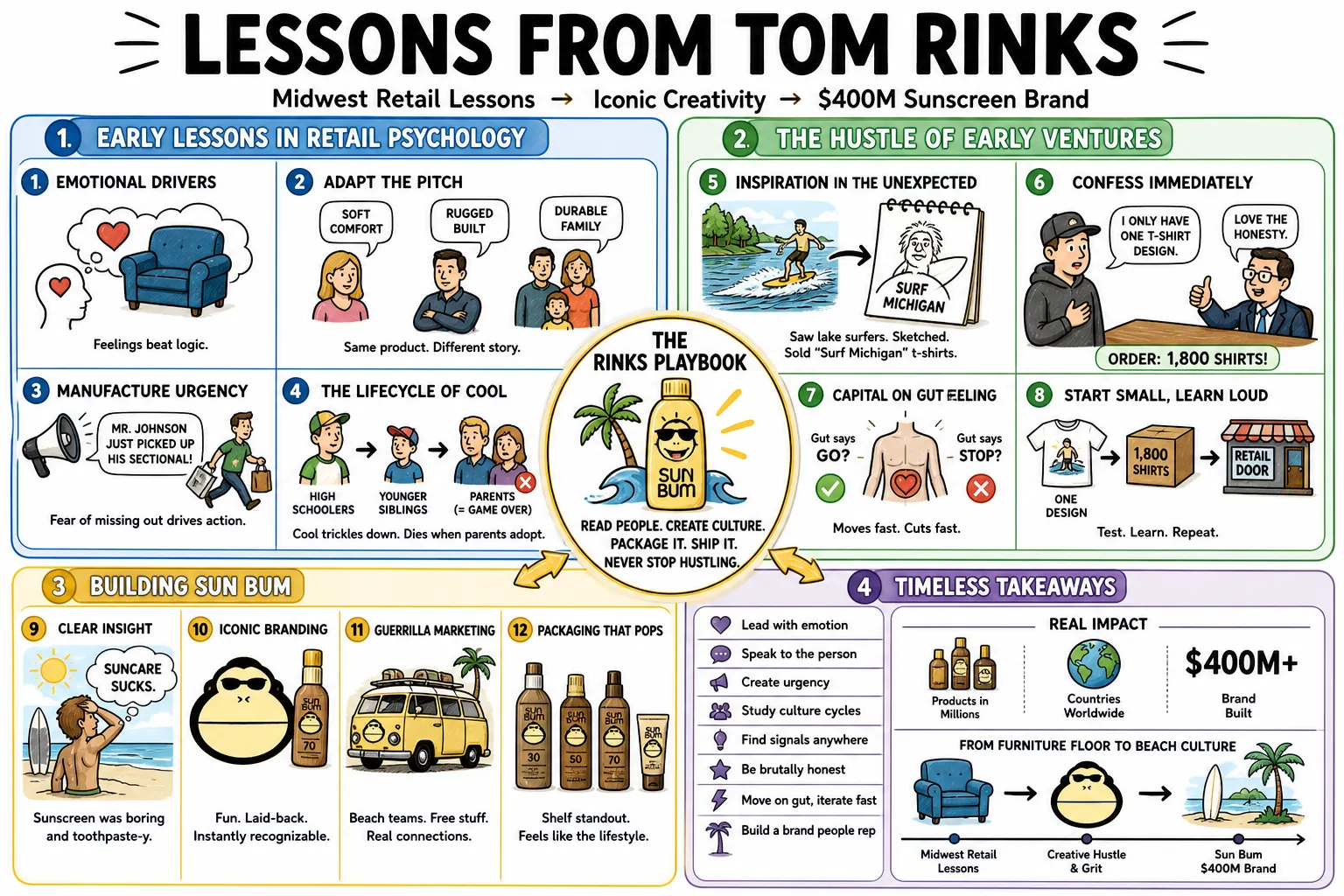
Part 1: Early Lessons in Retail Psychology
- On observing emotional drivers: Working in a midwestern furniture store taught Rinks that customers buy based on how a product makes them feel rather than logic alone. — Reference: HIBT Recaps
- On adapting the pitch: He learned to tailor his sales language to the customer's persona for the exact same physical product, emphasizing a leather sofa's softness to women, its ruggedness to men, and its durability to families. — Reference: RiffOn
- On manufacturing urgency: Rinks created the illusion of a buying frenzy by announcing fake customer furniture pickups over the store's loudspeaker, which prompted actual customers to buy before missing out. — Reference: RiffOn
- On the lifecycle of cool: By observing apparel trends, he noticed that a brand's cachet trickles down from high schoolers to younger siblings, but immediately dies the moment parents adopt it. — Reference: RiffOn
Part 2: The Hustle of Early Ventures
- On finding inspiration in the unexpected: After seeing locals surfing on a lake in Michigan, he sketched a cartoon of an old surfer and created a side hustle selling "Surf Michigan" t-shirts. — Reference: The Empire Builders Podcast
- On confessing immediately: To secure a pitch with a major retail buyer, he pretended to represent a full surf line, but upon entering the room, he confessed he only had a single t-shirt design. The buyer was impressed by his honesty and ordered 1,800 shirts. — Reference: RiffOn
- On capitalizing on local momentum: Recognizing the lack of stylish merchandise for the booming University of Michigan basketball team, he walked into the athletic director's office, secured an in-house licensing deal, and sold 10,000 custom shirts in one season. — Reference: HIBT Recaps
- On borrowing pop culture moments: A magazine photo of Madonna holding her new pet inspired him to create a line of tough-looking chihuahua shirts, which quickly sold by the tens of thousands. — Reference: Podscripts
Part 3: The Taco Bell Legal Battle
- On taking big swings at trade shows: Renting a booth at a New York licensing show put Rinks and his design partner in front of major corporate players, leading to a massive proposed mascot deal with Taco Bell. — Reference: The Empire Builders Podcast
- On protecting intellectual property: After 18 months of developing character designs, tray liners, and commercials, Taco Bell abruptly cut communication and later aired the exact campaign concepts Rinks had storyboarded. — Reference: Podscripts
- On enduring corporate warfare: Winning compensation for the ubiquitous fast food campaign required surviving a highly stressful, five-year legal battle against a major corporate titan and its top-tier law firms. — Reference: RiffOn
- On refusing early lowball offers: Rinks later admitted that he would have settled for just $200,000 early on to cover his work, but because Taco Bell refused to offer a dime, he took the case to trial and won a $30.1 million jury verdict plus interest. — Reference: Podscripts
Part 4: The Art of Brand Design
- On assessing the market: When asked to rescue a struggling sunscreen project with terrible names like "Race Face," Rinks spent a month researching the industry and found a massive void left by clinical, pharmaceutical-style legacy brands. — Reference: Balsa Surf
- On mashing up aesthetics: Sun Bum’s iconic look was created by blending completely disparate influences, including 1960s American surf culture, Japanese streetwear, and mid-century modern Scandinavian furniture. — Reference: RiffOn
- On the Elvis Principle: Rinks believes in combining opposing traits—such as an edgy, dangerous vibe with wholesome, humble virtues—to create a brand personality that appeals to a much wider demographic. — Reference: RiffOn
- On choosing a mascot: Instead of predictable surf imagery like crossed longboards, Rinks anchored the brand with a stone-faced ape in sunglasses, knowing it had broader global appeal and would never suffer a public relations scandal like a celebrity founder. — Reference: Podscripts
- On embedding the category in the name: Including the word "sun" in Sun Bum meant that customers were already saying half the brand name when thinking about the category itself. — Reference: RiffOn
- On premium positioning: For the DeLeón tequila brand, Rinks designed a heavy sterling silver cork carved with skulls and snakes by a celebrity jeweler to make buyers feel wealthy and rebellious. — Reference: Podscripts
Part 5: Creating the Illusion of Scale
- On the Trojan Horse strategy: Sun Bum refused to let stores selectively stock a few items. Retailers were forced to purchase a massive, custom-built IKEA bookcase display that included the full product line, instantly making the brand appear established. — Reference: RiffOn
- On manufacturing geographic authenticity: To ensure their sunscreen didn't look like it was made in the midwest, the company rented a P.O. Box in Cocoa Beach, Florida, while operating out of Michigan. — Reference: RiffOn
- On technical truths: When customers called their fake Florida headquarters during a snowstorm, the Michigan-based founders would vaguely but truthfully reply that the weather was "unbelievable." — Reference: RiffOn
- On graffiti marketing: The team distributed thousands of stickers featuring just their ape mascot without the company name, prompting curious consumers to call local radio stations and generating massive organic buzz. — Reference: Balsa Surf
Part 6: Building Brand Authenticity
- On staying out of the spotlight: Rinks deliberately avoided becoming the public face of his brands, believing that consumers wanted to imagine a tough guy behind his tequila or a surfer behind his sunscreen, rather than a designer from Michigan. — Reference: RiffOn
- On making products for yourself: The founding team did not rely on corporate focus groups, opting instead to formulate sunscreens that felt good, smelled good, and were safe enough for their own families to use daily. — Reference: Balsa Surf
- On lifestyle content: Instead of posting standard product catalogs, Sun Bum leveraged social media as a personal beach diary showcasing sunsets, skate parks, and surfers, building a deep emotional connection with its audience. — Reference: Balsa Surf
- On corporate responsibility: The brand established a nonprofit arm called Protect The Groms, partnering directly with schools to provide shade structures, sunscreen, and sun safety education for children. — Reference: Prevent Cancer Foundation
- On unconventional creativity: Rinks argued that relying on purely traditional marketing is no longer sufficient, suggesting that campaigns must "get weird" to break through highly saturated digital spaces. — Reference: ArtVersion
Part 7: Designing for Stagnant Markets
- On observational research: When hired to rebrand an oral care company, Rinks spent months standing in Target aisles observing how customers mindlessly grabbed their usual toothpaste brands without looking at the rest of the shelf. — Reference: Entrepreneur
- On answering consumer objections: He realized that if a shopper bought a new toothpaste, their family would question the change, meaning the brand's name needed to serve as an instant, logical defense for the purchase. — Reference: Entrepreneur
- On renaming for trust: He rebranded the company as "Made By Dentists" so that buyers could easily justify their purchase by citing the creators' professional expertise. — Reference: Entrepreneur
- On leaning into humor for kids: To differentiate the children's line, he abandoned standard mint and berry flavors, designing packaging for bizarre, countercultural flavors like "alien blood" and "eyeball juice." — Reference: Podscripts
Part 8: Managing Growth and Transition
- On recognizing personal limitations: Identifying strictly as a creative, Rinks knew he lacked the operational discipline and margins expertise required to successfully scale a massive consumer goods company. — Reference: RiffOn
- On proactively stepping down: Aware that creative founders often cause their companies to stagnate, he actively recruited his own CEO successor to ensure Sun Bum could grow past his own managerial ceiling. — Reference: RiffOn
- On strategic acquisitions: Sun Bum was ultimately acquired by SC Johnson for $400 million because international sunscreen expansion required navigating complex, country-specific drug regulations that only a massive global partner could handle. — Reference: RiffOn
- On the necessity of practice: He credits his success not just to lucky breaks, but to treating brand building like an art form and practicing it relentlessly over decades. — Reference: Podscripts
Part 9: Additional lessons on Additional lessons on The Hustle of Early Ventures
- On DIY logistics: When first launching his t-shirt side hustle, Rinks printed custom designs on blank Hanes shirts and carefully repacked them into original Hanes boxes to look like a legitimate vendor upon delivery. — Reference: How I Built This with Guy Raz
Part 10: Additional lessons on Additional lessons on The Taco Bell Legal Battle
- On the defense of independent creation: During the lawsuit, Taco Bell claimed they merely discussed licensing with Rinks and that their ad agency independently created the Chihuahua concept after spotting a dog in Venice Beach. — Reference: Los Angeles Times
- On the distraction of corporate theft: The lawsuit consumed his life and destroyed the value of his "Psycho Chihuahua" shirts, as consumers falsely assumed Rinks was knocking off Taco Bell's massive campaign. — Reference: How I Built This with Guy Raz
Part 11: Additional lessons on Additional lessons on The Art of Brand Design
- On rejecting bad premises: When approached to fix a failing sunscreen business, Rinks immediately threw out their terrible NASCAR and college-themed ideas, insisting on starting the concept from scratch. — Reference: How I Built This with Guy Raz
Part 12: Additional lessons on Additional lessons on Creating the Illusion of Scale
- On guerrilla distribution: Before landing major retail accounts, Sun Bum relied on a relentless independent sales rep who placed stickers on highway off-ramps and gas nozzles to manufacture curiosity. — Reference: How I Built This with Guy Raz
- On leveraging high-end exclusivity: Getting Richard Branson to stock Sun Bum exclusively on Necker Island provided a powerful talking point that quickly convinced other luxury resorts like the Four Seasons to carry the brand. — Reference: How I Built This with Guy Raz
Part 13: Additional lessons on Additional lessons on Building Brand Authenticity
- On educating the next generation: The brand established a nonprofit arm called "Protect The Groms," aimed at inspiring and teaching children about the importance of sun protection and community. — Reference: Freesurf Magazine
Part 14: Additional lessons on Additional lessons on Designing for Stagnant Markets
- On leaning on authentic founders: When rebranding an oral care line created by actual dentists, Rinks stayed entirely behind the scenes, recognizing that the founders' authentic professional credentials were the strongest selling point for consumers. — Reference: How I Built This with Guy Raz
Part 15: Additional lessons on Additional lessons on The Agency Model and Strategic Partnerships
- On a structured design process: While building brands for clients, Rinks established a disciplined three-month timeline: month one for researching industry holes, month two for creative ideation, and month three for laying down the final design work. — Reference: How I Built This with Guy Raz