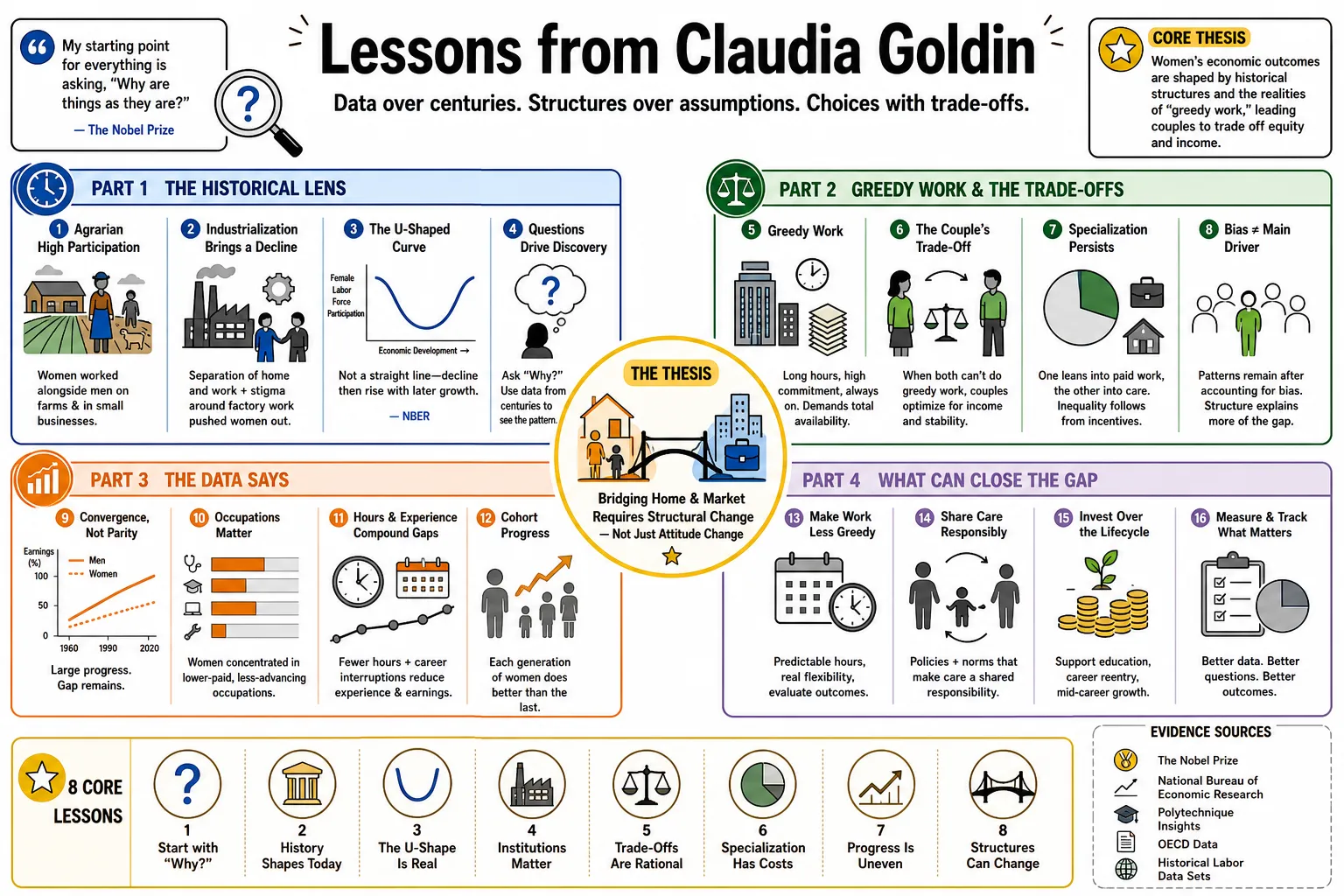
Lessons from Claudia Goldin
Claudia Goldin studies the economic history of women’s work and the gender earnings gap. Her research traces changes in education, careers, families and the way jobs reward hours and availability; it does not reduce every remaining gap to one cause. — Goldin’s Nobel Biography.
Part 1: The Historical Lens
- On asking the right questions: Goldin begins with historical puzzles and reconstructs evidence before accepting a familiar explanation for women’s economic outcomes. — Goldin’s Nobel Biography.
- On the U-shaped curve: Across development, measured market work by married women can first fall and later rise; Goldin’s U-shape does not mean women stopped working at home or on farms. — The U-Shaped Female Labor Force Function.
- On agrarian labor: In agricultural and family-production economies, much of women’s work occurred within households and farms, where historical records often failed to count it as market employment. — The U-Shaped Female Labor Force Function.
- On the stigma of factory work: During industrialization, rising household income and social stigma attached to married women’s manual wage work could reduce their measured labor-force participation. — The U-Shaped Female Labor Force Function.
- On the service sector shift: Expansion of white-collar work helped draw married women into paid employment after the earlier decline in measured market participation. — The U-Shaped Female Labor Force Function.
- On historical persistence: Historical earnings gaps changed over time; they should not be treated as a fixed feature of the labor market. — The Earnings Gap Between Male and Female Workers.
- On the income effect: When family income rose, some married women withdrew from paid manual work; Goldin identifies this income effect alongside norms and changing job types. — The U-Shaped Female Labor Force Function.
- On historical data: Goldin’s historical reconstruction shows why early census categories can obscure women’s work, especially work within the household or family enterprise. — Goldin’s Nobel Biography.
Part 2: The Quiet Revolution
- On the shift in mindset: Goldin calls the shift toward expecting a long career and making it part of adult identity a quiet revolution in women’s work. — The Quiet Revolution.
- On life-cycle expectations: Longer career horizons changed educational and occupational planning: more women expected sustained labor-force attachment. — The Quiet Revolution.
- On delayed milestones: Career expectations, education and delayed family formation moved together across cohorts; Goldin does not attribute every marriage delay to expectations alone. — The Quiet Revolution.
- On generational momentum: Women born in the late 1940s helped initiate the transition toward sustained careers, often before its full implications were visible. — The Quiet Revolution.
- On the nature of a job: Goldin distinguishes a job that mainly provides earnings from a career that is part of identity and expected long-run advancement. — The Quiet Revolution.
- On unfinished business: The change in aspirations and education did not by itself complete gender convergence in earnings or career outcomes. — The Quiet Revolution.
- On identity formation: As women formed career identities before marriage, education, work and family choices increasingly became part of joint household planning. — The Quiet Revolution.
Part 3: The Power of the Pill
- On reproductive control: Early legal access to oral contraception lowered the risk of career-interrupting pregnancy while women invested in lengthy professional training; it did not eliminate pregnancy risk. — The Power of the Pill.
- On the social multiplier: Goldin and Katz describe a social-multiplier channel: as marriage was delayed more widely, a woman could postpone marriage for training without facing the same thin later marriage market. — The Power of the Pill.
- On professional degrees: The study links early pill access to increased enrollment of women in long-duration professional programs, including law and medicine. — The Power of the Pill.
- On timing fertility: More reliable control of fertility helped some women sequence professional training, marriage and family formation differently; other changes also mattered. — The Power of the Pill.
- On the age of marriage: Early pill access contributed to later marriage among young women in the cohorts studied; the paper does not establish it as the single primary cause of the national shift. — The Power of the Pill.
- On state laws: Goldin and Katz use variation in state laws governing young unmarried women’s pill access to estimate effects on education and marriage timing. — The Power of the Pill.
- On the marriage market: Delayed marriage by more women could enlarge the later marriage market for those pursuing professional education, amplifying the pill’s direct effect. — The Power of the Pill.
Part 4: The Architecture of "Greedy Jobs"
- On defining greed: Goldin uses greedy work for jobs that disproportionately reward long, particular or on-call hours, making time flexibility costly. — A Grand Gender Convergence.
- On non-linear pay: In some high-paying occupations, an additional hour at work can be rewarded more than proportionally, so two shorter schedules may not earn what one long schedule does. — A Grand Gender Convergence.
- On the root cause: Goldin emphasizes the structure and time demands of high-paying jobs as a major barrier to convergence; this does not imply that direct discrimination has disappeared. — A Grand Gender Convergence.
- On time constraints: A couple with children must cover care when a school closes or a child is sick, while some careers demand availability at those same times. — Career and Family Excerpt.
- On the premium of face-time: When high-paying work rewards being constantly available, the person who takes the primary caregiving role can pay a substantial career and earnings cost. — Career and Family Excerpt.
- On professional services: Goldin identifies law and corporate or finance work as occupations where hours, client demands and limited flexibility often carry large earnings penalties. — Goldin Interview.
- On predictability: In Goldin’s occupational analysis, larger gaps correlate with less predictable schedules and greater time demands; she cautions that this is not necessarily causal. — Goldin Interview.
- On systemic redesign: Reducing the price of temporal flexibility in high-paying jobs is one route to narrowing earnings gaps. — A Grand Gender Convergence.
Part 5: Couple Equity and the Cost of Flexibility
- On rational choices: When one job pays a large availability premium, a couple may gain income by having one partner take that job and the other take a more flexible role. — Goldin on Work and Home.
- On sacrificed equity: Goldin describes the trade-off between a more equal division of paid and unpaid work and the higher household income available through specialization. — Goldin on Work and Home.
- On shared loss: Specialization has costs for both partners: the flexible worker can lose earnings and advancement, while the long-hours worker can lose family time. — Career and Family Excerpt.
- On household bargaining: The labor market’s price on flexibility helps shape who provides care at home; household choices cannot be read apart from job design. — Goldin on Work and Home.
- On the price of a flexible schedule: After children arrive, women in the samples Goldin discusses more often scale back hours or move toward flexibility, sometimes at a lower hourly rate. — Goldin Interview.
- On the illusion of choice: An apparent preference for a lower-paid flexible role may reflect the couple’s available jobs, care needs and social norms, not a free-standing preference. — Goldin on Work and Home.
- On same-sex couples: Goldin says couples of any sex can face an income-versus-equity trade-off when one job rewards availability, but she notes that direct measurements for same-sex couples remain limited. — Goldin on Work and Home.
- On historical context: Recent cohorts of college-educated women have increasingly sought both a career and family life; Goldin does not claim this combination was wholly absent from world history. — Goldin on Work and Home.
- On the caregiving default: When a child’s needs interrupt the workday, the partner in the more flexible job is often the one positioned to respond. — Career and Family Excerpt.
Part 6: Education and Generational Cohorts
- On the education paradox: Women’s average educational attainment has risen above men’s in the United States, yet sizable earnings gaps remain in some occupations. — Goldin Interview.
- On tracking cohorts: Goldin follows successive birth cohorts because expectations and constraints change across generations; a cross-section alone can hide that transition. — The Quiet Revolution.
- On the early pioneers: For many early cohorts of college-educated women, combining a lasting career with family was unusually difficult, though not literally impossible. — Goldin on Work and Home.
- On the transition generation: Goldin’s cohort account shows how women moved from jobs followed by family toward aspirations for career and family together; transitions differed by generation. — Goldin on Work and Home.
- On the race with technology: Goldin and Katz argue that the supply of educated workers and technology-driven demand jointly shape wage inequality; this is a broader inequality thesis, not a stand-alone explanation of the gender gap. — The Race between Education and Technology.
- On human capital: Women’s gains in education and work experience helped narrow older components of the earnings gap, while leaving a substantial residual. — A Grand Gender Convergence.
- On the mommy track: Among MBAs studied by Bertrand, Goldin and Katz, career interruptions and shorter hours after children contributed to widening earnings differences; a temporary scale-back need not permanently derail everyone. — Dynamics among Young Professionals.
- On educational parity: Education and experience convergence reduced the gap, but Goldin argues that those gains alone cannot eliminate the remaining earnings differences. — A Grand Gender Convergence.
- On future cohorts: Goldin describes more recent college-educated cohorts as expecting to combine careers and families, shifting attention toward how workplaces accommodate both. — Goldin on Work and Home.
Part 7: The Data Behind the Gap
- On the 78-cent metric: An aggregate cents-on-the-dollar figure summarizes earnings across workers, but it does not by itself isolate differences in hours, occupations, experience or unequal treatment. — A Grand Gender Convergence.
- On margins of work: Goldin distinguishes the historical extensive margin of whether women entered paid work from the intensive margin of how much those employed worked; neither alone explains every period. — UBS Goldin Interview.
- On occupational sorting: Goldin estimates that between-occupation sorting explains only about a quarter to a third of the gap she discusses; differences within occupations also matter. — Freakonomics Goldin Interview.
- On the motherhood penalty: In the MBA cohort studied, women and men began with more similar earnings, then the gap widened with parenthood and changes in hours and interruptions. — Dynamics among Young Professionals.
- On unobservable variables: Hours alone do not capture every time demand: predictability, client relationships and whether work can be handed off help explain occupational flexibility penalties. — Goldin Interview.
- On longitudinal data: Longitudinal data let researchers track the same people across parenthood and later careers; Goldin and coauthors find persistent parental earnings differences. — When the Kids Grow Up.
- On stalled progress: As education and experience differences narrowed, job flexibility and nonlinear pay became more prominent remaining issues; Goldin does not call them the sole reasons for every stalled trend. — A Grand Gender Convergence.
Part 8: Hidden Biases and Structural Solutions
- On blind auditions: Goldin and Rouse estimate that blind auditions increased women’s advancement probability by about 50 percent in certain preliminary rounds—a relative estimate, not an 11-point universal effect. — Orchestrating Impartiality.
- On overcoming bias: Their analysis attributes roughly 30–55 percent of the increase in the share of women among new orchestral hires to blind auditions; it does not report a 30 percent individual final-round hiring boost. — Orchestrating Impartiality.
- On pharmacy as a model: Pharmacy became a comparatively egalitarian high-paid profession as large employers, standardized work and substitutability made flexible schedules less costly. — The Most Egalitarian of All Professions.
- On substitutability: Pharmacists can often substitute for one another, reducing the price of flexibility; Goldin reports a smaller, not literally nonexistent, gender earnings gap. — Goldin Interview.
- On structural fixes: Greater equality would be easier if high-paying work depended less on one person’s particular hours and made flexibility less expensive. — A Grand Gender Convergence.
- On the role of technology: Goldin points to pharmacy information systems as one reason another qualified worker can take over a task without losing essential client information. — Goldin Interview.
- On fixing the system: Improving individual credentials or bargaining alone cannot remove a pay structure that rewards inflexible hours; workplace design matters too. — A Grand Gender Convergence.
- On corporate incentives: Goldin argues that firms may have incentives to redesign work when they can retain productive employees and reduce costly reliance on a single always-available worker; she does not say every firm will do so. — Goldin Interview.
- On the ultimate goal: Goldin’s broader goal is to make career and family less of a forced trade-off for both partners by lowering the workplace price of flexibility. — Goldin on Work and Home.