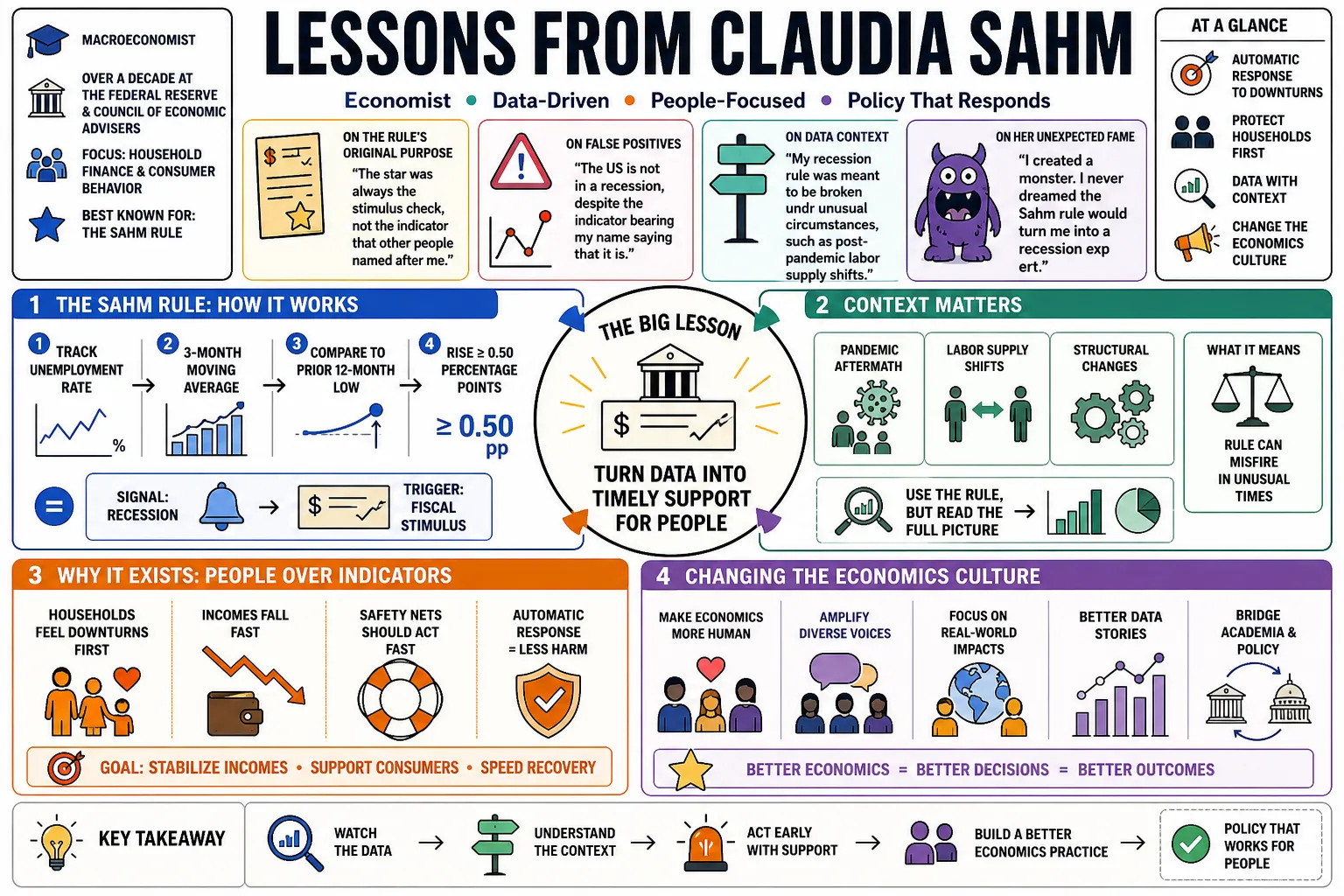
Lessons from Claudia Sahm
Claudia Sahm is a macroeconomist and former Federal Reserve economist whose research includes household finance and consumer spending. She devised the Sahm Rule as a trigger for automatic recession relief and writes about monetary policy, labor markets and the culture of economics. — MIT Sloan Sahm Interview.
Part 1: The Sahm Rule and Recession Indicators
- On the rule's original purpose: Sahm says the rule began as a trigger for automatic stimulus checks; helping families quickly was the goal, not making a famous recession indicator. — The Sahm Rule: I Created a Monster.
- On false positives: In 2024, Sahm cautioned that the unemployment-rate rise could reflect an influx of job seekers as well as weaker demand, so a rule signal should be read with other evidence. — Sahm on the 2024 Rule Signal.
- On data context: The rule is an empirical pattern, and unusually large post-pandemic labor-supply shifts can make its signal look stronger than underlying recession risk. — Sahm on the 2024 Rule Signal.
- On identifying downturns: The Sahm Rule triggers when the three-month average national unemployment rate rises at least 0.50 percentage points above its low in the previous 12 months. — Sahm’s Stimulus Proposal.
- On her unexpected fame: Sahm has described the attention around her recession rule as unexpected and sometimes distracting from its original policy purpose. — The Sahm Rule: I Created a Monster.
- On empirical limits: Sahm stresses that the rule summarizes a historical pattern, not an immutable economic law or a forecast of future unemployment. — The Sahm Rule: I Created a Monster.
- On apolitical policy: Her proposal would legislate a data-based trigger in advance so direct payments could reach households early in a recession without waiting for a new political debate. — Sahm’s Stimulus Proposal.
- On early warnings: A trigger based on rising unemployment can deliver relief earlier than waiting for the official recession-dating process. — Sahm’s Stimulus Proposal.
- On broad data reliance: Sahm reads unemployment alongside labor supply, hiring, quits, vacancies, layoffs and wages; no single release settles the labor-market picture. — Labor Market Conditions.
Part 2: Fiscal Policy and Direct Stimulus
- On stimulus checks: Sahm says the checks—not the indicator’s name—are central to her proposal because households can use them to spend, save or pay down debt. — MIT Sloan Sahm Interview.
- On automatic stabilizers: Making direct payments an automatic stabilizer would tie relief to a measurable downturn and reduce the lag of discretionary legislation. — Sahm’s Stimulus Proposal.
- On real-time data: Sahm argues that useful policy data require understanding how surveys are collected and whom they represent; she designed questions on stimulus because existing data were insufficient. — MIT Sloan Sahm Interview.
- On relief timing: The point of an automatic payment trigger is to act quickly enough to support households and limit the damage from a downturn. — The Sahm Rule: I Created a Monster.
- On tax rebates: In Sahm, Shapiro and Slemrod’s household surveys, one-time 2008 rebate payments elicited a larger reported spending response than the 2009 tax-credit withholding change. — Sahm–Shapiro–Slemrod Stimulus Study.
- On policy coordination: For supply-driven inflation, Sahm argues that Congress and the White House can use more targeted tools, while interest-rate changes mainly manage demand. — Can the Fed Bring Inflation Down Alone?.
- On household resilience: Sahm judges recession relief partly by whether households can maintain spending, savings and debt repayment through a downturn. — MIT Sloan Sahm Interview.
Part 3: The Federal Reserve and Monetary Policy
- On Fed independence: Sahm argues that interest-rate decisions should be insulated from presidential pressure while the Fed remains accountable and explains its choices publicly. — MIT Sloan Sahm Interview.
- On data-driven decisions: Sahm says forecasters must test historical patterns against current data because a major shock can change the relationships they expect to hold. — Morningstar Sahm Interview.
- On communication strategy: Sahm wants Fed communication to explain what officials are doing and why; opaque or reduced guidance can weaken public accountability. — Where Is the Fed Headed?.
- On interest rate limits: Interest-rate policy is more direct against demand-driven inflation than against shortages of labor, food or energy; Sahm favors relevant supply-side responses as well. — Can the Fed Bring Inflation Down Alone?.
- On labor market cooling: Sahm warns that keeping rates restrictive too long can needlessly weaken employment even while inflation improves. — Inflation, Inflation, Inflation.
- On policy equilibrium: Cooling an overheated labor market back toward balance is different from a recession; the composition of unemployment and pace of hiring matter. — Labor Market Conditions.
- On the dot plot: Sahm sees merit in the dot plot’s transparency goal but calls the tool difficult to interpret; her priority is clearer Fed reasoning, not preserving every chart unchanged. — Where Is the Fed Headed?.
- On apolitical wins: In her June 2026 discussion of the Cook ruling, Sahm argued that protecting Fed officials from political removal helps keep rate decisions grounded in evidence. — Where Is the Fed Headed?.
- On forecasting challenges: Sahm’s years on the Fed forecasting staff taught her to revisit models after shocks and to care about the economic story, not only a precise point forecast. — Morningstar Sahm Interview.
- On the Fed's dual mandate: The Fed’s dual mandate requires weighing inflation and employment risks together; Sahm supported recalibration in 2024 as downside risks to jobs rose. — Labor Market Conditions.
Part 4: Post-Pandemic Inflation and the Whiplash Economy
- On the inflation debate: Sahm rejects a single-cause account of the post-pandemic inflation cycle: supply shocks mattered, but the full decomposition requires further evidence. — Inflation, Inflation, Inflation.
- On supply shocks: Sahm describes a succession of supply disruptions—from pandemic bottlenecks to wars and tariffs—that repeatedly raised costs in the 2020s. — Whiplash Economy.
- On the whiplash economy: She calls the economy “whiplash” because changing labor supply, tariffs and other shocks can alter familiar relationships in the data quickly. — Whiplash Economy.
- On service-sector inflation: In mid-2026 Sahm viewed some nonhousing-services inflation as stickier than energy effects, including prices in recreation, hotels and other personal services. — Where Is the Fed Headed?.
- On the last mile of inflation: Sahm argues that easing labor shortages by adding workers can relieve supply pressure more directly than cutting demand; no single labor-supply fix guarantees the last step to 2% inflation. — Can the Fed Bring Inflation Down Alone?.
- On tariffs and prices: In her 2026 review of the prior year, Sahm linked 2025 tariff increases to higher core-goods prices and some persistence in headline inflation; the estimate is time-specific. — Whiplash Economy.
- On misdiagnosing inflation: Sahm argues that blaming post-pandemic inflation only on fiscal stimulus misses supply-chain, energy and food shocks. — Can the Fed Bring Inflation Down Alone?.
- On preparing for disruptions: Sahm advises policymakers to plan for more than one scenario when supply shocks recur; she explicitly leaves open whether the recent string was bad luck rather than a permanent new law. — Whiplash Economy.
- On resolving bottlenecks: Sahm attributes part of the 2022–23 disinflation to easing energy, food and supply shortages, not solely to monetary tightening. — Inflation, Inflation, Inflation.
Part 5: Labor Markets and Employment Data
- On interpreting unemployment: A rise in unemployment driven partly by new labor-force entrants is different from one driven mainly by layoffs, though Sahm warns that demand can still be weakening. — Labor Market Conditions.
- On protecting workers: Sahm endorsed protecting a strong labor market in 2024 and discussed Powell’s warning against further cooling; the quoted warning belongs to Powell, not Sahm. — Labor Market Conditions.
- On AI and job loss: Sahm says AI may raise long-run productivity, but rapid displacement during the transition could require policymakers to respond to workers losing jobs. — Morningstar Sahm Interview.
- On a slow-building crisis: Sahm told Business Insider that slower, diffuse AI displacement worried her because it might attract less rapid policy attention than a sudden mass-layoff shock; this is a scenario, not a forecast. — Business Insider Sahm Interview.
- On labor shortages: Sahm highlights that the tight 2020–23 labor market brought real-wage gains to lower-paid workers, though those gains were not universal. — Sahm on the Strong Labor Market.
- On assessing layoffs: Sahm cautions that low initial claims or layoffs do not rule out weakness: hiring can slow first and make jobs harder to find. — Labor Market Conditions.
- On worker leverage: In the exceptionally tight 2020–23 labor market, Sahm says job switching and employer competition gave many lower-paid workers more bargaining power. — Sahm on the Strong Labor Market.
Part 6: Consumer Sentiment and Economic Perception
- On the sentiment disconnect: Sahm documents a large post-2020 gap between people’s assessments of their own finances and of the national economy; she offers several possible explanations, not one proven cause. — Anger About the Economy.
- On cumulative stress: Sahm treats weak sentiment in early 2026 as partly cumulative strain from repeated price shocks and the effort households expend adapting to them. — Whiplash Economy.
- On behavioral shifts: Sahm argues that uncertainty need not stop spending outright: expectations about whether a price shock will persist can change how households use savings or pull back. — Consumer Sentiment and Politics.
- On policy perception: Sahm finds that political affiliation strongly colors survey responses, while gasoline prices and other economic shocks still matter across party lines. — Consumer Sentiment and Politics.
- On financial realities: In the 2026 survey Sahm cites, more than half of families said higher prices left them worse off than a year earlier; this is a dated survey result, not a timeless claim. — Whiplash Economy.
- On the validity of surveys: Sahm says consumer-sentiment surveys remain useful for understanding expectations that may shape decisions, even as growing partisan gaps complicate interpretation. — Consumer Sentiment and Politics.
- On the Vibeconomy: Sahm describes post-pandemic economic gloom as more than a simple response to inflation, including disruption and uncertainty; those possible explanations remain hypotheses. — Anger About the Economy.
- On negativity bias: Sahm suggests that negative economic news and social media can amplify pessimism, but does not present media bias as the sole measured cause of sentiment. — Anger About the Economy.
- On lived experience: Sahm distinguishes the current pace of price increases from the higher price level accumulated since 2021; both can matter to household experience. — Inflation, Inflation, Inflation.
Part 7: Reforming the Economics Profession
- On toxicity in economics: In a first-person critique, Sahm calls economics a disgrace and argues that racism, sexism, elitism and exclusion damage both people and policy advice. — Economics Is a Disgrace.
- On exclusionary practices: Sahm recounts bullying, harassment and weak mentorship that can drive aspiring economists away; these are her documented observations and judgments, not a census of every institution. — Economics Is a Disgrace.
- On intellectual humility: Sahm says engaging seriously with people who disagree is difficult but essential to improving her thinking. — MIT Sloan Sahm Interview.
- On seeking contradictions: She actively seeks views that contradict her own so she can test where her economic analysis may be wrong. — MIT Sloan Sahm Interview.
- On academic job markets: Sahm quotes economist John DiNardo’s reminder that a person’s worth is not determined by academic job-market results; the line is DiNardo’s, not Sahm’s. — Time Demands in Economics.
- On institutional accountability: Sahm urges professional organizations and employers to create more respectful, inclusive conditions rather than treating harmful conduct as an individual problem alone. — A Healthy Environment for Economists.
- On retaliation: Sahm describes professional costs and pushback from criticizing economists’ culture, while arguing that protecting younger scholars makes speaking out necessary. — Economics Is a Disgrace.
- On valuing female experts: Sahm argues that harassment and dismissal of women’s contributions must not be excused as ordinary job demands or neutral market outcomes. — Time Demands in Economics.
- On broadening perspectives: Sahm argues that exclusion narrows the perspectives available to economics and harms the quality of its research and policy advice. — Economics Is a Disgrace.
Part 8: Public Service and the Human Element in Policy
- On limiting human damage: For Sahm, the rule matters as a way to limit harm to people during recessions, not as a trophy for accurate prediction. — The Sahm Rule: I Created a Monster.
- On real-world impact: Sahm says economic analysis should start with reliable data and end with policy that helps real households, not just elegant models. — MIT Sloan Sahm Interview.
- On empathy in policymaking: Sahm’s direct-payment proposal focuses on supporting household spending as jobs and incomes come under pressure in recessions. — Sahm’s Stimulus Proposal.
- On public service motivations: Sahm says her criticism of economics is motivated in part by making the field safer and more supportive for the next generation. — Economics Is a Disgrace.
- On beyond the numbers: Sahm reminds readers that an unemployment-rate change reflects the changing circumstances of millions of workers, not merely a dashboard number. — Sahm on the 2024 Rule Signal.
- On data-driven economics: Sahm says economists must understand how data are collected, whom they represent and what they miss so policy reflects people’s actual circumstances. — MIT Sloan Sahm Interview.