Cliff Obrecht is the co-founder and COO of Canva. — UWA Interview.
On Entrepreneurship and Building a Business
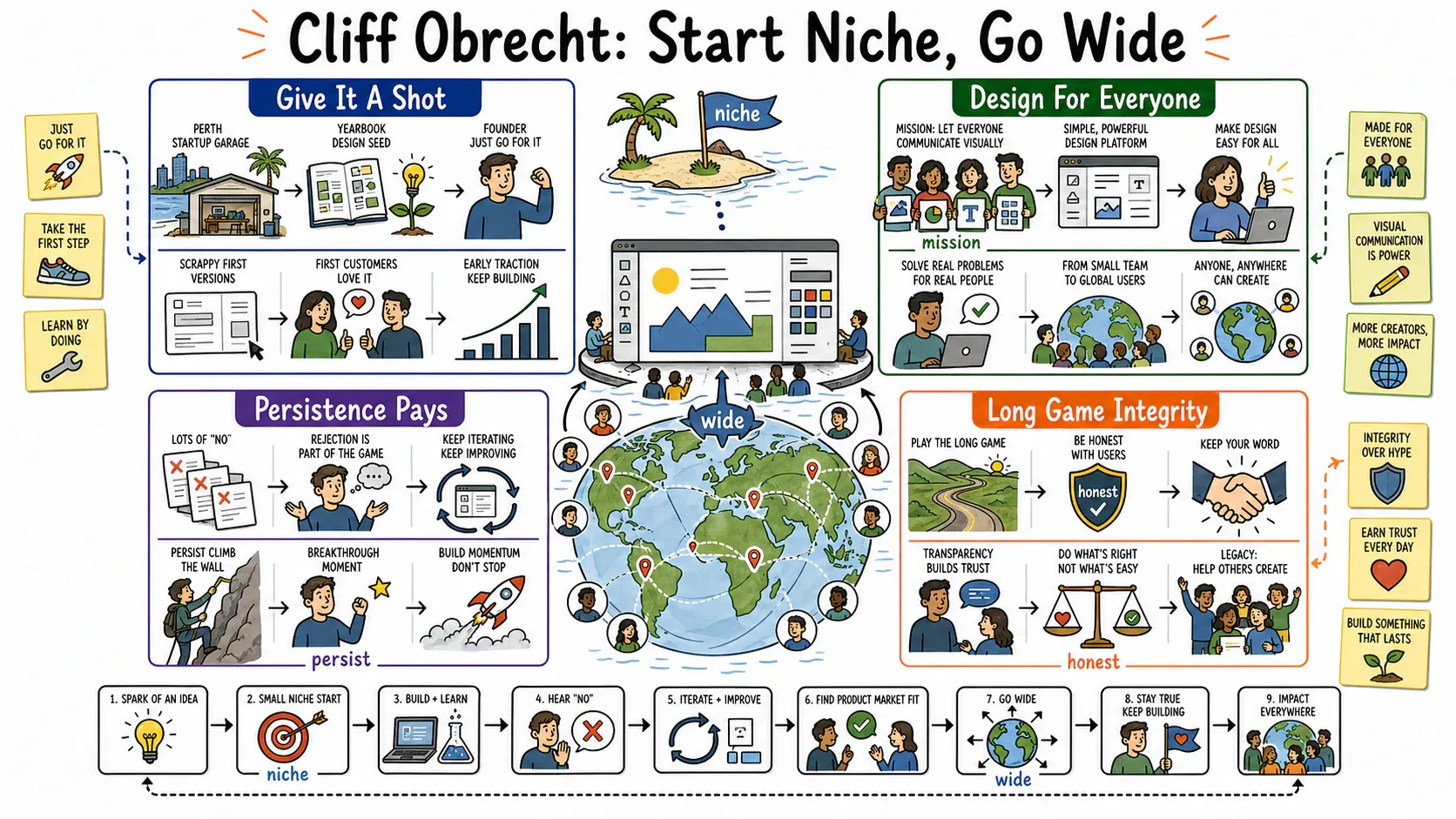
- Give the idea a shot: Obrecht urges prospective founders to try rather than later wonder what might have happened. — UWA Interview.
- Make design accessible: Canva grew from the founders’ belief that design tools could be simpler, more affordable and more widely usable. — UWA Interview.
- Persist with a viable idea: After repeated investor rejections, Obrecht emphasized persistence while adding that a founder still needs a credible idea. — 20VC Interview.
- Play the long game with integrity: Obrecht treats business relationships as a long game: tell the truth, honor commitments and leave rejected candidates with a good impression. — 20VC Interview.
- Start with a narrow problem: Canva first served people with an acute design need, then expanded to adjacent users rather than trying to serve everyone at launch. — 20VC Interview.
- Allow creative speed with direction: Obrecht says a little organizational chaos can accompany speed and creativity, but it still needs a clear vision and someone steering it. — Social Champ Interview.
- Choose talent over fashionable geography: Obrecht said an online business need not move to Silicon Valley when it can access strong product and marketing talent elsewhere. — Social Champ Interview.
- Let naivety prompt action: Obrecht says not anticipating every difficulty helped him and Perkins tackle fundraising despite being outsiders to Silicon Valley. — 20VC Interview.
On Hiring and Team Building
- Look at distance traveled: Obrecht values candidates who have developed skills and overcome obstacles from nontraditional starting points, not only prestigious credentials. — 20VC Interview.
- Do not outsource judgment to prestige: Obrecht says imposter syndrome led Canva to overvalue impressive résumés and make poor hires; founders should test fit and trust their own informed judgment. — 20VC Interview.
- Develop internal talent: Canva promoted a former contract content writer to CMO and a former executive assistant to head of people while also bringing in outside expertise. — 20VC Interview.
- Leave rejected candidates on good terms: Obrecht says respectful treatment after a declined offer can preserve a relationship and sometimes lead a candidate back later. — 20VC Interview.
On Leadership and Personal Growth
- Lead with honest coaching: Obrecht describes moving from merely modeling hard work to giving frank, transparent feedback and coaching people through expectations. — 20VC Interview.
- Make performance sustainable: Obrecht says his earlier work-hard-play-hard approach became unsustainable, and he came to value sleep and exercise. — 20VC Interview.
- Keep learning: Obrecht associates strong performers with curiosity and an awareness that they do not know everything. — 20VC Interview.
On Philanthropy and Wealth
- Let firsthand experience broaden perspective: Obrecht says travel exposed him to inequality and helped shape his motivation to give; this is his personal account, not a general causal claim. — StartGiving Interview.
- Protect children’s earned accomplishment: Obrecht worries that leaving excessive wealth to his children could diminish their opportunity to build their own sense of accomplishment; this is his view, not clinical evidence. — StartGiving Interview.
- Start giving, then learn: Obrecht says taking an initial step in philanthropy is hard but lets donors learn which projects are effective and important to them. — StartGiving Interview.
- Use a small giving commitment to begin: Obrecht describes Pledge 1% as a practical forcing function that helped Canva start giving and learn from experience. — StartGiving Interview.
- Define abundance beyond price: Obrecht says he felt fortunate even before Canva’s valuation grew, citing inexpensive preferences and the ability to travel as examples. — 20VC Interview.
Additional Quotes and Learnings
- Protect non-work time with a cofounder partner: Obrecht says he and Perkins try to set aside times without work talk, though the boundary is imperfect and requires deliberate recharge. — 20VC Interview.
- Align goals openly in deals: Obrecht prefers stating Canva’s objectives and valuation logic early in acquisition talks, then looking for a genuine fit with the other side’s goals. — 20VC Interview.
- Honor your word without discarding contracts: Obrecht says commitments should be trustworthy, while explicitly acknowledging that term sheets and legal documents still matter. — 20VC Interview.
- Use discoverable content as a growth channel: Obrecht says Canva used SEO to make its design content discoverable and bring searchers to the product. — 20VC Interview.
- Make the free product worth sharing: Obrecht credits Canva’s free, polished initial product and its users as part of its early growth strategy. — 20VC Interview.
- Align paid pricing with use: Obrecht describes charging teams for active seats so payment tracks actual customer use; the recording does not establish a universal paid-versus-free rule. — 20VC Interview.
- Give access to educators: Obrecht describes free Canva access for schools as part of the company’s education focus; Canva also documents its free education and nonprofit programs. — UWA Interview.
- Apply teaching experience to a concrete need: Obrecht’s education background and Perkins’s design teaching helped the founders recognize how hard school design tasks were and start with yearbooks. — UWA Interview.
- Notice how upbringing shapes values: Obrecht connects his modest but comfortable upbringing with his views on money, experiences and giving. — StartGiving Interview.
- Learn by giving: Obrecht says early philanthropic projects produced mistakes and lessons that helped him and Perkins refine their priorities. — StartGiving Interview.
- Work with capable giving partners: Obrecht says strong partner organizations let Canva pursue philanthropy while learning from their specialized capabilities. — StartGiving Interview.
- Pair enterprise ambition with a social mission: Canva states a two-step plan: build a valuable company and use its resources to do as much good as it can; this is the company’s aspiration, not proof of final impact. — Canva Two-Step Plan.
- Build from outside a traditional hub: Obrecht says Australia’s startup environment had improved and encourages founders in Perth to try building there. — UWA Interview.
- Use a focused first product as proof: Fusion Books let Obrecht and Perkins test collaborative design in yearbooks before broadening the concept into Canva. — UWA Interview.
- Mix homegrown and outside talent: Obrecht values people developed inside Canva while also recruiting experienced outsiders to complement them. — 20VC Interview.
- Make expectations discussable: Obrecht says frank explanations and coaching help colleagues understand what to improve instead of assuming expectations are obvious. — 20VC Interview.
- Listen to users before refining resources: Canva says it regularly connects with education and nonprofit users to better understand their needs and improve supporting tools; this is a company practice, not a verified personal quotation. — Canva Two-Step Plan.
- Adapt feedback to the receiver: Obrecht says straightforward feedback may need to be delivered differently to people with different communication styles. — 20VC Interview.
- Coach with specific examples: Obrecht favors concrete, candid feedback on what someone did and how they might approach it differently. — 20VC Interview.
- Make launch quality deliberate: Obrecht recalls Perkins resisting pressure to launch immediately so Canva could debut a product users would enjoy and share. — 20VC Interview.
Learn more:
- Cliff Obrecht talks Canva, start-ups and the road to success - The University of Western Australia
- Canva's Cliff Obrecht: How We Turned Our Yearbook Company to $40B Business | 20VC #971
- Cliff Obrecht Interview on Marketing Strategies — Social Champ
- Cliff Obrecht on how to give thoughtfully - StartGiving
- Canva’s Two-Step Plan: Celebrating 10 Years of Impact — Canva Newsroom