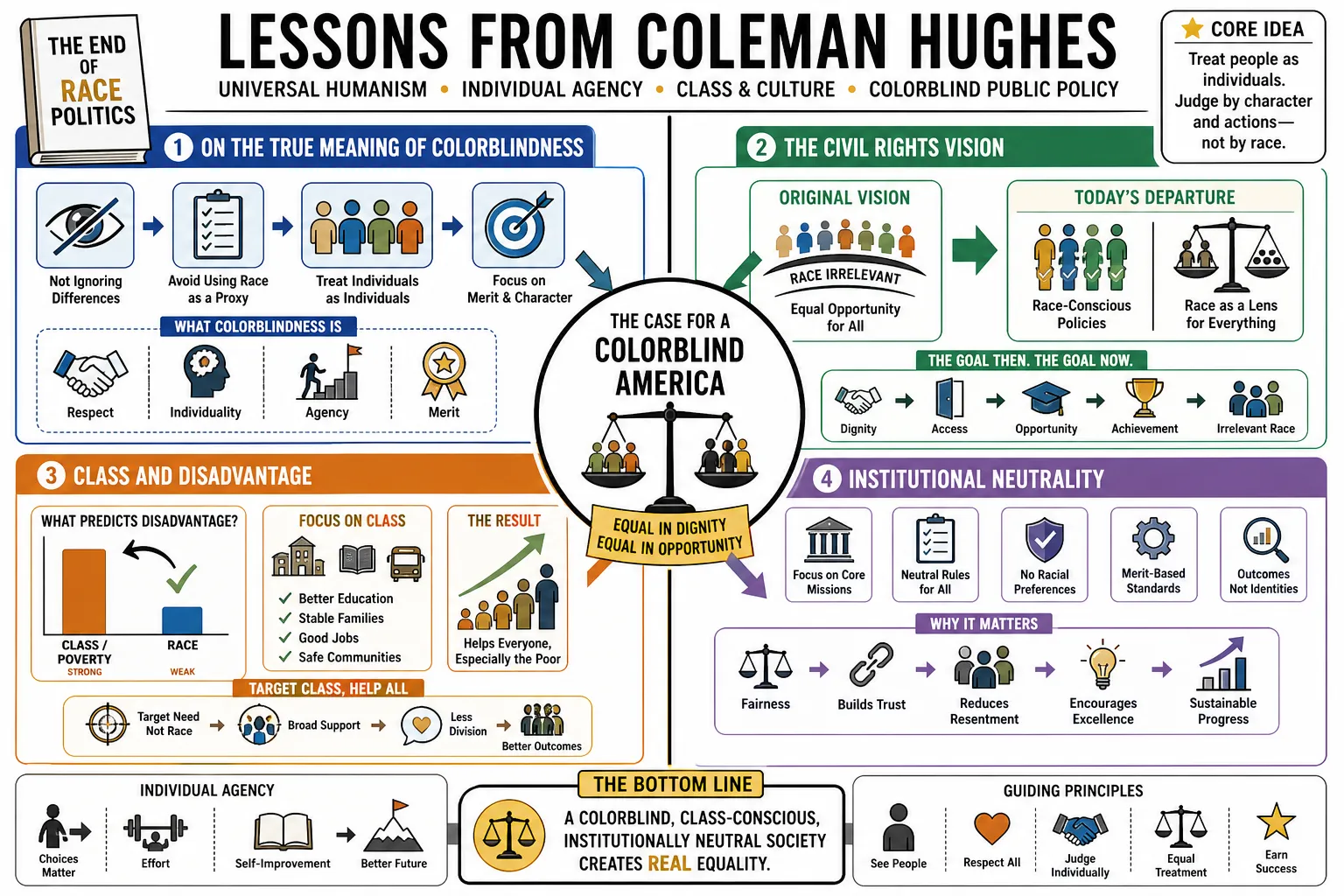
Lessons from Coleman Hughes
Writer and podcaster Coleman Hughes argues for colorblind public policy and against identity-based orthodoxies. Known for his book The End of Race Politics, he emphasizes individual agency, class, and culture over race-centric approaches to racial disparities. This collection outlines his defense of universal humanism.
Part 1: The Case for a Colorblind America
- On the Meaning of Colorblindness: Hughes argues that colorblind public policy means treating people without regard to race, not denying that race and racism exist. — Actually, Color-Blindness Isn’t Racist.
- On the Civil-Rights Ideal: Hughes presents race-neutral treatment as a central civil-rights ideal and criticizes the later return to race-based preferences. — Actually, Color-Blindness Isn’t Racist.
- On Class and Disadvantage: Where disadvantage is economic, Hughes favors targeting need directly instead of using race as a proxy. — Conversations with Tyler.
- On Viewpoint Diversity at Institutions: Hughes argues that institutions hosting public debate should make room for a broad range of views, including ones their staff may oppose. — My Last Word on TED.
- On Martin Luther King Jr.: Hughes argues that King’s ideal of judging people by character is in tension with today’s race-based preferences. — Actually, Color-Blindness Isn’t Racist.
- On Reverse Discrimination: Hughes opposes present-day racial preferences as a way to remedy past discrimination, arguing that policy should apply race-neutral principles. — Actually, Color-Blindness Isn’t Racist.
- On Individual Rights: His universalist approach starts with equal treatment of individuals rather than assigning rights or moral standing by racial group. — A Better Anti-Racism.
- On Medical Risk Proxies: In a 2020 essay on COVID-19, Hughes argued for discussing age and pre-existing conditions directly rather than treating race as a stand-in for individual risk. — Do COVID-19 Racial Disparities Matter?.
- On Policy Design: Hughes argues that class-focused measures can reach disadvantaged people without making race itself the eligibility rule. — Actually, Color-Blindness Isn’t Racist.
- On the Post-Racial Ideal: Hughes treats a colorblind society as an aspirational policy principle, while recognizing that current racial disparities and racism remain. — Coleman Hughes on the New Racism.
Part 2: The Pitfalls of Modern Anti-Racism
- On Socially Accepted Racial Thinking: Hughes argues that some contemporary race-conscious ideas receive social approval despite, in his view, repeating forms of racial essentialism. — Coleman Hughes on the New Racism.
- On Disparity and Racism: He warns against treating every unequal group outcome as sufficient proof of present-day discrimination; the causes require separate analysis. — A Better Anti-Racism.
- On Binary Anti-Racism: Hughes criticizes frameworks that sort policies into racist or anti-racist solely by whether group disparities persist. — A Better Anti-Racism.
- On White Fragility: In his review of Robin DiAngelo, Hughes argues that a theory treating argument or pushback as evidence of fragility leaves too little room for genuine disagreement. — Black Fragility?.
- On Status and Anti-Racism: Hughes argues that race-conscious politics can promise status to some adherents without necessarily delivering practical improvements. — A Better Anti-Racism.
- On Lower Expectations: Hughes objects to proposals that lower standards for Black students, arguing that doing so may undermine rather than improve achievement. — A Better Anti-Racism.
- On the DEI Bureaucracy: Hughes criticizes the spread of race-based preferences in government and corporate hiring, promotion, and training. — The End of DEI.
- On Disagreement and Resilience: Hughes worries that teaching young people to treat offensive speech as a harm they must be shielded from can leave them less able to handle disagreement. — The New American Discourse.
- On Equity and Individual Rights: Hughes warns that pursuing identical group outcomes by fiat can subordinate an individual’s right not to face racial discrimination. — A Better Anti-Racism.
- On White Guilt: In his review of White Fragility, Hughes argues that guilt can make DiAngelo’s account appealing while distracting from concrete reforms. — Black Fragility?.
Part 3: Culture, Agency, and Disparities
- On Interpreting Disparities: Hughes cautions that a disparity between groups does not explain itself; competing historical, economic, and cultural causes need examination. — Black American Culture and the Racial Wealth Gap.
- On Culture and Group Differences: Hughes argues that group-level outcomes can reflect differences in habits and circumstances as well as discrimination, and that the relevant causes must be investigated. — Black American Culture and the Racial Wealth Gap.
- On Thomas Sowell: Hughes invokes Thomas Sowell in challenging explanations that treat every unequal outcome as evidence of discrimination. — Black American Culture and the Racial Wealth Gap.
- On Multiple Explanations: Hughes acknowledges historical exclusion but argues that the current wealth gap also warrants examination of other economic and cultural factors. — Black American Culture and the Racial Wealth Gap.
- On Personal Agency: Hughes argues that individuals’ financial habits and choices should not disappear from explanations of wealth accumulation, even when structural barriers also matter. — Black American Culture and the Racial Wealth Gap.
- On Family Structure: In discussing Moynihan, Hughes treats fatherlessness and family structure as important questions in the pursuit of economic equality, without claiming a single settled cause. — Coleman Hughes on the Legacy of Slavery.
- On Asian-American Outcomes: Hughes points to Asian-American educational and economic outcomes despite a history of exclusion as one challenge to explanations based solely on past government favoritism. — Black American Culture and the Racial Wealth Gap.
- On Preparing for Achievement: Hughes argues that changing an academic standard to match current performance may disguise a preparation gap rather than close it. — What the New Integrationists Fail to See.
- On Crime and Incarceration: Hughes argues that US mass incarceration reflects both crime levels and prosecutorial decisions; he also acknowledges racist political appeals and uncertainty about the causes of crime. — Coleman Hughes on the Legacy of Slavery.
Part 4: Slavery, Reparations, and the Past
- On the Harm of Broad Reparations: Hughes warned Congress that broad descendant payments could deepen division and make coalitions for current reforms harder to build; he distinguished this from compensation for people directly harmed under Jim Crow. — My Testimony on Reparations.
- On Inherited Claims: Hughes argues that compensation should go to people harmed by a policy, or at most their immediate family, rather than treating distant ancestry as an unlimited claim. — 10 Notes on the End of Affirmative Action.
- On Acknowledging History: Hughes calls slavery and Jim Crow grave injustices, but argues that acknowledging them should not eclipse remedies for present problems. — My Testimony on Reparations.
- On Historical and Present Wealth: Hughes argues that historic exclusion matters, but that the modern wealth gap should not be attributed to slavery or New Deal policy alone. — Black American Culture and the Racial Wealth Gap.
- On Ancestry-Based Eligibility: Hughes notes that a reparations-style admissions policy would have to distinguish descendants of slavery and Jim Crow from other applicants of the same race. — 10 Notes on the End of Affirmative Action.
- On Black American Progress: Hughes argues that a focus only on persistent gaps misses substantial improvements in Black Americans’ well-being over time. — The Case for Black Optimism.
- On Current Needs: Hughes favors safer neighborhoods, better schools, less punitive criminal justice and affordable health care over broad ancestry-based cash payments. — My Testimony on Reparations.
- On Historical Grievance: Hughes warns that treating long-past group harms as a basis for current racial double standards can create fresh grievances. — The High Price of Stale Grievances.
- On Moral Debts: Hughes argues that a payment to descendants cannot settle the moral debt of slavery; he nevertheless calls the failure to compensate freed slaves a grave injustice. — My Testimony on Reparations.
Part 5: The Impact of Social Media and Algorithms
- On Smartphones and Perception: Hughes links the early-2010s shift in perceptions of police violence partly to smartphones making rare incidents easy to record and share. — Coleman Hughes on Police Reform and Data.
- On Outrage in Social Feeds: Hughes argues that social feeds often present material likely to confirm or outrage viewers, distorting their sense of how representative it is. — Coleman Hughes on Police Reform and Data.
- On Echo Chambers: Hughes warns that algorithmic feeds can show people what they already believe and only superficial versions of opposing arguments. — Coleman Hughes on Police Reform and Data.
- On Viral Examples: Hughes argues that a viral video can be important evidence of an event but cannot by itself establish how common that event is. — Coleman Hughes on Police Reform and Data.
- On Selective Coverage: Hughes argues that national coverage of police killings has emphasized some cases while leaving comparable others largely unknown. — Coleman Hughes on Police Reform and Data.
- On Threatening Dissenters’ Jobs: Hughes distinguishes legitimate criticism from campaigns to make a dissenter unemployable, arguing that the latter can chill discussion. — The Successor Ideology.
- On Checking Perceptions Against Data: Hughes urges comparing vivid stories and viral footage with longer-run data before drawing conclusions about trends. — Coleman Hughes on Police Reform and Data.
Part 6: Education and Early Intervention
- On Early Intervention: Hughes argues that efforts to reduce education gaps should begin before college, during the years when skills and habits are still forming. — 10 Notes on the End of Affirmative Action.
- On Affirmative Action: Hughes argues that race-based college admissions affect relatively few students and cannot substitute for improving earlier education. — 10 Notes on the End of Affirmative Action.
- On Academic Mismatch: Hughes argues that some students admitted under lower standards may struggle or switch majors, while acknowledging that the scope and degree of mismatch remain debatable. — 10 Notes on the End of Affirmative Action.
- On School Improvement: Hughes points to research on effective charter-school practices and argues for applying high expectations, tutoring and data-guided instruction earlier in children’s education. — 10 Notes on the End of Affirmative Action.
- On Entrance Tests: Hughes defends academic entrance examinations against the assumption that disadvantaged students cannot prepare for them, while stressing the value of better preparation. — What the New Integrationists Fail to See.
- On the Purpose of College: In describing his own course, Hughes says students should compare opposing arguments and learn to evaluate them critically rather than simply adopt the instructor’s view. — Coleman Hughes on the Legacy of Slavery.
- On Childhood Environments: Hughes identifies peer culture, parental investment and schooling as important influences on skills before age eighteen. — 10 Notes on the End of Affirmative Action.
Part 7: Free Speech and Heterodoxy
- On the Importance of Debate: Hughes argues that controversial ideas should be answered with words and evidence rather than intimidation or threats of losing work. — The New American Discourse.
- On Speaking Against Consensus: In the TED dispute, Hughes argues for a wider range of acceptable viewpoints, including ideas an institution’s staff may dislike. — My Last Word on TED.
- On the Cost of Cancellation: Hughes argues that making people fear for their jobs over disputed ideas can deter others from speaking honestly. — The Successor Ideology.
- On Suppressed Ideas: Hughes argues that suppressing speech can drive both good and bad ideas underground, leaving them less open to public challenge. — The New American Discourse.
- On Lived Experience and Data: Hughes says anecdotes matter but cannot establish a population-wide trend without broader evidence. — Coleman Hughes on Police Reform and Data.
- On Engaging Disagreement: Hughes favors disputing offensive or mistaken ideas with words instead of violence, intimidation or threats to employment. — The New American Discourse.
- On Hidden Dissent: Hughes argues that pressure to silence taboo views may push them out of public debate without changing what people privately believe. — The New American Discourse.
- On Independent Media: Hughes says independent media gives him room to discuss subjects without institutional speech codes that constrained discussion in his college experience. — E Pluribus Disunion.
Part 8: Identity and Human Universals
- On Common Humanity: Hughes’s universalist anti-racism stresses the shared humanity of people across racial categories while acknowledging remaining injustice. — A Better Anti-Racism.
- On Race and Culture: Hughes distinguishes race from culture and argues that people of one broad racial category may have very different cultural experiences. — Conversations with Tyler.
- On Diversity Within Groups: Hughes rejects treating Black people as a single group with one settled opinion about race. — Black Fragility?.
- On Racial Essentialism: Hughes criticizes approaches that assign moral weight or expected viewpoints to people on the basis of racial categories. — A Better Anti-Racism.
- On Jazz and Cultural Exchange: Hughes points to the relatively integrated early jazz scene as an example of cultural creativity crossing racial boundaries. — Conversations with Tyler.
- On Inherited Grievances: Hughes cautions against asking people to identify personally with harms suffered by distant ancestors in ways that create new racial resentments. — The High Price of Stale Grievances.
- On Individual Dignity: Hughes argues that anti-racism should give moral priority to our shared humanity rather than treat racial categories as determinants of worth. — A Better Anti-Racism.
- On Opportunity and Race: Hughes argues for equal opportunity under race-neutral rules rather than designing policy to force identical racial outcomes. — Actually, Color-Blindness Isn’t Racist.