Colin Camerer is an economist whose research connects behavioral game theory with neuroeconomics. His experimental work examines where models of strategic choice fit observed behavior and how neural evidence can inform accounts of decision-making. This profile collects directly sourced lessons about strategic reasoning, social preferences, risk and learning. — Neuroeconomics: How Neuroscience Can Inform Economics.
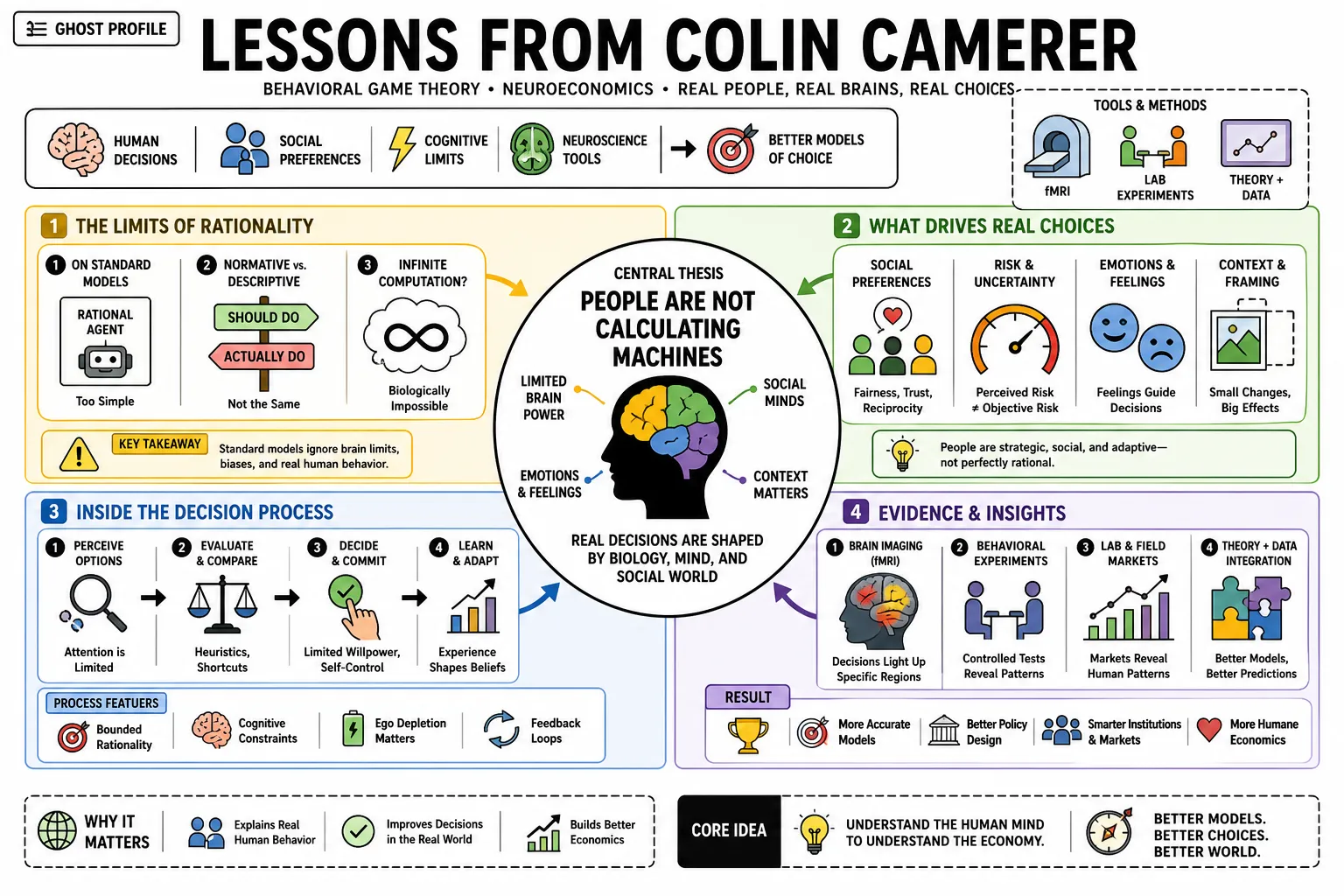
Part 1: The Limits of Rationality
- On Descriptive Models: Behavioral economics tests whether standard rational-choice assumptions describe how people actually decide. Camerer’s work uses observed behavior to refine the model rather than treating the idealized benchmark as a complete description. — Behavioral Economics.
- On Normative and Descriptive Theory: A model of what an ideal decision-maker should do is not automatically a good account of what people do. Behavioral economics compares those predictions with observed choices. — Behavioral Economics.
- On Limits to Calculation: Camerer and coauthors argue that economic models should account for limited foresight and multiple interacting decision systems, rather than assume unlimited calculation in every setting. — Behavioral Game Theory: Thinking, Learning and Teaching.
- On Testable Theory: Camerer criticizes descriptive game theory built with too little careful observation. Formal predictions are most useful when they can be confronted with experimental choices. — Progress in Behavioral Game Theory.
- On Mathematics and Behavior: Camerer and coauthors retain the mathematical structure of game theory while relaxing assumptions about players’ foresight and beliefs when experiments show those assumptions fail. — Behavioral Game Theory: Thinking, Learning and Teaching.
- On Multiple Decision Systems: The neuroeconomics review describes choice as the interaction of controlled and automatic processes, with both cognition and emotion contributing to decisions. — Neuroeconomics: How Neuroscience Can Inform Economics.
- On New Types of Evidence: Camerer and coauthors propose using neural measurements alongside observed choices to examine assumptions about preference, risk and decision processes. The attributed quotation about the economics profession was not verified. — Neuroeconomics: How Neuroscience Can Inform Economics.
- On Psychology in Economic Models: Behavioral game theory incorporates psychological evidence about social preferences and limited foresight into formal models of strategic choice. — Behavioral Game Theory: Thinking, Learning and Teaching.
- On Bounded Foresight: In studied games, players sometimes reason through only a limited number of others’ possible moves. Camerer and coauthors model this bounded strategic thinking explicitly. — Behavioral Game Theory: Thinking, Learning and Teaching.
- On Adapting Models: Camerer’s behavioral game-theory approach keeps formal precision while changing selected psychological assumptions to better fit experimental behavior. — Behavioral Game Theory: Thinking, Learning and Teaching.
Part 2: Neuroeconomics and the Brain
- On the Brain as Evidence: Neuroeconomics adds brain and biological evidence to observed choices to test explanations of economic behavior. The slogan quoted in the old profile was not verified as Camerer’s wording. — Neuroeconomics: How Neuroscience Can Inform Economics.
- On Integrating Disciplines: Camerer describes neuroeconomics as connecting mathematical models of choice with evidence about neural mechanisms. The old 90/10 quotation differs from the located interview wording, so this is a paraphrase. — Neuroeconomics: Using Neuroscience to Make Economic Predictions.
- On Levels of Explanation: Neuroeconomics seeks to connect mathematical accounts of choice and observable behavior with the neural circuits that implement decisions. — Goals, Methods, and Progress in Neuroeconomics.
- On the Long-Term Goal: Camerer defines a long-run aim of neuroeconomics as a theory of choice and exchange that is neurally detailed, mathematically accurate and behaviorally relevant. — Neuroeconomics: Opening the Gray Box.
- On Automatic Processes: Camerer and coauthors distinguish controlled and automatic systems, both of which can guide choice. This supports studying processes beyond self-report, but not the old numerical claim about how much brain activity is unconscious. — Neuroeconomics: How Neuroscience Can Inform Economics.
- On Opening the Black Box: Neural measurements can add detail to economic models of choice by examining the brain mechanisms behind behavior. They are evidence about mechanisms, not a direct readout of every thought. — Neuroeconomics: How Neuroscience Can Inform Economics.
- On the Limits of Eye Tracking: In a study of hypothetical consumer choice, Camerer and coauthors found a small predictive improvement from mouse tracking but did not detect an improvement from eye tracking. Fixations alone do not prove exactly what information a person considered. — When the Eyes Say Buy.
- On Neural Responses to Loss: In a financial-choice study, behavioral loss aversion correlated with amygdala responses to losses relative to gains, and emotion regulation changed both behavior and neural response. This does not establish that financial loss uses exactly the same circuitry as physical pain. — Emotion Regulation Reduces Loss Aversion.
- On Physiological Evidence: Camerer and coauthors use behavioral and physiological responses alongside fMRI to study how reappraisal affects loss aversion. Such signals can inform a study but cannot by themselves identify a subject’s exact emotion. — Emotion Regulation Reduces Loss Aversion.
- On Linking Biology and Economics: Camerer’s neuroeconomics work connects formal choice models to biological and neural mechanisms, where more than one decision system can shape behavior. The claimed personal motivation for a transition from physics was not verified. — Neuroeconomics: How Neuroscience Can Inform Economics.
Part 3: Behavioral Game Theory
- On Closing the Descriptive Gap: Camerer’s behavioral game theory uses psychological evidence and experiments to model how people play strategic games, including limited foresight and social preferences. The original quoted passage is publisher description, not a verified statement by Camerer. — Behavioral Game Theory — Thinking and Learning.
- On Refining Game Theory: Camerer and coauthors retain the strategic structure and precision of game theory while relaxing assumptions about mutually consistent beliefs and foresight to better fit observed play. — Behavioral Game Theory — Thinking and Learning.
- On Experimental Rigor: Camerer writes, “The way in which an experiment is conducted is unbelievably important.” He treats design choices as part of how game-theoretic predictions should be tested. — Behavioral Game Theory, p. 34.
- On Financial Incentives: Performance-based payment can matter in experiments, particularly for judgment tasks responsive to effort, but Camerer and Hogarth’s review of 74 studies found no effect on mean performance was the most common result. Incentives are important to design, not a universal cure. — Effects of Financial Incentives.
- On Beliefs About Others: Strategic choices depend on beliefs about what other players will do. Camerer, Ho and Chong model how those beliefs can be mistaken even when a player responds rationally to them. — A Cognitive Hierarchy Model of Games.
- On Nash Equilibrium: Nash equilibrium requires beliefs about others’ choices to be mutually consistent. Camerer, Ho and Chong show that participants in many studied games did not meet that condition, while equilibrium still predicted some other games well. — A Cognitive Hierarchy Model of Games.
- On Missing Social Preferences: Some bargaining and cooperation results are difficult to model using material self-interest alone. Camerer and Fehr review experimental games that reveal concern for others’ payoffs, including both costly help and punishment. — Measuring Social Norms.
- On a Middle Course: Camerer argues that behavioral game theory should sit between highly demanding rationality models and very simple adaptive models, using careful observations to build descriptively useful theory. — Progress in Behavioral Game Theory.
- On Observation Before Theory: Camerer criticizes descriptive game theory that relies on too little careful observation. Experimental results can test when a formal model describes behavior and where its assumptions need revision. — Progress in Behavioral Game Theory.
- On Modeling Systematic Deviations: The thinking-learning-teaching framework represents limited foresight and learning with a compact set of parameters and fit it to several thousand experimental observations. The resulting deviations are modeled, not dismissed as random noise. — Behavioral Game Theory — Thinking and Learning.
Part 4: Hypothetical Bias and Real Choice
- On Hypothetical Bias: A hypothetical purchase answer need not predict a consequential purchase. Camerer and coauthors compared real and hypothetical choices directly; “cheap talk” is not another name for hypothetical bias. — Hypothetical and Real Choice.
- On Polling Intentions: A stated intention to vote does not guarantee turnout. Camerer describes acquiescence in polling answers and says pollsters adjust questions or seek other information; the 70% and 45% figures in this interview were introduced by the host, not established as Camerer’s finding. — Masters in Business — Camerer Interview.
- On Purchase-Intent Surveys: Consumers in experiments often report greater willingness to buy in hypothetical settings than when a purchase becomes real. Treat survey purchase intent as a forecast to test, not a committed sale. — When the Eyes Say Buy.
- On Tracking Attention: In a coauthored laboratory study, adding visual-attention measures modestly improved prediction of real purchases with mouse tracking; the improvement was not evident with eye tracking. — When the Eyes Say Buy.
- On Incentivized Choices: Camerer says experimental economists generally tie participants’ payments to their choices so answers have consequences. He contrasts this with polling and new-product purchase questions, where stated intentions can overpredict later action. — Masters in Business — Camerer Interview.
- On Neural Measures: Brain recordings can reveal differences between hypothetical and real purchase decisions in controlled experiments, but they do not provide a general-purpose lie detector for survey responses. — Hypothetical and Real Choice.
- On Real Versus Hypothetical Choice: In a controlled purchase experiment, both real and hypothetical decisions engaged orbitofrontal and ventral-striatal valuation areas, with stronger value-related activity in the real-choice condition. That result does not mean a scan can reliably predict any individual’s future action. — Hypothetical and Real Choice.
- On Stated Intent: The gap between a hypothetical answer and a consequential choice need not imply deliberate deception; incentives, task design and the stakes of the real decision can change responses. — Differences in Hypothetical and Real Choices.
Part 5: Social Preferences and Fairness
- On Social Preferences: Experimental games show that a substantial fraction of studied participants also consider others’ payoffs, so material self-interest alone does not explain every choice. The finding is not that almost nobody acts selfishly. — Measuring Social Norms.
- On Ultimatum Offers: In a three-player ultimatum experiment, respondents rejected offers at a higher rate than in comparable studies, especially when outside options and social comparison changed what they regarded as acceptable. This does not prove fairness is innate. — Three-Player Ultimatum Experiments.
- On Costly Punishment: Camerer and Fehr describe experimental situations in which participants spend resources to reduce another player’s payoff. Punishment is a documented social preference in some designs, not an action all people readily take. — Measuring Social Norms.
- On Signals of Intention: In Camerer’s gift-giving model, a gift can signal a person’s intention to invest in a relationship; an economically inefficient gift may convey more than cash. This is a formal explanation of signaling, not evidence that intentions always outweigh outcomes. — Gifts as Economic Signals.
- On Inequality Aversion: In a paired fMRI experiment, higher-paid participants’ valuation-region activity responded more strongly to transfers to their partner than to themselves, consistent with aversion to advantageous inequality in that setting. — Neural Evidence for Inequality Aversion.
- On Cross-Cultural Variation: A coauthored study across 15 small-scale societies found that self-interest alone failed to predict experimental play in every group studied, while prosocial behavior varied substantially with social and economic organization. It did not prove a universal punishment instinct. — Economic Man Across Cultures.
- On Modeling Social Preferences: Camerer argues that behavioral economics can incorporate fairness, reciprocity and limits on self-interest into formal models, while testing when those additions improve predictions. It is not a claim that adding any single emotion makes every model accurate. — Behavioral Economics.
Part 6: Cognitive Hierarchy and Strategic Depth
- On Limited Thinking Steps: The cognitive-hierarchy model treats strategic reasoning as a limited sequence of steps: a player responds to what less sophisticated players might do rather than assuming everyone reaches equilibrium. — A Cognitive Hierarchy Model of Games.
- On Defining the Model: In Camerer, Ho and Chong’s model, each player assumes their own strategy is the most sophisticated and responds to players modeled at lower reasoning levels. — A Cognitive Hierarchy Model of Games.
- On Step-Zero Players: Step zero is the model’s baseline type: it chooses without strategic reasoning, represented by random choice for simplicity. It is a modeling assumption, not a diagnosis of particular people. — A Cognitive Hierarchy Model of Games.
- On the Estimated Thinking Depth: An average of about 1.5 thinking steps fit data from many games analyzed by Camerer, Ho and Chong. That is a model estimate for those datasets, not a measurement of how far every person thinks ahead. — A Cognitive Hierarchy Model of Games.
- On Modeling Other Players: A step-k thinker in the model best-responds as though opponents occupy lower levels, from step zero through k−1; the model omits opponents at the same or higher level from that thinker’s belief. — A Cognitive Hierarchy Model of Games.
- On Predictive Precision: Camerer, Ho and Chong use a parsimonious cognitive-hierarchy model to explain why equilibrium predicts some experimental games well and others poorly. Its empirical fit is assessed across their studied games, not guaranteed to beat equilibrium in every setting. — A Cognitive Hierarchy Model of Games.
- On Beauty-Contest Games: In experimental “guess two-thirds of the average” games, initial guesses usually remain above the equilibrium answer of zero. Repeated play can move the group average toward zero, illustrating why beliefs about others’ reasoning matter. — A Cognitive Hierarchy Model of Games.
- On Working Memory: The authors discuss working memory as a plausible constraint on strategic thinking and cite a modest correlation between digit-span performance and eliminating dominated strategies. They do not establish a fixed biological ceiling for everyone. — A Cognitive Hierarchy Model of Games.
Part 7: Markets, Bubbles, and Financial Decisions
- On Repeated Market Experiments: Controlled asset-market experiments let researchers observe price bubbles and crashes under known rules while recording participants’ choices and neural activity. This is a research method, not a verified verbatim “simulating earthquakes” quotation. — Experimental Market Bubbles.
- On Bubble Formation: In Camerer’s laboratory markets, bubbles occurred often, though not always, even when the asset’s fundamental value was controlled and known to traders. The evidence does not establish a single cognitive-hierarchy cause for all bubbles. — Camerer Group — Market Bubbles.
- On Gains and Losses: Prospect-theory patterns include different risk attitudes for gains and losses. Camerer’s gamble experiments replicated such differences, but individual choices vary and the result is not a universal rule that everyone seeks risk after losses. — Experimental Test of Utility Theories.
- On Known Value and Mispricing: In controlled asset markets where researchers fixed the asset’s fundamental value and told traders what it was, experimental bubbles still sometimes formed. This is narrower than claiming all real-market mispricing persists because arbitrageurs lack capital. — Camerer Group — Market Bubbles.
- On Neural Bubble Signals: In an experimental bubble study, aggregate nucleus-accumbens activity tracked price increases, while an anterior-insula signal in higher earners preceded a price peak and was associated with selling. These are laboratory associations, not a real-time market forecast. — Experimental Market Bubbles.
- On Overconfidence and Trading: Frydman and Camerer’s review reports that investors trade too often and that even senior corporate managers can be influenced by overconfidence and personal history. It does not attribute general market volatility to both groups. — Financial Decision-Making Review.
- On Extrapolating Returns: The Frydman–Camerer review identifies overextrapolation from past returns as a recurrent investor error. That supports caution about projecting a recent trend, not the profile’s specific claim that headlines crowd out superior historical base rates. — Financial Decision-Making Review.
- On the Disposition Effect: In a securities-trading experiment, subjects tended to sell winning shares and retain losing ones; automatically selling positions each period substantially reduced that pattern. The study does not establish a single biological cause. — Disposition Effect Experiment.
- On Emotion and Financial Choice: In an fMRI study coauthored by Camerer, loss aversion covaried with amygdala responses to losses, and a reappraisal strategy reduced both the behavioral bias and the neural response. Emotion matters, but the study does not show that calculation is absent. — Emotion Regulation and Loss Aversion.
Part 8: Learning, Habits, and Experience
- On Experience-Weighted Attraction: Camerer and Ho’s EWA model updates the attractiveness of strategies using experienced payoffs and the payoffs other choices would have produced; it is a model tested on experimental games, not a claim that everyone consciously calculates this way. — Experience-Weighted Attraction Learning.
- On Neural Autopilot: Camerer and Li propose a two-process model in which reliable rewards and contextual cues can make a choice habitual, reducing the need to deliberate each time. They present this as a model and research direction, not proof that most daily financial decisions run on autopilot. — Neural Autopilot and Habits.
- On Learning from Repetition: In a dynamic savings experiment, participants initially saved too little but learned toward the model’s optimal strategy over repeated simulated lifecycles. This is evidence of learning in that task, not a general rule that painful losses cause stronger adjustment. — Learning and Visceral Temptation.
- On Convergence with Experience: Camerer notes that deviations from game-theory predictions sometimes diminish with experience as players learn about others’ behavior; convergence depends on the game and learning conditions. — Behavioral Game Theory.
- On Social Learning: In the savings experiment, participants approached the optimal saving pattern within four repeated lifecycles, or within one to two when social learning was available. The result is task-specific, not a universal law of adaptation speed. — Learning and Visceral Temptation.
- On Visceral Temptation: In a controlled savings experiment, thirsty participants offered immediate cola rewards overspent relative to participants whose consumption was delayed. The study supports a role for immediate temptation, not a claim that financial education generally fails because of entrenched neural pathways. — Learning and Visceral Temptation.
- On Foregone Payoffs: EWA allows the payoff a player would have received from an unchosen strategy to influence its future attractiveness. That hypothetical reinforcement is a feature of the model, not evidence that every player explicitly simulates alternatives. — Experience-Weighted Attraction Learning.
- On Trust and Reciprocity: In a repeated two-person trust game, one player’s reciprocity predicted the partner’s future trust; the researchers also observed related dorsal-striatum signals as reputations developed. The finding is limited to this experimental exchange. — Getting to Know You — Trust Study.