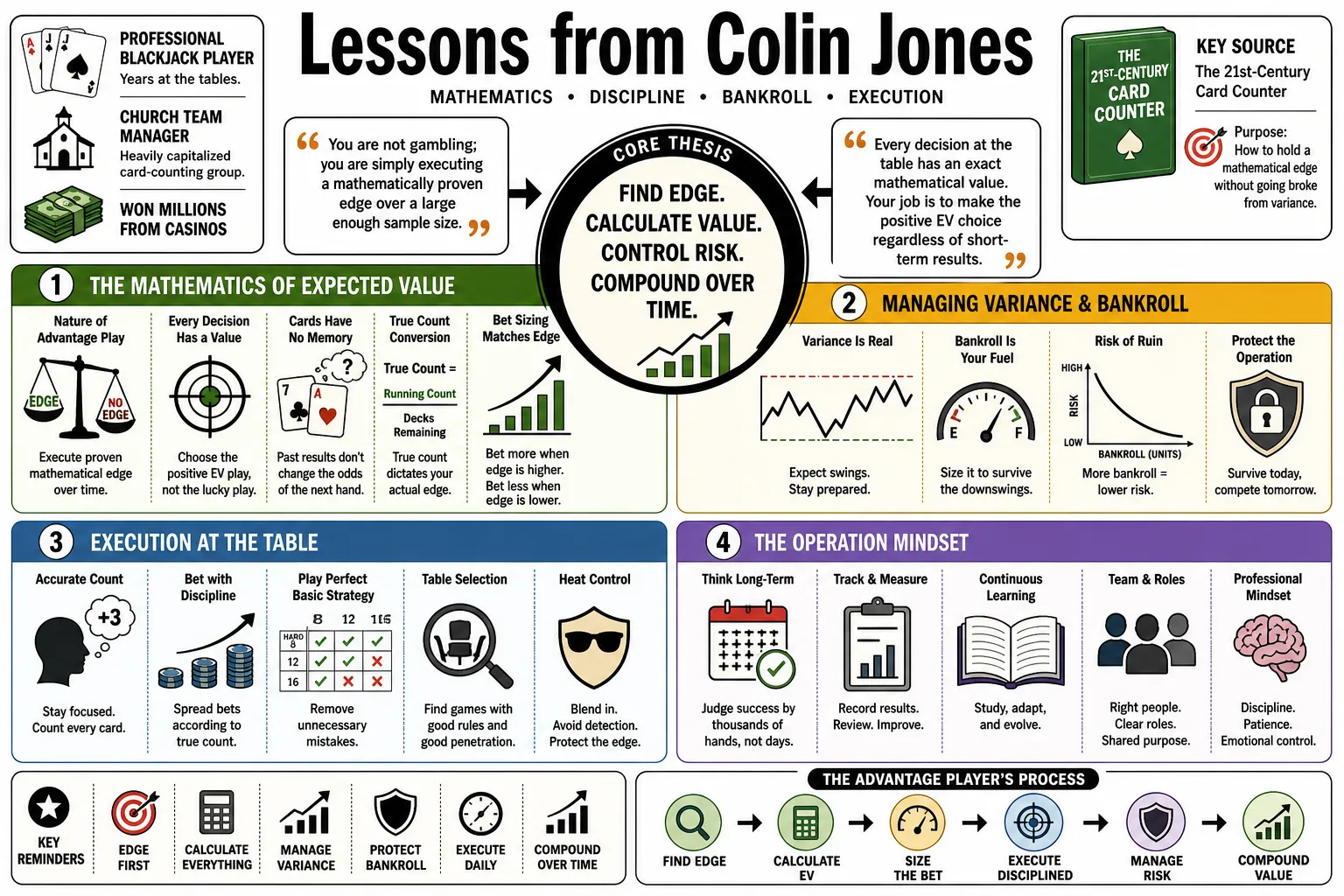
Lessons from Colin Jones
Colin Jones learned card counting with Ben Crawford, then co-managed the Church Team, a large blackjack team that pooled bankrolls, trained players, and won millions from casinos. He later founded Blackjack Apprenticeship to teach the mathematics, practice, and bankroll discipline behind advantage play. This profile distills his documented lessons while distinguishing a favorable long-run edge from the financial and operational risks of any particular session. — American Casino Guide Interview.
Part 1: The Mathematics of Expected Value
- On Advantage Play: Jones distinguishes card counting from betting on a hunch: a counter uses information about cards already dealt to identify favorable conditions and estimates an edge over repeated play. A positive expectation is not a promise of a winning session. — Top Gambling Myths.
- On Expected Value: Jones defines expected value as the statistical value of play under specified conditions. Actual session results can differ markedly from that projection, so he separates the quality of the game from a short-run win or loss. — Recommended Blackjack Bankroll.
- On the Gambler’s Fallacy: A losing streak does not make the next hand “due” to win. Jones distinguishes that belief about past outcomes from card counting, which uses the composition of cards remaining in the shoe to estimate changing odds. — Top Gambling Myths.
- On True Count Conversion: In a multideck game, Jones divides the running count by estimated decks remaining to obtain a per-deck true count. That number is more useful than the raw running count for judging the current edge and making betting decisions. — True Count Conversion Guide.
- On Bet Sizing: Jones says bets should generally rise when the true count indicates a better player edge, within a spread and bankroll risk chosen for the game. Betting too little in favorable situations can erase the expected gain. — True Count Conversion Guide.
- On Evaluating Side Bets: A side bet needs its own pay-table and risk analysis. A Blackjack Apprenticeship technical study found a large baseline house edge for the Lucky Ladies bet and warned that even count-dependent favorable spots can demand extreme play volume because of rare top payouts. — Lucky Ladies Side-Bet Analysis.
- On the “Flow” of Cards: Jones rejects a mystical “flow of the cards.” A player can use the observed mix of cards already dealt to estimate what remains, but changing seats or playing by feel does not create a mathematical edge. — Top Gambling Myths.
- On Basic Strategy: Jones recommends learning basic strategy before combining it with counting, true-count conversion, betting and deviations. His training progression emphasizes accurate execution of each component before risking real money. — 8 Reasons to Practice Card Counting.
- On Short-Run Variance: Even with a favorable calculated edge, a counter can lose hands, days or weeks. Jones advises practicing through swings so short-run results do not get mistaken for proof that the underlying strategy has changed. — 8 Reasons to Practice Card Counting.
Part 2: Managing Risk and the Bankroll
- On the Bankroll: Jones treats capital and skill as separate requirements: even a large bankroll cannot rescue poor execution, while a skilled player still needs enough capital to absorb adverse swings at the chosen stakes. — Recommended Blackjack Bankroll.
- On Risk of Ruin: Risk of ruin is the modeled chance of losing an entire bankroll under specified rules, bet spread and bankroll size. Jones says his own preferred threshold fell to about 1% or lower once blackjack was his full-time income; he does not prescribe a universal two-percent cutoff. — Recommended Blackjack Bankroll.
- On the Kelly Criterion: Jones names the Kelly criterion as one way to size bets for long-run capital growth and risk management. In practice he stresses estimating game-specific EV and risk of ruin rather than copying another player’s betting spread; the original claim about fractional Kelly was not found in his direct source. — Bet Spreads for Hi-Lo Card Counting.
- On Overbetting: A player can have a positive edge yet bet too much for the available bankroll. Jones says this raises risk of ruin and may result from overestimating the edge, underestimating variance, or failing to follow a planned spread. — Bet Spreads for Hi-Lo Card Counting.
- On Trip Bankrolls: Jones distinguishes total bankroll from the cash carried for a session or trip. He recommends sizing the trip amount to planned hours and game variance so a player is neither stranded during a favorable game nor carrying more cash than necessary for their risk tolerance. — Recommended Blackjack Bankroll.
- On Chasing Losses: Jones rejects raising bets merely to recover a loss. A bet should follow the calculated count and bankroll plan, not the previous hand’s result or an urge to get even. — Recommended Blackjack Bankroll.
- On Matching Capital to Living Needs: Blackjack Apprenticeship says a livelihood-level bankroll depends on desired income, monthly living expenses, playing time and risk tolerance. The old quotation about “rent money” was not verified and is removed. — Blackjack Apprenticeship FAQ.
- On Expected Hourly Rate: Jones’s hourly EV figures are projections under stated rules and bet spreads, not wages paid each hour. A player’s actual results over a short session may differ substantially from the modeled expectation. — Recommended Blackjack Bankroll.
- On Variance Reserves: For the same game, a larger bankroll can support a given spread at lower risk of ruin. Jones’s examples show why a thin bankroll exposes even a technically skilled counter to a material chance of losing the capital before the long run arrives. — Recommended Blackjack Bankroll.
- On Sizing Down: When cash available for a session falls, Jones advises reducing a bet if necessary to retain enough for possible splits and doubles. At the career level, he also recalculates spreads as bankroll, rules and risk tolerance change. — Recommended Blackjack Bankroll.
Part 3: The Reality of Variance and Losing Streaks
- On Losing Streaks: Jones recalls repeated six-figure losing streaks on the Church Team, including a drawdown of roughly $465,000 from a roughly $1.2 million bankroll. A favorable long-run expectation did not spare the team substantial interim losses. — Blackjack Insider Interview, Part 2.
- On Sample Size: Jones cautions that a few sessions cannot establish whether a card-counting strategy works. His training article proposes extended practice and emphasizes that variance can dominate results over short periods. — 8 Reasons to Practice Card Counting.
- On Testing the Edge: Jones says estimates of EV and risk of ruin should come from game-specific simulations or calculations, not confidence in a short winning run. Early simulation showed him that one of his own games had weak EV and high ruin risk. — Bet Spreads for Hi-Lo Card Counting.
- On Winning Streaks: Jones says the Church Team was in a large positive swing when filming began and had lost more than half its bankroll in a preceding month. He cautions against treating either swing alone as proof that the team was playing especially well or poorly. — Colin’s Thoughts on the Documentary.
- On Standard Deviation: Blackjack Apprenticeship explains standard deviation as a measure of how far results can deviate from expectation. It can help a player assess likely swings and the bankroll needed for a particular game and stake. — Blackjack Math: Advantage Play.
- On N-Zero: In Blackjack Apprenticeship’s math guide, N-zero estimates the number of hands needed for expected winnings to reach one standard deviation. It depends on the actual game rules and betting strategy, so it is not a universal hour count. — Blackjack Math: Advantage Play.
- On Handling Emotional Swings: Jones acknowledges that large drawdowns were stressful. His direct account focuses on maintaining playing standards and interpreting outcomes through variance, not on feeling exactly the same after every win and loss. — Colin’s Thoughts on the Documentary.
- On the Grind: Jones describes high-stakes card counting as more grueling than prospective recruits expect. That reality affected whom the Church Team trained and invited to join. — Blackjack Insider Interview, Part 2.
- On Diagnosing a Downswing: When results are poor, Jones’s approach is to separate variance from possible execution errors: he describes staged test-outs and regular live retesting of players rather than relying only on confidence in the math. — Blackjack Insider Interview, Part 2.
Part 4: Training and Execution
- On Practice: Jones recommends drilling basic strategy and the running count separately, then watching a real shoe without betting to test whether one can keep the count without errors or mental fatigue. — How to Practice Blackjack Card Counting.
- On Testing: The Church Team used staged test-outs and retests before trusting players with larger bets. Jones describes a progression from training to low-stakes live play, not a ban on every dollar of team money before one test. — Blackjack Insider Interview, Part 1.
- On Playing Deviations: Jones favors learning roughly the top twenty playing deviations rather than every possible index; he estimates that this captures most of the available deviation value with much less memorization. — Colin’s Guide to Deck Estimation.
- On Fatigue: The team regarded a player’s willingness to end a session when tired and error-prone as part of trustworthiness. Accurate execution matters more than forcing extra hours. — How to Start a Blackjack Team.
- On the Cost of Mistakes: Jones warns that more complex true-count calculations can create mistakes that cost more expected value than their small theoretical gain. Choose a method you can perform reliably. — Colin’s Guide to Deck Estimation.
- On Counting Speed: Jones recommends learning the count accurately first and building speed afterward; a quick conversion is useful only when it remains reliable under play conditions. — Colin’s Guide to Deck Estimation.
- On Software Training: Jones recommends card-counting drills and simulated play to practice strategy, count conversion, betting, and exposure to losing streaks before raising the stakes in a casino. — 8 Reasons to Practice Card Counting.
- On Acting Natural: Jones says he chose Hi-Lo partly because its manageable mental load let him converse at the table while maintaining the count; the skill has to survive ordinary casino interaction. — Blackjack Insider Interview, Part 1.
- On Self-Evaluation: The Church Team tested and retested players in live conditions. Its team guidance also makes accurate records and continued practice explicit responsibilities. — How to Start a Blackjack Team.
- On Adapting to Game Conditions: Jones advises calculating the expected value and risk of a bet spread for the actual rules, penetration, and bankroll rather than relying on one spread for every game. — Bet Spreads for Hi-Lo Card Counting.
Part 5: Building and Managing a Team
- On Pooling Bankrolls: Pooling capital lets a team size bets from a larger common bankroll and can increase expected value at a given risk relative to several smaller solo bankrolls. — How to Start a Blackjack Team.
- On Shared Variance: A team can accumulate playing hours faster across several players. The team guide describes this as bringing the statistical long run nearer, not eliminating variance or guaranteeing that losses offset. — How to Start a Blackjack Team.
- On Trust: The Church Team’s founders emphasize trust in honesty, accurate records, secure handling of money, practice, and judgment as prerequisites for pooling a bankroll. — How to Start a Blackjack Team.
- On Detecting Problems: The team’s published account treats record-keeping and trust as essential, while warning that a dispute serious enough to require a lie detector already signals broken trust. Variance alone does not prove theft. — How to Start a Blackjack Team.
- On Vetting Members: The Church Team recruited through people it already knew and trusted, then trained and tested them. This approach prioritized trust while still requiring demonstrable playing competence. — How to Start a Blackjack Team.
- On Management Structures: A team needs explicit decisions about risk, bet spreads, records, bankroll custody, transfers, and distribution of winnings. Jones’s team guide presents these as management work that takes time away from play. — How to Start a Blackjack Team.
- On the Church Team: Jones and his co-founders built the Church Team through people they already knew and trusted; the existing shared network helped recruitment but did not replace training and testing. — How to Start a Blackjack Team.
- On Paying Players: The team guide says members need to agree in advance how winnings will be divided and how uneven hours and investment will be handled. It does not substantiate the original claim that this team always paid players by expected value. — How to Start a Blackjack Team.
- On Ending a Team: The Church Team disbanded at the end of 2011. In a direct interview, Jones says he and Ben were ready to move on, rather than presenting a universal lifespan rule for teams. — Blackjack Insider Interview, Part 2.
Part 6: Casino Countermeasures and Heat
- On Back-Offs: Jones describes being asked to leave casinos as a recurring occupational constraint for skilled card counters. His account does not present a back-off as proof that every specific session was profitable. — American Casino Guide Interview.
- On Cover Plays: Jones says modern conditions may require larger bet spreads and fewer cover plays. Cover therefore has an expected-value cost; it is not a blanket substitute for choosing good games and managing casino attention. — Is This the End of Card Counting?.
- On Surveillance: Jones notes that casinos use cameras and tracked chips and that a trained card counter’s varying bets can draw attention. He does not reduce casino detection to a single surveillance signal. — GeekWire Interview.
- On Casino Attention: Jones says that casinos sometimes treat card counters harshly and ask them to leave. The practical constraint is to anticipate scrutiny while choosing an approach whose expected value remains positive. — GeekWire Interview.
- On Casino Databases: Jones says he earned most of his personal card-counting profit after being placed in major casino databases. Database inclusion can limit access, but his experience does not support the claim that one back-off automatically ends play nationwide. — Is This the End of Card Counting?.
- On Game Selection: Jones emphasizes that rules, deck penetration, bankroll, heat, and the number of hands all affect an optimal bet spread. Game selection requires modeling those conditions together. — How True Count Changes Your Edge.
- On Longevity: Jones presents a trade-off between preserving access and using a bet spread large enough to produce worthwhile expected value. His own early play favored aggressive spreads and little concern about back-offs. — Recommended Blackjack Bankroll.
- On Aggressive Play: Jones recalls using a wide 1–20 or greater spread when he and Ben were starting out, accepting greater visibility and back-off risk. That was a situational choice, not a universal instruction to exhaust every casino. — Recommended Blackjack Bankroll.
Part 7: The Mindset of an Advantage Player
- On Money and Purpose: Jones says the Church Team’s winnings supported families and created freedom over how its members spent their time. Money was a means, not the team’s only reason to exist. — Colin’s Thoughts on the Documentary.
- On Ego: Jones describes card counting as a trained craft requiring accurate play rather than a get-rich-quick wager. Confidence alone cannot substitute for a practiced edge. — How to Practice Blackjack Card Counting.
- On Routine: Jones likens both card counting and building a website to farming: repeat useful work while recognizing that the payoff may arrive later and unevenly. — GeekWire Interview.
- On Casino Distractions: Jones says training at home is not enough: before betting, a player should observe a live shoe and check whether the count can be maintained without distraction or fatigue. — How to Practice Blackjack Card Counting.
- On Isolation: Blackjack Apprenticeship describes solo card counting as isolating and notes that a team can offer companionship and practical support through losing periods and casino back-offs. — How to Start a Blackjack Team.
- On Process Over Outcome: Jones advises evaluating the accuracy of strategy, count, and betting rather than interpreting a short winning or losing run as proof of skill. His training drills make errors visible before casino play. — 8 Reasons to Practice Card Counting.
- On Setbacks: Jones says becoming a card counter takes enough skill and fortitude to persist through large swings and being asked to leave casinos. He does not define professionalism by a single recovery. — Blackjack Insider Interview, Part 2.
- On Continued Practice: Jones recommends ongoing review of basic strategy and counting so infrequent decisions remain automatic. Even a practiced player can lose the edge by introducing avoidable errors. — How to Practice Blackjack Card Counting.
Part 8: Translating Edge to Business
- On Investing: Jones distinguishes card counting with a calculated advantage from ordinary casino gambling. In a direct interview, he describes that trained, positive-expectation activity as investing his effort and capital—not as a universal model for securities investing. — GeekWire Interview.
- On Risk Tolerance: Jones’s early $2,000 bankroll involved substantial risk of ruin; he presents bankroll size and risk tolerance as choices to calculate for a particular player, not as a promise that risk will lead to business success. — Recommended Blackjack Bankroll.
- On Decision Frameworks: Jones says he carried lessons from the Church Team into online ventures: learn what customers want, test what works, improve conversion, and keep useful practices as the business grows. — GeekWire Interview.
- On Business Persistence: Jones compares the delayed and uneven returns of card counting with creating value on a website and waiting to see which efforts grow. The direct interview supports patience, not the claim that blackjack downswings automatically build startup resilience. — GeekWire Interview.
- On Hiring: Jones says a practical lesson from the Church Team is to partner with people he likes and trusts. He valued those relationships as well as their contribution to the work. — GeekWire Interview.
- On Scaling Operations: Jones says the Church Team held meetings, paired newcomers with veterans, developed a culture, and worked with advisers on its structure. He later recognized similar management needs in online businesses. — GeekWire Interview.
- On Finding an Edge: After running the Church Team, Jones applied an experimental approach to websites: understand user needs, attract traffic, improve conversion, and strengthen retention. The interview does not support the original real-estate and stock-market examples. — GeekWire Interview.
- On the Goal Beyond Casinos: Jones says the team offered camaraderie, income, and freedom from a conventional job; money alone would not have sustained it. He rejects the idea that beating casinos was its only purpose. — GeekWire Interview.