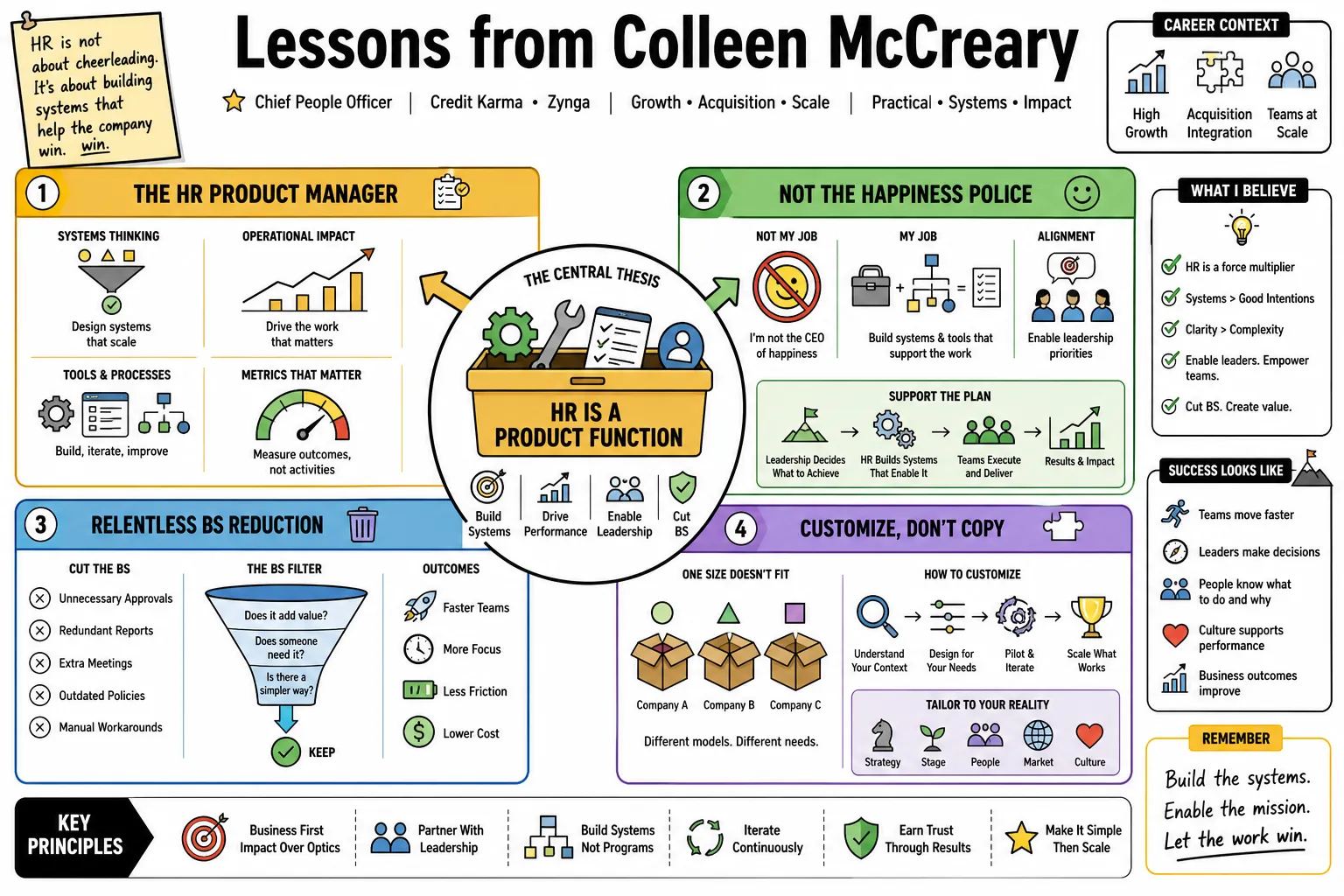
Lessons from Colleen McCreary
Colleen McCreary held senior People roles at Zynga and Credit Karma during periods of rapid growth and change. She describes People leadership as designing the systems and rituals through which a company works, and has written about reducing bureaucracy. These lessons draw on her interviews and essays about founders, culture, communication, feedback, scaling, and leadership. — Aspire Q&A with Colleen McCreary.
Part 1: The HR Product Manager
- On the True Role of HR: McCreary describes the People leader as a product manager for the systems and tools that help the company work, rather than the sole owner of its culture. — First Round Review Interview.
- On Not Being the Happiness Police: She rejects “CEO of happiness” as a job description: happiness is personal, while the People team can shape the systems and decision-making rituals employees experience. — Aspire Q&A with Colleen McCreary.
- On Treating HR Like Product: People systems should start with what the organization is trying to accomplish, then be designed and revised for that particular workforce. — First Round Review Interview.
- On Bureaucracy: Her “BS Reduction” program invited employees to identify unnecessary reports, meetings, training, and procedures, then tracked changes with executive help. — BS Reduction.
- On Customization: She warns against importing a previous employer’s people practices without first asking what problem the new company is trying to solve. — First Round Review Interview.
- On Evaluating HR Tools: After compensation or promotion cycles, McCreary’s team reviews employee questions and friction, then changes the process or tools for the next cycle. — First Round Review Interview.
- On Employee Experience: Her product-manager framing covers recruiting, onboarding, rewards, career progression, departures, and communications as connected employee-facing systems. — First Round Review Interview.
- On Process Creep: A process may have solved a real problem when introduced and still become unnecessary later; revisit ownership and remove the work it no longer justifies. — BS Reduction.
Part 2: Navigating Founder Dynamics
- On Underestimating People Work: McCreary says founders and early leaders often underestimate how difficult people problems will be as a company grows. — First Round Review Interview.
- On Founder Frustration: When new hires argue for policies from prior employers, founders and People leaders should clarify the problem their own company actually needs to solve. — First Round Review Interview.
- On CEO and HR Partnerships: The CEO–People leader relationship is tested by real disagreements over compensation, managers, performance, and communications; candor during hiring and continued conversations help establish alignment. — Founder CEO & Head of HR Divorce Rates.
- On Moving Too Fast: Founders may move to a new priority before employees have absorbed the last one; McCreary recommends slowing down and repeating the central mission. — First Round Review Interview.
- On Early Leadership Hires: A founder who spends much of the day on people problems should reconsider treating a senior People hire as dispensable. — First Round Review Interview.
- On Founder Expectations: Founder and People leader must work out the operating choices together, including rewards, performance expectations, and communication practices, rather than assume alignment from an interview. — Founder CEO & Head of HR Divorce Rates.
- On Pushback: McCreary describes leadership as the willingness to voice a different opinion, push back, and carry difficult messages through the organization. — First Round Review Interview.
Part 3: The Realities of Company Culture
- On Defining Culture: What counts as a good employee culture depends on what employees and leaders value; McCreary cautions against assuming a universal definition. — Does a Good Employee Culture Matter?.
- On Culture Tradeoffs: Leaders should examine the costs and benefits of cultural problems instead of treating “culture” as an abstract score. Attrition, recruiting strength, execution, and employee experience interact. — Does a Good Employee Culture Matter?.
- On Narrative Alignment: McCreary says the company’s internal account of how it operates should match the story told outside; a mismatch can distort employees’ understanding of their experience. — First Round Review Interview.
- On Authentic Workplaces: She defines culture by the systems, tools, and rituals through which decisions get made, rather than perks or values printed on a wall. — Aspire Q&A with Colleen McCreary.
- On Subcultures: McCreary distinguishes company-wide culture from the ways individual employees and teams like to work; leaders should learn those differences before codifying practices. — Aspire Q&A with Colleen McCreary.
- On Remote Adjustments: After Credit Karma moved suddenly to remote work in 2020, McCreary used recurring written updates to provide employees with context amid the acquisition and pandemic. — Aspire Q&A with Colleen McCreary.
- On Talent Versus Systems: McCreary rejects the idea that a handful of star hires can rescue a scaling company; leaders need the broader organization to work effectively. — First Round Review Interview.
- On Culture Metrics: Rather than rely only on a “best place to work” label, she points to attrition, succession, employee experience, execution, and connection to customers as signals to examine. — Does a Good Employee Culture Matter?.
Part 4: Communication and Transparency
- On Clarity: Clarity means telling employees plainly what message or outcome leadership is trying to convey. — Aspire Q&A with Colleen McCreary.
- On Context: Context means explaining why and how a decision was made so people can understand it and their role in what comes next. — Aspire Q&A with Colleen McCreary.
- On Consistency: Consistency requires repeating a core message through the same channels until it is understood across the organization. — Aspire Q&A with Colleen McCreary.
- On Weekly Updates: During the pandemic and pending acquisition, McCreary sent Sunday emails to employees for two years to explain business developments and keep a communication channel open. — Aspire Q&A with Colleen McCreary.
- On Hard Conversations: She warns that leaving difficult subjects such as attrition unaddressed lets employees assume the worst; leaders should raise problems even when no one asks. — First Round Review Interview.
- On Acquisition Messaging: Credit Karma’s CEO explained the mission rationale for its Intuit acquisition, while McCreary held 17 small-group sessions to address employees’ concerns. — Aspire Q&A with Colleen McCreary.
- On Town Halls: McCreary used all-hands meetings to raise questions employees were likely considering but reluctant to ask, including difficult business and people issues. — First Round Review Interview.
- On Transparency Limits: She says trust can mean openly acknowledging that leaders cannot yet give certainty, while still communicating what is known and what decisions are pending. — Aspire Q&A with Colleen McCreary.
Part 5: Feedback and Performance
- On Focusing on Weaknesses: McCreary says she had to unlearn a corrective-feedback habit and spend more time helping people build on what they already do well. — First Round Review Interview.
- On Career Conversations: Managers and employees should discuss goals and growth regularly, including opportunities inside and outside the company, rather than wait for an annual review. — Why I’ve Ripped Out Performance Reviews.
- On Check-ins: McCreary replaced annual reviews with quarterly check-ins and more frequent recognition, giving managers and employees a recurring forum for progress. — Why I’ve Ripped Out Performance Reviews.
- On Reflective Feedback: Her “Karma Combo” asks employees to reflect on peer perspectives and the gap between how they see themselves and how colleagues experience working with them. — First Round Review Interview.
- On Real-Time Feedback: When managers regularly discuss work against clear expectations, formal reviews should not introduce months-old negative surprises. — Why I’ve Ripped Out Performance Reviews.
- On Manager Feedback Skills: McCreary says managers often struggle with corrective feedback; specific, contextual, near-real-time observations are easier to deliver than broad negative reviews. — Why I’ve Ripped Out Performance Reviews.
- On Performance Frameworks: Employees need clear job frameworks and regular feedback so they can understand what growth or readiness for a promotion means. — Why I’ve Ripped Out Performance Reviews.
- On Career Progression: McCreary rejects a promotion-only view of growth: lateral moves, new products, and new collaborators can also develop a career. — First Round Review Interview.
- On Corrective Action: For behavior that needs to change, McCreary favors specific, situational feedback soon after the event rather than vague or delayed annual criticism. — Why I’ve Ripped Out Performance Reviews.
Part 6: Navigating Growth and Scale
- On Code and People: An engineer McCreary worked with at Zynga told her that people problems are harder than coding; she uses the anecdote to explain why founders underestimate People work. — First Round Review Interview.
- On Hypergrowth Realities: At Zynga, McCreary helped build People systems while headcount rose from about 130 to more than 4,000 in three years; frequent feedback and clear job frameworks became important at that pace. — Why I’ve Ripped Out Performance Reviews.
- On Alternatives to Layoffs: Before layoffs, she urges leaders to consider alternatives; at Credit Karma, pay cuts and redeployment of recruiting and marketing employees helped preserve jobs. — There Is a Right Way to Do Layoffs.
- On Budget Scrutiny: The HR Heretics discussion with McCreary frames budget scrutiny as a stakeholder-management problem: People leaders need to plan proactively and explain business relevance to CEOs, CFOs, and boards. — HR Heretics Budget Scrutiny Episode.
- On Hiring Pace: McCreary argues that hiring too quickly can create the need for painful layoffs later; she favors more deliberate growth rather than treating headcount as progress. — There Is a Right Way to Do Layoffs.
- On Scaling Managers: As a company expands, leading ten or twenty people and managing managers become different jobs; leaders should discuss that transition openly. — First Round Review Interview.
- On Organizational Debt: Rapid growth can leave people processes that once solved a problem but are no longer useful; McCreary’s bureaucracy-reduction work shows the value of revisiting them. — BS Reduction.
- On Onboarding at Scale: McCreary counts onboarding among the People systems that need deliberate ownership and iteration as the company grows. — First Round Review Interview.
- On Public-Company Incentives: She cautions that after an IPO employees can mistake stock price for the company’s definition of success, even though leadership cannot control that price. — First Round Review Interview.
Part 7: Leadership and Courage
- On Courage: McCreary argues that courage is undervalued in the workplace, especially the willingness to challenge bad ideas and have difficult conversations. — How to Sleep at Night.
- On Defending Employees: She criticizes leaders who blame people with less power while failing to confront those responsible for decisions; she values CEOs who stand beside People leaders and own the message. — How to Sleep at Night.
- On Hard Decisions: In McCreary’s examples, strong leaders provide context and make difficult choices without hiding behind a committee or delegating all responsibility for the message. — First Round Review Interview.
- On Navigating Turbulence: During Credit Karma’s pandemic disruption, leaders acknowledged uncertainty, examined alternatives for weeks, and kept employees informed before announcing a decision. — First Round Review Interview.
- On Accountability: McCreary calls out the gap between stated values and practices, such as claiming pay-for-performance while rewarding conformity or avoiding hard feedback. — How to Sleep at Night.
- On Hearing Employees: At Credit Karma, McCreary spoke with 100 employees in her first 30 days and wrote a six-page summary to surface concerns and priorities for leadership. — Aspire Q&A with Colleen McCreary.
- On Leading in Crisis: Her Credit Karma example shows the value of stating what is uncertain, choosing a decision date, and answering employee questions after leadership has explored the options. — First Round Review Interview.
- On HR Budget Scrutiny: An HR Heretics conversation with McCreary focuses on proactive planning and explaining People spending to CEOs, CFOs, and boards. — HR Heretics Budget Scrutiny Episode.
- On Leading Through Change: McCreary’s communication approach combines clarity, context, and repeated messages; during a major acquisition she also held small-group sessions and sustained weekly emails. — Aspire Q&A with Colleen McCreary.
Part 8: The Nuance of DEIB and Modern Work
- On DEIB Dialogue: In a 2024 roundtable with McCreary, the participants examine why DEI discussions need a real dialogue about which practices work and which priorities a company will pursue. — Getting Honest About DEI in 2024.
- On Inclusion in Practice: The DEI roundtable considers where companies allocate resources and whether inclusion work is integrated into leadership rather than left as a standalone program. — Getting Honest About DEI in 2024.
- On Candidate Appearance: In an HR Heretics episode, McCreary and Kelli Dragovich examine a makeup-related hiring rejection and the difficulty of giving useful, appropriate candidate feedback. — No Makeup, No Offer?.
- On Pay Equity: At Credit Karma, McCreary pursued role-based pay and clearer job frameworks so employees in the same role could understand why they were paid the same way. — Innovating on Compensation: Role-Based Pay.