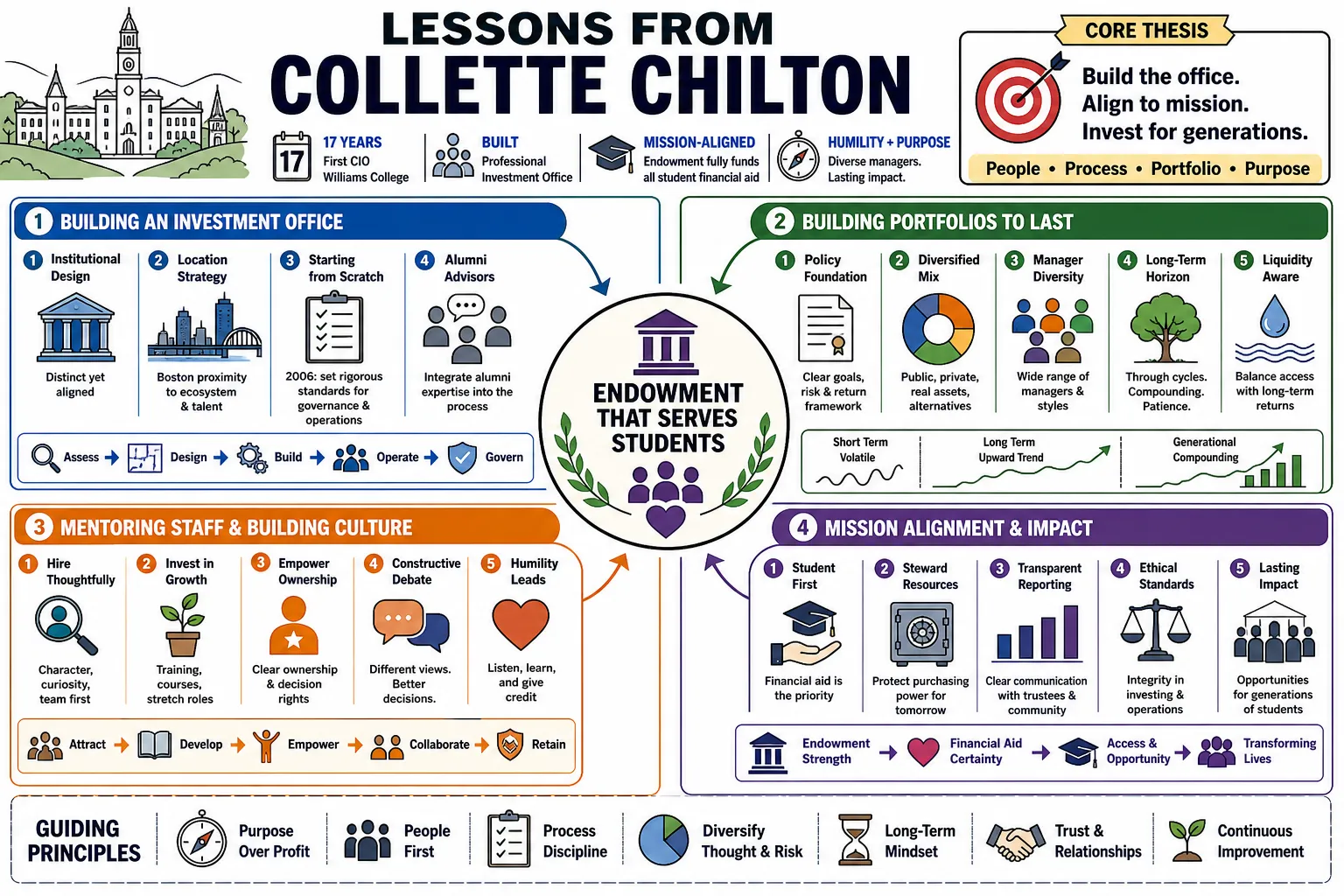
Lessons from Collette Chilton
Collette Chilton became Williams College’s first full-time chief investment officer in 2006 and built its professional investment office before stepping down in 2023. She described the endowment as a way to support students and the college today while preserving resources for future generations. These lessons examine how she built the office, worked with alumni advisers, managed the portfolio and developed the next generation of investors. — Williams 2023 Investment Report.
Part 1: Building an Investment Office
- On Institutional Design: As Williams’ first full-time CIO, Chilton professionalized investment oversight when the endowment’s size and complexity had outgrown an alumni-volunteer-only model. — Williams 2023 Investment Report.
- On Office Location: The new investment office was planned for Boston; Chilton initially worked in Williamstown while it was being set up. — Capital Allocators Interview.
- On Starting from Scratch: Chilton began with a small founding group, recruited people willing to build an office while managing the endowment, and grew the team over time. — Williams 2023 Investment Report.
- On Alumni Advisors: Chilton credits experienced Williams alumni on the Investment and Advisory Committees as a distinctive source of investment judgment and manager access. — Williams 2016 Investment Report.
- On Team Structure: When hiring for the new office, Chilton sought people excited by an investment-office startup; later she emphasized careers and institutional memory rather than short stops. — Williams 2023 Investment Report.
- On Institutional Alignment: Williams’ investment mission combines long-term return with ample liquidity because the endowment supports roughly half the college’s budget. — Williams 2016 Investment Report.
- On Measuring Returns: The office assessed returns against its policy-portfolio benchmark and a long-term objective of a 5% real return, rather than a single short-term market number. — Williams 2016 Investment Report.
- On Governance Roles: Williams kept alumni asset-class advisory committees while making the trustee Investment Committee the fiduciary body that approves manager hiring. — Capital Allocators Interview.
- On Succession: Abigail Wattley joined as the office’s first analyst and later succeeded Chilton as CIO, showing the continuity built into the team. — Williams 2023 Investment Report.
Part 2: Humility and Loyalty
- On Measuring Success: Williams measured its investment program against its own long-term return objective and the college’s mission, rather than treating a one-year ranking as the central measure. — Williams 2016 Investment Report.
- On Institutional Loyalty: Chilton described the endowment as a tool for the college: it must support current students while preserving resources for future students. — Williams 2023 Investment Report.
- On Learning from Mistakes: Chilton recalled that moving too quickly on a manager recommendation, without her team’s usual slow diligence, had produced a poor result. — Capital Allocators Interview.
- On Staff Continuity: Chilton wanted investment-office roles to become careers, not short stops, because long investment decisions benefit from people who remember why earlier choices were made. — Williams 2023 Investment Report.
- On Managing Expectations: The office reported disappointing one-year returns alongside its long-term objective and explained why it continued to focus on a diversified, disciplined approach. — Williams 2016 Investment Report.
- On Resisting Crowds: Chilton warned against investing in a manager merely because respected peers had done so; her team needed to understand the person and strategy itself. — Capital Allocators Interview.
- On Long-Term Stewardship: Williams’ investment horizon was perpetuity, yet the office still needed returns and enough liquidity to fund the college’s current mission. — Williams 2016 Investment Report.
Part 3: Asset Allocation and Philosophy
- On Hedge-Fund Allocation: Williams’ large hedge-fund allocation grew from conviction in specific managers, not from setting a high percentage target and filling it mechanically. — Capital Allocators Interview.
- On Venture-Capital Pacing: Chilton said Williams kept its venture relationships and commitment pattern broadly steady even when strong performance pushed the actual allocation well above target. — Capital Allocators Interview.
- On Independent Judgment: Chilton treated the popularity of a manager as insufficient evidence: the office still had to understand the investment and be comfortable with the people. — Capital Allocators Interview.
- On Private-Market Liquidity: Williams kept its private-equity and venture targets constrained by the need to fund a large share of the college’s operating budget and monitor unfunded commitments. — Capital Allocators Interview.
- On Portfolio Diversification: Chilton described a portfolio spread across nine asset classes and roughly 60 complementary managers because no single strategy leads every year. — Williams 2023 Investment Report.
- On Return Targets: The college’s long-term objective was a 5% real return, paired with ample liquidity so the endowment could support current spending without eroding future purchasing power. — Williams 2016 Investment Report.
Part 4: Endowment Management and Mission
- On the Greatest Accomplishment: Chilton identified the billions of dollars the investment office had supplied to Williams as its greatest accomplishment, because the money supported the college’s work. — Williams Record Interview.
- On Funding Financial Aid: At the office’s tenth anniversary, Chilton calculated that investment outperformance over its first decade had paid for Williams’ financial aid in that period. — Williams 2023 Investment Report.
- On the Operating Budget: Because the endowment supplied more than half of Williams’ operating budget, Chilton emphasized both funding current needs and protecting resources for future students. — Williams 2023 Investment Report.
- On Teaching Students: The investment office used Winter Study, summer analyst roles and full-time analyst positions to expose Williams students to endowment management. — Williams Record Interview.
- On Intergenerational Spending: Chilton argued that Williams must spend to help current students without depleting the endowment that future students will need. — Williams 2023 Investment Report.
- On the Purpose of Capital: Endowment spending supported faculty, staff, facilities and financial aid, making the investment program directly consequential to Williams’ educational mission. — Williams 2016 Investment Report.
- On College Priorities: Chilton saw the endowment as a tool that lets the president and senior staff make educational choices, including financial-aid priorities. — Williams 2023 Investment Report.
- On the Perpetual Horizon: The office treated the endowment’s horizon as perpetuity and used that long-term focus while maintaining sufficient liquidity for the college. — Williams 2016 Investment Report.
Part 5: Risk Management and the 2008 Crisis
- On the 2008 Crisis: Chilton described the 2008 financial crisis as an early challenge for the new office; the episode reinforced its attention to liquidity and diversification. — Williams 2016 Investment Report.
- On Liquidity Needs: A liquid legacy account helped Williams meet transfers to the college during the financial crisis, illustrating why endowment liquidity mattered alongside returns. — Capital Allocators Interview.
- On Staying with the Process: After 2008, the office kept its core approach of selecting a manageable number of strong managers while monitoring liquidity and diversification. — Capital Allocators Interview.
- On Committee Stability: During the 2008 crisis, experienced investment and advisory committee members provided continuity and reassurance to the newly built office. — Capital Allocators Interview.
- On Defensive Liquidity: Williams had core fixed income and a liquid legacy position going into the crisis; Chilton said both helped when the endowment still had to send money to the college. — Capital Allocators Interview.
- On Institutional Memory: Chilton valued long-tenured staff who could remember earlier investment decisions and the reasons behind them—an asset when markets and managers changed. — Williams 2023 Investment Report.
Part 6: Diversity and Mentorship
- On Building a Pipeline for Women: Chilton saw programs that reach college women early as a way to expand the pipeline into investment management. — Williams 2023 Investment Report.
- On a Diversity Regret: Chilton said she wished the office had begun its student-program diversity and inclusion work earlier. — Williams Record Interview.
- On Scarce Female Mentors: Chilton recalled that she had few female mentors early in her finance career and had often worked in rooms dominated by men. — Williams Record Interview.
- On Tracking Inclusion: Williams deliberately tracked whether its student hires included women and people of color rather than relying on a vague claim that the pipeline was improving. — Williams 2023 Investment Report.
- On Girls Who Invest: Chilton served on the Girls Who Invest board and recruited at Williams to bring more women into investing careers. — Williams 2023 Investment Report.
- On Practical Exposure: The office brought outside managers into student programs to discuss investments and ask students to assess a stock or short idea. — Capital Allocators Interview.
- On Winter Study: Chilton described Winter Study as an introduction to endowment management that could reach students who had not otherwise encountered the field. — Capital Allocators Interview.
- On Liberal-Arts Talent: Chilton argued that investment management rewards analysis, critical reading, writing and building a defensible thesis—skills liberal-arts students can bring. — Williams 2023 Investment Report.
- On Uneven Industry Progress: Chilton perceived more women in endowment leadership but cautioned that the available data did not necessarily confirm the degree of progress she sensed. — Williams 2023 Investment Report.
Part 7: Manager Selection and Relationships
- On Manager Trust: For Chilton, a manager’s honesty and trustworthiness mattered alongside an understandable strategy that she could explain to the Investment Committee. — Capital Allocators Interview.
- On First-Time Managers: Williams was willing to back first-time funds and managers without long standalone track records when the team understood the people and strategy. — Capital Allocators Interview.
- On Underperforming Managers: Chilton described meeting a strong manager during a weak period to understand how the person was thinking, not simply to demand a position-by-position defense. — Capital Allocators Interview.
- On Reference Checks: A rushed manager hire taught Chilton to preserve time for repeat meetings and references, including other investors and people who knew the firm. — Capital Allocators Interview.
- On Manager Count: The office limited new managers partly to avoid diluting returns and partly because a small team had to monitor a global portfolio. — Capital Allocators Interview.
- On Explainability: Chilton preferred managers whose activity could be understood and explained to the committee; that kept much black-box macro and quantitative investing out of the portfolio. — Capital Allocators Interview.
- On Long Manager Relationships: Chilton said some Williams manager relationships had lasted about two decades, and the office tried to be a respectful long-term client rather than monopolizing managers’ time. — Capital Allocators Interview.
- On Track Records: Chilton noted that a first-time fund may lack a standalone record, so her team relied on extensive meetings, career context and whether its strategy made sense. — Capital Allocators Interview.
Part 8: Career Lessons and Leadership
- On Public-Pension Service: Chilton described public-pension work as mission-driven but exposed to scrutiny around the state treasurer, while retirees depended directly on the fund. — Capital Allocators Interview.
- On Corporate-Pension Liabilities: At Lucent, Chilton managed assets against defined pension obligations, a different constraint from Williams’ endowment spending mission. — Capital Allocators Interview.
- On Board Collaboration: Chilton valued an experienced, patient Investment Committee and described its close, collaborative relationship with the office as particularly useful in uncertain markets. — Williams 2023 Investment Report.
- On Weathering Setbacks: Over time, Chilton learned that a bad investment or difficult market period need not define the future; she credited a positive outlook with helping her stay steady. — Capital Allocators Interview.
- On Professional Humility: After years leading large pools of capital, Chilton said she still felt fortunate to do this work and considered lack of humility a serious fault in investing. — Capital Allocators Interview.
- On Evolving Judgment: Chilton became more comfortable backing first-time managers as her experience grew, while acknowledging that such risk did not always pay off. — Capital Allocators Interview.