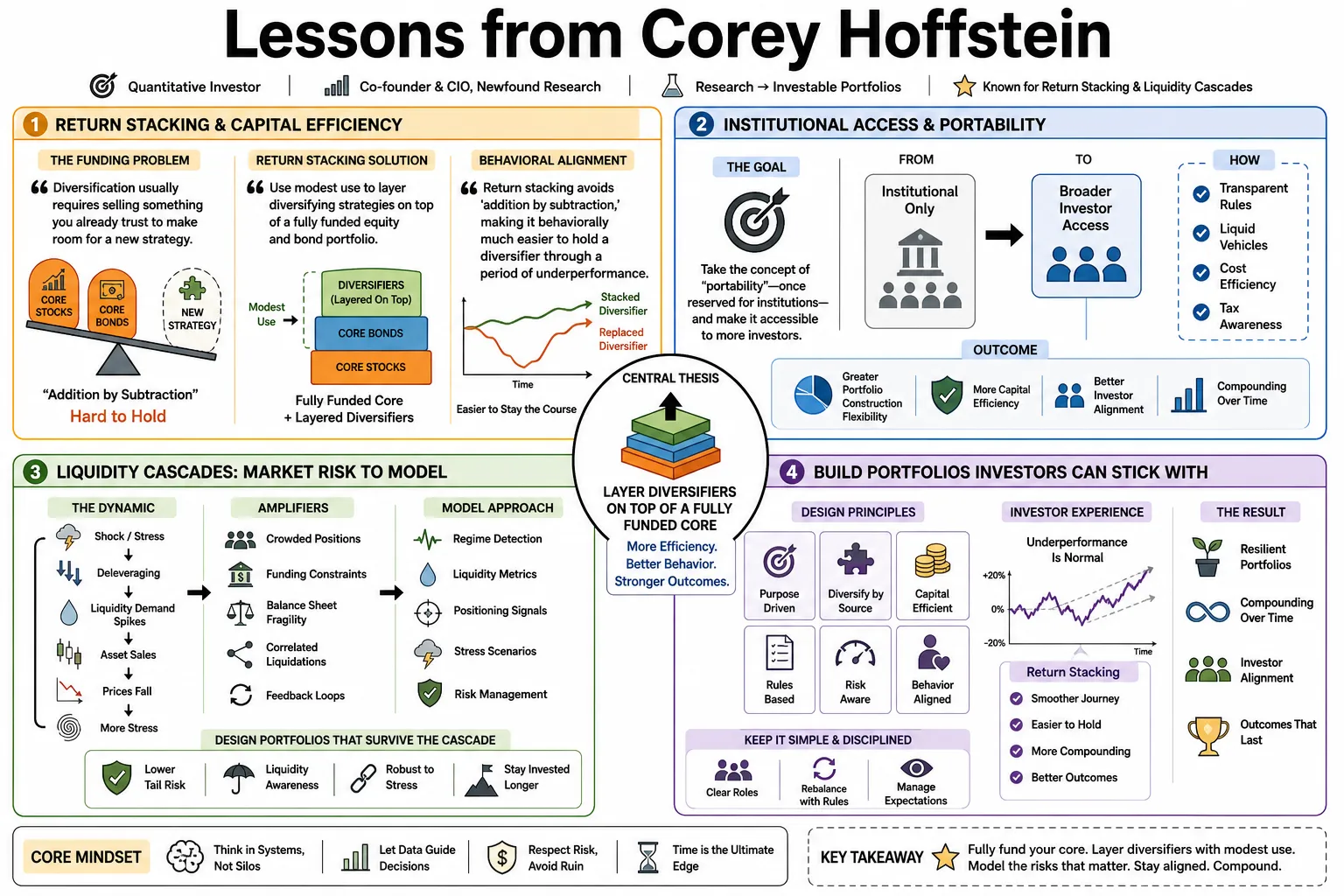
Lessons from Corey Hoffstein
Corey Hoffstein is co-founder and chief investment officer of Newfound Research. His work explores portfolio construction, quantitative strategies and the risks investors must bear to pursue returns; this profile examines those ideas across return stacking, liquidity, diversification and behavioral discipline. — 15 Ideas, Frameworks, and Lessons from 15 Years.
Part 1: Return Stacking & Capital Efficiency
- On the funding problem: Funding a diversifying strategy by selling stocks or bonds creates an implicit hurdle: the new allocation must overcome the return from what was sold. — Portfolio Tilts versus Overlays.
- On return stacking: Return stacking uses capital-efficient implementation to add diversifying strategies while maintaining the core stock and bond exposures an investor wants to keep. — Get Stacked Inaugural Episode.
- On behavioral alignment: Adding alternatives without selling a core holding may reduce the regret and performance-chasing pressure associated with funding a diversifier by subtraction. — Diversification 2.0.
- On wider access to portable alpha: Portable-alpha overlays historically required a derivatives book or separate manager and were easier for flexible institutions to implement. Hoffstein notes that capital-efficient mutual funds and ETFs now package some of that exposure for allocators who could not readily implement the overlay themselves. — Portfolio Tilts versus Overlays.
- On leverage: Capital-efficient instruments can preserve a desired stock-and-bond exposure while freeing capital for diversifying strategies, but the financing cost and net portfolio exposure still matter. — Return Stacking in an Inverted Yield Curve.
- On the 60/40 portfolio: A capital-efficient 90/60 implementation can reproduce 60/40 stock-and-bond exposure with part of the capital, leaving room for another return source without first selling the core allocation. — Return Stacking in an Inverted Yield Curve.
- On cash collateral: In Hoffstein's illustrative 90/60-plus-managed-futures portfolio, the cash components net out, leaving stock, bond and active futures-strategy exposures to evaluate together. — Return Stacking in an Inverted Yield Curve.
- On expected returns: In a levered stock-and-bond portfolio, the relevant comparison is the expected excess return from the scaled risk premia after financing, not the headline yield on a single instrument. — Return Stacking in an Inverted Yield Curve.
- On benchmark deviation when funding alternatives: Selling stocks or bonds to make room for a diversifier can cause the portfolio to diverge sharply from a familiar benchmark. In a coauthored paper, Hoffstein and colleagues propose retaining core exposures while adding alternatives through capital-efficient funds to reduce that specific source of tracking error. — Return Stacking Paper.
Part 2: Liquidity Cascades & Market Structure
- On coordinated risk: Independently chosen market strategies can still share a pro-cyclical demand for liquidity. Hoffstein presents their interaction as a potential common vulnerability, while cautioning that the individual causal narratives are circumstantial. — Liquidity Cascades.
- On pro-cyclical forces: Hoffstein argues that passive/indexed flows and volatility-contingent strategies may interact with shrinking liquidity during stress, potentially amplifying a market move. — ReSolve Liquidity Cascades Interview.
- On melt-ups and crashes: The same broad concern about flow-driven feedback can apply in both directions: in Hoffstein's account, lower volatility and changing dealer hedges may create renewed buying pressure after a sell-off. — ReSolve Liquidity Cascades Interview.
- On market microstructure: Hoffstein distinguishes cap-weighted passive investing from other indexed strategies and suggests that basket flows may alter marginal liquidity and price formation; he does not present that mechanism as proven causation. — ReSolve Liquidity Cascades Interview.
- On reflexivity: In Hoffstein's proposed liquidity-cascade loop, liquidity providers may pull back as volatility-contingent hedging demands more liquidity, allowing price declines to reinforce further selling. — ReSolve Liquidity Cascades Interview.
- On unseen convergence: Strategies designed separately may converge on the same need for liquidity during stress, making a market move harder to absorb than each position suggests in isolation. — ReSolve Liquidity Cascades Interview.
- On central-bank influence: Hoffstein suggests that low rates and fixed return obligations can push some investors toward yield-seeking or volatility-selling strategies, potentially increasing conditional market stress. — ReSolve Liquidity Cascades Interview.
- On passive investing's impact: Hoffstein distinguishes cap-weighted passive funds from other indexed products and argues that new flows into a drifting factor index can sometimes resemble a momentum trade between rebalances. — ReSolve Liquidity Cascades Interview.
- On surviving cascades: For investors who find the liquidity-cascade thesis plausible, Hoffstein discusses balancing participation in potential upside with convex hedges against a reversal, while acknowledging that the strategy depends on uncertain assumptions. — ReSolve Liquidity Cascades Interview.
Part 3: Diversification & Portfolio Construction
- On diversification beyond holdings: Hoffstein argues that diversification is not just a count of securities or funds: investors can diversify what they own, the payoff shapes of their strategies, and when decisions are made. — Payoff Diversification.
- On managed futures: Hoffstein describes managed futures as a historically low-correlated complement to stocks and bonds that has helped in some equity and inflation stress periods; that record does not guarantee protection in every joint selloff. — Meb Faber Podcast Interview.
- On long/short framing: Comparing a portfolio with its benchmark as a long/short overlay exposes the active overweights and underweights—and the bets the investor is making. — Portfolio Tilts versus Overlays.
- On tolerating a different portfolio: An alternative allocation can look attractive in an optimizer yet be hard to hold through years of underperformance against a familiar stock-and-bond portfolio; portfolio design must account for that behavioral constraint. — Meb Faber Podcast Interview.
- On ensemble methods: Diversify not only what a strategy owns but how its signals and portfolio rules are specified; averaging signals before selection can differ materially from averaging separately constructed portfolios. — 15 Ideas from 15 Years.
- On allocating under uncertainty: When two portfolio-construction methods were both plausible and his research did not identify a clear winner, Hoffstein divided the allocation between them. He describes this as diversifying the decision rather than claiming to know which method would win. — 15 Ideas, Frameworks, and Lessons.
- On changing stock–bond correlations: Stock and bond returns have not always offset one another. Hoffstein notes that their realized correlation was positive in parts of the 1960s–1980s and later flipped, with the market's emphasis on inflation risk versus economic risk a possible contributor. — Tactical Portable Beta.
- On structural edges: Hoffstein describes access to trades others cannot pursue as one possible structural moat for an active manager. He contrasts such advantages with behavioral edges that persist because they are difficult for investors to hold. — 15 Ideas from 15 Years.
- On path-dependent loss: A portfolio can look acceptable on average while the one return path an investor experiences triggers a permanent planning failure. Hoffstein highlights large or prolonged drawdowns near retirement as a particular example. — Drawdowns and Portfolio Longevity.
- On compounding paths: For a multi-period investor, the path of returns matters as well as their simple average. Hoffstein's growth-optimal analysis shows how lower volatility can improve compound accumulation even when expected single-period returns are lower, subject to horizon and liability needs. — Growth Optimal Portfolios.
Part 4: Factor Investing & Momentum
- On data as a quantitative moat: In introducing his interview with Bloomberg data executive Angana Jacob, Hoffstein notes that many models have become easier to replicate and highlights the quality of data sourcing, cleaning, linking and delivery as a possible competitive edge. The idea is presented as a theme of their conversation, not a proved rule for every factor strategy. — Hoffstein on Data as a Moat.
- On a behavioral theory of momentum: Hoffstein describes anchoring-driven underreaction to new information, followed by herding and overreaction, as one theory for why price trends emerge. He distinguishes that explanation from the historical evidence for trend following and does not present it as a proven universal cause. — Protect & Participate.
- On value investing: Hoffstein treats the long slump in traditional price-to-book value as a genuine challenge but cautions against a single explanation: accounting changes, ordinary return variation, crowding and a broken measure are among the possibilities he considers. — Factor Fimbulwinter.
- On factor timing: In Hoffstein's historical test, business-cycle rotations across equity factors did not add meaningful value over a diversified factor benchmark, even when the cycle labels were known in hindsight; that raises the hurdle for tactical factor timing. — Style Surfing the Business Cycle.
- On trend following: In Hoffstein's analysis, trend following has historically displayed positive skew and a convex payoff shape: it can incur repeated small losses in reversals and larger gains when trends persist. Those features depend on implementation and do not guarantee a hedge in every crisis. — Trend: Convexity & Premium.
- On multi-factor construction: Combining value, momentum and other factors is not a single mechanical choice: blending factor portfolios and blending security-level signals can create different exposures, with turnover and factor interactions affecting the result. — Diversification in Multi-Factor Portfolios.
- On momentum crashes: Hoffstein notes that historical momentum-factor returns have sometimes been interrupted by short, pronounced drawdowns; his analysis cautions against treating a smooth long-run profile as evidence that sudden losses cannot occur. — Factor Fimbulwinter.
- On strategy crowding: A strategy that appears to offer easy excess returns can attract enough capital to erode its edge. Hoffstein argues that some premiums persist partly because the strategies are difficult to hold through disappointing periods. — 15 Ideas from 15 Years.
Part 5: Risk Management & Tail Risk
- On defining investment risk: Hoffstein frames risk in relation to an investor's goal: an accumulation-stage investor can fail by growing too slowly to meet future liabilities, while an investor taking withdrawals can be hurt by a large drawdown at the wrong time. — No Pain, No Premium.
- On tail-risk hedging: A put-based tail hedge can provide convex protection, but its premium, expiration and monetization rules matter. Hoffstein cautions that a hedge held to expiration may miss much of the value created when markets reprice risk. — Tail Hedging.
- On buying protection before a crisis: Waiting until market stress is visible to buy put protection may save premiums in calm periods, but it risks finding that protection has become too expensive or that the damaging move has already happened. — Heads I Win, Tails I Hedge.
- On sequence of returns: When a retiree makes fixed withdrawals, poor returns early in retirement raise the share of the remaining portfolio needed to fund those withdrawals. Hoffstein's historical-return simulations associate larger early drawdowns with a higher risk that the portfolio runs out of money. — Drawdowns and Portfolio Longevity.
- On managing drawdowns: Hoffstein's retirement analysis emphasizes both the depth and duration of losses: with fixed withdrawals, a shrinking portfolio must support the same spending from a smaller base, increasing the risk of failure. — Drawdowns and Portfolio Longevity.
- On implied volatility in put hedges: Deep out-of-the-money puts are sensitive to changes in implied volatility as well as the underlying index. In Hoffstein's example, a sharp rise in implied volatility contributed to a hedge's value before expiration, underscoring that price and monetization rules both matter. — Tail Hedging.
- On rebalancing: Returning a drifted portfolio to its policy weights is an active rule with trade-offs: in Hoffstein's stock-bond example it can help after relative performance reverses, but can lag if a trend continues. — Payoff Diversification.
- On hidden volatility exposure: Structured products and option-linked yield strategies can leave a portfolio exposed to changes in volatility even when the investor is not explicitly trading volatility. Hoffstein groups these among volatility-contingent strategies whose demand for liquidity may rise during stress. — ReSolve Liquidity Cascades Interview.
Part 6: Quantitative Research & Data Quality
- On data quality in backtests: Historical options quotes can be stale or have wide spreads, making a naive options backtest misleading. Hoffstein fitted a volatility surface to reduce some data problems, while warning that modeled strikes made his illustration not directly investable. — Tail Hedging.
- On overfitting: A single backtest is one historical realization, so test how a strategy behaves when assumptions, dates and investable universes change before trusting its apparent edge. — 15 Ideas from 15 Years.
- On balancing simplicity and robustness: Simple investing rules can be robust, but simplicity alone is not a virtue: a single trend signal can be fragile, while combining signals may reduce sensitivity to noise if the diversification benefit justifies added estimation risk. — When Simplicity Met Fragility.
- On parameter stability: Vary process parameters and entry or exit timing to learn whether a result depends heavily on one particular backtest specification. — 15 Ideas from 15 Years.
- On trading costs: Stress-test a backtest against different slippage and market-impact assumptions; historical gross results alone do not show how the strategy might fare in implementation. — 15 Ideas from 15 Years.
- On testing investability: A statistically promising backtest is not the same as an investable strategy. Hoffstein urges testing trading-cost assumptions and changing the investable universe to see whether an apparent edge survives implementation and sample choices. — 15 Ideas from 15 Years.
- On systematic design choices: Systematic trading still depends on human choices about markets, signal speeds, risk weights and constraints. Hoffstein describes those choices as part of designing a trend model, rather than decisions made anew for every trade. — Top Traders Unplugged Interview.
- On training across regimes: When fitting a model with many parameters, Hoffstein favors a long history that includes periods when different markets contributed gains and losses. A model trained on one short era may misread the strategy's underlying mix. — Top Traders Unplugged Interview.
Part 7: Behavioral Finance & Investor Psychology
- On sticking with the plan: A portfolio's theoretical appeal is not enough if the investor cannot maintain the allocation when a diversifier lags; Hoffstein urges treating the decision as a long-term strategy rather than a reaction to recent performance. — Meb Faber Podcast Interview.
- On line-item risk: A diversifier held as a separate product may stand out during disappointing performance and become harder for clients to keep. Hoffstein argues that packaging it alongside familiar stock or bond exposure could reduce this behavioral friction, though it cannot ensure investors stay invested. — Alpha Exchange Interview.
- On the behavioral cost of tracking error: An alternative can be useful over a full cycle yet still deviate from a familiar stock-and-bond portfolio for years. Hoffstein and his coauthors warn that fear of missing out during those periods can cause investors to abandon a diversifier before its expected benefit appears. — Return Stacking Paper.
- On recent performance: Recent returns can tempt investors and advisors to change a strategic allocation at the wrong time; Hoffstein argues that the rationale for a long-term portfolio should not depend on the latest relative performance. — Meb Faber Podcast Interview.
- On explaining investment products: In an interview about the business of asset management, Hoffstein discusses educational materials and content as part of distribution and brand building, alongside the need to address client problems beyond a market-beating claim. — Other People's Money Interview.
- On the boredom of diversified strategies: A blended, diversified strategy may offer less excitement than a concentrated market call. Hoffstein agrees that it can feel boring and warns that investors may struggle to stay with it through years of relative underperformance. — Meb Faber Interview.
- On market timing: The more diversified a portfolio already is, the more accurate a timing forecast must be to beat a simple diversified allocation. — 15 Ideas from 15 Years.
Part 8: The Business of Asset Management & Content
- On building a brand: Hoffstein says a recognizable personal brand can matter in asset management. He describes trying thoughtful finance media as a way for Newfound's systematic work to have a human voice, while acknowledging that content experiments do not automatically gain traction. — Mutiny Fund Interview.
- On podcast production: Hoffstein describes making finance podcasts as a hands-on media experiment. Editing early episodes himself helped him understand the work and judge what to look for when hiring a specialist. — Mutiny Fund Interview.
- On ETF transparency: For a complex actively traded ETF, market makers need timely visibility into the underlying basket to hedge and quote prices. Hoffstein says less disclosure can mean wider spreads, and some less-liquid or hard-to-hedge strategies may fit a mutual fund better. — Alpha Exchange Interview.
- On collaborative portfolio research: Return stacking was developed and explained through work shared across firms: Hoffstein coauthored a primary paper with ReSolve's Rodrigo Gordillo and Adam Butler that combines their portfolio-construction perspectives. — Return Stacking Paper.
- On challenging an investment thesis: Before concluding that the market is wrong, Hoffstein says he starts by assuming he may have missed something and works through alternative explanations. That is his stated research habit, not evidence of a formal firm-wide culture policy. — 15 Ideas from 15 Years.
- On surviving asset-management cycles: Hoffstein notes that raising assets depends partly on market performance and whether an investment style is in favor—factors a manager cannot control simply by setting a fundraising target. — Mutiny Fund Interview.
- On what managers sell beyond returns: Hoffstein argues that a claim to beat the market has become a commoditized proposition; managers also need to solve specific client problems to attract assets. — Other People's Money Interview.