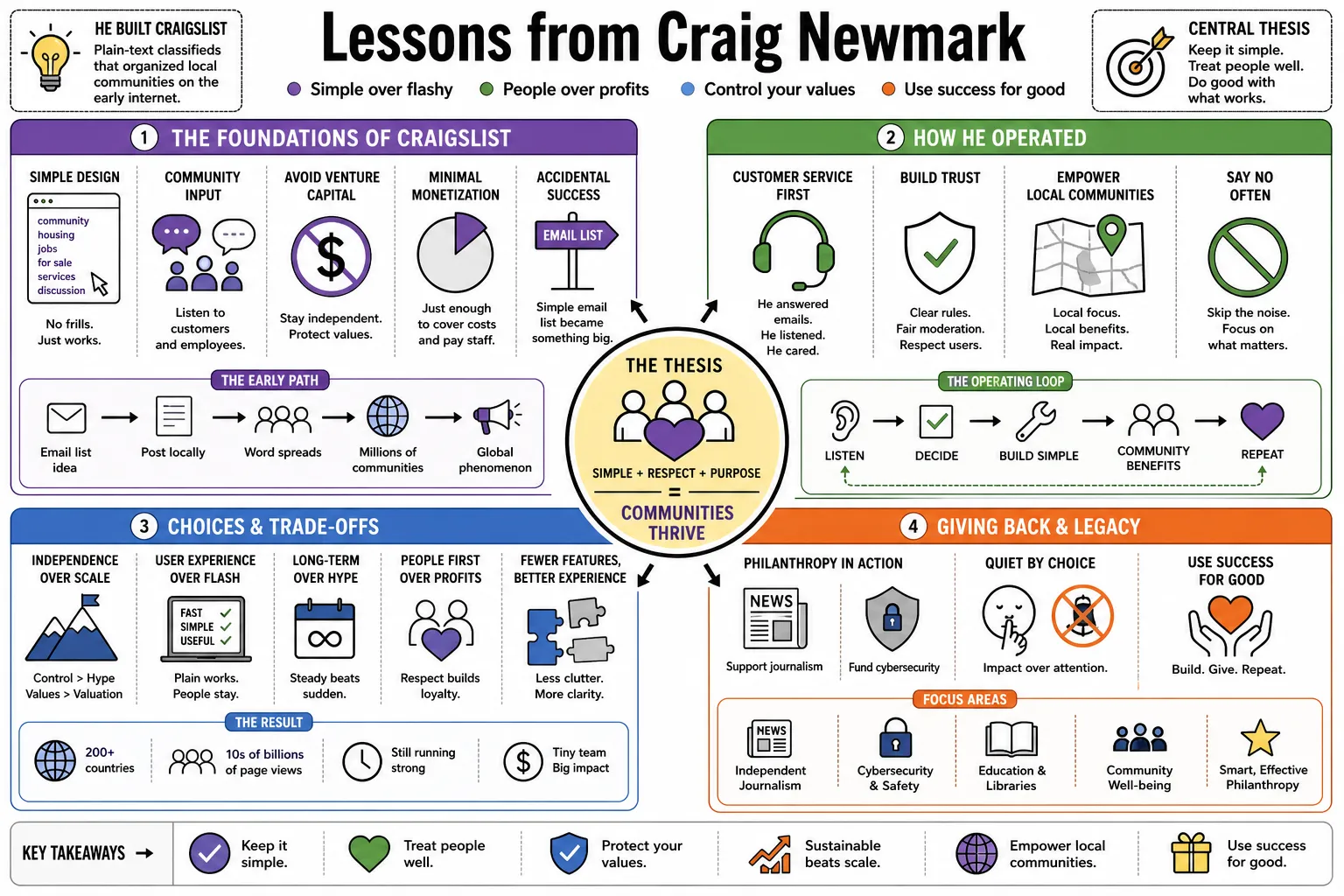
Lessons from Craig Newmark
Craig Newmark began Craigslist as a small San Francisco email list, then shaped its simple design and modest monetization around what users needed. After stepping away from management, he stayed close to customer service and later focused his giving on public-interest work. — Thirty Minute Mentors — Craig Newmark.
Part 1: The Foundations of Craigslist
- On Simple Design: Newmark kept Craigslist's original interface straightforward and obvious because he wanted a practical service, not a display of fancy design. — Thirty Minute Mentors — Craig Newmark.
- On Community Input: Newmark says he listened to users and employees and acted on their feedback when shaping Craigslist's services and internal tools. — Thirty Minute Mentors — Craig Newmark.
- On Venture Capital: Newmark says he declined lucrative banker and venture-capital offers because his enough-is-enough ethic mattered more to him than maximizing the site's financial upside. — Thirty Minute Mentors — Craig Newmark.
- On Minimal Monetization: Newmark initially charged for selected job listings so Craigslist could cover bills and pay staff, while keeping most uses free and useful to the community. — Thirty Minute Mentors — Craig Newmark.
- On Accidental Beginnings: Craigslist started in 1995 as Newmark's email list for technology and arts events; user requests soon expanded it into jobs, sales and housing listings. — Thirty Minute Mentors — Craig Newmark.
- On Local Community: Newmark saw web tools as a way to reconnect people around everyday neighborhood needs, from finding a sofa to helping one another after a disaster. — This I Believe — That Golden Rule Thing.
- On User Feedback: Newmark says user requests helped determine which services and cities Craigslist added; he favored responding to that feedback over following a fixed expansion formula. — Craigslist Archive — nPost Interview.
- On Long-Term Utility: Newmark favored modest fees, a simple site and incremental improvements that helped users, rather than treating each new feature as an opportunity to extract more revenue. — Craigslist Archive — nPost Interview.
Part 2: Customer Service as Leadership
- On Staying Grounded: After stepping away from management, Newmark continued doing some Craigslist customer service because it kept him close to users' real problems. — Half a Life in Customer Service.
- On Combating Elitism: Newmark says direct customer service can puncture a leader's elitism by repeatedly exposing them to other people's needs. — Half a Life in Customer Service.
- On Empathy: Newmark says decades of direct customer service gave him empathy and compassion, an experience he carried into how he communicates with nonprofit grantees. — 5 Ways Nonprofits and Funders Can Better Connect.
- On Basic Needs: From answering Craigslist users, Newmark concluded that most people are trying to get through ordinary daily challenges, while genuinely bad actors are a small minority. — Conversations with Tyler — Craig Newmark.
- On Executive Customer Service: Newmark urges CEOs and other company leaders to do some customer service so they keep contact with users and recover empathy. — Half a Life in Customer Service.
- On Public Service: Newmark says he created Craigslist to help people help one another; he saw the platform's value in making that everyday mutual aid easier. — This I Believe — That Golden Rule Thing.
- On Handling Abuse: Newmark says Craigslist used mechanisms to identify harmful postings and handled those issues directly; trust in most users did not mean ignoring bad actors. — Craigslist Archive — nPost Interview.
Part 3: Community and Trust
- On Baseline Morality: After years of customer service, Newmark came to believe that most people using Craigslist played fair and shared basic expectations of goodwill, while recognizing exceptions. — This I Believe — That Golden Rule Thing.
- On Systems of Help: Newmark says Craigslist became a tool people could repurpose to help each other; after Hurricane Katrina, users used it to locate loved ones and offer housing and jobs. — This I Believe — That Golden Rule Thing.
- On Learning to Trust: Newmark says customer service made him more trusting, but also taught him that personal honesty alone is no defense against people who lie for a living. — Conversations with Tyler — Craig Newmark.
- On Shared Values: Newmark says many Craigslist users share simple expectations: play fair, give others a break and treat people as they would want to be treated. — This I Believe — That Golden Rule Thing.
- On Trusting Users: Newmark designed around the expectation that most users would act decently, while the team maintained ways to find and handle misuse. — Craigslist Archive — nPost Interview.
- On Protecting Trust: Newmark calls trust a central challenge for journalism; he argues that accurate reporting, vetted sources and accountability matter more than attention-grabbing but unreliable stories. — Restore Trust in News — Craig Newmark.
- On Local Connection: Newmark says separate Craigslist city sites helped a large service remain manageable and personal, allowing people to meet everyday local needs. — Craigslist Archive — nPost Interview.
- On Iterating with Feedback: Newmark describes his method as listening to others, acting on useful input, then repeating the cycle as the project develops. — Startups.com — Listen, Act, Repeat.
- On Managing Abuse: Newmark acknowledges that a small number of bad actors are drawn to trust-based communities; Craigslist used community feedback and direct intervention to address abuse. — This I Believe — That Golden Rule Thing.
Part 4: Nerd Values and Philosophy
- On Being a Nerd: Newmark openly describes himself as an old-school nerd, recalling the pocket protector and taped glasses of his youth without turning that identity into a claim of superior problem-solving. — Inc. — Craig Newmark Interview.
- On Nerd Values: For Newmark, earning enough for a comfortable future creates room to use one's skills to change things for the better. — Reason — The Real Community Organizer.
- On Plain Functionality: Newmark says Craigslist remained simple, straightforward and fast because users consistently preferred that to a fancier design. — Inc. — Craig Newmark Interview.
- On Rejecting Banner Ads: Newmark turned down a proposal to run banner ads and resisted advice to monetize every part of Craigslist, favoring lower-cost service for users. — Inc. — Craig Newmark Interview.
- On Practical Ethics: Newmark connects his business choices to a simple ethic learned early: treat people as he would want to be treated and help them meet practical needs. — The Giving Pledge — Craig and Eileen Newmark.
- On Stepping Back: After recognizing his weaknesses as a manager, Newmark hired Jim Buckmaster and handed him operations; Newmark says Buckmaster could run Craigslist better. — Inc. — Craig Newmark Interview.
- On Speaking Without a Script: Ahead of UC Berkeley's 2008 commencement, Newmark said he planned to advise students not to read a prepared speech unless they were good at it; the source records his intention, not proof of the final wording. — UC Berkeley — Newmark Commencement Preview.
- On the Internet's Democratic Promise: Newmark saw the internet as a way for people to organize from the grassroots, speak for themselves and make collective action easier. — Reason — The Real Community Organizer.
Part 5: Redefining Wealth and Giving
- On the Giving Pledge: Newmark says he has more money than he needs and intends to give it away; he and Eileen joined the Giving Pledge in 2025. — The Giving Pledge — Craig and Eileen Newmark.
- On Enough: Newmark credits an early lesson about knowing when enough is enough and applies surplus resources to helping repair the world. — The Giving Pledge — Craig and Eileen Newmark.
- On a Network of Networks: Newmark says his philanthropic method is to build a network of people who know how to address the needs he cares about. — The Giving Pledge — Craig and Eileen Newmark.
- On Funding Experts: Newmark's stated approach is to find capable groups, fund them, encourage them to work together and then get out of their way. — The Giving Pledge — Craig and Eileen Newmark.
- On Adjusting His Giving: Newmark has shifted more of his attention toward cybersecurity and support for veterans and military families; his 2025 Giving Pledge letter names these as core priorities. — The Giving Pledge — Craig and Eileen Newmark.
- On Repairing the World: Newmark says his teachers introduced him to the Jewish idea of repairing the world, which remains a stated reason for his giving. — The Giving Pledge — Craig and Eileen Newmark.
- On Civic Defense: Newmark frames support for cybersecurity as a form of domestic civil defense in which ordinary people can help protect their communities. — Craig Newmark Philanthropies — Cybersecurity.
- On Veterans and Military Families: Newmark names veterans and military families among the main groups his philanthropic network is designed to support. — The Giving Pledge — Craig and Eileen Newmark.
Part 6: Defending Journalism and Truth
- On the Press as Democracy's Immune System: Newmark uses an image learned from his high-school history teacher: a trustworthy press serves as an immune system for democracy by scrutinizing powerful claims. — Newmark — Restore Trust in News.
- On Speaking Truth to Power: Newmark worries that news outlets can erode public trust when they repeat powerful people's claims without checking them. — Newmark — Restore Trust in News.
- On Journalistic Ethics: Newmark argues that journalists should verify consequential claims and make their standards of ethics and accountability visible to readers. — Newmark — Restore Trust in News.
- On News He Can Trust: Newmark approaches journalism as a news consumer who wants trustworthy reporting, not as someone claiming to prescribe a complete business model for news. — Newmark — Restore Trust in News.
- On Fact-Checking: Newmark identifies serious fact-checking as a core requirement for trustworthy journalism, particularly when a public figure makes a false claim. — Newmark — Restore Trust in News.
- On Professional Standards: Newmark says traditional journalism is strongest when it fact-checks and holds power to account; he wants newer forms of media to meet the same evidentiary standard. — Reason — The Real Community Organizer.
- On Journalism Infrastructure: Newmark's support helped establish Columbia's center dedicated to journalism ethics and journalists' digital and physical security. — Columbia — Craig Newmark Center.
- On Visible Corrections: Newmark argues that inaccurate reporting should be corrected promptly and visibly, with news organizations accountable for how errors spread. — Newmark — Restore Trust in News.
- On Trustworthy Watchdogs: Newmark supports journalism that verifies facts, discloses its methods and can challenge deceptive public claims. — Newmark — Restore Trust in News.
Part 7: Cybersecurity as Civil Defense
- On Cyber Civil Defense: Newmark's philanthropy frames cyber threats as a domestic defense challenge in which ordinary people and organizations have a role. — Craig Newmark Philanthropies — Cybersecurity.
- On Everyday Cybersecurity: Newmark's cyber initiative calls basic protection of people and communities a form of patriotism for regular people. — Craig Newmark Philanthropies — Cybersecurity.
- On Critical Infrastructure: His cyber-defense initiative highlights threats to power grids, digital infrastructure and connected devices in people's homes. — Craig Newmark Philanthropies — Cybersecurity.
- On Cyber Clinics: Newmark funded a network of university cybersecurity clinics where supervised students provide no-cost help to under-resourced community organizations. — UC Berkeley — Cyber Clinics.
- On Clear Cyber Advice: Newmark says cybersecurity efforts need to explain practical tools and habits clearly enough for people to protect themselves and their families from scams. — Osano — Craig Newmark Interview.
- On Local Cyber Defense: Newmark's clinic funding backs locally delivered security help for community organizations; the widely repeated 'community security is national security' wording belongs to Berkeley program director Sarah Powazek, not Newmark. — UC Berkeley — Cyber Clinics.
- On Defending the Internet: Newmark describes protection of digital systems and cyber infrastructure as a public-defense obligation, not merely a private technical issue. — Craig Newmark Philanthropies — Cybersecurity.
- On Memory Safety: Drawing on programming bugs he recalls from 1985, Newmark has funded work on memory-safe software as one way to strengthen internet security. — Internet Security Research Group — Newmark Grant.
- On Collective Cyber Action: Newmark says scam and cyber defense require a broad public effort: people need understandable guidance and must help one another protect their families and organizations. — Osano — Craig Newmark Interview.
Part 8: The Golden Rule in Practice
- On the Golden Rule: Newmark credits his Sunday-school teachers with teaching him to treat others as he would want to be treated, a principle he says guides his adult choices. — The Giving Pledge — Craig and Eileen Newmark.
- On Applying the Rule: Newmark describes practical application of the Golden Rule through customer service: listen to people and respond to what they need. — Thirty Minute Mentors — Craig Newmark.
- On Respectful Service: In his own account, Newmark treated direct customer service as a practical way to exercise empathy rather than as a theory of conflict de-escalation. — Thirty Minute Mentors — Craig Newmark.
- On Fair Monetization: Newmark links his decision to keep Craigslist minimally monetized to his enough-is-enough and Golden Rule ethics. — Thirty Minute Mentors — Craig Newmark.
- On Accountability and Anonymity: Newmark says services must balance privacy and anonymity with accountability for bad actors, while trying to include people who lack conventional credentials. — Osano — Craig Newmark Interview.
- On Voting Rights: Newmark says he backs voting-rights groups on a nonpartisan basis because people need the ability to vote and reliable information to make choices. — Inc. — Craig Newmark Interview.
- On Respecting Users: Newmark says people wanted Craigslist simple and fast, and he chose restrained monetization rather than banner advertising. — Inc. — Craig Newmark Interview.
- On an Informed Public: Newmark argues that trustworthy news and fact-checking help citizens understand government and hold powerful people accountable. — Newmark — Restore Trust in News.
- On Helping Others Help Each Other: Newmark says Craigslist's purpose was to help people help one another, and he later applied the same practical-service idea to philanthropy. — Inc. — Craig Newmark Interview.