Lessons from Craig Rosenberg
Craig Rosenberg co-founded TOPO to study what high-growth B2B sales and marketing organizations actually did, then turn those findings into specific, usable guidance. This profile reviews his lessons on sales development, account-based work and the buying process. — Growth Colony — Craig Rosenberg on TOPO.
Part 1: The Evolution of Sales Development (SDRs)
- On the SDR Role: Rosenberg describes sales development representatives as a dedicated team that identifies, connects with and qualifies leads before handing them to a salesperson. — Adam Mendler — Craig Rosenberg Interview.
- On Dedicated Follow-Up: A dedicated SDR team prevents incoming leads from going untouched by applying sustained follow-up before qualified opportunities move to sales. — Adam Mendler — Craig Rosenberg Interview.
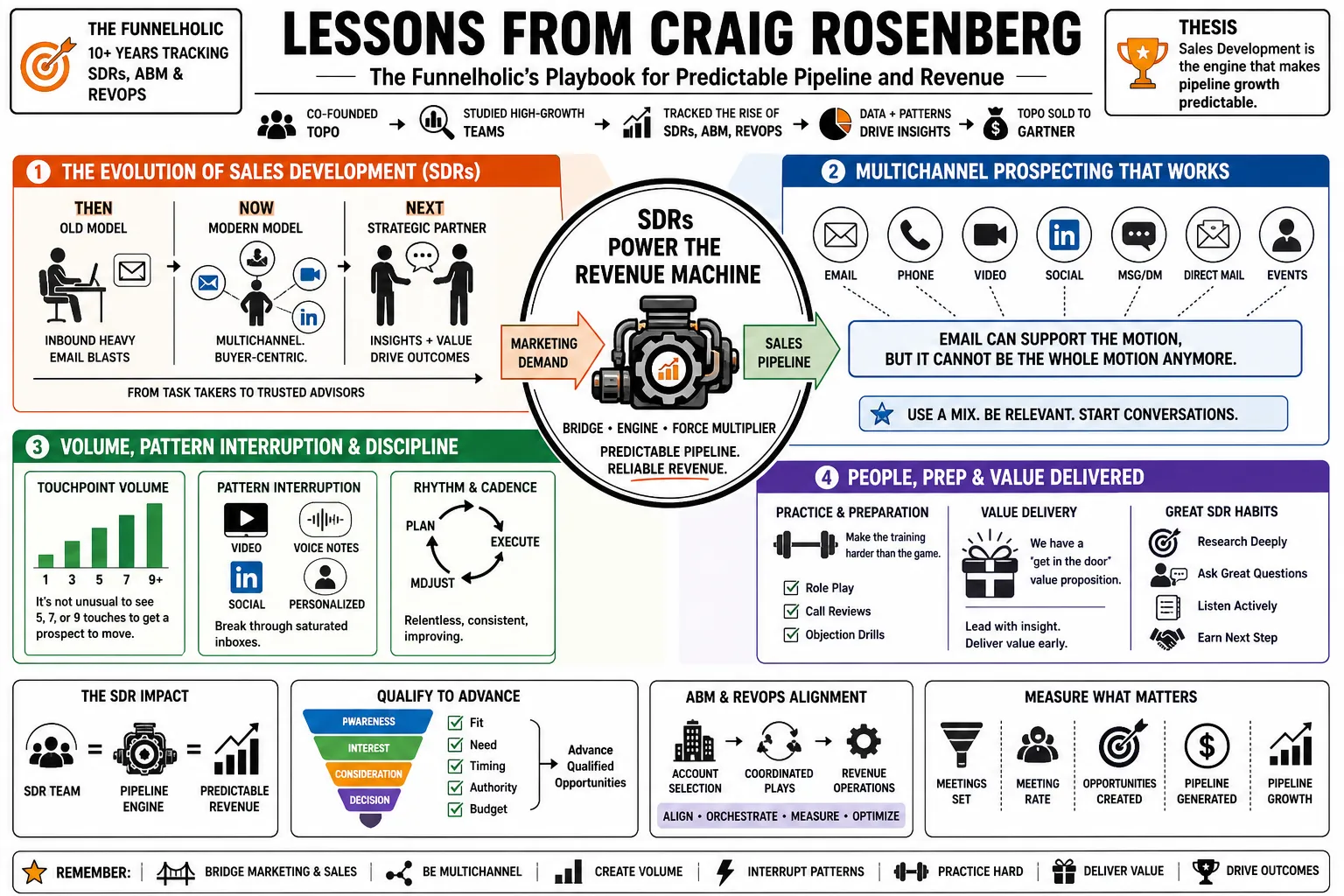
- On Multichannel Prospecting: Rosenberg recommends combining email, phone, social channels, direct mail and video in a coordinated prospecting campaign rather than relying on one channel. — Adam Mendler — Craig Rosenberg Interview.
- On Touchpoint Cadence: As one prospecting example, Rosenberg suggests an 8–12-touch campaign across two to three weeks, tailored to the buyer. — Adam Mendler — Craig Rosenberg Interview.
- On Varying the Approach: Rosenberg suggests mixing channels, including video and social outreach, while tailoring each message to the buyer's situation to stand out from inbox noise. — Adam Mendler — Craig Rosenberg Interview.
- On SDR Preparation: Rosenberg and Kristina McMillan argue that SDR teams need ongoing enablement and adaptable playbooks as the outreach environment changes. — Scale — Sales Development Framework.
- On Offering Value First: Rosenberg argues that reaching a buyer is easier when outreach offers value up front instead of immediately demanding a meeting. — Salesman Podcast — Craig Rosenberg.
- On Talking to Customers: Rosenberg says TOPO learned more by talking directly to customers; he urges teams to understand who buyers are, what they care about and why a solution matters. — Craig Rosenberg — Talk to Customers.
- On Sales-Accepted Targets: Before launching account-based work, Rosenberg says marketing should get sales to affirm the target-account list explicitly so both teams invest in accounts sales wants to pursue. — TwentyThree — Craig Rosenberg on ABM.
Part 2: Account-Based Everything (ABE)
- On the Definition of ABM: The TOPO account-based definition combines personalized marketing and sales to engage a selected set of accounts. — Engagio — Complete Guide to ABM.
- On Post-Meeting Strategy: Rosenberg argues that winning a first meeting is the beginning of an account-based program, not its endpoint. — Engagio — Complete Guide to ABM.
- On Treating Accounts as Markets: An account-based program starts with a jointly selected target-account list that marketing and sales agree to work. — TwentyThree — Craig Rosenberg on Account-Based Strategy.
- On Account-Based Coordination: For Rosenberg, account-based work involves coordinated sales and marketing engagement across an account's lifecycle, beyond a single campaign. — TwentyThree — Craig Rosenberg on Account-Based Strategy.
- On Missing Marketing Links: Rosenberg says outbound prospecting can work, but it is only one route into a target account; marketing should help build broader account engagement. — Engagio — Complete Guide to ABM.
- On Defining the TAM: In an account-based program, Rosenberg treats the selected target-account list as the addressable market the team is working. — TwentyThree — Craig Rosenberg on Account-Based Strategy.
- On Measuring ABM Success: Rosenberg treats revenue from target accounts as the ultimate ABM outcome, while also tracking target-account pipeline and opportunity rates along the way. — CMSWire — Craig Rosenberg on ABM and Social Media.
- On Personalization: Rosenberg urges sellers to make outreach specific to the account and lead with a relevant, high-value offer before asking for a meeting. — Salesman.com — Account-Based Selling with Craig Rosenberg.
Part 3: The Art of Discovery & Pitching
- On Core Sales Mechanics: Rosenberg organizes a typical sales process into six plays: prospecting, discovery, pitch or presentation, demo, trial and proposal. Each play should reflect the target market and stakeholder. — Adam Mendler — Craig Rosenberg Interview.
- On Early Discovery: Rosenberg says deals are often won or lost early; deep discovery should establish the buyer's situation before proposing a solution. — Adam Mendler — Craig Rosenberg Interview.
- On Insight-Led Selling: Rosenberg recommends opening with a useful market, industry or role insight so the first conversation provides value to the buyer. — Daily Sales Tips — Craig Rosenberg on Insight-Led Selling.
- On Better Discovery Openings: Instead of opening with a generic question about what keeps the buyer awake, Rosenberg suggests offering observed problems in the buyer's market and asking whether they fit. — Daily Sales Tips — Craig Rosenberg on Insight-Led Selling.
- On the Peer-Insight Opening: A practical opening is to share three patterns heard from similar buyers, then ask whether those patterns match this prospect's experience. — Daily Sales Tips — Craig Rosenberg on Insight-Led Selling.
- On Active Listening: Rosenberg recommends playing back what you heard in your own words so the buyer can correct misunderstandings and fill gaps. — Adam Mendler — Craig Rosenberg Interview.
- On Trust and Candor: For Rosenberg, trust depends on honesty about what the seller can and cannot do, even when that news is unfavorable. — Adam Mendler — Craig Rosenberg Interview.
- On Proposals: Rosenberg advises scheduling a meeting to walk through a proposal rather than emailing a price quote alone; the presentation should revisit the buyer's challenges, proposed solution and expected outcomes. — Daily Sales Tips — Craig Rosenberg on Proposals.
- On the Art of the Ask: Give the buyer value before requesting something, but make the request explicitly rather than hesitating. — Adam Mendler — Craig Rosenberg Interview.
Part 4: Navigating the Buyer's Journey
- On Consultative Restraint: Before proposing a solution, Rosenberg urges sellers to understand the buyer's situation and objectives, then tailor the response to what they learned. — Adam Mendler — Craig Rosenberg Interview.
- On a Changing GTM Environment: Rosenberg describes AI tools and shifting buyer expectations as reasons to revisit established sales practices and make account research a baseline capability. — The Transaction — GTM Midlife Crisis Transcript.
- On Breaking Buyer Patterns: Rosenberg recommends combining practical guidance with a surprising view of what is now possible, especially when buyers need to learn a new approach. — The Transaction — GTM Midlife Crisis Transcript.
- On Early Buyer Engagement: Rosenberg says sellers can lose momentum after a demo when they fail to understand the buyer's decision process or agree on a useful next step. — Craig Rosenberg — Avoid the Dark Stage.
- On BANT's Limits: Rosenberg cautions that buyer questions should go beyond a BANT checklist to uncover the buyer's process and what they need to move forward. — Craig Rosenberg — Avoid the Dark Stage.
- On Qualification Versus Discovery: Rosenberg distinguishes qualification—whether to work an opportunity—from discovery—how to help the buyer and potentially win it; blending the two into a checklist can frustrate buyers. — The Transaction — To Gate or Not to Gate Transcript.
- On Founder-Led Presence: Rosenberg and Mark Gustaferro recommend founders build a consistent LinkedIn presence to raise awareness and establish trust with prospective customers. — Scale — Founder-Led Sales and Marketing.
- On a Credible Seller Profile: Rosenberg uses his LinkedIn profile to help prospective buyers understand his expertise and build trust before or after a meeting. — LinkedIn — Buyer First Interview with Craig Rosenberg.
Part 5: Marketing & Sales Alignment
- On Shared Accountability: Rosenberg argues that repeatable revenue requires sales and marketing to agree on qualified-lead definitions, responsibilities and metrics rather than operating as separate funnels. — Craig Rosenberg — Sales and Marketing Alignment.
- On Productive Tension: Even when both teams want alignment, Rosenberg says expectations can diverge; an agreed lead definition and explicit feedback from sales give the relationship a workable structure. — Craig Rosenberg — Sales and Marketing Alignment.
- On Nurturing Target Accounts: Rosenberg recommends sharing relevant content through social channels to stay engaged with target accounts over a longer buying process. — CMSWire — Rosenberg on Social Media and ABM.
- On Intent Signals: Rosenberg describes intent and engagement data as clues about accounts researching a solution, enabling timely and relevant outreach; he does not require a strict IQL category. — LinkedIn — Buyer First Interview with Craig Rosenberg.
- On Social Relationships: In account-based selling, Rosenberg treats social channels as a way to build and nurture relationships over time, not just collect immediate downloads. — CMSWire — Rosenberg on Social Media and ABM.
- On Social Media's Volume Limits: Rosenberg cautions that social media may not deliver the immediate volume expected from a conventional demand-generation campaign, even when it helps target-account relationships. — CMSWire — Rosenberg on Social Media and ABM.
- On Waiting for Inbound: Rosenberg cautions that relying on inbound content alone can leave sellers too late in the buyer's process; teams should engage suitable accounts earlier with a useful message. — Craig Rosenberg — Four Impediments to Alignment.
- On Buyer-Centric Messaging: Rosenberg recommends testing marketing language against real sales conversations so the eventual message reflects how buyers describe their needs. — Craig Rosenberg — Sales and Marketing Alignment.
- On Handoff Definitions: Sales and marketing should agree on what qualifies a lead and on the handoff from marketing to sales development and then to a salesperson. — Craig Rosenberg — Sales and Marketing Alignment.
Part 6: Go-To-Market & Revenue Operations
- On GTM Experimentation: Rosenberg describes the current GTM environment as a chance for teams to experiment creatively with new tools and tactics instead of merely increasing old-playbook volume. — The Transaction — GTM Midlife Crisis Transcript.
- On Adapting the Playbook: When familiar GTM methods stop working, Rosenberg recommends learning from teams already experimenting and updating the playbook as results emerge. — The Transaction — GTM Midlife Crisis Transcript.
- On Data-Driven GTM: Rosenberg and Gustaferro recommend comparing win rates, pipeline-source mix and sales-ramp times with relevant peers as GTM models change. — Scale — GTM Benchmark Tool.
- On Account Intelligence: Rosenberg urges teams to research target accounts and people before outreach, then turn that intelligence into relevant communication rather than generic volume. — The Transaction — GTM Midlife Crisis Transcript.
- On Updating Messaging: When buyer conditions shift, Rosenberg recommends revisiting messaging and standing out with relevant content instead of recycling a familiar campaign. — The Transaction — GTM Midlife Crisis Transcript.
- On Target-Market Focus: Rosenberg’s marketing framework starts with the target market: it should inform GTM strategy, messaging and the pipeline motion. — Scale — The Scale Marketing Framework.
Part 7: AI, Technology & The Modern Tech Stack
- On Human Judgment With AI: Rosenberg says AI-assisted account research still depends on trained sellers who can turn the information into relevant, meaningful action. — The Transaction — GTM Midlife Crisis Transcript.
- On Sales Engagement Expansion: In a 2020 statement, Rosenberg expected sales-engagement platforms to expand beyond tech prospecting into wider account-executive and enterprise use. — Groove — Sales Engagement Announcement.
- On AI Account Research: Rosenberg treats AI-assisted account research before and during sales conversations as a baseline capability for modern GTM teams. — The Transaction — GTM Midlife Crisis Transcript.
- On Personalization at Scale: Rosenberg says AI can make one-to-one account research and campaign customization more feasible, but the resulting communication still needs relevance. — The Transaction — GTM Midlife Crisis Transcript.
Part 8: Leadership, Mindset & The Funnelholic Philosophy
- On Buyer Value: Rosenberg advises sellers to understand the buyer’s desired outcome and demonstrate its value before making an ask. — Adam Mendler — Craig Rosenberg Interview.
- On Conviction and Trust: Rosenberg argues that trust and ethics matter in B2B selling, especially when products and messages look similar. — Adam Mendler — Craig Rosenberg Interview.
- On Learning From Mistakes: Rosenberg says he gets sales judgments wrong more often than right; the point is to keep examining assumptions rather than hide errors. — Adam Mendler — Craig Rosenberg Interview.
- On Skepticism: After a major customer collapsed, Rosenberg concluded that sellers should question assumptions about a deal and test whether the buyer has a real reason to buy. — Adam Mendler — Craig Rosenberg Interview.
- On Persistence: Rosenberg’s Cub Scout popcorn example illustrates that repeated, direct asks can matter: his children kept pitching and roughly one in three people bought. — Adam Mendler — Craig Rosenberg Interview.
- On Targeting the Right Crowd: In the same popcorn example, Rosenberg identifies choosing a high-end grocery-store audience as part of why the pitch worked. — Adam Mendler — Craig Rosenberg Interview.
- On the Human Element: Rosenberg notes that liking the seller can influence a buying decision, as in his children’s popcorn pitch, where their charm helped. — Adam Mendler — Craig Rosenberg Interview.
- On Listening and Action: Rosenberg identifies two linked pitfalls: failing to listen to the buyer and failing to turn what was learned into relevant follow-up messaging. — Adam Mendler — Craig Rosenberg Interview.