Lessons from Crystal Widjaja
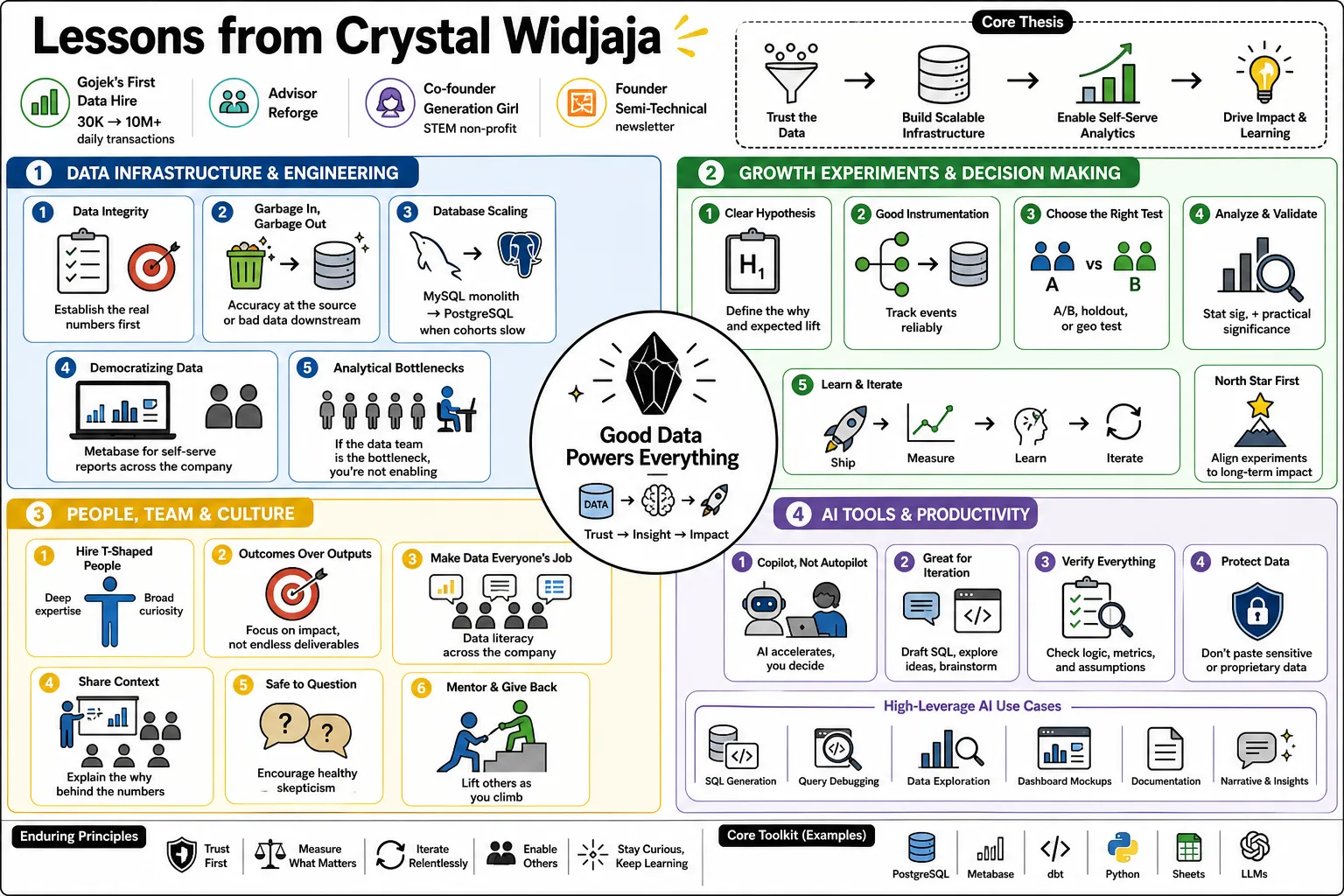
Crystal Widjaja was Gojek's first technical data hire. She says the teams she built helped the company grow from 30,000 to more than 10 million transactions a day. Her roles there spanned business intelligence, growth, and Chief of Staff; she later advised startups and co-founded Generation Girl to expand young women's access to STEM. — Crystal Widjaja — About.
Part 1: Data Infrastructure & Engineering
- On Data Integrity: Establish what the numbers actually measure before relying on sophisticated analysis. — Why Most Analytics Efforts Fail.
- On Garbage In, Garbage Out: Show engineers how inaccurate source data obscures the impact of their work, so data quality becomes a shared concern. — Tech Lead Journal #13.
- On Database Scaling: Gojek moved from manual reports and MySQL/MongoDB inputs to Postgres, then to a BigQuery data lake as scale demanded; infrastructure evolved with the queries the business needed. — Tech Lead Journal #13.
- On Democratizing Data: Design self-service analytics around the questions that product, marketing, and operations teams need answered, even when those teams do not write SQL. — Why Most Analytics Efforts Fail.
- On Analytical Bottlenecks: Automate repeated manual reporting so the data team and business users can spend more time on decisions rather than waiting for routine exports. — Tech Lead Journal #13.
- On Building Trust: Use clear event definitions and reliable pipelines so colleagues can understand and trust the data they use. — Why Most Analytics Efforts Fail.
- On Tool Empowerment: Giving customer-care colleagues self-service access let some teach themselves SQL and answer operational questions directly. — MALAKA — Crystal Widjaja on Data.
- On Problem-First Architecture: Start with the decisions and user questions the data system must support, then automate and upgrade infrastructure as needs become clear. — Why Most Analytics Efforts Fail.
- On Defining Metrics: Agree on what each tracked event means before teams use the same metric to make different decisions. — Why Most Analytics Efforts Fail.
Part 2: Product Management & Alignment
- On Altitude Maps: Map product decisions and input levers to a manager's and company's higher-level outcome metrics, then revisit the map as you learn. — Stop Data Theater: Use Altitude Maps.
- On Unmeasurable Metrics: When an outcome is difficult to measure directly, use a practical proxy and state its limits instead of pretending the data is perfect. — Reforge — Unsolicited Feedback E9.
- On Managerial Alignment: Connect your product measures and day-to-day levers to the broader outcomes your manager owns. — Stop Data Theater: Use Altitude Maps.
- On Strategic Decisions: Spend analytical effort on choosing the right problem, then run quick experiments that can reveal whether the hypothesis is wrong. — Crystal Widjaja on LinkedIn.
- On Feature Bloat: Gojek shut down cleaning, massage and beauty services when they confused customers and did not fit the strengths of its driver platform. — Martech Family Interview.
- On Product Speculation: Test the intended experience cheaply, as Gojek did with driver-assisted subscription pitches and simple screen overlays, before building a full feature. — Lenny's Podcast.
- On User Feedback: Use observed user behavior to test a product hypothesis, rather than assuming an untested feature request will solve the problem. — Lenny's Podcast.
Part 3: Growth & Experimentation
- On Scrappy Growth: Use cheap, concrete tests to learn what users will do before investing in heavy growth infrastructure. — Lenny's Podcast.
- On Frequent Experiments: Run focused experiments often enough to replace assumptions with observations; the useful cadence depends on the problem, not an arbitrary daily quota. — Lenny's Podcast.
- On Interpreting Patterns: A behavior correlated with retention is a clue to investigate, not proof that changing that behavior alone will cause retention. — Tech Lead Journal #13.
- On Marketplace Supply: Account for the driver side of a marketplace and the channels through which supply reaches customers before treating acquisition spend as the whole growth plan. — Lenny's Podcast.
- On Growth Teams: Give an early growth hire a known bottleneck to solve and test for statistical and experimental judgment, not just familiarity with growth tools. — Lenny's Podcast.
- On Incentive Design: Gojek used incentives to help drivers introduce GoPay to first-time users, showing how marketplace participants can support adoption. — Lenny's Podcast.
- On Retention Over Acquisition: Match promotions to the product's natural use frequency; too many messages can drive unsubscribes and costly reacquisition. — Tech Lead Journal #13.
- On High-Leverage Actions: Look for the largest current constraint in the user journey and test an inexpensive intervention there before building a comprehensive solution. — Martech Family Interview.
- On Failing Experiments: When a test fails to generalize, examine its design and rollout context before treating the result as a permanent verdict on the idea. — MALAKA — Crystal Widjaja on Data.
Part 4: AI & Context Engineering
- On Agent Workflows: A product manager can make AI more useful by defining a repeatable workflow with clear inputs and completion checks, rather than collecting isolated prompts. — Semi-Technical — Chief of Stuff.
- On Context Engineering: Maintain relevant task context and explicit acceptance criteria so an AI workflow has enough information to complete the right job. — Semi-Technical — Chief of Stuff.
- On AI as Chief of Staff: Delegate routine follow-ups, drafts and note triage to AI while keeping novel relationship work and judgment with a person. — Semi-Technical — Chief of Stuff.
- On Command-Line Literacy: Product managers who learn basic command-line workflows can use current AI tools more directly and inspect what those tools do. — Atlassian — PMs and the CLI.
- On Productivity Traps: Use AI to finish low-leverage work rather than creating more drafts and material for yourself to review. — Atlassian — PMs and the CLI.
- On Human Evaluation: Human judgment remains necessary for novel, high-context choices even when AI can draft or organize routine work. — Semi-Technical — Chief of Stuff.
- On the AI Era: Define the outcome and review AI-produced work instead of assuming generated code or text is correct by default. — Semi-Technical — Chief of Stuff.
- On Automating Data Pulls: Validate AI-written SQL against the actual schema before trusting a natural-language data pull. — Semi-Technical — Why LLMs Are Bad at SQL.
- On Technical Intuition: Understanding basics such as client-side and server-side behavior helps a product manager spot when an AI prototype cannot work in production. — MALAKA — Crystal Widjaja on Data.
- On Iterative Prompting: Iterate on workflow, context and testable completion conditions; better prompts alone are not enough. — Semi-Technical — Chief of Stuff.
Part 5: Women in STEM & Education
- On Early Exposure: Give girls an early chance to try coding and technology, before stereotypes narrow the range of careers they consider. — KRASIA — Crystal Widjaja Interview.
- On Mentorship: Pair girls with university-age mentors and women in technical roles so they can see accessible paths into STEM. — Tech Lead Journal #13.
- On Building Confidence: Generation Girl gives participants a safe place to try technical work, make mistakes and discover whether they enjoy it. — Tech Lead Journal #13.
- On Bridging the Gap: Address unequal access to technical opportunities before girls reach the point of choosing a job or degree. — KRASIA — Crystal Widjaja Interview.
- On Normalizing STEM: Make it ordinary for girls and women to see themselves trying and working in technical fields. — Tech Lead Journal #13.
- On Safe Environments: Use free holiday bootcamps as welcoming places where girls can experiment with STEM alongside peers and mentors. — KRASIA — Crystal Widjaja Interview.
- On Future Leaders: Early technical education and mentorship can widen the path for more women to pursue technical careers and leadership. — KRASIA — Crystal Widjaja Interview.
- On Giving Back: Invite working technologists and partner companies to mentor girls and expand access to STEM programs. — KRASIA — Crystal Widjaja Interview.
Part 6: Career Trajectory & Angel Investing
- On Starting at the Bottom: She began at Gojek by asking what the reports actually measured and how reliable the figures were before helping build a broader data organization. — BRAVE E92 — Crystal Widjaja.
- On Parallel Lives: A career can connect roles in product, investing, advising and nonprofit work rather than forcing them into separate identities. — CreativeMornings — Crystal Widjaja on Parallel.
- On Angel Investing: Her investment in Eppo drew on firsthand experience with difficult marketplace experiments and a belief that better tooling could make rigorous testing easier for teams. — Martech Family Interview.
- On Career Progression: Her move from analytics and growth into Chief of Staff work changed the problem from individual analysis to company-wide management systems. — BRAVE E92 — Crystal Widjaja.
- On Choosing Companies: She examined Gojek's underlying user problem and market before joining; a career move should be judged by the problem the team is solving. — MALAKA — Crystal Widjaja on Data.
- On Chief of Staff Roles: A Chief of Staff can identify neglected operating problems and build practical management support across an expanding company. — BRAVE E92 — Crystal Widjaja.
- On Leaving Comfort Zones: She left a comfortable Gojek role to test whether her skills would transfer and to keep learning in a different setting. — Tech Lead Journal #13.
Part 7: Leadership & Organizational Debt
- On Scaling Teams: As Gojek grew, management training and shared operating practices became necessary alongside growth in the data and product teams. — BRAVE E92 — Crystal Widjaja.
- On Organizational Debt: Fast growth leaves gaps in management and coordination; repair the debt that causes burnout while allowing some flexibility that helps a changing company adapt. — BRAVE E92 — Crystal Widjaja.
- On Hiring Scrappily: Test an early growth hire's grasp of statistics, random sampling and first-principles experiment design, not just prior titles or tools. — Lenny's Podcast.
- On Information Silos: Shared event definitions and discoverable data documentation make it easier for teams to understand and use the same information. — Why Most Analytics Efforts Fail.
- On Managing Up: At Kumu, she asked what visibility her manager lacked and tried to turn new information into useful context and insights. — Your Activation Experience — Crystal Widjaja.
Part 8: Philosophy & Personal Development
- On Rationality: Focus discussion on risks that warrant action or awareness, rather than spending scarce attention debating probabilities that will not change a decision. — Reforge — Unsolicited Feedback E9.
- On Productivity Systems: Adapt a productivity workflow through repeated use and refactoring until it reliably handles the routine work you actually have. — Semi-Technical — Chief of Stuff.
- On Embracing Failure: She values the mistakes she made at Gojek because they taught her what to change; a failed attempt can be useful evidence. — BRAVE E92 — Crystal Widjaja.
- On Burnout Risk: After experiencing long hours and burnout risk, she weighed the personal cost of rebuilding another organization before taking on the work. — BRAVE E92 — Crystal Widjaja.
- On Evaluating Advice: For messy organizational problems, she sought experienced perspectives because generic online answers missed the context and tradeoffs. — BRAVE E92 — Crystal Widjaja.
- On Deep Work: She schedules three-hour writing blocks three days a week, making time to draft or edit even when inspiration is absent. — Martech Family Interview.
- On Intentional Practice: She relies on intentional writing time rather than waiting for inspiration to arrive; consistent engagement helps work move forward. — Martech Family Interview.
- On Legacy: At Gojek, some of her most durable work was manager training, culture documentation and OKR scaffolding built for a larger organization. — BRAVE E92 — Crystal Widjaja.