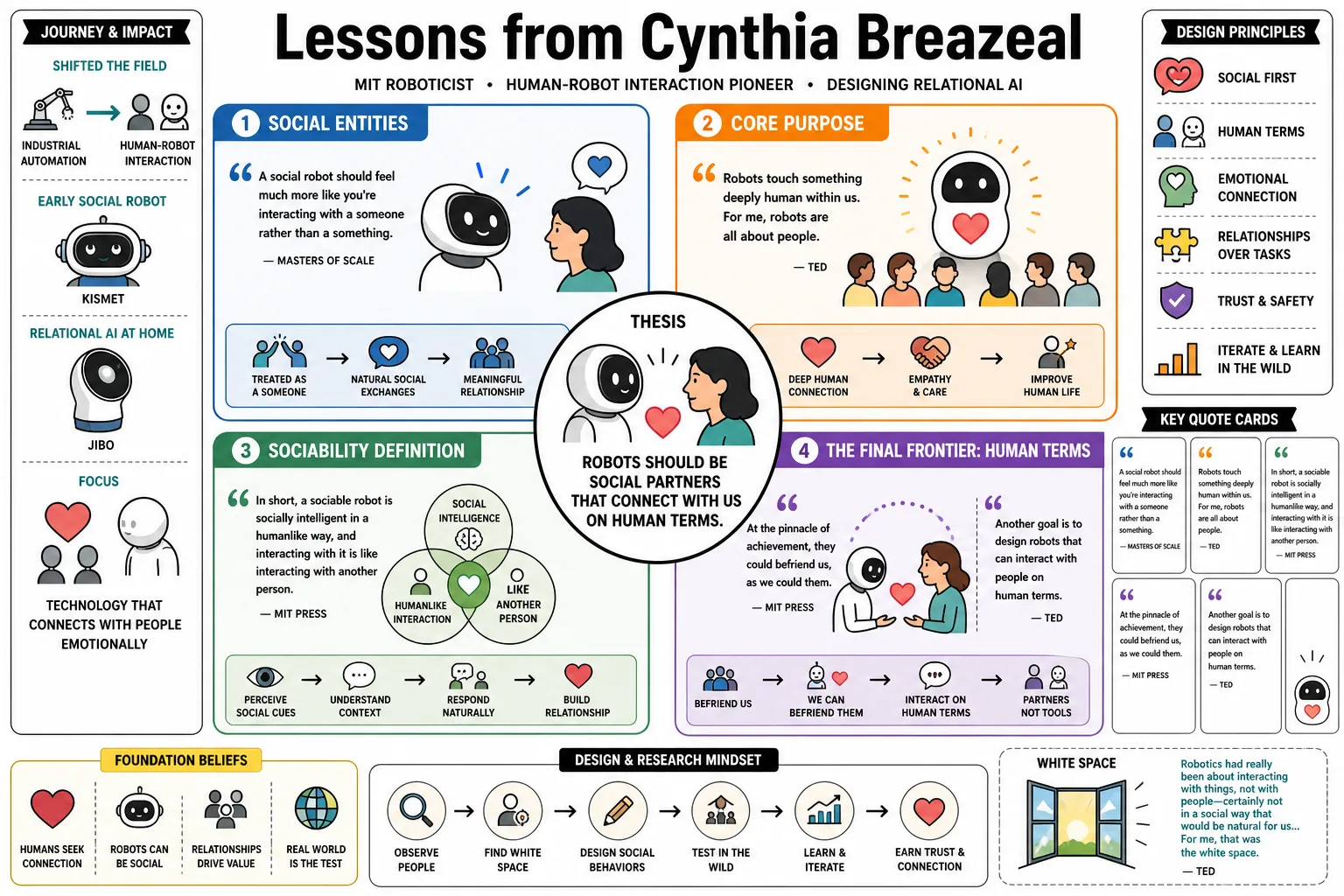
Cynthia Breazeal is an MIT Media Lab roboticist who shifted her field's focus from industrial automation to human-robot interaction. She built the early social robot Kismet and founded Jibo to test how relational AI works in the home. This collection covers her approach to designing technology that connects with people emotionally.
Part 1: The Nature of Social Robotics
- On Social Entities: "A social robot should feel much more like you're interacting with a someone rather than a something." — Masters of Scale
- On the White Space: "Robotics had really been about interacting with things, not with people—certainly not in a social way that would be natural for us... For me, that was the white space." — TED
- On Core Purpose: "Robots touch something deeply human within us. For me, robots are all about people." — TED
- On Sociability Definition: "In short, a sociable robot is socially intelligent in a humanlike way, and interacting with it is like interacting with another person." — MIT Press
- On The Final Frontier: "At the pinnacle of achievement, they could befriend us, as we could them." — MIT Press
- On Human Terms: "Another goal is to design robots that can interact with people on human terms." — MIT Press
- On Emulating Development: "The robot starts off in a rather helpless and primitive condition, and requires the help of a sophisticated and benevolent caretaker to learn and develop." — Capitol Technology University
- On Social Partners: "A sociable robot is neither a tool nor a gadget, but a partner who should be integrated into the social environment and interaction usual for humans." — CORE
- On Star Wars Inspiration: "Ever since I was a little girl, seeing Star Wars for the first time, I've been fascinated by this idea of personal robots." — TED
Part 2: Designing for Emotion and Anthropomorphism
- On Emotional Mapping: "When the word 'emotion' appears with quotes, we are using it as an analogy to emotions in animals or humans." — MIT Media Lab
- On The Illusion of Life: "The life-like human style sociability is achieved via the human tendency to anthropomorphize those movements." — ZF Medienwissenschaft
- On Attributing Intent: "Humans interpret the moving behavior in terms of being governed by internal intentional states, such as beliefs, desires, intents, goals, feelings." — ZF Medienwissenschaft
- On Form Factor: "It’s not trying to be human in any way: it doesn’t have arms, it doesn’t have legs. It’s anthropomorphic, it’s designed to be familiar to you, but it doesn’t have to look like an animal." — SlashGear
- On Familiarity Without Imitation: "It doesn’t have to look like a real person for people to see it as an 'other' rather than a 'thing'." — SlashGear
- On Turning Them Off: "It is jarring for people to play with Kismet and then see it turned off, suddenly becoming an inanimate object." — MIT Press
- On Natural Social Machinery: "If done well, humans will be able to engage the robot by utilizing their natural social machinery instead of having to overly and artificially adapt their way of interaction." — MIT Press
- On The Human Dance: "Social robots join the human dance of communication." — Masters of Scale
- On Non-Verbal Communication: "For robots to be effective in human environments, they must understand non-verbal cues, intentions, and emotions instead of strictly relying on physical tasks." — YouTube
Part 3: Relational AI vs. Transactional Tools
- On the Relational Concept: "I call it 'relational AI' — AI that can understand us as people and treat us as people." — Psychology of Technology Conference
- On the Role of Technology: "Relational AI is more than a tool we use; it acts as an empathetic, collaborative ally." — Psychology of Technology Conference
- On the Limits of Current Tech: "My fundamental gripe with technology is that it fails to support a more holistic human experience. It falls short in giving people a personally meaningful, emotionally engaging experience." — Masters of Scale
- On Assistants vs Companions: "I often use the language of there’s the Digital Assistant... they’re modeled after the executive assistant. We talk about Jibo as being a helpful companion." — MIT Open Learning
- On Relational Metrics: "Companion speaks more to the social, emotional, the relational aspects of it." — MIT Open Learning
- On Utility vs Connection: "Whether they're helping us to become creative and innovative, or whether they're helping us to feel more deeply connected despite distance... for me, robots are all about people." — TED
- On The Human-Robot Bond: "I do think, in time, people will have relationships with certain kinds of robots... where they might feel that it is a sort of friendship, but it's going to be of a robot-human kind." — QuoteFancy
- On Focus of Relationship: "A Roomba has a relationship with dirt. A social robot has a relationship with the family." — SXSW
- On Understanding People: "The quest of building socially intelligent robots forces us to examine these questions even today... Robots will become more socially intelligent and by doing so will become more like us." — MIT Press
Part 4: The Physics and Movement of Machines
- On Hardware Indifference: "Robotics is hard. As I say, Mother Nature doesn't care about your algorithm or how hard you've worked." — Masters of Scale
- On The Value of Arcs: "Organic things move in arcs, they move in ways that trigger our brain to think 'organic,' whereas machines tend to move in rectilinear ways, very abrupt." — SlashGear
- On Secret Sauce: "Movement is the secret sauce. It’s the difference between uber-efficiency versus fluidity and expressivity... the big thing is arcs." — SlashGear
- On Origin Labs: "If we're ever going to see robots like Star Wars, it's going to happen in a lab just like this. This is where it's going to start." — Masters of Scale
- On Multilayered Connections: "Kismet connects to people on a physical level, on a social level, and on an emotional level." — MIT Media Lab
- On Inventing Mechanisms: "When we started building these machines, we had to invent the underlying mechanisms that would allow them to physically express themselves." — TED
- On Embodiment: "Embodiment matters. Bringing technology off the screen and into our physical world changes how we process and trust the information it gives us." — Simplecast
- On Shared Physical Space: "A physical robot shares your space, and because it is physically present, your brain treats it fundamentally differently than an avatar on a flat screen." — MIT Media Lab
- On Expressive Cues: "We give them the physical ability to express curiosity, joy, or confusion so that the humans around them know exactly how to engage with them." — TED
Part 5: Human Psychology in Robotic Interaction
- On Social Scaffolding: "We designed the interaction so that humans naturally 'scaffold' the robot's learning process, much like a parent interacts with an infant." — MIT Press
- On Tapping into Instincts: "This little robot [Kismet] was somehow able to tap into something deeply social within us, and with that, the promise of an entirely new way we could interact with robots." — TED
- On Boundaries: "Jibo revealed a lot about attachment, trust, and healthy boundaries. It showed how powerful embodied AI can be." — Simplecast
- On Asking for Help: "A robot must be designed to know its limits and gracefully ask its human counterpart for help when it is stuck." — TechRepublic
- On Trusting Machines: "Trust in a machine goes beyond simple correctness; it depends on the machine signaling that it understands your state and your goals." — Masters of Scale
- On Persuasion and Motivation: "If robots can be engaging, if we like to cooperate with robots, if robots are persuasive, maybe a robot can help you maintain a diet and exercise program." — Singularity Hub
- On The Digital Conscience: "Sort of like a digital Jiminy Cricket... the kind of friendly, supportive presence that's always there to be able to help you make the right decision." — TED
- On Emotional Reflection: "We use social robots as a mirror. They reflect back to us our own social wiring and how heavily we rely on non-verbal behavior." — MIT Press
- On Heartbreak and Attachment: "We were all heartbroken about the company... but it was heartbreaking for people because of Jibo. Everybody felt that." — Masters of Scale
Part 6: Education and Cognitive Debt
- On AI Literacy: "AI literacy is no longer optional; it is a fundamental requirement for digital citizenship." — Wired
- On Beyond Coding: "Learning about AI goes beyond writing code; it requires understanding how the systems work, their ethical implications, and using them for computational action." — Wired
- On AI Natives: "Today’s children are 'AI natives' who grow up interacting with intelligent machines. They need to understand the 'why' and 'how' behind these tools to avoid being manipulated by them." — Wired
- On Cognitive Outsourcing: "If children rely too heavily on AI for problem-solving, they risk incurring 'cognitive debt'—losing durable human skills like critical thinking, creativity, and independent learning." — India Today
- On Human Wisdom: "Humans must remain the wisdom-bringers. AI can be intelligent in its own way, but it lacks human wisdom, ethics, and empathy." — India Today
- On Problem Solving: "Our goal is to teach kids how to creatively make and problem-solve with AI, avoiding passive consumption." — Wired
- On Durable Skills: "In an era of AI, skills like empathy, collaboration, and conflict resolution become more valuable, not less." — YouTube
- On the Role of Teachers: "We must encourage teachers to move from being gatekeepers to guides, helping students use AI judiciously rather than banning it." — World Governments Summit
- On Tangible Play: "I want them to play—like real-world play... how can we take what's so engaging about digital media and literally bring it off the screen into the real world of the child?" — TED
- On Creating Media: "I really want to come up with new ways of children's media that foster creativity and learning and innovation. I think that's very, very important." — TED
Part 7: Designing the Family Robot
- On Group Dynamics: "Jibo is a community experience. Jibo can look at me and talk to me, and look at my kids and talk to my kids. We can use Jibo together." — Popular Science
- On Shared Attention: "We don’t have to feel like there’s something competing for our focused attention the way a phone screen does." — Popular Science
- On The Chief Family Officer: "The people who we’ve been engaging in our early research are busy with family: we call them the Chief Family Officer. They’re the people who make sure things get done." — SlashGear
- On First Impressions: "When the Chief Family Officers see Jibo, their eyes light up because they see a supportive presence in the home." — SlashGear
- On Companionship Value: "The value of a family robot is not in how fast it can retrieve data, but in how it makes you feel when you enter the room." — Popular Science
- On Sustained Interaction: "For a robot to survive in a home, it has to offer sustained engagement over months and years, which requires a dynamic personality." — SlashGear
- On Research Platforms: "My research group has continued to use Jibo as a really one-of-a-kind research platform. Jibo lives in that context." — Masters of Scale
- On Bringing Tech Home: "The home is the ultimate unstructured environment. Designing a robot that can navigate both the physical clutter and the social complexity of a household is the ultimate challenge." — TED
- On Replacing Screens: "The goal of the family robot is to get us looking up and interacting with each other again, rather than looking down at our individual devices." — Popular Science
- On The Sidekick Model: "I loved the idea of a robot that interacted with us much more like a helpful, trusted sidekick—something that would delight us and enrich our lives." — TED
Part 8: Technology for Human Flourishing
- On Human-Centered Design: "We need a human-led future where technology is designed to dovetail with human needs rather than replace human relationships." — World Governments Summit
- On Flourishing: "Technology should be designed to help humans become who they aspire to be, focusing on health, education, and emotional wellness." — Masters of Scale
- On Persuasive Technology: "We must advocate for AI literacy so that people can be informed users of persuasive technologies that they may form emotional bonds with." — APA
- On Elder Care: "Personified AI helps support emotional wellness and mitigates the social isolation experienced by older adults." — APA
- On Emotional Wellness: "We often measure AI by efficiency, but we should be measuring its success by how much it improves our emotional wellness and social connections." — APA
- On Bridging the Gap: "The future of technology is about bridging the gap between human well-being and AI." — MIT Open Learning
- On Diversity in Robotics: "We need diverse voices building these machines. The presence of women in robotics is necessary when designing systems that will interact with all of humanity." — TechRepublic
- On Democratizing AI: "Initiatives like Day of AI are about ensuring that every student, regardless of background, has access to the tools to shape their digital future." — Wired
- On AI as a Mirror: "In designing AI that communicates with us, we are ultimately forced to hold a mirror up to our own human nature." — Psychology of Technology Conference
- On The Final Goal: "Ultimately, we are not building robots to replace people; we are building robots to help us be more fully human." — Masters of Scale