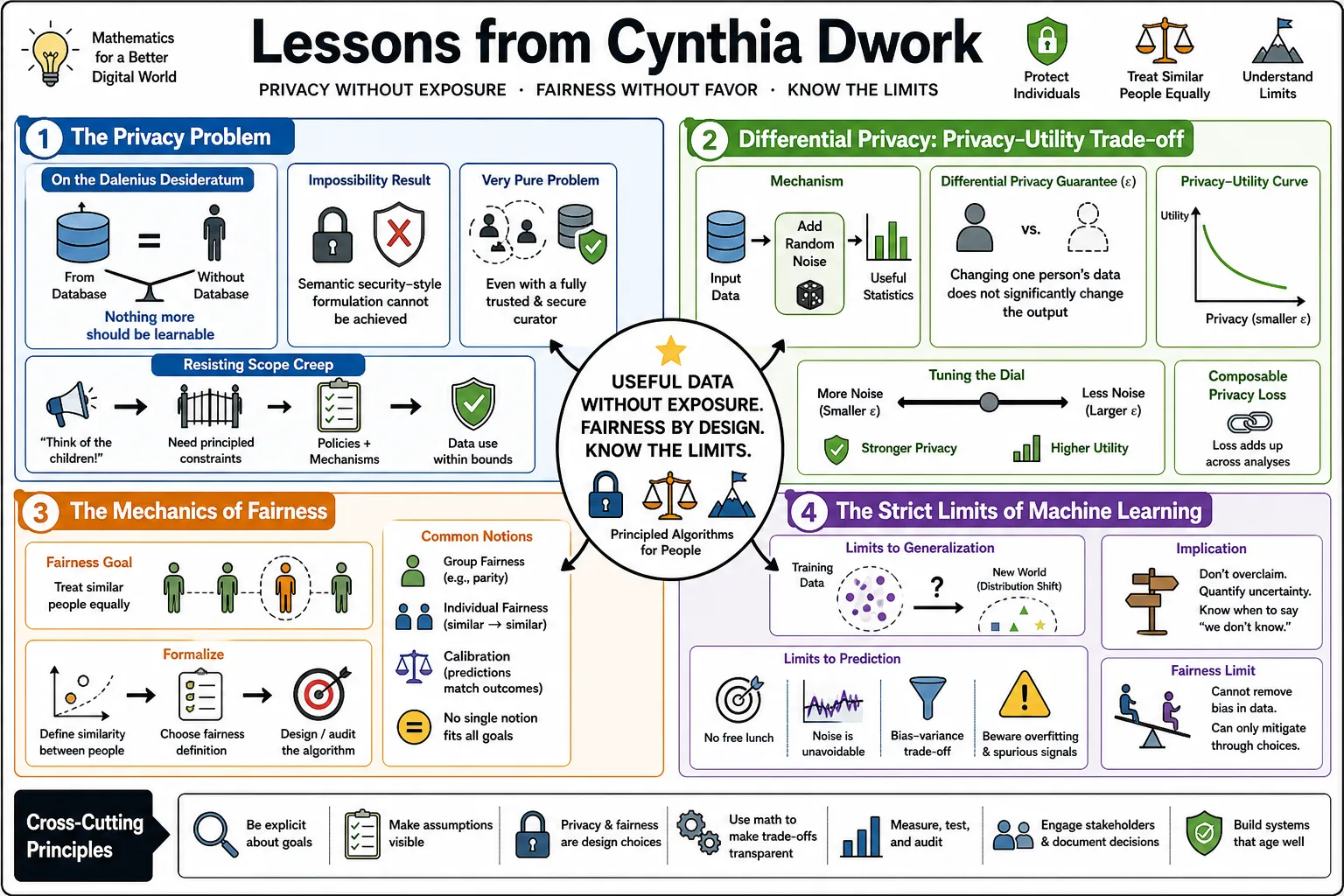
Lessons from Cynthia Dwork
Cynthia Dwork helped establish differential privacy as a rigorous approach to privacy-preserving data analysis and co-launched the theoretical study of algorithmic fairness. Her work also connects privacy to adaptive data analysis and real-world systems such as the US Census. — Harvard — Cynthia Dwork Biography.
Part 1: The Privacy Problem
- The Dalenius Desideratum: Dalenius's aspiration was that a statistical database reveal nothing about an individual beyond what could be learned without it. Dwork showed that a formal version of this goal is impossible for useful databases when auxiliary information is available. — Dwork — Differential Privacy.
- The Pure Privacy Problem: In a talk described by Ethan Zuckerman, Dwork framed the challenge as learning useful population statistics while protecting individuals even when the data curator is trusted. — Berkman Talk — Cynthia Dwork.
- Resisting Scope Creep: Dwork's Berkman talk warned that a curator can face pressure to reuse collected data for new purposes; a formal privacy guarantee helps set limits on what analyses can reveal. — Berkman Talk — Cynthia Dwork.
- Beyond Vague Privacy Policies: Dwork criticized vague institutional promises of confidentiality that leave broad exceptions; a precise guarantee gives data subjects a clearer account of what release can change. — Berkman Talk — Cynthia Dwork.
- Anonymization Is Not Enough: Removing names alone does not guarantee privacy: released data can be linked with auxiliary information to identify or learn about people. — The Algorithmic Foundations of Differential Privacy.
- Auxiliary Information Changes the Risk: External information can turn an otherwise useful statistic into a disclosure about an individual, even one absent from the underlying database. — Dwork — Differential Privacy.
- The Limit of Absolute Privacy: Dwork's impossibility result rules out an absolute guarantee that useful statistical releases teach nothing new about any person; differential privacy instead bounds the extra risk caused by participation. — Dwork — Differential Privacy.
- Protecting Nonparticipants: A population statistic can affect someone who never contributed data. Differential privacy limits the effect of joining a database; it does not prevent all inferences about nonparticipants. — Dwork — Differential Privacy.
- Why a Mathematical Definition Matters: A formal privacy definition lets researchers state guarantees against broad auxiliary information and future analyses, unlike ad hoc removal of identifiers. — The Algorithmic Foundations of Differential Privacy.
- The Curator's Role: In the central model, a trusted data curator mediates access through privacy-preserving analyses and tracks cumulative privacy loss; other models make different trust assumptions. — The Algorithmic Foundations of Differential Privacy.
Part 2: Differential Privacy Foundations
- A Definition, Not One Algorithm: Differential privacy is a mathematical property of a randomized analysis, not one specific noise-adding algorithm. — The Algorithmic Foundations of Differential Privacy.
- The Participation Guarantee: A differentially private analysis makes its output distributions similar whether any one person's data is included or excluded. This bounds the effect of participation, not all possible harms from learning population facts. — The Algorithmic Foundations of Differential Privacy.
- A Property of the Mechanism: The guarantee belongs to a randomized mechanism across neighboring datasets, rather than to a particular dataset in isolation. — The Algorithmic Foundations of Differential Privacy.
- The Epsilon Parameter: The privacy parameter ε bounds how much the probability of an output may change when one person's data changes. A smaller ε is a stronger bound, often requiring more noise or less accuracy. — The Algorithmic Foundations of Differential Privacy.
- Plausible Participation Deniability: Because neighboring datasets can produce overlapping output distributions, an observer cannot infer participation with certainty solely from a differentially private release. — The Algorithmic Foundations of Differential Privacy.
- Worst-Case Guarantee: The guarantee quantifies over every neighboring pair of datasets and every possible output event, so it does not depend on assuming a weak adversary. — The Algorithmic Foundations of Differential Privacy.
- Composition: Privacy losses accumulate when multiple analyses access the same data; composition theorems provide bounds for the combined release. — The Algorithmic Foundations of Differential Privacy.
- Post-Processing: Processing an already differentially private output without accessing the underlying data again cannot worsen its formal privacy guarantee, though it can affect the result's usefulness. — The Algorithmic Foundations of Differential Privacy.
- What the Proof Does—and Does Not—Replace: A proof of differential privacy gives a checkable statement about a release's participation risk, but deploying it still requires trust in implementation, parameter choice and data governance. — The Algorithmic Foundations of Differential Privacy.
- A Toolkit of Mechanisms: Different mechanisms can satisfy the same privacy definition; the book develops tools suited to numeric queries, selection and other analyses. — The Algorithmic Foundations of Differential Privacy.
Part 3: The Mechanics of Noise
- Calibrated Randomness: Useful nontrivial differential privacy mechanisms rely on randomization; for numeric queries, calibrated noise is a common way to limit one person's effect on the output. — The Algorithmic Foundations of Differential Privacy.
- Query Sensitivity: Global sensitivity measures the greatest change in a query's answer when one person's data changes; it helps determine the noise needed by common mechanisms. — The Algorithmic Foundations of Differential Privacy.
- The Laplace Mechanism: The Laplace mechanism adds noise scaled to a function's global sensitivity and the chosen ε privacy parameter. — The Algorithmic Foundations of Differential Privacy.
- Central and Local Privacy: A central model relies on a trusted curator to randomize released results; in a local model, each participant randomizes their data before the curator receives it. — The Algorithmic Foundations of Differential Privacy.
- Cover from Randomization: Randomization makes many outputs possible with or without any one participant, limiting what an observer can infer from the released result alone. — The Algorithmic Foundations of Differential Privacy.
- Interactive and Noninteractive Release: An interactive mechanism answers selected queries, while a noninteractive mechanism publishes a one-time sanitized output for later analysis; the utility challenges differ. — Dwork — Differential Privacy.
- The Exponential Mechanism: The exponential mechanism privately selects among candidate outputs by favoring higher-scoring choices; it is useful when adding numeric noise directly is not the right formulation. — The Algorithmic Foundations of Differential Privacy.
- Limits on Unlimited Accuracy: Too many highly accurate answers can enable reconstruction of private data; useful systems must limit accuracy, query volume or both. — The Algorithmic Foundations of Differential Privacy.
- Randomized Response: Randomized response lets participants introduce randomness before reporting sensitive answers, enabling population estimates while obscuring any one response. — The Algorithmic Foundations of Differential Privacy.
Part 4: Fairness Through Awareness
- Blindness Is Not a Fairness Test: Ignoring a protected attribute does not by itself establish fairness: context and correlated features can still produce unequal treatment. — Quanta — Cynthia Dwork Interview.
- What Awareness Means: The paper's 'awareness' concerns an explicit, task-specific similarity metric. It does not say that using a protected attribute is always necessary or sufficient for fair classification. — Fairness Through Awareness.
- Task-Specific Similarity: Individual fairness assumes a task-specific distance between people and asks a classifier to treat people similarly when that distance is small. — Fairness Through Awareness.
- Fairness with Utility: The framework optimizes a classifier's utility subject to a fairness constraint on how similarly situated individuals are treated. — Fairness Through Awareness.
- Proxy Risks: Dwork's discussion shows why apparently neutral features and cultural context deserve scrutiny; removing a named sensitive field is not enough to settle whether the resulting decisions are fair. — Quanta — Cynthia Dwork Interview.
- Fair Affirmative Action: The authors separately develop 'fair affirmative action': an adaptation that can impose statistical parity while preserving as much individual fairness as possible. A similarity metric alone does not force that policy. — Fairness Through Awareness.
- Context Shapes the Metric: The similarity metric should reflect the classification task and be open to public discussion and revision; choosing it is a social as well as technical decision. — Fairness Through Awareness.
- Group Parity Can Miss Individuals: A classifier can meet statistical parity across groups yet treat particular individuals blatantly unfairly, which is why the paper distinguishes group from individual fairness. — Fairness Through Awareness.
- The Limits of Group Parity: Statistical parity balances aggregate outcomes across groups, but by itself does not determine whether each person's classification is justified by task-relevant similarities. — Fairness Through Awareness.
Part 5: Individual Fairness and Metrics
- Treat Similar People Similarly: The paper's individual-fairness principle is to treat people who are similar for the task similarly in the distribution of outcomes. — Fairness Through Awareness.
- A Lipschitz Fairness Constraint: The framework formalizes individual fairness as a Lipschitz constraint: the statistical distance between two people's outcome distributions must not exceed their task-specific distance. — Fairness Through Awareness.
- The Metric Is the Hard Part: The approach depends on a defensible task-specific metric, whose construction and legitimacy may be harder than solving the resulting optimization problem. — Fairness Through Awareness.
- Make the Metric Contestable: Dwork argues that computer science alone cannot decide what counts as similar treatment; the metric must be exposed to discussion by people affected and by other fields. — Quanta — Cynthia Dwork Interview.
- A Connection to Differential Privacy: The authors relate their individual-fairness constraint to differential privacy and adapt technical tools from privacy, while treating the two goals as distinct. — Fairness Through Awareness.
- Equal Treatment Under the Metric: Under the chosen metric, people at zero distance must receive identical outcome distributions. Whether the metric captures the right notion of similarity remains a separate question. — Fairness Through Awareness.
- Randomized Fair Outcomes: The framework models a classifier as a randomized mapping to distributions over outcomes, which can satisfy similarity constraints that a rigid deterministic threshold would not. — Fairness Through Awareness.
- Surface the Assumptions: Publishing a similarity metric can expose assumptions that would otherwise remain hidden and allow the public to contest how a classifier defines fairness. — Quanta — Cynthia Dwork Interview.
- Formalization Has a Boundary: A precise fairness constraint makes one chosen standard testable, but the mathematics cannot decide whether that standard is ethically right for the task. — Fairness Through Awareness.
Part 6: Outcome Indistinguishability
- Beyond One Loss Score: Outcome Indistinguishability asks whether outcomes generated from a predictor can be distinguished from observed outcomes by a specified class of tests, going beyond a single average-error score. — Outcome Indistinguishability.
- Bounded Auditors: An outcome-indistinguishable predictor passes every test in a specified computationally bounded auditor class; the strength of the guarantee depends on that class and its access to the predictor. — Outcome Indistinguishability.
- An Indistinguishability Test: The authors use a computational-indistinguishability lens: an auditor tries to tell generated outcomes from real ones, within a defined test class. Passing does not mean the model recovers every hidden individual probability. — Outcome Indistinguishability.
- Multicalibration Connection: At a specified access level, the framework connects to multicalibration, requiring predictions to agree with observed frequencies over many identifiable subsets rather than only in aggregate. — Outcome Indistinguishability.
- The Four-Level Hierarchy: The paper organizes guarantees by what an auditor can access about the predictor—none, samples, an oracle or its code—not by a progression toward exact individual trajectories. — Outcome Indistinguishability.
- Cryptographic Lens: The framework borrows computational indistinguishability from cryptography, comparing two generated worlds using bounded distinguishers rather than demanding literal equality of distributions. — Outcome Indistinguishability.
- Testing Risk Predictions: For risk predictions, the proposed test compares model-generated outcomes with observed outcomes under the chosen auditor class; it does not directly reveal an unknowable true risk for each person. — Outcome Indistinguishability.
- Auditing Discrepancies: An auditor that finds a systematic, testable discrepancy in a specified subgroup can witness failure of the corresponding indistinguishability guarantee. — Outcome Indistinguishability.
- What We Can Observe: Because only one outcome is observed per instance, the paper frames quality through distinguishable distributions rather than claiming access to each person's hidden probability of an event. — Outcome Indistinguishability.
- Accuracy and Fairness Are Not Identical: The links to multiaccuracy and multicalibration can reveal certain subgroup errors under a rich enough auditor class. They do not guarantee fairness for every subgroup or eliminate discrimination automatically. — Outcome Indistinguishability.
Part 7: Data Utility and Trade-offs
- The Privacy–Utility Trade-Off: Stronger privacy often requires more noise or reduced accuracy, although the feasible trade-off depends on the analysis, data size and privacy parameter. — The Algorithmic Foundations of Differential Privacy.
- Accuracy Costs Are Design Choices: Dwork's Census interview describes practical accuracy costs of privacy mechanisms and cautions that post-processing choices can add bias beyond the privacy noise itself. — The Markup — Cynthia Dwork Interview.
- Budgeting Privacy Loss: A sequence of analyses spends a cumulative privacy budget; a curator must account for composition and cannot promise a fixed bound while answering indefinitely without adjusting its mechanism. — The Algorithmic Foundations of Differential Privacy.
- Small Groups Are Harder: When the population or subgroup is small, the noise needed for a given privacy guarantee can be large relative to the signal, making useful estimates harder. — The Algorithmic Foundations of Differential Privacy.
- A Social Choice Within Technical Bounds: Choosing how much accuracy to trade for a privacy guarantee is an institutional and public-policy judgment, not a value supplied by the theorem alone. — The Markup — Cynthia Dwork Interview.
- Learn Patterns, Limit Participation Effects: Differentially private learning can extract useful aggregate patterns while limiting the influence of any one training record; this is not a promise that a model learns nothing about any individual. — The Algorithmic Foundations of Differential Privacy.
- Adaptive Generalization: Under specified assumptions, differential-privacy-based techniques can support valid generalization during adaptive data analysis and safer reuse of a holdout set. — Generalization in Adaptive Data Analysis and Holdout Reuse.
- Safeguards for Adaptive Analysis: When researchers choose later questions after seeing earlier answers, ordinary holdout guarantees can fail; the authors develop privacy-based methods to control this adaptive overfitting. — Generalization in Adaptive Data Analysis and Holdout Reuse.
Part 8: Algorithmic Justice and Society
- Differential Privacy at the Census: The 2020 US Census adopted a differential-privacy-based disclosure-avoidance system. Dwork's interview also describes consequential choices about noise, post-processing and resulting accuracy. — The Markup — Cynthia Dwork Interview.
- Beyond Ad Hoc Anonymization: The formal definition exposes why removing direct identifiers is not enough to make statistical releases private in the presence of auxiliary information. — The Algorithmic Foundations of Differential Privacy.
- Interdisciplinary Fairness: Dwork's interview treats fair algorithm design as a problem requiring input from people affected, social context and disciplines beyond computer science. — Quanta — Cynthia Dwork Interview.
- The Limits of a Formal Guarantee: A classifier can satisfy a specified mathematical fairness condition only relative to the task metric and constraints chosen; the paper leaves their social legitimacy open to discussion. — Fairness Through Awareness.
- A Future-Proof Privacy Bound: Dwork describes differential privacy as robust to additional auxiliary information that may become available later; this is a bounded participation guarantee, not a system that makes all data abuse impossible. — The Markup — Cynthia Dwork Interview.