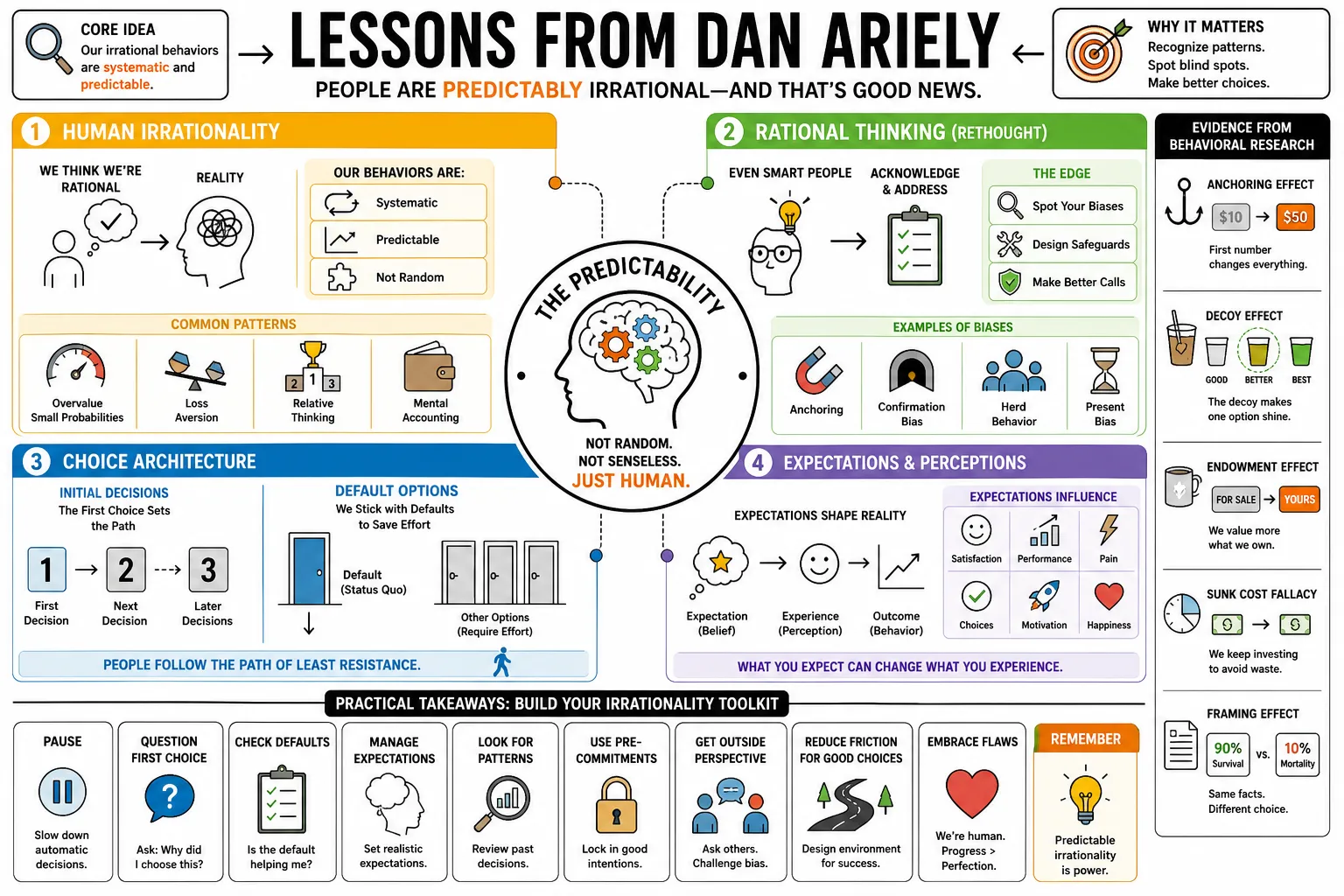
Lessons from Dan Ariely
Dan Ariely studies how context, expectations and incentives shape decisions. These lessons summarize bounded findings from his experiments and first-person writing, with direct sources attached to each point. — Predictably Irrational — Revised Introduction.
Part 1: The Predictability of Irrationality
- On predictable irrationality: Across a series of experiments, Ariely argues that departures from rational-choice predictions can follow recurring, observable patterns. — Predictably Irrational — Revised Introduction.
- On analytical blind spots: Knowing the rational ideal does not immunize people against context-sensitive choices; Ariely argues that studying these patterns can help people notice them. — Predictably Irrational — Revised Introduction.
- On initial choices: In his anchoring experiments, arbitrary initial valuations influenced later willingness to pay. — Coherent Arbitrariness Study.
- On expectations: In a beer-tasting experiment, expectations set by a description changed how participants evaluated the same drink. — Beer Expectations Experiment.
- On defaults: In the organ-donation examples Ariely presents, whether the form defaults to opting in or opting out is associated with dramatically different participation. — Dan Ariely TED Talk on Choice.
- On rationalizations: Ariely’s dishonesty experiments suggest that people may justify small benefits to themselves while preserving an honest self-image. — Self-Concept Maintenance and Dishonesty Study.
- On price and placebo effects: In the reported placebo experiments, participants given a higher stated price for an otherwise similar treatment sometimes reported stronger effects. — Duke Placebo-Price Study.
- On arbitrary anchors: After an arbitrary first price, participants’ later willingness to pay was internally consistent but still tied to that starting point. — Coherent Arbitrariness Study.
- On hot and cold states: In one study of male college students, reported decisions under sexual arousal differed from what participants predicted when not aroused. — Sexual Arousal and Decision-Making Study.
Part 2: Motivation, Meaning, and the Workplace
- On meaningful work: Ariely’s work experiments suggest that seeing a purpose for one’s effort can affect persistence and motivation. — Dan Ariely TED Talk on Work and Meaning.
- On effort and ownership: In Ariely’s origami experiments, making an object oneself increased its subjective value, even when outsiders rated it less highly. — Dan Ariely TED Talk on Work and Meaning.
- On undermining motivation: In the Lego and paper-task experiments, removing visible meaning or acknowledgement reduced participants’ willingness to keep working. — Dan Ariely TED Talk on Work and Meaning.
- On high-stakes incentives: In controlled tasks, very large incentives sometimes worsened performance, so higher pay is not a universally effective motivator. — Large Stakes and Big Mistakes Study.
- On what work provides: Ariely points to meaning, challenge, ownership and identity alongside compensation as possible sources of work motivation. — Dan Ariely TED Talk on Work and Meaning.
- On acknowledgement: Participants whose completed sheets were briefly acknowledged persisted longer than those whose work was ignored or shredded in Ariely’s experiment. — Dan Ariely TED Talk on Work and Meaning.
- On motivation’s complexity: Ariely cautions that pay alone is an incomplete explanation of why people keep working. — Dan Ariely on What Shapes Motivation.
- On gifts versus cash: Ariely suspects that a thoughtful gift can convey recognition differently from an equivalent cash payment; he presents this as a hypothesis, not a general experimental rule. — Ariely on Cash and Gifts.
- On meaning and ease: Ariely distinguishes the motivation that comes from meaningful effort from simple momentary pleasure; even difficult work can feel worthwhile. — Dan Ariely TED Talk on Work and Meaning.
Part 3: The Complex Nature of Honesty
- On small-scale cheating: In Ariely’s laboratory studies, many participants cheated a little rather than taking the maximum possible gain; the inherited population percentages are unverified. — Dan Ariely TED Talk on Cheating.
- On the honest self-image: The self-concept account proposes that people may take a small dishonest gain while still seeing themselves as honest. — Self-Concept Maintenance and Dishonesty Study.
- On first dishonest steps: In an interview, Ariely warns that a first small dishonest act can make subsequent rationalizations easier; this is his caution, not a universal law. — Wharton Interview on Dishonesty.
- On creative justifications: In a coauthored experimental study, greater creativity was associated with more self-serving justification and dishonest behavior in the tested tasks. — Creativity and Dishonesty Study.
- On distance from cash: In Ariely’s reported experiment, participants were more willing to take tokens convertible to cash than cash itself; this is a lab finding, not proof about cashless societies. — Dan Ariely TED Talk on Cheating.
- On conflicts of interest: Ariely argues that disclosure alone may not neutralize the pull of a professional’s financial incentives on judgment. — Ariely on Conflict-of-Interest Disclosure.
- On social cheating cues: A coauthored experiment found that observing a member of one’s own group cheat affected others’ behavior in the tested setting. — Contagion of Dishonesty Study.
Part 4: The Psychology of Money and Spending
- On the value of effort: Ariely’s work experiments found that people can value an object they made more highly than outsiders do; effort is part of perceived value, not a reason to pay for poor outcomes. — Dan Ariely TED Talk on Work and Meaning.
- On payment complexity: Ariely argues that painless payment can obscure the tradeoff between a purchase and other uses of money. — Ask Ariely on Painless Payments.
- On relative comparisons: In his choice talk, Ariely shows that people often use an easy nearby comparison rather than evaluate an option in isolation. — Dan Ariely TED Talk on Choice.
- On separate spending categories: Ariely cautions that evaluating each expense separately can hide its place in an overall budget. — Ask Ariely on Options and Budgets.
- On the pain of paying: In an Ariely lecture, the physical act of paying cash is presented as more salient than some less tangible payment methods, which can make spending easier to overlook. — Ariely Lecture on Money and Spending.
- On opportunity costs: Ariely recommends asking what else the same money could buy before judging whether a purchase is worthwhile. — Ariely Lecture on Money and Spending.
- On free offers: In Ariely’s free-price experiments, dropping a price to zero changed choices more than an otherwise comparable small reduction. — Ariely on the Free Experiment.
- On price and perceived effect: In one placebo study, the stated price of the same treatment changed reported outcomes; this does not establish that all expensive products are better. — Duke Placebo-Price Study.
- On description and taste: In the beer study, learning an ingredient before tasting influenced evaluations differently from learning it afterward. — Beer Expectations Experiment.
Part 5: Misbelief and Social Trust
- On social trust: Ariely’s account of misbelief emphasizes that social trust and belonging matter for how people respond to unfamiliar or distressing claims. — Ariely on Misbelief.
- On stress and misbelief: Ariely identifies stressful periods and a desire for explanatory stories as conditions that can make some people more receptive to false beliefs. — Ariely on Misbelief.
- On belonging as a buffer: In his account, feeling accepted by a community can help people withstand distress; the inherited claim about a measured scarcity buffer is not supported. — Ariely on Misbelief.
- On eroding trust: Ariely warns that distrust can weaken the social connections needed to challenge misbelief constructively. — Ariely on Misbelief.
- On identity and belief: Ariely argues that reasoning ability alone does not prevent misbelief when social identity and belonging are at stake. — Ariely on Misbelief.
- On social exclusion: Ariely describes how mockery and ostracism can push a person toward communities that accept their false beliefs. — Ariely on Misbelief.
- On emotional context: His explanation of misbelief asks readers to consider distress and the appeal of a coherent story, not just a lack of information. — Ariely on Misbelief.
- On empathy in disagreement: Ariely advocates listening and rebuilding trust when engaging someone who holds a false belief, rather than assuming a factual argument alone will work. — Ariely on Misbelief.
Part 6: Self-Control and Future Thinking
- On future plans: Ariely describes a gap between what people plan to do later and what feels tempting or urgent now. — Ariely on Procrastination.
- On procrastination: Ariely’s essay describes putting off important tasks despite knowing that delay can be costly. — Ariely on Procrastination.
- On removing temptation: Ariely advises changing one’s environment to remove temptations instead of relying only on resistance in the moment. — Ariely on Removing Temptation.
- On forecasting a hot state: In the arousal study, participants in a calm state underestimated how a more aroused state would change their reported decisions. — Sexual Arousal and Decision-Making Study.
- On adapting to change: Ariely writes from experience about adjusting to changed circumstances, while cautioning that adaptation is neither uniform nor guaranteed. — Ariely on Adaptation.
Part 7: Relativity and the Illusion of Choice
- On relative value: Ariely’s choice examples show that the attractiveness of an option often depends on what alternatives sit beside it. — Dan Ariely TED Talk on Choice.
- On decoy options: Ariely explains how adding a clearly inferior comparison can make a nearby option look more attractive in a particular choice set. — Ariely on the Decoy Effect.
- On too many options: In a signed response, Ariely says that a large choice set can produce decision paralysis; this is his discussion, not a claim to have discovered the effect. — Ask Ariely on Options and Budgets.
- On constructed valuations: The coherent-arbitrariness experiments show that a participant’s later valuations can depend on an arbitrary initial anchor rather than a fixed intrinsic preference. — Coherent Arbitrariness Study.
- On price anchors: Ariely’s anchoring experiments show why a presented starting number can shape later willingness to pay, even if the number itself was arbitrary. — Coherent Arbitrariness Study.
Part 8: Ownership, Effort, and Value
- On the IKEA effect: In the original study, people valued self-assembled products more when they successfully completed the work; effort alone did not always produce the effect. — The IKEA Effect Study.
- On endowment: Ariely discusses how owning an object can increase one’s attachment to it and asking price. — Ariely on the Endowment Effect.
- On virtual ownership: In an auction study, bidding and time spent engaged with an item could foster a sense of ownership before purchase. — Auction Fever Study.
- On buyer and seller focus: An original study describes buyers and sellers attending to different forgone opportunities when valuing a transaction. — Buyer–Seller Valuation Study.
- On parting with possessions: Ariely applies the endowment effect to the reluctance people may feel when giving up possessions they already own. — Ariely on the Endowment Effect.
- On keeping options open: Ariely argues that preserving too many options can consume resources and distract from better choices. — Ariely on Closing Doors.
- On designing better choices: Ariely argues that recognizing recurring decision errors can help people design choices and institutions around real behavior. — Predictably Irrational — Revised Introduction.