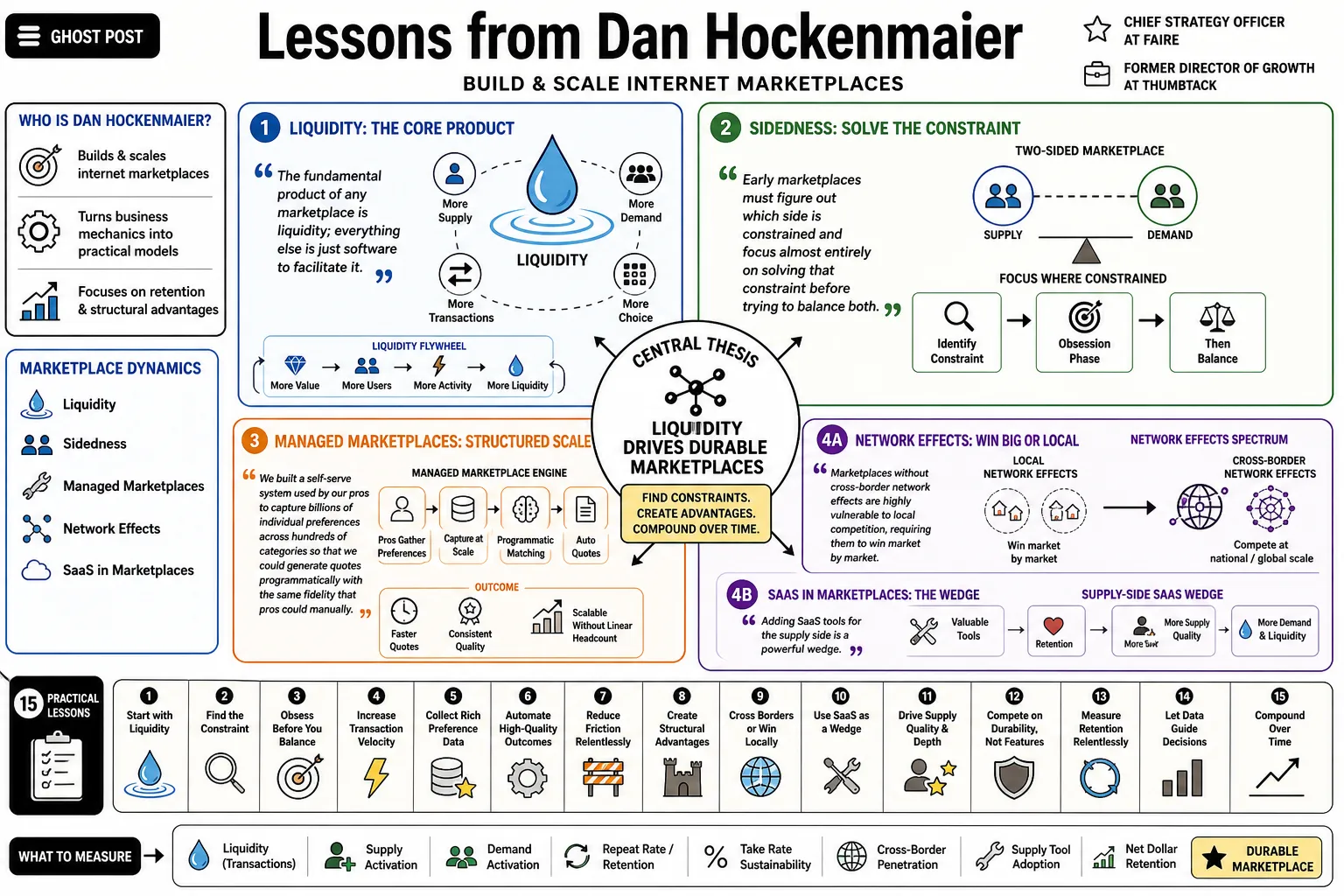
Lessons from Dan Hockenmaier
Dan Hockenmaier is a former Chief Strategy Officer at Faire and former growth leader at Thumbtack. His work on marketplaces, growth models, and organizational decision-making informs the lessons below. — How to Build a High-Growth Operating System.
Part 1: Marketplace Dynamics
- On Liquidity: Early marketplace growth depends on getting enough relevant supply and demand into a focused market for transactions to happen. Once product-market fit is established, other constraints can become more important. — The New Problems Every Marketplace Faces After Product Market Fit.
- On Sidedness: Both sides matter, but early supply often constitutes the product; later, teams can underinvest in demand acquisition. Diagnose which constraint currently limits transactions. — Lenny’s Podcast: Dan Hockenmaier.
- On Managed Marketplaces: Thumbtack illustrates how structuring service offers can make previously bespoke transactions easier to compare and complete online. — Service Marketplaces.
- On Network Effects: Marketplace defensibility depends on geographic reach, supply variety, and suppliers’ ability to serve competing platforms; a narrow local network can be replicated market by market. — The Leaky Bucket Theory of Network Effects.
- On SaaS in Marketplaces: A liquid marketplace may add useful supplier software, but the tools should solve a genuine user problem rather than simply provide a reason to raise monetization. — Lenny’s Podcast: Dan Hockenmaier.
- On Take Rates: Managed marketplaces can charge higher take rates when they create additional value beyond matching; fees must be weighed against incentives for buyers and sellers to transact off-platform. — The Future of Marketplaces.
- On B2B vs Consumer Marketplaces: B2B markets may have more concentrated buyers or suppliers and larger transactions, changing how much intermediation a marketplace can provide and charge for. — Lenny’s Podcast: Dan Hockenmaier.
- On Supply Quality: Adding low-quality supply may lift near-term marketplace volume while damaging customer experience and retention. Track the quality of matches, not just supply count. — Lenny’s Podcast: Dan Hockenmaier.
- On the Cold Start Problem: A new marketplace must bootstrap enough local or category-specific liquidity before growth efforts can compound; early acquisition and incentives should focus on that constraint. — The New Problems Every Marketplace Faces After Product Market Fit.
- On Fragmentation: Fragmented markets create a stronger reason for buyers and sellers to use an intermediary than markets where counterparties can easily find each other directly. — Lenny’s Podcast: Dan Hockenmaier.
Part 2: Growth Strategy
- On the Primary Growth Engine: A company’s initial breakout generally comes from becoming exceptionally good at one primary growth engine before layering on other engines. — Reforge: Racecar Growth Framework.
- On Focus: Consumer startups should choose an acquisition lane suited to their product and commit to it rather than spread scarce resources thinly across many channels. — First Round: Customer Acquisition Playbook.
- On the Racecar Framework: The Racecar Growth Framework separates a repeatable engine from turbo boosts, lubricants, and fuel; the engine must work before accelerants can sustainably scale it. — Reforge: Racecar Growth Framework.
- On Strategy vs Tactics: Separate durable, repeatable growth engines from one-time boosts; a spike is not evidence that a growth system compounds. — Reforge: Racecar Growth Framework.
- On Predictability: A growth engine is a repeatable loop in which outputs can be reinvested to generate more growth, rather than a succession of disconnected campaigns. — Reforge: Racecar Growth Framework.
- On Scaling: As a startup grows, an initial acquisition lane may approach diminishing returns, requiring a deliberate second lane or customer segment. — First Round: Customer Acquisition Playbook.
- On Experimentation: Run experiments that test distinct hypotheses and share what they reveal about users, rather than assuming the first forecast of each test’s effect is right. — Y Combinator: Growth Teams.
- On Competitors: The Booking.com case in Dan and Lenny’s acquisition playbook shows why a paid-channel strategy must account for competitors bidding in the same auction; the quoted example belongs to Arthur Kosten. — First Round: Customer Acquisition Playbook.
- On Patience: A promising acquisition lane needs sustained commitment and iteration to become a reliable growth engine; switching channels too early can squander that investment. — First Round: Customer Acquisition Playbook.
Part 3: Acquisition & Loops
- On SEO: Thumbtack concentrated on search pages, links, and landing-page conversion when SEO was its major growth engine, rather than treating SEO as a peripheral marketing task. — Reforge: Racecar Growth Framework.
- On Paid Acquisition: Heavy paid acquisition should follow evidence of meaningful retention; Dan describes paid spend as an accelerant rather than a substitute for a product people keep using. — Y Combinator: Growth Teams.
- On Viral Loops: Virality is most plausible when a product becomes more valuable as others join or is naturally useful to share; incentives cannot create that fit from nothing. — First Round: Customer Acquisition Playbook.
- On Content Loops: Products with public user-generated content or distinctive data can create discoverable pages whose coverage expands as participation grows. — First Round: Customer Acquisition Playbook.
- On Performance Marketing: Paid acquisition is a competitive business-model problem: the channel must produce viable customer payback after conversion and retention are accounted for. — First Round: Customer Acquisition Playbook.
- On Channel Saturation: Acquisition lanes can face diminishing returns at scale, so teams may need to expand a lane, enter new segments, or develop another engine. — First Round: Customer Acquisition Playbook.
- On Activation vs Acquisition: Before building another acquisition engine, improve activation and retention within the existing one; otherwise additional traffic can flow through a weak conversion path. — Reforge: Racecar Growth Framework.
- On Incentives: Referrals work best when recommending the product is genuinely helpful or socially valuable; incentives can amplify that behavior but do not replace product value. — First Round: Customer Acquisition Playbook.
- On B2B Sales: A product that spreads through users can help identify and qualify organizations for a sales motion, as Dan illustrates with Zoom; this is an example, not a universal B2B formula. — Y Combinator: Growth Teams.
- On Demand Generation: Some marketplaces can turn suppliers into a cost-effective demand-acquisition channel, but relying on suppliers for too much demand can weaken the marketplace’s own cross-side network effects. — Casey Winters and Dan Hockenmaier: Supply-Driven Demand.
Part 4: Retention
- On Early Retention: In a growth model, improving customer retention can affect more than repeat purchases: retained customers can contribute referrals, content, and contribution margin. — Lenny’s Podcast: Dan Hockenmaier.
- On Core Value: Look for cohorts whose retention stabilizes before making major acquisition investments; acquisition cannot compensate indefinitely for a product that users abandon. — Y Combinator: Growth Teams.
- On Onboarding: The first weeks of the user experience can strongly influence later retention, so investigate and reduce early friction before relying on win-back tactics. — Lenny’s Podcast: Dan Hockenmaier.
- On Habit Formation: Infrequent-use service marketplaces have limited natural repeat usage and therefore must keep finding customers or create additional reasons for them to return. — Service Marketplaces.
- On Measuring Retention: Use cohort retention curves to see whether users continue to return before scaling acquisition; aggregate signup growth alone can hide a weak underlying product. — Y Combinator: Growth Teams.
- On Resurrection: Users who have churned have already rejected the product; improving the initial experience can be more tractable than trying to resurrect them later. — Lenny’s Podcast: Dan Hockenmaier.
Part 5: Growth Models
- On Tradeoffs: Growth models are most useful for comparing the likely relative impact of different levers, not for predicting a precise long-term revenue number. — Why Growth Models Fail.
- On Forecasting: Small errors in linked assumptions compound, so a growth model is a poor long-range forecast even when it is valuable for understanding a business. — Why Growth Models Fail.
- On Diagnostic Utility: A model can help compare whether changes in activation, paid conversion, or referrals are more likely to matter, provided its inputs reflect how the business actually works. — Why Growth Models Fail.
- On The Dirty Secret: Building a growth model can clarify business mechanics for its creator even if the company never adopts the spreadsheet broadly. — Why Growth Models Fail.
- On Simplicity: A complex marketplace may need smaller models for distinct components rather than a single giant spreadsheet that tries to predict everything. — Why Growth Models Fail.
- On Sensitivity Analysis: Compare scenarios for major inputs to see which changes could have the largest effect on output; the answer depends on the business, not a universal ranking of levers. — Why Growth Models Fail.
- On Metrics: Choose metrics that track the inputs driving the growth engine, not only distant output targets the team cannot move directly. — Reforge: Racecar Growth Framework.
Part 6: Growth Teams & Organization
- On Team Structure: Give growth and product teams clear, non-overlapping accountability for the actual growth problem; organizational design should reflect the company and stage. — Y Combinator: Growth Teams.
- On the First Hire: An early growth hire should be a smart analytical generalist willing to work across functions, rather than a narrow specialist whose job title dictates the team’s scope. — Y Combinator: Growth Teams.
- On Mandates: Growth work often overlaps product work, so leaders should give teams a clear problem to own and avoid dividing responsibility for the same outcome ambiguously. — Y Combinator: Growth Teams.
- On A/B Testing: Instrument the product and make data queryable before relying on experiments; off-the-shelf testing tools can be sufficient, so building a bespoke platform is not always required. — Y Combinator: Growth Teams.
- On Culture: Sharing the outcomes of experiments, including misses, can help teams learn about users and build an evidence-driven growth culture. — Y Combinator: Growth Teams.
- On Leadership: Do not optimize a short-term growth metric so aggressively that it harms longer-term customer value or the consumer experience. — Y Combinator: Growth Teams.
Part 7: Career Building
- On the Generalist Trap: Breadth can help early in a career, but remaining a generalist indefinitely can limit leverage; specialize where your strengths meet a valuable problem. — Generalist Disease.
- On Choosing Companies: When choosing a startup, Dan prioritizes stage, team, and business quality before role title or compensation; a strong role at a weak company may not deliver the expected career upside. — How to Choose a Startup.
- On Stage Fit: The skills and working style that fit a pre-product-market-fit startup differ from those needed during explosive growth or at scale; choose a stage that suits you. — How to Choose a Startup.
- On Frameworks: The work of a company can be framed as building the product, selling it, and understanding the customer and business well enough to guide decisions. — Build, Sell, Understand.
- On Consulting vs Operating: Dan credits consulting with teaching business communication and analysis, but argues that career leverage comes from applying specialized skills to real operating problems. — Generalist Disease.
- On Compounding Relationships: Do valuable work for great people and let skills and reputation compound, rather than optimizing every role and interaction for a predetermined career plan. — Playing Game One.
- On Writing: Writing in prose forces strategic synthesis, exposes gaps in reasoning, and makes a clear recommendation easier to share across a company. — How to be Strategic.
- On Strategy Roles: Strategic work cannot be separated from execution: the strategist should execute the recommendation or work closely with those who will. — How to be Strategic.
Part 8: Productivity & AI
- On Writing Clearly: Dan’s C.R.I.S.P. framework organizes decision writing into Context, Requirements, Insights, Solutions, and Proof. — How to Make Your Writing C.R.I.S.P..
- On AI in Business: Choose meaningful work for AI deliberately; unfocused experimentation with new tools can waste time, and unreviewed low-quality output can erode trust. — How to Use AI Without Losing Your Mind.
- On Tool Proliferation: Most people can get substantial value from a small set of mature AI tools; adopting every new product early often creates work without improving effectiveness. — How to Use AI Without Losing Your Mind.
- On AI Workflows: AI can automate repeatable execution tasks, while open-ended strategic work still benefits from human exploration with AI as a thought partner. — How to Use AI Without Losing Your Mind.
- On Synthesizing Data: As AI reduces the mechanical work of extracting and charting data, analysts may become more valuable for framing hard questions, exercising judgment, and communicating decisions. — Vibe Analysis.
- On Meeting Culture: At Faire, Dan used pre-read documents and comments before major meetings so the meeting could focus on unresolved questions rather than replaying a presentation. — How to Build a High-Growth Operating System.