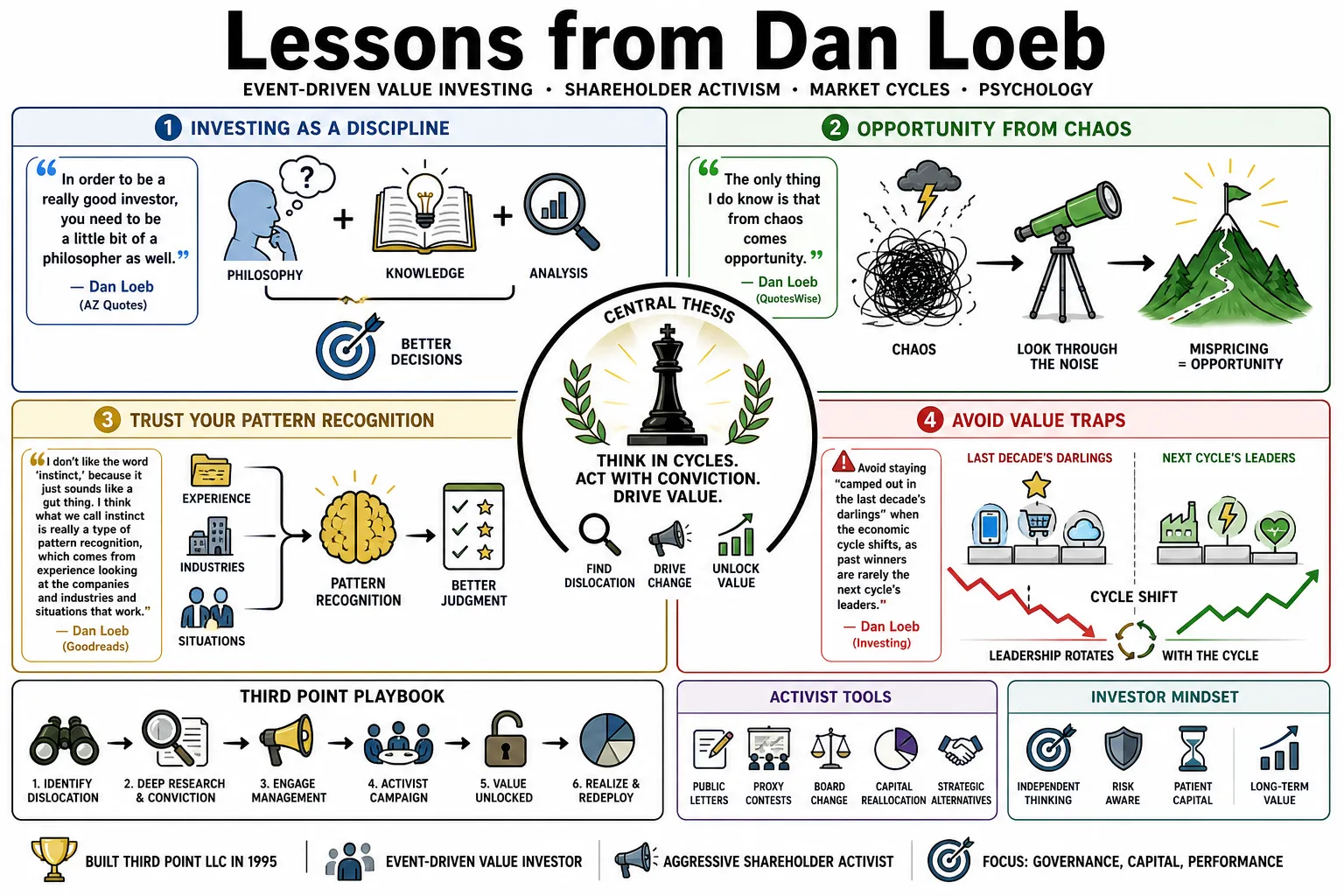
Lessons from Dan Loeb
Daniel S. Loeb founded Third Point in 1995 and leads its investing across equities, credit and venture capital. The firm describes an opportunistic, event-driven approach that can include engagement with public companies. This profile examines his investment process and several documented shareholder campaigns. — Third Point.
Part 1: The Philosophy of Value Investing
- On opportunity amid pessimism: In October 2022, Loeb wrote that attractive valuations were emerging amid widespread pessimism, while acknowledging recession and geopolitical risks. — Third Point Q3 2022 Letter.
- On experience and pattern recognition: Loeb said that judging management remains qualitative and that decades of investing experience contribute to his pattern recognition. — All-In Interview with Dan Loeb.
- On reconsidering former winners: Loeb said Third Point’s strategy evolved from low-multiple deep value toward assessing business quality, growth and technological change rather than treating an earlier playbook as permanent. — Invest Like the Best Interview.
- On an adaptive strategy: Third Point describes an opportunistic approach across equities, corporate and structured credit, and venture, adjusting exposures as market risk and opportunity change. — Third Point Investment Strategy.
- On correcting a market mistake: Loeb recalled that he turned too bearish in March 2009, then changed his view and increased exposure when new data contradicted his earlier outlook. — Third Point Q3 2022 Letter.
- On event-driven catalysts: Third Point looks for mergers, restructurings and other special situations where a specific event may unlock value, rather than relying only on a low quoted price. — Third Point Investment Strategy.
- On fundamental research: A 2011 New Jersey due-diligence memo described Third Point’s investment process as research-intensive and based on fundamental, bottom-up analysis of individual opportunities. — New Jersey Investment Memo.
- On learning technology: Loeb said investors once could ignore technology and still make money, but that today he would not want to be technologically illiterate given technology’s influence across businesses. — All-In Interview with Dan Loeb.
Part 2: Activism and Corporate Governance
- On the option of a proxy contest: At the 2025 Sohn Hearts & Minds conference, Loeb said private activist engagement can still need the credible possibility of a proxy contest. — Sohn Hearts & Minds Interview.
- On attracting long-term shareholders: In a 2020 Disney letter, Loeb argued that greater investment in streaming could attract growth-minded, long-term investors. He explicitly credited the “companies get the shareholders they deserve” line to Warren Buffett. — Third Point–Disney Letter.
- On matching conviction with capital: In a 2006 letter to AEP Industries CEO Brendan Barba, Loeb pressed the company to repurchase shares or explore a sale and challenged Barba to buy shares if he opposed a premium bid. — Third Point–AEP Letter.
- On the Star Gas letter: In a 2005 letter to Star Gas CEO Irik Sevin, Loeb asked him to resign and used the now-famous Hamptons-mansion line. The criticism concerned Star Gas, not Sotheby’s. — Third Point–Star Gas Letter.
- On a stake without management endorsement: In a 2004 letter to InterCept CEO John Collins, Loeb said Third Point’s $22 million stake was not a vote of confidence in the company’s management or board and criticized its governance and acquisitions. — Third Point–InterCept Letter.
- On a governance target: In his 2005 Star Gas letter, Loeb criticized CEO Irik Sevin for what Third Point regarded as years of value destruction and strategic mistakes and asked him to step aside. — Third Point–Star Gas Letter.
- On family ties and board oversight: Loeb’s Star Gas letter questioned whether the CEO’s mother could independently oversee the company as a board member, using that relationship as part of a wider governance critique. — Third Point–Star Gas Letter.
- On private activism: Loeb said at the 2025 Sohn Hearts & Minds conference that Third Point conducts much of its activist work behind the scenes, including scrutiny of margins, spending and strategy. — Sohn Hearts & Minds Interview.
- On the formal sign-off: Loeb signed the pointed 2005 Star Gas letter with the conventional closing “Very truly yours” above his name, a contrast with its critical body. — Third Point–Star Gas Letter.
Part 3: Managing Risk and Downside
- On process before outcomes: In a 2011 interview, Loeb compared confidence built on a bad investment process to surviving several rounds of Russian roulette: a run of lucky outcomes does not make the method sound. — The Alpha Masters — Loeb Interview.
- On probability-weighted sizing: New Jersey’s 2011 due-diligence memo reported that Third Point sized individual positions using probability-weighted upside and downside estimates. — New Jersey Investment Memo.
- On a weekly risk committee: A 2011 New Jersey investment memo reported that Third Point had two risk-reporting professionals and a firm-wide risk committee that met weekly to review portfolio exposures. — New Jersey Investment Memo.
- On the FTX mistake: Loeb called Third Point’s FTX investment one of his hardest lessons: the firm could observe activity on-chain, but he said its later due diligence added basic checks such as bank-balance verification. — Invest Like the Best Interview.
- On building across asset classes: Third Point expanded beyond its original distressed-debt focus into equities, structured and corporate credit, venture and other strategies; Loeb describes the ability to move between equities and credit as an edge. — Third Point Q1 2025 Letter.
- On a position-level downside guideline: The same 2011 memo reported a general Third Point guideline of limiting estimated downside to 2% at the individual-position level. — New Jersey Investment Memo.
- On shifting exposures: In early 2025, Third Point reduced market-sensitive equity exposure and added catalyst-oriented event-driven and credit opportunities as its assessment of risk changed. — Third Point Q1 2025 Letter.
- On RiskPoint: New Jersey’s 2011 memo said Third Point used a proprietary in-house system called RiskPoint to evaluate portfolio risk exposures. — New Jersey Investment Memo.
Part 4: Market Psychology and Cycles
- On retail-driven short squeezes: In a 2023 investor letter, Loeb said option expirations and Reddit discussion had complicated single-name short selling; Third Point was reducing individual short positions and using more baskets and market hedges. — Third Point Q2 2023 Letter.
- On learning from peers: Loeb said he learned investing not only from senior mentors but from colleagues and customers whose approaches he observed and adapted during his early career. — All-In Interview with Dan Loeb.
- On cheap securities and catalysts: Loeb recalled that Third Point’s early event-driven strategy sought complex transactions where dislocation, opacity and a catalyst could create investment opportunity. — All-In Interview with Dan Loeb.
- On adapting short selling: Third Point’s 2023 letter described short selling as more difficult amid squeeze dynamics and said the firm was diversifying and reducing the size of individual short positions. — Third Point Q2 2023 Letter.
- On rates and the real economy: In October 2022, Loeb framed a central market question as whether inflation and Fed policy or a bottom in employment, income, spending and GDP mattered more for the next turn. — Third Point Q3 2022 Letter.
- On learning across capital structures: Loeb said experience in venture, arbitrage, credit and equities helped Third Point analyze where an enterprise offered the best risk-reward across its capital structure. — Invest Like the Best Interview.
- On avoiding a doom spiral: In October 2022, Loeb warned that bearish consensus can miss attractive valuations; he recalled changing a gloomy 2009 view when new data arrived and increasing exposure shortly before markets recovered. — Third Point Q3 2022 Letter.
Part 5: Assessing Management and Leadership
- On waste at Sotheby’s: Third Point alleged that a Sotheby’s management offsite included an extravagant meal costing shareholders multiple hundreds of thousands of dollars, using it as an example of weak expense discipline. — Third Point–Sotheby’s Letter.
- On Intel’s engineering talent: In a 2020 letter to Intel’s chairman, Loeb warned that the company had lost talented chip designers and leaders and asked the board for a plan to address its human-capital problem. — Third Point–Intel Letter.
- On Intel’s acquisitions: Third Point asked Intel’s board to evaluate strategic alternatives, including whether to divest certain acquisitions it considered unsuccessful. — Third Point–Intel Letter.
- On verifying executive credentials: In a 2012 SEC-filed Yahoo letter, Third Point challenged inaccurate educational credentials attributed to CEO Scott Thompson and director Patti Hart and demanded an immediate board investigation and action. — Third Point–Yahoo Credentials Letter.
- On Sony film performance: In its 2013 investor letter, Third Point criticized the poor box-office results of After Earth and White House Down and compared them to Waterworld and Ishtar while questioning Sony Entertainment’s oversight. — Third Point Q2 2013 Letter.
- On a constructive opening: Third Point opened its 2013 Sony campaign in a stated spirit of partnership, proposing a minority listing of Sony Entertainment and offering to help implement the plan. — Third Point–Sony Letter.
Part 6: Navigating Macroeconomics and Data
- On current macro priorities: In a 2026 interview, Loeb said energy prices and the evolution of AI were the two macro forces he was most focused on at that moment. — Invest Like the Best Interview.
- On looking beyond macro releases: Loeb said standard growth, employment, inflation and rate reports mattered less to his 2026 focus than oil/geopolitics and AI spending and its economic effects. — Invest Like the Best Interview.
- On evolving beyond deep value: Loeb said Third Point became less rigid about low-multiple deep-value stocks and began looking more closely at faster-growing companies with stronger returns on capital. — Invest Like the Best Interview.
- On bottom-up analysis: The New Jersey Division of Investment described Third Point’s 2011 process as bottom-up fundamental research, supplemented by portfolio-level risk management rather than a blanket refusal to consider macro conditions. — New Jersey Investment Memo.
- On macro uncertainty: Amid tariff uncertainty in early 2025, Third Point reduced broad market exposure and added event-driven positions whose specific catalysts it believed could help in a choppier market. — Third Point Q1 2025 Letter.
- On credit dislocations: Third Point said it had historically increased corporate-credit exposure after market selloffs and expected to look for opportunities during the tariff-driven dislocation of 2025. — Third Point Q1 2025 Letter.
- On macro forces and exposure: Third Point said in 2025 that tariff uncertainty and associated market volatility led it to reduce broad equity exposure and focus on more specific event-driven opportunities. — Third Point Q1 2025 Letter.
- On AI’s possible economic scale: Third Point argued in 2023 that generative AI could have an economic impact comparable to the Industrial Revolution, while acknowledging that its size and timing were uncertain. — Third Point Q2 2023 Letter.
- On pricing power in inflation: Third Point cited Colgate-Palmolive’s pricing power as one reason for buying the defensive consumer business during inflationary conditions in 2022. — Third Point Q3 2022 Letter.
Part 7: Specific Campaigns and Deals
- On Sotheby’s board renewal: Loeb offered to join Sotheby’s board and recruit directors with experience in art, technology, luxury brands and sales, arguing that an owner’s perspective was needed. — Third Point–Sotheby’s Letter.
- On Yahoo’s Asian assets: In 2011, Third Point argued that Yahoo’s stakes in Yahoo Japan and Alibaba were obscured sources of value and urged tax-efficient outcomes for those assets. — Third Point–Yahoo Letter.
- On Sony’s structure: Third Point saw Sony Entertainment as a valuable but partly obscured asset and proposed listing a 15–20% minority stake while Sony retained control and gained capital to strengthen electronics. — Third Point–Sony Letter.
- On Intel’s manufacturing position: Third Point argued in 2020 that Intel had lost manufacturing leadership to TSMC and Samsung and urged the board to assess whether to remain an integrated device manufacturer. — Third Point–Intel Letter.
- On Sotheby’s leadership: Loeb asked William Ruprecht to step down as Sotheby’s chairman, president and CEO, while acknowledging his earlier stewardship during crises and arguing that new leadership was needed for growth. — Third Point–Sotheby’s Letter.
- On Yahoo’s CEO choice: Third Point criticized Yahoo’s board for hiring Carol Bartz despite what it regarded as her limited consumer-internet experience, then for waiting too long to replace her. — Third Point–Yahoo Letter.
- On X and xAI debt: Loeb said Third Point bought financing debt tied to X and xAI after using its broader business analysis to assess the underlying companies, including a sizeable X credit position. — Invest Like the Best Interview.
- On opportunities in Japan: In a 2026 interview, Loeb described Japan, Korea and Taiwan as attractive hunting grounds for companies, while saying activism in Japan remained difficult. — Invest Like the Best Interview.
Part 8: Life, Mindset, and Surfing
- On the name Third Point: Ahuja’s direct-interview account identifies a Malibu surf break as the inspiration for the name Third Point. — The Alpha Masters — Loeb Interview.
- On surf travel: Loeb described surfing trips with his coach Brad to Indonesia, the Maldives, Mexico, Costa Rica and the Caribbean as highlights of his life, second only to time with his family. — Loeb’s Wave Ki Testimonial.
- On practicing surfing: Loeb credited Brad’s land-based drills and coaching in the water with helping him progress from longboards to boards suited to waves in Indonesia and the Maldives. — Loeb’s Wave Ki Testimonial.
- On life outside the portfolio: Loeb said that a major personal worry is losing time for family, surfing and reading amid the demands of investing. — Invest Like the Best Interview.